
Ant Bailin Ling-2.6-flash officially open-sourced

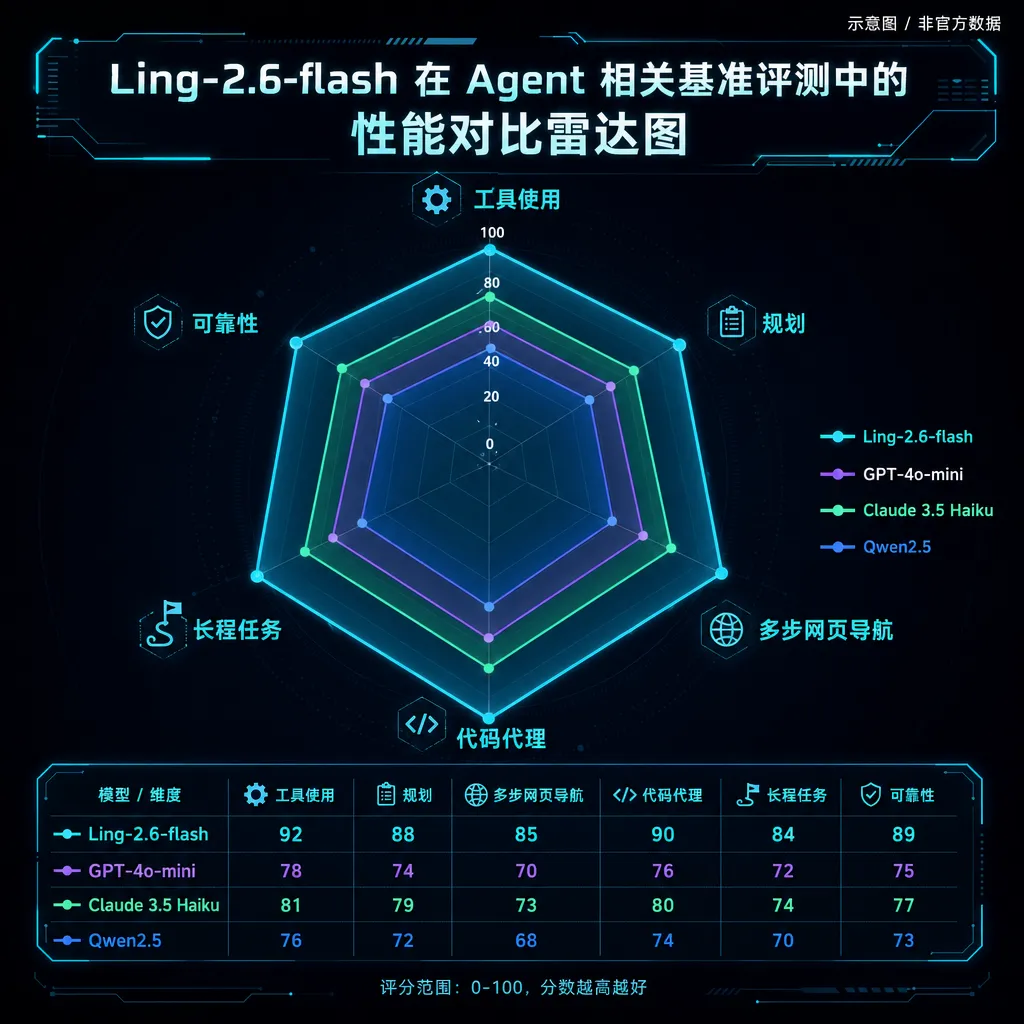
Ant Group announced today that the Bailing large model **Ling-2.6-flash** is now officially open-sourced, offering BF16, FP8, and INT4 multi-precision versions. The model has a total of **104B parameters**, with only **7.4B active parameters**, focusing on inference efficiency and token efficiency, and achieving **SOTA** performance among models of the same size in agent scenario evaluations.
Ant Bailing Ling-2.6-flash Officially Open Sourced: 104B Parameters, Multi-Precision Versions, Agent Scenarios Reaching SOTA
I. News Overview
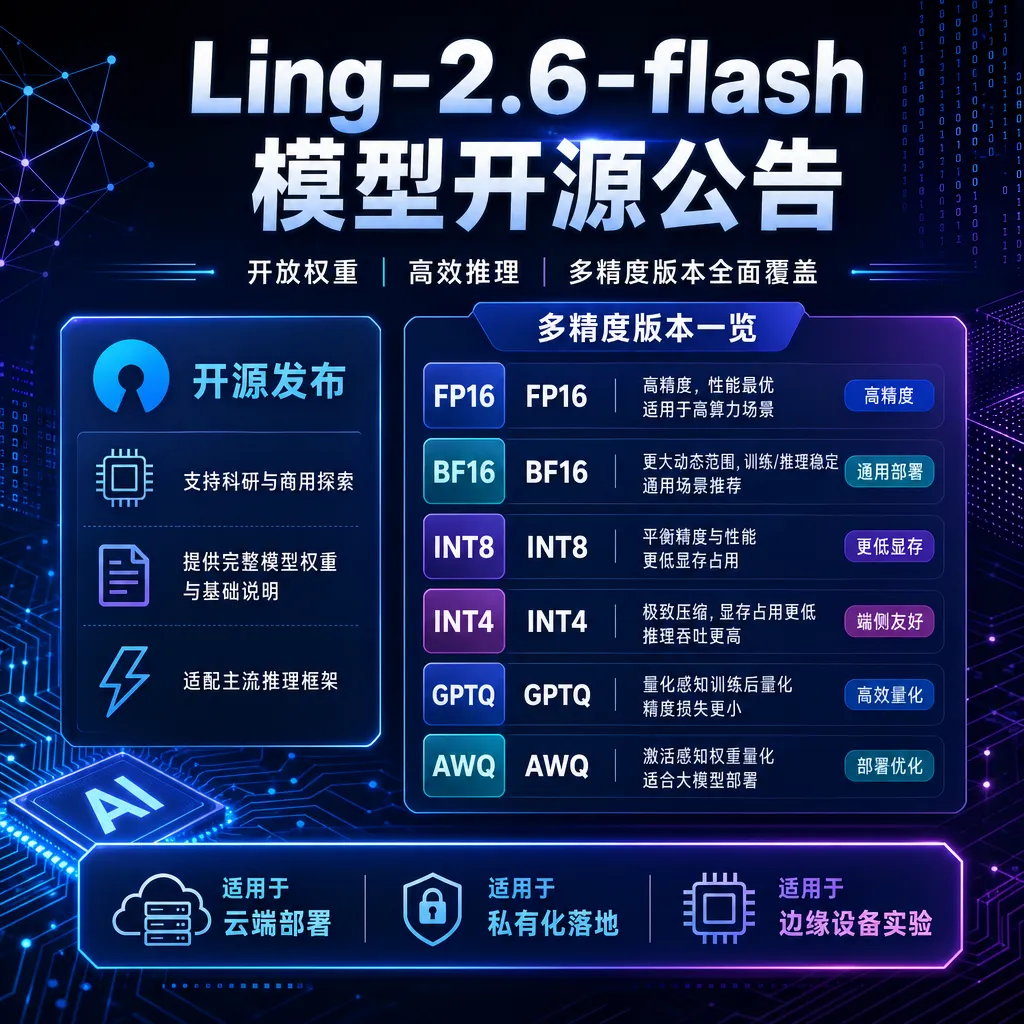
On April 29, the Bailing large model team under Ant Group officially announced that the Ling-2.6-flash model is now fully open source, along with the release of BF16, FP8, and INT4 precision versions. Developers can flexibly choose based on their hardware, inference cost, and deployment needs. The model weights have been simultaneously published on Hugging Face and ModelScope.
This fulfills the Bailing team’s promise of “open source soon” following Ling-2.6-flash’s API release one week prior—moving from public announcement on April 22 to full open-sourcing on April 29, a pace rarely seen in China’s large model ecosystem.
II. Review: Full Timeline from Anonymous Testing to Official Open-Source
To understand the significance of Ling-2.6-flash’s open-source release, it’s necessary to review its timeline:
| Date | Event | |------|-------| | ~April 15 | An anonymous model codenamed Elephant Alpha quietly went live on the OpenRouter platform | | First week after launch | Inference volumes climbed steadily, leading the Trending chart for several days, with daily token calls reaching 100B level and weekly growth over 5000% | | April 22 | Ant Bailing officially “claimed” Elephant Alpha, revealing it as Ling-2.6-flash, and launched the API service with pricing | | Apr 22 – Apr 29 | The team collected real developer feedback, ran multiple optimization iterations, improving Chinese-English switching ability and better integration with major coding frameworks | | April 29 (today) | Ling-2.6-flash officially open sourced, BF16 / FP8 / INT4 weights released on Hugging Face and ModelScope |
The “anonymous testing → official release → rapid open-source” three-step approach allowed the model to go through substantial real-user testing and feedback-driven refinement before open-sourcing, reducing the likelihood of major defects surfacing post-release.
III. Model Basic Parameters
Ling-2.6-flash is an Instruct model based on an MoE (Mixture of Experts) architecture, with core details as follows:
- Total parameters: 104B (104 billion)
- Active parameters: 7.4B (7.4 billion)
- Architecture type: Highly sparse MoE + hybrid linear design
- Model type: Instruct (instruction-following)
- Precision versions: BF16, FP8, INT4
- License: Refer to Hugging Face / ModelScope repo pages
With 104B total parameters and only 7.4B activated at a time, the sparsity ratio reaches about 93%, meaning that fewer than 1/14 of the parameters are active per inference pass. This aligns closely with industry trends—large models like DeepSeek-V3 (671B / 37B active), Qwen3.5-35B-A3B (35B / 3B), and Doubao 2.0 Pro (744B / 40–44B active) follow similar high-capacity, low-activation MoE designs.
IV. In-Depth Analysis of Three Core Capabilities
4.1 Hybrid Linear Architecture: Unlocking Inference Efficiency
Ling-2.6-flash’s most distinctive technical feature is its hybrid linear architecture. Unlike traditional pure Transformer attention, some layers substitute linear attention or linear RNN variants for standard Softmax attention, improving computational efficiency at the base level.
Measured performance highlights:
- Peak inference speed: up to 340 tokens/s on 4× H20 GPUs
- Stable output speed: about 215 tokens/s
- Prefill throughput: 2.2× that of Nemotron-3-Super
What does this mean? For a roughly 500‑character Chinese response (~300–400 tokens), Ling-2.6-flash can generate the full reply in under 1.5 seconds at peak speed or around 2 seconds at a stable rate. This is valuable for online applications requiring rapid responses, such as chatbots, real‑time code completion, or Agent toolchains.
Another key advantage is VRAM friendliness. Linear attention requires less KV cache than standard attention, moderating memory growth in long‑context scenarios. Combined with the open‑source INT4 quantization release, developers can potentially run this multi‑billion‑parameter model on consumer‑grade multi‑GPU setups.
4.2 Token Efficiency Optimization: Doing More with Fewer Tokens
Token efficiency is a central differentiator repeatedly emphasized by Ling-2.6-flash. The team refers to it as the “Intelligence‑Efficiency Ratio” (智效比)—instead of inflating outputs to boost benchmark scores, the model aims to achieve equivalent quality using minimal tokens.
Key comparison data (from Artificial Analysis):
| Model | Total tokens used in evaluation | |--------|------------------| | Ling-2.6-flash | ≈15M tokens | | Nemotron-3-Super and peers | ≈110M+ tokens |
Ling-2.6-flash uses only about 1/10 of its peers’ token count.
The real-world benefits are direct:
- Lower inference cost: lower total usage translates to cheaper API execution
- Shorter latency: fewer tokens generated mean faster responses
- Higher concurrency: more requests handled simultaneously per GPU
- Reduced context window load: history accumulation slower in multi‑turn dialogues and Agent tasks
Technically, token efficiency wasn’t achieved merely by shortening replies—quality was maintained by calibrating token use during training. The reward model and reinforcement learning stages explicitly incorporated “output conciseness” as an optimization goal so the model could convey the same information with fewer words.
4.3 Targeted Agent Enhancements: Tool Calls, Multi-Step Planning, and Task Execution
Since late 2024, Agent applications have become one of the hottest LLM application fields. Ling-2.6-flash introduces systematic targeted augmentations in three aspects:
- Tool Calling: accurately interpret tool specs, generate valid call parameters, and process tool responses
- Multi-step Planning: decompose complex goals and plan logical execution sequences
- Task Execution: maintain high completion rates in tasks like coding, file ops, and information retrieval
Benchmark performance:
| Benchmark | Evaluation Focus | Ling-2.6-flash Result | |------------|-----------------|-----------------------| | BFCL-V4 | Function call accuracy | SOTA for comparable model size | | TAU2-bench | Agent comprehension & execution | SOTA for comparable model size | | SWE-bench Verified | Real GitHub issue fixing | Near or at SOTA | | Claw-Eval | Tool-calling chain composite test | Near or at SOTA | | PinchBench | Agent robustness | Near or at SOTA |
Remarkably, many of these comparisons include models with much higher active parameter counts, yet Ling-2.6-flash still matches or exceeds them—proving its MoE structure and Agent‑oriented fine‑tuning effective.
V. Multi-Precision Open Source: BF16 / FP8 / INT4 Flexibility
A major highlight of this open release is that it offers BF16, FP8, and INT4 variants simultaneously—accommodating developers across diverse environments.
BF16 (Brain Floating Point 16)
- Highest precision, closest to training representation
- Suitable for users with abundant VRAM pursuing maximum fidelity
- Recommended hardware: multi‑GPU A100 / H100 / H20 clusters
FP8 (Float Point 8)
- Balanced trade‑off between accuracy and efficiency
- Consumes about half the VRAM of BF16; inference speed significantly improved
- Recommended hardware: FP8‑capable GPUs (H100, H200, L40S, etc.)
INT4 (Integer 4-bit Quantization)
- Lowest memory footprint, about one‑fourth of BF16
- Ideal for VRAM‑limited or cost‑sensitive setups
- Minor precision trade‑offs on complex tasks, little impact on typical instruct use
- Recommended hardware: 2–4 × RTX 4090 or mid‑range datacenter GPUs
By open-sourcing all three simultaneously, Ant Bailing greatly broadens the model’s usability. For startups or independent developers, the INT4 variant enables deployment of an Agent‑capable SOTA model even on modest hardware.
VI. API Pricing and Free Quota
In addition to open weights, Ling-2.6-flash provides paid API access.
OpenRouter Pricing
| Metric | Price | |--------|-------| | Input | $0.1 / million tokens | | Output | $0.3 / million tokens | | Cache hit | $0.02 / million tokens (20% of cost) |
Official Platform Pricing
| Metric | Price | |--------|-------| | Input | ¥0.6 / million tokens | | Output | ¥1.8 / million tokens | | Daily free quota | 500k tokens |
The API pricing is highly competitive, and given its lower token consumption, the real cost per completed task could be one‑tenth or even less of typical models.
VII. Industry Background and Competitive Landscape
MoE Has Become the Mainstream Paradigm
Ling-2.6-flash’s launch reinforces a clear industry trend: high‑sparsity MoE architectures are the dominant LLM route. Parameter comparison:
| Model | Organization | Total Params | Active Params | Sparsity | |--------|--------------|--------------|----------------|-----------| | DeepSeek-V3 | DeepSeek | 671B | 37B | ~94.5% | | Ling-2.6-flash | Ant Bailing | 104B | 7.4B | ~92.9% | | Qwen3.5-35B-A3B | Alibaba Tongyi | 35B | 3B | ~91.4% | | Doubao 2.0 Pro | ByteDance | 744B | 40–44B | ~94.1% |
Despite differences in total and active sizes, all maintain over 90% sparsity—signifying consensus that MoE enables “large capacity, low compute” scaling.
A New Efficiency-Oriented Competition Dimension
Unlike the earlier “parameter arm race,” competition now centers on efficiency. Ling-2.6-flash particularly stands out for:
- Inference efficiency: 340 tokens/s peak via hybrid linear layers
- Token efficiency: concise output optimization during training
- Cost efficiency: lower activation + token usage + API pricing
- Deployment efficiency: multi‑precision compatibility across hardware
This “fourfold efficiency synergy” makes Ling-2.6-flash not only strong in benchmarks but also practical for real applications.
Accelerating the Open-Source Ecosystem
Ant Group has ramped up open‑source LLM efforts. Previously released models include Ling‑2.5‑1T (trillion‑parameter) and Ming‑Flash‑Omni 2.0. Ling‑2.6‑flash further expands the open Bailing series.
Taking only a week from announcement to open‑source underscores Ant’s determination to foster a developer ecosystem. By enabling on‑premise deployment and fine‑tuning, Bailing anticipates more community feedback, forming a healthy cycle of “open → feedback → iteration → re‑open.”
VIII. Developer Access Guide
Model Download Links
- Hugging Face:
https://huggingface.co/inclusionAI/Ling-2.6-flash - ModelScope:
https://www.modelscope.cn/models/inclusionAI/Ling-2.6-flash
Developers can choose based on network condition; domestic users are advised to use ModelScope for faster downloads.
Quick Start Recommendations
- Hardware Assessment: check available VRAM and choose the proper precision
- 4× H20 / A100 (80GB) or higher → BF16
- 2× H100 / H200 → FP8
- 2–4× RTX 4090 (24GB) → INT4
- Framework choice: optimized support for mainstream inference frameworks such as vLLM and SGLang
- Scenario adaptation: for Agent use, reference official tool‑calling prompt templates for best performance
IX. Summary and Outlook
The full open‑sourcing of Ling‑2.6‑flash marks a major milestone for Ant Bailing’s open‑source LLM ecosystem. With 104B total and 7.4B active parameters—high‑sparsity MoE, hybrid linear attention, training‑time token efficiency tuning, and targeted Agent enhancements—it exhibits outstanding, balanced performance at its scale.
Simultaneous release of BF16 / FP8 / INT4 variants demonstrates genuine openness, allowing developers across hardware tiers to deploy effectively. This “lower barrier, wider reach” strategy should drive rapid community adoption and usage.
Looking ahead, as Agent workloads proliferate and efficiency demands rise, models like Ling‑2.6‑flash—striking a refined balance between capability and performance—are poised to become essential tools for developers. Ant Group’s “anonymous testing to rapid open‑source” strategy may also serve as a valuable new playbook for the industry.
References
- Ant Group’s Bailing Large Model Open‑Sources Ling‑2.6‑flash with BF16, FP8, INT4 Editions – IT Home — IT Home, April 29 report on Ling‑2.6‑flash open‑source release
- Ling‑2.6‑flash Model Repository – Hugging Face — official model weights download page (Hugging Face)


