
Step Star Image Editing upgraded again — Step Image Edit 2 fully launched

On April 29, Step Universe officially released its new generation image generation and editing model, Step Image Edit 2, which has been fully launched on the Step Universe Open Platform and Step Plan, continuing its intensive pace of development in the multimodal field.
StepFun Image Editing Upgraded Again: Step Image Edit 2 Fully Launched on the Open Platform
On April 29, StepFun officially released the next-generation image generation and editing model Step Image Edit 2, which was simultaneously launched in full on the "StepFun Open Platform" and Step Plan. This marks another iteration for StepFun in the image editing track—just one day after the release of the previous open-source model, Step1X-Edit.
Yes, just one day.
That pace itself is worth talking about.
From Step1X-Edit to Step Image Edit 2: Two Moves in One Day
Let’s first sort out the timeline. On April 28, StepFun released and open-sourced its general-purpose image editing model Step1X-Edit, which quickly climbed to the trending leaderboard on Hugging Face's Spaces upon launch. This 19B-parameter model focuses on “understanding accurately, editing precisely, and preserving content well,” covering 11 high-frequency image editing tasks such as text replacement, portrait enhancement, style transfer, and texture transformation. On its self-developed benchmark GEdit-Bench, it achieved open-source SOTA performance.
Then the very next day, Step Image Edit 2 arrived.
The relationship between the two is more like a division between “open-source version” and “commercial version.” Step1X-Edit is targeted at the developer community—both code and weights are fully open, and you can pull and deploy it directly from GitHub, Hugging Face, or ModelScope; Step Image Edit 2, in contrast, is a platform-level product accessible via StepFun's open platform API, aimed at business users and application developers who need stable service without managing inference and deployment.
This dual-track strategy—“open-source for visibility + closed-source API for commercialization”—has become increasingly common among domestic large model companies. Zhipu, DeepSeek, and Baichuan are all doing the same. But StepFun compressing the two moves within 24 hours is indeed quite aggressive.
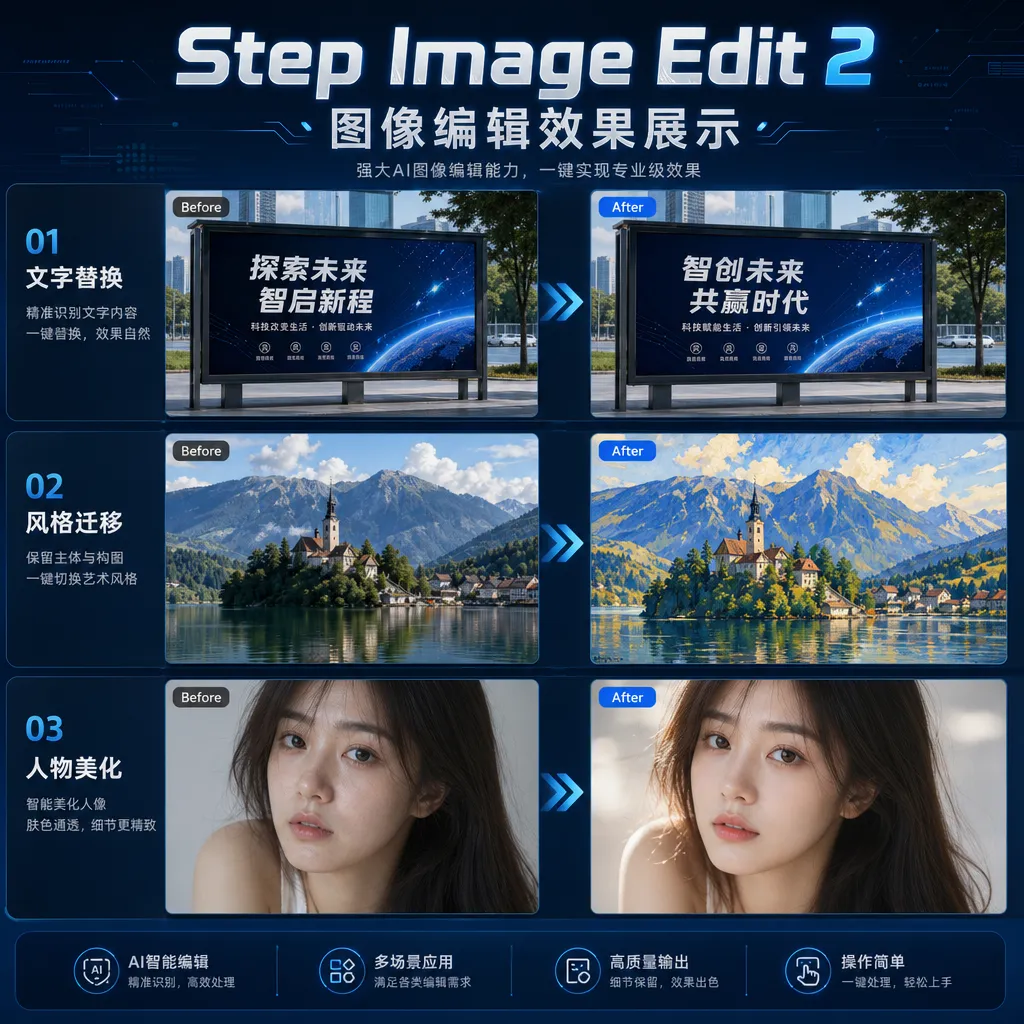
The Technical Foundation of Step1X-Edit: Three Key Capabilities
Although StepFun has not fully disclosed the technical details of Step Image Edit 2, we can infer the direction of this generation of image editing models from Step1X-Edit released the day before. After all, the commercial version is most likely an engineering-optimized and capability-enhanced version built on the open-source base.
The core capabilities of Step1X-Edit can be divided into three parts:
1. Precise Semantic Parsing
This is the most fundamental—and most failure-prone—aspect of image editing models. When a user says, “replace the cat in the background with a dog,” the model must accurately interpret which region refers to “the cat in the background” and what “replace with a dog” means. It sounds simple, but when commands get complicated—like “change the clothes of the person on the left to a blue suit but keep the person on the right unchanged”—many models start to get confused.
Step1X-Edit far outperforms other open-source models on GEdit-Bench’s semantic understanding metrics, showing that it has made serious progress in “understanding human instructions.” This likely benefits from StepFun’s multimodal language model foundation—the Step series—and its integration of language understanding into visual instruction parsing.
2. Identity Consistency Preservation
This is a long-standing challenge in image editing. Ask a model to change a person’s hairstyle and their face changes too; change the background and the clothing texture shifts. “Identity consistency” means ensuring that parts that shouldn’t change remain completely intact while editing.
This ability is especially critical in business scenarios. E-commerce product images may need background replacement without changing details; social media beautification requires enhancement without distorting facial features; advertisement assets may need style transfer without losing brand elements—all demand zero tolerance for inconsistency.
3. High-Precision Region-Level Control
Not all edits are global. Often users only want to modify a small region of the image, leaving everything else untouched. Region-level control determines whether a model can “edit what’s pointed to” instead of “changing everything at once.”
These three abilities together form the basic skill set of a practical image editing model. Step1X-Edit’s GEdit-Bench performance proves its leadership in the open-source space, and Step Image Edit 2, as the commercial version, should be even stronger in theory.
GEdit-Bench: The Significance and Limitations of Self-Built Evaluation
StepFun’s self-developed benchmark dataset, GEdit-Bench, deserves separate discussion.
Existing image editing benchmarks largely share a common problem: there’s a noticeable gap between test data and real-world user needs. Academic evaluation sets tend to favor specific editing types, which differ greatly from the wide variety of real user editing requests.
GEdit-Bench instead collects evaluation data from genuine community editing requests—a sound idea, as evaluations should stay as close to real use cases as possible. However, the limitation of a self-built benchmark is obvious: being both “player and referee” invites skepticism. Ranking first on one’s own test track naturally weakens persuasiveness somewhat.
Of course, Step1X-Edit is open-source, allowing the community to verify independently. Its popularity on Hugging Face also indirectly indicates that developers’ early experiences with the model have been positive.
StepFun’s Multimodal Ambition
Zooming out, Step Image Edit 2’s release is not an isolated event but a piece of StepFun’s broader multimodal strategy.
Public information shows that within the past month, StepFun has launched three multimodal models in succession:
- Image-to-video open-source model: expanding into the video generation track
- Multimodal reasoning model: strengthening cross-modal understanding and reasoning
- Step1X-Edit / Step Image Edit 2: iterative progress in image editing
Currently, around 70% of the Step series foundation models are multimodal—a notably high ratio, showing StepFun’s heavy strategic bet on multimodality as its core differentiator.
This logic makes sense. The pure-text LLM track is already overcrowded, led by OpenAI, Anthropic, and Google, while domestic players are busy catching up. But multimodality—especially image generation and editing—remains a field with high technical barriers, broad product potential, and comparatively clear commercialization paths. E-commerce, advertising, design, and social media all have massive image editing demands waiting to be met by AI.
The Image Editing Track: Who’s on the Field
Positioning Step Image Edit 2 within the overall image editing landscape, the competitive picture looks roughly like this:
| Player | Representative Product | Features | |--------|----------------------|-----------| | Adobe | Firefly / Photoshop AI | Integrated pro toolchain and designer ecosystem | | Midjourney | Midjourney Editor | Strong generation, catching up in editing | | Stability AI | Stable Diffusion series | Largest open-source ecosystem, community-driven | | Google | Imagen / Gemini multimodal | End-to-end multimodal, integrated with search scenarios | | StepFun | Step Image Edit 2 | Dual-track of open-source + commercial API, leading domestic multimodal | | Zhipu AI | CogView series | Domestic representative in open-source image generation |
StepFun’s differentiation lies in offering both open-source (Step1X-Edit) and commercial API (Step Image Edit 2) options, allowing developers to choose between self-deployment and API calls depending on their needs. This flexibility is attractive in the domestic market—many small and medium teams want strong models without being locked into a single platform.
However, competition in the image editing race goes far beyond model capabilities. Adobe’s moat lies in decades of professional toolchain accumulation and designer habits; Midjourney benefits from its brand and community; Stability AI thrives on open-source ecosystem network effects. For StepFun to secure a place in this field, outperforming on benchmarks isn't enough—it will also need sustained investment in developer ecosystems, applied scenarios, and API usability.
What It Means for Developers
If you are developing an image-related application, the full launch of Step Image Edit 2 gives you a new, directly callable option.
According to StepFun Open Platform’s description, Step Image Edit 2 positions itself as a “general-purpose image editing and generation model,” highlighting three features:
- Intelligent creation: Beyond simple filters or crops, it supports understanding-based intelligent editing
- Extreme performance: Balanced between model power and inference efficiency
- Second-level response: API latency controlled within seconds, suitable for real-time interactive scenarios
For teams wanting self-deployment, the open-source Step1X-Edit is a viable alternative. Its 19B parameter size is non-trivial but feasible to deploy on one or two GPUs with today’s hardware. The full code and weights are available on GitHub and Hugging Face.
Developers can find details on API usage and pricing on the StepFun Open Platform (platform.stepfun.com).
A Broader Trend
Finally, a more macro observation.
Since 2025, the release pace of domestic large-model companies has clearly accelerated, with increasing focus on multimodal directions. Image generation, image editing, video generation, multimodal understanding—these capabilities are rapidly evolving from “lab demos” to “callable API services.”
The driving force is straightforward: the commercialization ceiling for text-only models is already looming, while multimodal capabilities directly map onto broader, clearer, and more monetizable use cases. Automatic generation of e-commerce product images, smart editing of short videos, batch production of advertising materials—these use cases have much higher willingness and ability to pay than “help me write an email.”
StepFun launching three multimodal models in a month epitomizes this trend. Whether Step Image Edit 2 can win out amid fierce competition remains to be seen, but judging by its technical roadmap and product tempo, StepFun’s multimodal bet is a serious one.
For developers, the good news is more options, stronger capabilities, and likely lower prices ahead. The image editing race is set to get even hotter in the second half of 2025.
StepFun Open Platform now supports API access to Step Image Edit 2. Developers can visit platform.stepfun.com for details. Those accustomed to unified access across multiple model providers may also watch for integrations on API aggregators such as OpenAI Hub.
References
- Step1X-Edit Open-Source Model – Hugging Face — StepFun’s Hugging Face model page for accessing Step1X-Edit weights and code
- Step1X-Edit Open-Source Repository – GitHub — StepFun’s GitHub organization page with open-source model code


