
Yuanbao Bot integrates with Hermes Agent — the era of native AI in instant messaging has arrived.

On April 29, Tencent Yuanbao officially completed integration and adaptation with Hermes Agent. Users can now directly deploy AI agents within Yuanbao Chat, enabling complete AI collaboration from private chats to group chats. This marks another Tencent IM platform adoption for Hermes Agent, following WeChat and QQ.
Yuanbao Bot Connects to Hermes Agent — The Era of Native IM AI Has Arrived
On April 29, Tencent Yuanbao officially announced that it had completed integration with Hermes Agent, becoming one of the officially supported messaging platforms for Hermes Agent. Users can now directly deploy AI agents based on Hermes Agent within Yuanbao Party, covering the full range of AI collaboration scenarios in private and group chats.
This is not the first time Hermes has connected with Tencent’s products. Two weeks earlier, on April 16, the QQ Bot channel was officially merged into the Hermes Agent repository. Before that, the integration of personal WeChat in mid-April had set the Chinese developer community ablaze. Now, it’s Yuanbao’s turn — the third piece of the Hermes puzzle within Tencent’s IM landscape has fallen into place.
Three major integrations in one month — an impressive pace. But what’s more noteworthy isn’t the speed itself, but the emerging trend behind it: IM applications are evolving from “chat tools” into “agent runtimes.”
What is Hermes Agent and Why Is Everyone Talking About It
If you haven’t kept up with the AI Agent space lately, the name “Hermes” might sound unfamiliar. Here’s the quick background.
Hermes Agent is an open-source autonomous AI agent framework released by Nous Research in February 2026, and its GitHub stars have already shot past 66,000. What sets Hermes apart from most existing agent frameworks can be summed up in two words: persistent runtime and self-growth.
Most agents are “one-shot”: you give them a task, they run it, and then the process ends — next time it’s back to square one. Hermes is different. It’s designed as a background-resident system, like a digital assistant that’s always online:
- Cross-session memory: Tasks from last week? It still remembers the context this week; no need to re-explain.
- Self-evolution: Learns from experience during task execution, improving performance over time.
- Cross-platform communication: Talks to you through messaging apps rather than separate web pages or clients.
That last point is key. The design philosophy of Hermes is: Agents should go where the users are, not the other way around. What apps do you open the most daily? WeChat, QQ, DingTalk, Lark. That’s where the agent should live.
Simple in concept, tricky in execution. It requires adapting to each IM platform’s Bot API, messaging protocol, and permission system. The Hermes team chose a pragmatic path: using only official APIs, avoiding reverse engineering and unofficial clients. Reliable, but slow.
So when Hermes managed to connect to WeChat, QQ, and Yuanbao — three of Tencent’s IM platforms — in just one month, the community was thrilled. It signaled that Tencent’s bot ecosystem infrastructure is finally mature enough to support seamless integrations.
What Yuanbao Brings to the Table: More Than Just Chat
Back to today’s star — what exactly can the Yuanbao Bot do with Hermes Agent integration?
According to currently available information, the integration enables:
- Text messaging: The core capability — Agents can chat naturally with users inside Yuanbao Party.
- Group collaboration: Agents can join group chats, engage in discussions, and respond to @mentions.
- Multimodal message interaction: Supports handling of images and other modalities (more types coming).
- Cross-session memory persistence: Context memory within Yuanbao is retained — closing the window doesn’t reset the agent’s brain.
This feature set matches what the QQ Bot integration already offers. That’s logical — Hermes’ architecture is platform-independent. The core agent logic runs server-side; IM platforms simply act as different “communication channels.” Changing channels doesn’t shrink the agent’s capabilities.
But Yuanbao integration includes one interesting detail: it uses the “Yuanbao Party” entry point. Yuanbao Party is the built-in smart agent distribution platform in Tencent Yuanbao, with its own ecosystem for creating, sharing, and using agents. With Hermes integrated, Yuanbao Party’s native agents gain powerful new abilities — persistent memory, self-growth, autonomous task execution — well beyond traditional bots.
To illustrate: Yuanbao Party’s previous smart agents were like “skill cards” — click to trigger a preset workflow. With Hermes, they become “interns” — you can assign open-ended tasks, and they’ll figure out how to complete them, getting better the more they work.
Tencent’s IM + Agent Strategy
Zooming out, Tencent’s moves in the IM + Agent space follow a clear timeline:
| Date | Event | |------|--------| | Mid-April | Personal WeChat integrated with Hermes Agent via Tencent’s official iLink Bot API | | April 16 | QQ Bot plugin merged into Hermes Agent official repository | | April 29 | Tencent Yuanbao completes Hermes Agent integration |
Within two weeks, WeChat, QQ, and Yuanbao all connected. That’s unlikely to be a coincidence — it looks more like Tencent intentionally pushing for a unified Agent ecosystem across its IM platforms.
Strategically, it makes perfect sense. Tencent commands China’s largest IM user base: WeChat’s 1.3 billion MAU, QQ’s 500 million+, and the fast-growing Yuanbao AI app. If the future of AI Agents is “assistants living inside chat windows,” Tencent is naturally the world’s largest Agent distribution network.
But for that to happen, the platforms must be developer-friendly — open Bot APIs, support major Agent frameworks, provide stable messaging channels. Without that infrastructure, developers won’t come.
Hermes Agent’s rapid integration effectively serves as a “stress test” of Tencent’s Bot ecosystem maturity. The results look promising: the official APIs work fine, integration is standardized, and no hacks were needed.
Technical Details: How the Integration Works
From a developer’s perspective, the technical details matter most.
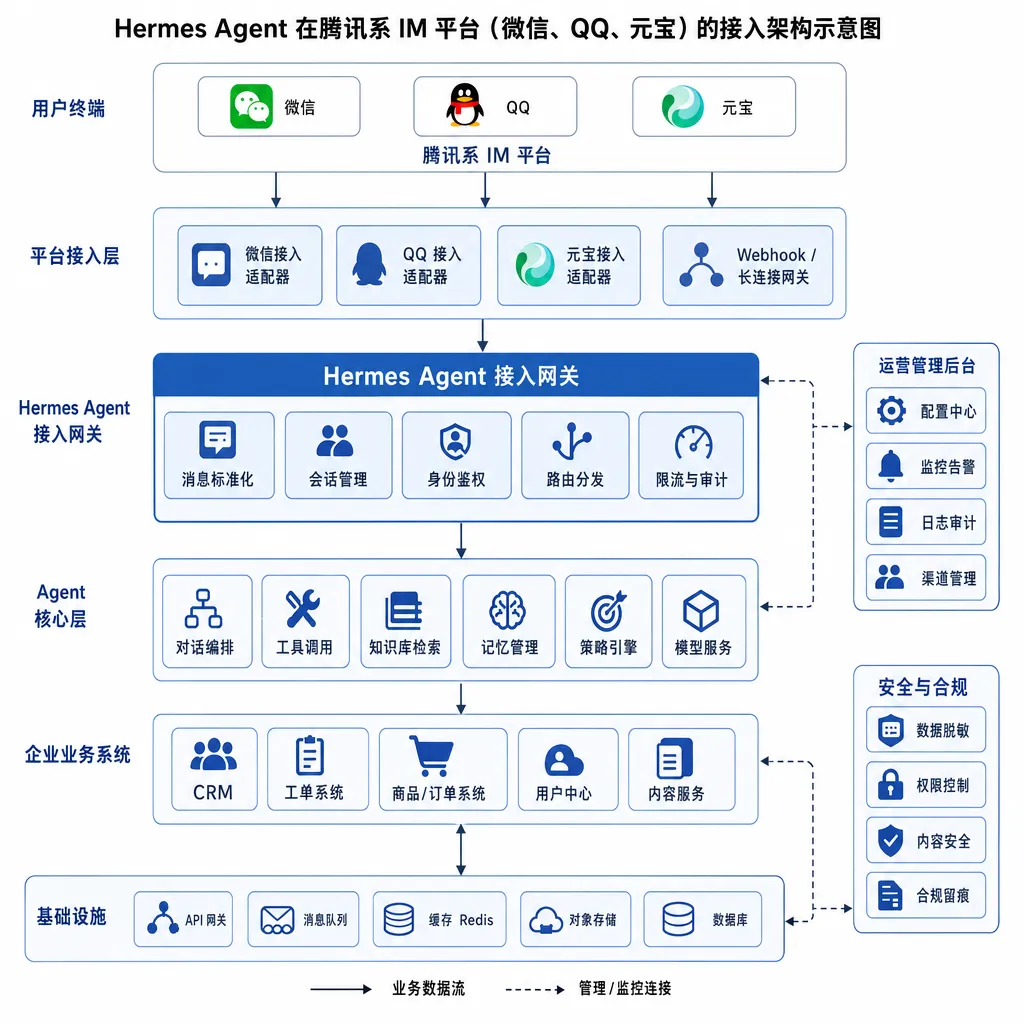
Hermes Agent’s architecture consists of three layers:
- Core Agent – Handles memory, task planning, self-evolution; runs server-side
- Gateway – Connects APIs across platforms, manages message sending and format conversion
- Messaging Platforms – Platform-specific plugins; one per messaging app
Yuanbao integration occurs at the third layer. Developers select the Yuanbao Bot channel in Hermes configuration, complete authentication, and the Gateway automatically manages message protocol handling.
Based on prior QQ and WeChat integrations, the setup process usually goes like this:
# Install Hermes Agent (if you haven’t yet)
pip install hermes-agent

# Run the gateway setup wizard
hermes gateway setup
The wizard lists all supported messaging platforms; after selecting one and completing authentication, credentials are saved to the ~/.hermes/ directory — no manual management required.
Environment variables follow a standard configuration pattern similar to QQ/WeChat setups:
# Typical entries in a .env file
ACCOUNT_ID=your-account-id
DM_POLICY=allowlist
ALLOWED_USERS=user_id_1,user_id_2
GROUP_POLICY=allowlist
GROUP_ALLOWED_USERS=group_id_1
HOME_CHANNEL=chat_id
HOME_CHANNEL_NAME=Home
DM_POLICY and GROUP_POLICY control who the Agent responds to. In allowlist mode, only whitelisted users/groups can trigger it. This safeguard is crucial — you wouldn’t want a semi-autonomous agent replying to everyone indiscriminately.
Known Issues and Limitations
Now for the not-so-great parts — current known pain points, based on WeChat and QQ integration experience, likely relevant to Yuanbao as well:
1. Poor long-response experience
WeChat limits single messages to 4000 tokens, automatically chunking beyond that. QQ and Yuanbao may differ, but segmented responses are never ideal — you get a barrage of messages instead of one coherent reply. Hermes is still working on a better solution; this remains an open issue.
2. Session expiration causing disconnections
A common problem — sessions expiring (WeChat error code -14). The fix: rerun hermes gateway setup to re-scan and reconnect. For 24/7 operation, this can be annoying.
3. Token-instance limitation
Each token can only be linked to one gateway instance at a time. Running both dev and prod environments simultaneously triggers Another local Hermes gateway is already using this token. Use different tokens or stop one instance.
4. Multimedia file handling dependencies
WeChat’s CDN uses AES-128-ECB encryption, requiring the cryptography library for image/media transmission:
pip install cryptography
Yuanbao may use different mechanisms, but if image transfers fail, start troubleshooting here.
None of these are fatal issues, but they affect experience. Hermes moves fast — most should be fixed in coming releases.
Self-Evolution Explained: Insights from the Autoreason Paper
Earlier we mentioned Hermes Agent’s core feature — “self-evolution.” It might sound vague, but Nous Research’s Autoreason paper provides a solid technical basis.
Traditional “self-optimization” typically uses a critique-revision loop: generate, critique, revise, repeat. Sensible on paper, but Nous found three fatal flaws:
- Over-editing – the model can’t distinguish improvement from destruction; after 15 cycles, a 345-word text could shrink to 102 words (a 70% reduction)
- Convergent mediocrity – repeated editing flattens creativity, yielding bland outputs
- No stop criterion – lacks a mechanism to decide “good enough, stop now”
Autoreason’s solution is elegant — treat each iteration as a three-way tournament:
- Competitor A: Keep current output
- Competitor B: Apply modifications
- Competitor AB: Merge best aspects
A pool of “blind evaluator agents” votes using Borda count ranking. The key design: if “keep current output” wins twice consecutively, the system halts iterations immediately. Only genuinely improved modifications push it forward.
Results are impressive:
- Using Haiku 3.5 (one-tenth the cost of Sonnet) with Autoreason achieves Sonnet 4-level output quality
- Across 150 coding tasks, recovery rate hit 62%, surpassing single-generation’s 43%
- In 5 writing tasks, Autoreason scored 27.8 points on average via Borda count, never dropping below second place
This is the technical foundation for Hermes Agent’s “getting better with use.” It doesn’t merely remember what you said — it learns through structured self-play that accumulates truly useful experience.
The IM + Agent Horizon
Back to the big picture: Hermes Agent’s rapid proliferation across Tencent IM platforms reflects a broader industry trend — IM is becoming the primary battleground for AI agents.
Why IM?
First, IM apps dominate user time — no contest. Having the agent live there means zero friction: no app switching, no new UI learning — AI available in the most familiar context.
Second, IM naturally supports multi-turn conversations — ideal for agent interaction. You don’t need to craft perfect prompts upfront; instead, you can clarify tasks conversationally, just like talking to a colleague.
Third, group chats enable collaboration — one agent serving multiple people simultaneously, participating in discussions, providing information, completing tasks. Much more efficient than everyone having isolated AI chats.
Currently, Hermes Agent supports an extensive list of messaging platforms: personal WeChat, QQ, Yuanbao, DingTalk, Lark, WeCom, plus global ones like Discord and Telegram. Practically all major IM tools used by Chinese developers are covered.
For developers, this means one unified agent logic can serve multiple platforms via configurable channel plugins. Write once, run everywhere — a slogan overused in frontend development, but now reality for AI agents.
Of course, there’s room for improvement. Message length limits, session stability, multimedia handling — all basic functionality that needs polishing. But the direction is clear: future AI agents won’t be standalone apps; they’ll live inside the tools you already use, as a “person” among them.
Tencent Yuanbao’s latest move is yet another milestone in that evolution.
If you want to experience Hermes Agent’s multi-model capabilities, OpenAI Hub now supports unified API access to GPT, Claude, Gemini, DeepSeek, and other mainstream models. These can serve as backend model providers for Hermes Agent, sparing developers from juggling multiple APIs.
References
- Hermes Agent GitHub Repository — Source code and documentation, currently 66k Stars
- What is Hermes Agent? The Logic Behind Its Popularity — Zhihu Column — Deep analysis from the Chinese community
- Tencent QQ Announces Native Hermes Agent Integration — IThome — Report on QQ Bot channel integration


