
iFlytek Spark X2-Flash: 30B Compact Model, Trillion-Level Performance
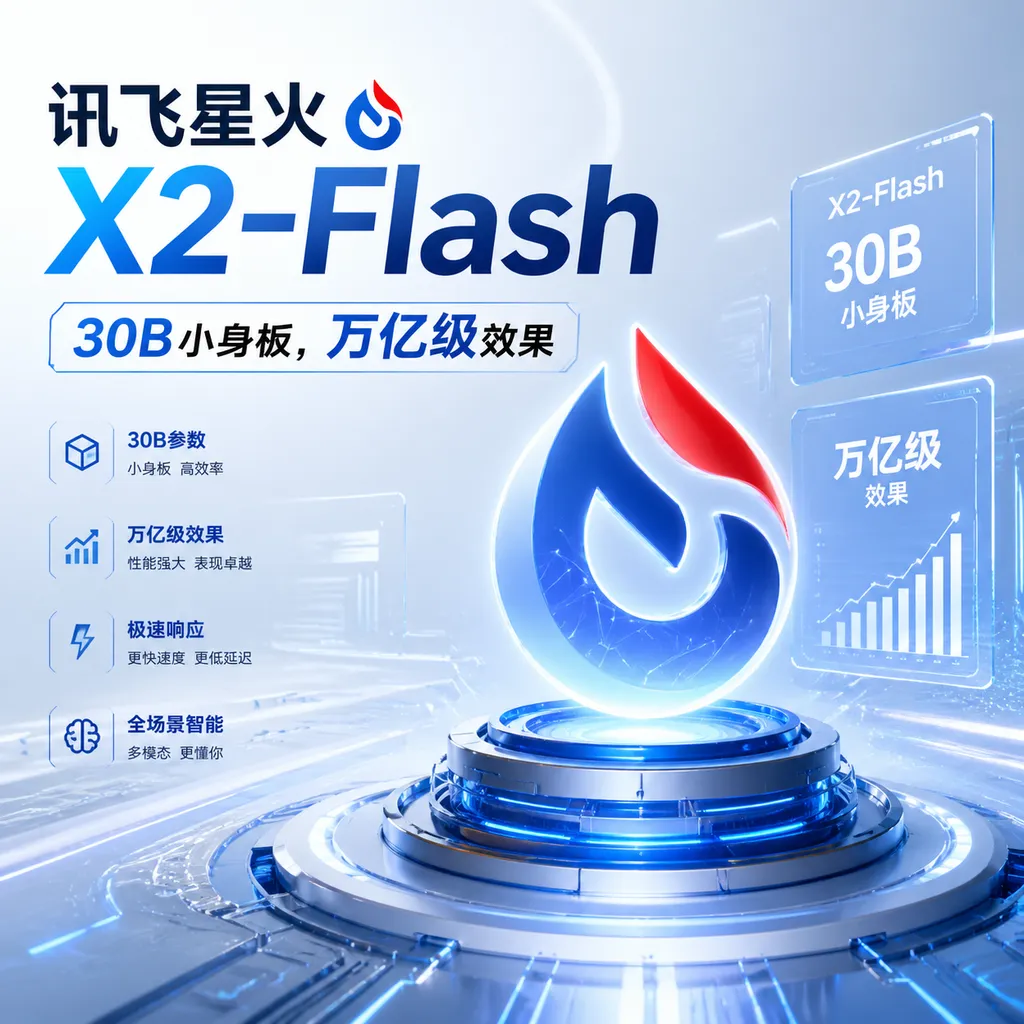
iFLYTEK released the Spark X2-Flash, a 30B MoE architecture model trained on Huawei Ascend 910B. It features a 256K context window, and real-world Agent scenario testing shows performance close to that of trillion-parameter models, while token consumption is only one-third of mainstream large models.
iFlytek Spark X2-Flash: A 30B Lightweight Model Delivering Trillion-Level Performance
On April 29, iFlytek officially released the Spark X2-Flash model, with the API opened simultaneously. In short: this is a 30B-parameter MoE model running on Huawei Ascend 910B, supporting a 256K context window, and claiming near-trillion-scale model performance in Agent scenarios—while its token consumption is only one-third that of mainstream large models.
Its positioning is clear: it doesn’t compete on parameter count, but on cost-effectiveness and practicality.
30B MoE — Why It Dares to Challenge Trillion-Parameter Models
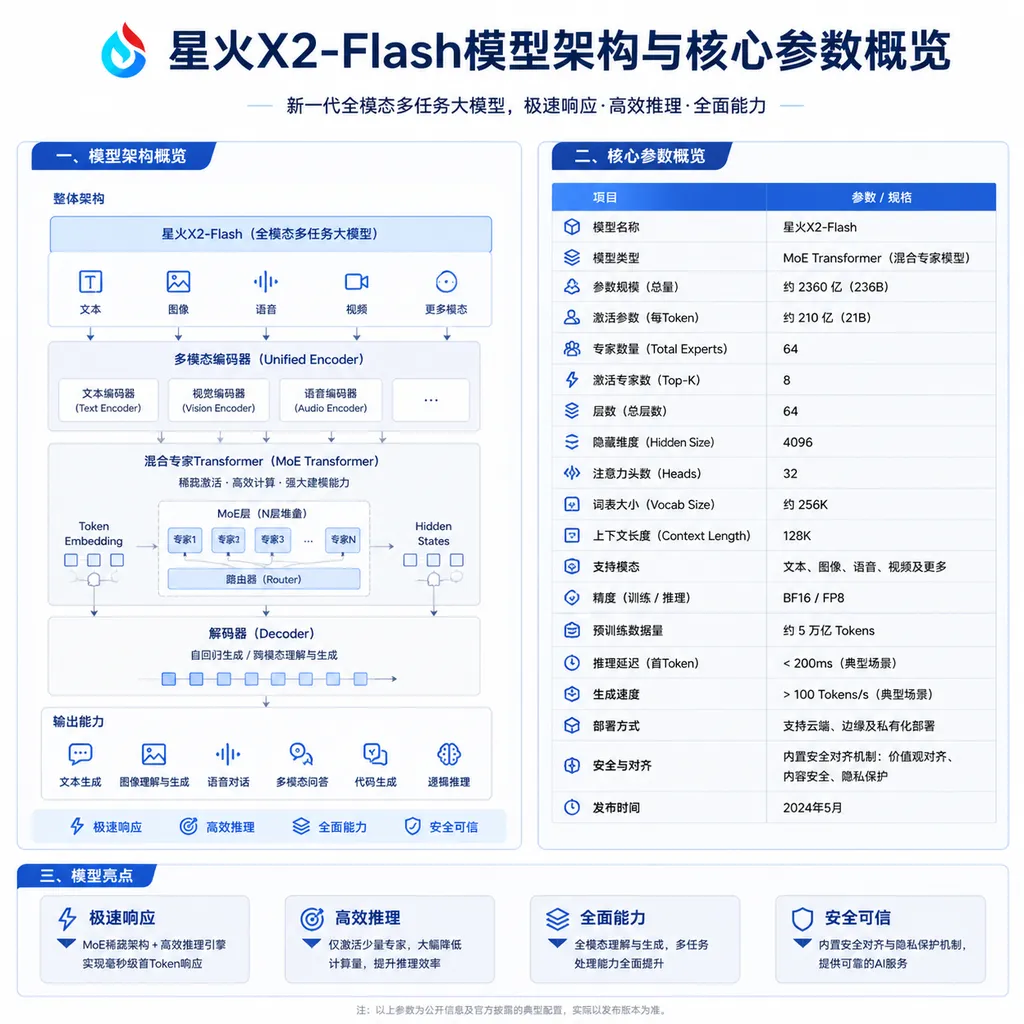
Let’s start with the hard specs. Spark X2-Flash adopts a Mixture of Experts (MoE) sparse architecture with a total of 30B parameters. The advantages of MoE are well known—it activates only some expert networks during inference, meaning much lower computation compared to dense models with equivalent parameter sizes. That’s why players like DeepSeek and Mixtral are betting on this approach.
But claiming that a 30B MoE can match the performance of trillion-parameter dense models sounds ambitious. iFlytek’s justification comes from AstronClaw’s real-world testing: for frequent Agent tasks such as research report generation, skill management and invocation, and system control and execution, X2-Flash’s performance was reported as “close to leading trillion-level models.”
Note the wording—“close,” not “surpassing,” nor “equal.” This phrasing is conservative. Given the efficiency advantage of MoE architectures, approaching large model effects in specific tasks is plausible, particularly since Agent scenarios emphasize instruction adherence, tool use, and long-context understanding more than raw knowledge capacity.
Even more noteworthy is the cost data: under the same workflow, X2-Flash’s total token consumption is less than one-third of current mainstream large models. For developers building complex Agent applications, that means triple the throughput on the same budget. In pay-per-token billing schemes, this gap translates directly into real savings.
256K Context Window: A Breakthrough on Domestic Compute
The 256K context window is another major selling point. In the broader industry, 256K isn’t the longest—Gemini has surpassed a million tokens, and Claude features 200K—but for a 30B model, 256K is impressive. More importantly, this long-context capability is achieved entirely on domestic hardware.
iFlytek disclosed substantial technical details. X2-Flash is the first model trained on domestic compute to combine DSA (Dynamic Sparse Attention) and MTP (Multi-Token Prediction):
- DSA (Dynamic Sparse Attention): Instead of computing full attention across all tokens, it dynamically selects key tokens for computation—critical for long contexts. A 256K context leads to quadratic attention costs if done densely, while sparse attention drastically reduces the load.
- MTP (Multi-Token Prediction): The model predicts multiple tokens per step instead of one-at-a-time, directly improving generation speed. Meta mentioned this concept in its papers, and DeepSeek V3 uses a similar technique—but implementing it efficiently on domestic chips is a major engineering feat.
iFlytek shared a tangible figure: through operator optimization and distributed training strategies tailored to domestic chips, training efficiency improved from 20% to 90% of the equivalent A800 cluster.
This number deserves interpretation. Compared with NVIDIA’s A800, Ascend 910B lags in operator ecosystems and software stack maturity. Many teams report only a fraction of A800’s utilization when training on 910B. Raising that ratio to 90%—if accurate—shows serious engineering prowess on the Ascend platform.
This is not just a technical benchmark. Under current chip supply patterns, the practical availability of domestic compute directly determines the ceiling for domestic large model development. Boosting 910B utilization from 20% to 90% effectively multiplies usable compute by over four—a far greater impact than merely adding more hardware.
Agent Scenarios: X2-Flash’s True Battlefield
From the announcement, X2-Flash’s main focus isn’t general conversation but Agents.
Two platforms, AstronClaw and Loomy, have already integrated the model. iFlytek also emphasized that X2-Flash is fully compatible with mainstream Agent frameworks such as OpenClaw and Claude Code.
This compatibility is crucial. The Agent ecosystem is taking shape quickly, and developers choose models not just by benchmark scores but by how seamlessly they plug into existing toolchains. If a model requires heavy adaptation before fitting an Agent workflow, even high test results won’t save it from being sidelined. X2-Flash’s proactive integration shows that iFlytek clearly understands its target users.
One concrete use case: building a complex video generation Skill with X2-Flash. After parsing detailed requirements, the model can generate complete skill structures, core function descriptions, and usage examples. This type of task tests structured output, instruction following, and long-context comprehension—exactly where MoE architectures shine.
In Agent reinforcement learning training, X2-Flash’s DSA optimization increases sampling and decoding efficiency by over 2×, solving a very real bottleneck. RL for Agents involves massive sample-inference loops; if each sampling round is slow, the whole pipeline stalls. On 910B, this is especially acute, as domestic chips typically have lower decoding throughput than NVIDIA’s A series. DSA effectively compensates for this hardware gap at the software level.
Within iFlytek’s Large Model Ecosystem
To understand X2-Flash’s role, we need to place it in iFlytek’s full Spark lineup.
Back in February, iFlytek launched Spark X2—a 293B-parameter MoE model positioned as a flagship rivaling GPT-5.2 and Gemini 3 Pro. It scored 95.7 on AIME 2025 and 87.3 on MMLU Pro—top-tier among domestic models.
X2-Flash, by contrast, is the lightweight version. Parameters dropped from 293B to 30B, shifting positioning from “omnipotent flagship” to “Agent specialist.” This product tactic follows industry trends—major AI makers are building tiered model matrices: flagships for benchmarks and brand image, lighter models for deployment at scale. OpenAI has GPT-4o mini, Anthropic has Claude Haiku, Google has Gemini Flash, and iFlytek is following the same logic.
Even more notably, during an earnings briefing today, iFlytek President Wu Xiaoru revealed a major update:
In October, iFlytek will release China’s first flagship model on Huawei Ascend 950, positioned to rival the world’s most advanced mainstream models.
The Ascend 950 is Huawei’s next-generation AI chip, expected to deliver major performance gains over 910B. If iFlytek can train a truly world-class model on 950, then the engineering experience accumulated from X2-Flash—DSA, MTP, distributed optimization—will serve as critical technical groundwork.
In that light, X2-Flash is not just a product launch, but a demonstration and preview of iFlytek’s capabilities on domestic compute.
Financial Reality: AI Investment Amid Losses
Beyond the technology story, let’s look at the financials. In its Q1 2026 report, iFlytek disclosed:
| Metric | Value | YoY Change | |--------|--------|------------| | Operating Revenue | ¥5.274 billion | +13.23% | | Net Profit (Attributable) | -¥170 million | +12.17% (loss narrowing) | | Adjusted Net Profit | -¥430 million | -88.58% | | Operating Cash Flow | -¥1.069 billion | -50.06% |
Revenue is growing, but adjusted net profit declined sharply, and cash flow worsened—indicating iFlytek is still in the “burn money to scale” phase for AI. However, its 2025 full-year forecast projects net profit of ¥785–950 million, up 40–70%, suggesting improvement ahead.
For developers, a vendor’s financial health affects API stability and service continuity. As an A-share listed company, iFlytek has steady revenue backing—an advantage over many VC-funded startups still burning through capital.
How to Integrate
The Spark X2-Flash API is now live:
https://xinghuo.xfyun.cn/sparkapi
Based on current info, X2-Flash is compatible with mainstream Agent frameworks like OpenClaw and Claude Code, allowing developers to swap in the model endpoint for direct testing.
If you’re building Agent applications, X2-Flash is worth trying in these scenarios:
- Long-context Agent interactions: The 256K window covers most multi-turn dialog and document analysis needs.
- Complex skill orchestration: Strong structured output and instruction-following abilities are core strengths.
- Cost-sensitive batch tasks: Reducing token consumption by two-thirds significantly cuts costs in high-frequency call scenarios.
Of course, the claim of “near-trillion-level model performance” still needs more independent verification. Developers are advised to run A/B tests in their own contexts rather than rely solely on official benchmarks.
Currently, OpenAI Hub also supports integration with the Spark series, letting developers call through a unified API format and avoid separate integration efforts.
Final Thoughts
The launch of Spark X2-Flash reflects a new trend in China’s large-model competition: the battlefield is shifting from parameter arms races to efficiency and real-world deployment. A 30B model no longer seeks to dominate general benchmarks but aims to be good enough and affordable for Agent use cases.
That’s the right direction. For most developers, a model that’s three times cheaper and good enough is far more useful than one that’s three times the cost but only 5% better on tests.
And iFlytek’s engineering breakthroughs—raising 910B training efficiency from 20% to 90%—may prove even more valuable long-term than the model itself. In a world constrained by chip supply, whoever can best utilize domestic compute gains a larger effective training budget—and faster iteration cycles.
Come October, the Ascend 950 flagship will be iFlytek’s true exam. X2-Flash is the warm-up—and it’s a strong start.
References
- iFlytek Spark X2-Flash Model Released: Trained on Huawei Ascend 910B Cluster, Up to 256K Context – IT Home — Launch details and technical specs
- iFlytek President Wu Xiaoru: Flagship Domestic Model on Huawei Ascend 950 Coming This October – IT Home — Wu Xiaoru’s briefing and Q1 financial data
- Another Giants’ Arena! iFlytek Spark X2 Debuts Powerfully, Driving Industry-wide Upgrades – Zhihu — Technical architecture and application analysis of the Spark X2 series


