
440MB fits 33 languages — Tencent “crammed” its translation large model into a smartphone

Tencent Hunyuan open‑source mobile offline translation model **Hy-MT1.5-1.8B-1.25bit**, uses extreme quantization compression to reduce a 1.8B‑parameter model to **440 MB**, supports offline translation in **33 languages**, runs on a **Snapdragon 865**, and delivers translation quality that surpasses **Google Translate**.
440MB Packed into 33 Languages: Tencent “Forces” Its Translation Model into a Smartphone
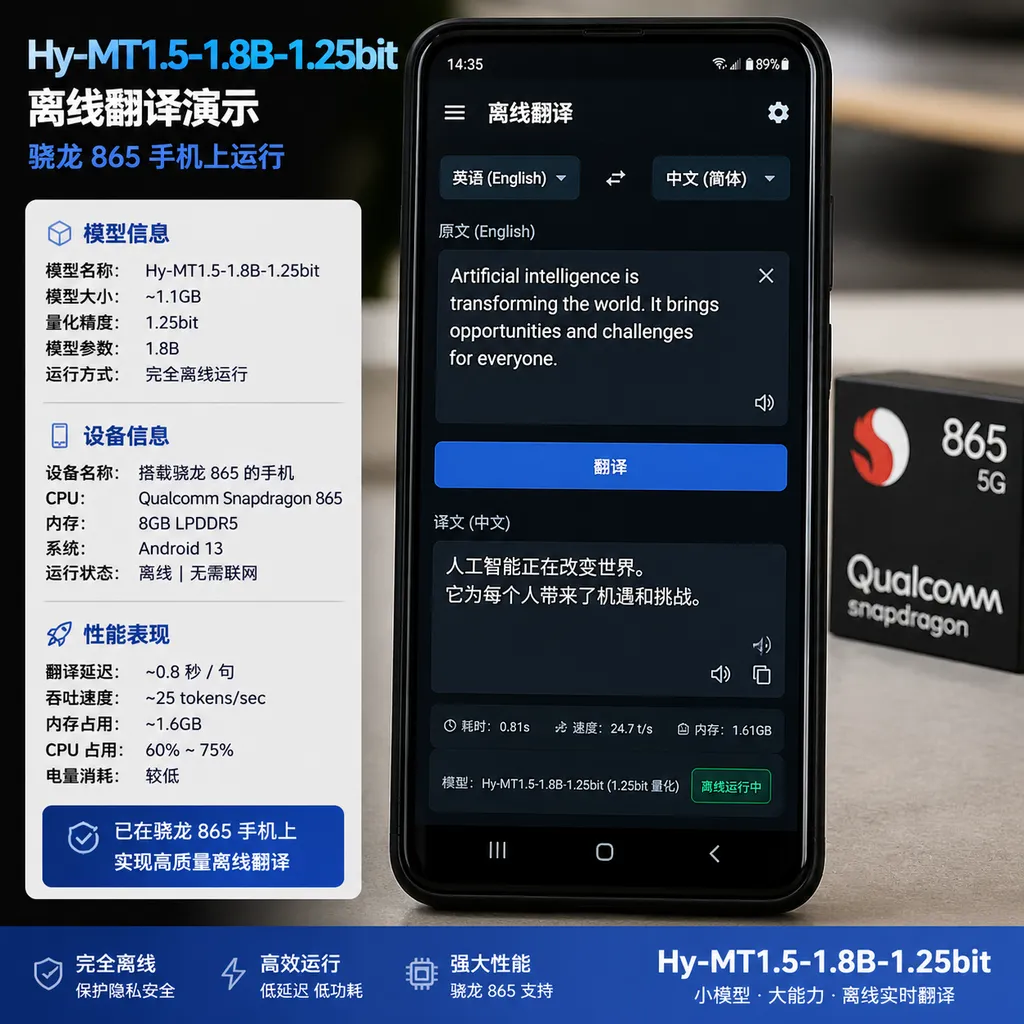
Today, Tencent’s Hunyuan team open-sourced a mobile offline translation model, Hy-MT1.5-1.8B-1.25bit. The core selling point is straightforward: 440MB in size, 33 languages, completely offline, runs directly on a smartphone after download. The demo device uses a Snapdragon 865 with 8GB RAM — a flagship chip from 2020, which is mid-range by today’s standards.
In other words, your Android phone from 2–3 years ago can probably run it.
First, the Translation Quality: 1.8B Parameters for 235B-Level Performance
The model is built upon Tencent Hunyuan’s professional translation large model Hy-MT1.5. It has only 1.8B parameters, but Tencent claims surprisingly strong performance — on the FLORES-200 benchmark, its translation quality not only surpasses Google Translate, but even rivals 235B-scale large models and commercial translation APIs.
1.8B vs 235B — over 130× fewer parameters, yet comparable results. This shows that for a specialized task like translation, architectural and training optimization matters far more than just “stacking parameters.” Unlike general dialogue models that require massive world knowledge, translation relies more on accurate language pair mapping and contextual understanding. Tencent clearly invested heavily in targeted optimizations here.
The language coverage is also impressive: 33 languages, 5 dialects (including Chinese minority languages), and 1,056 translation directions. It covers mainstream languages like English, Chinese, French, and Japanese, as well as Arabic, Russian, and even minority languages such as Tibetan and Mongolian.
1,056 directions means every language pair can be directly translated without pivoting through Chinese or English.
This has major practical benefits. Traditional multilingual systems often rely on a “pivot language” strategy — e.g., translating Thai → English → Japanese, with two translation steps and double the loss. Direct pairwise translation improves both speed and accuracy.
The Real Technical Highlight: Compressing 3.3GB Down to 440MB
A 1.8B-parameter model requires about 3.3GB of memory at FP16 precision. That’s still too large for mobile — your phone also needs memory for the OS, WeChat, and many background services, leaving very limited space for a translation model.
The key problem, then, is: how to shrink the model while preserving translation quality.
Tencent offers two approaches, for different use cases.
Option 1: 2-bit Quantization, 574MB (Mid-to-High-End Devices)
Quantization basics are simple: each model parameter, originally stored as a 16-bit float, is reduced to fewer bits. Dropping from 16-bit to 2-bit reduces storage by 8×.
But lowering precision too aggressively severely hurts performance. Tencent’s 2-bit version uses a technique called Stretched Elastic Quantization (SEQ). In simple terms: instead of mapping weights evenly to {0,1}, it maps them to {-1.5, -0.5, 0.5, 1.5}. These carefully spaced values better preserve the original distribution characteristics.
Combined with quantization-aware distillation — where the quantized model “learns” from the output of the full-precision model — the final 574MB 2-bit model achieves nearly lossless translation quality.
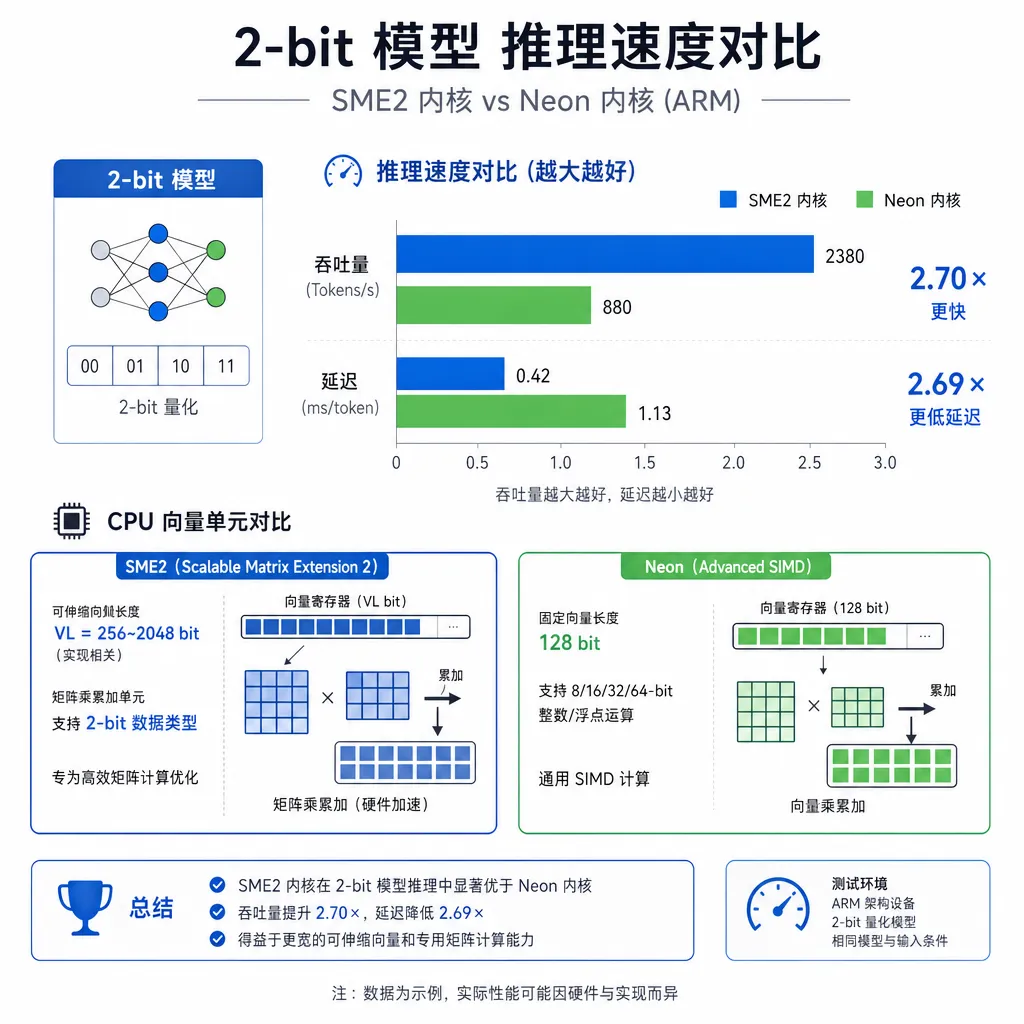
Another bonus: on new mobile chips supporting the Arm SME2 instruction set, the 2-bit model runs significantly faster. SME2, introduced by Arm in 2023, is a matrix math extension optimized for low-bit operations. This means that as new phone chips evolve, the model’s inference speed will continue to improve.
Option 2: 1.25-bit Quantization, 440MB (All Devices)
2-bit wasn’t enough — Tencent went further, releasing a 1.25-bit version using its proprietary Sherry extreme compression scheme.
What does 1.25-bit mean? Normally quantization goes as low as 2-bit or 1.58-bit (as in Meta’s BitNet). 1.25-bit means each parameter is encoded using only 1.25 bits on average — barely more than one binary bit. This reduces the model from 3.3GB to 440MB, nearly an 8× compression.
This compression ratio is remarkable industry-wide. For comparison, Meta’s 1.58-bit BitNet is already considered ultra-quantized — Tencent pushed it even further to 1.25.
Of course, at that level of compression, some loss in translation quality is inevitable. But based on Tencent’s FLORES-200 test results, while the 1.25-bit version performs slightly worse than the 2-bit one, it remains usable — a reasonable trade-off for offline translation on a smartphone.
To put 440MB in perspective: about the size of a mid-tier mobile game or a few dozen high-resolution photos. Download once, use forever offline — no data, no server dependency.
Why Offline Translation Matters
You might wonder — WiFi is everywhere, and online APIs are fast and powerful, so why bother with offline?
Some real-world scenarios:
International travel: In Tokyo’s subway, Bangkok’s night markets, or Istanbul’s old town, signal can be unreliable and roaming data expensive. In such cases, a 440MB offline translator is essential.
Privacy-sensitive content: Internal enterprise files, legal contracts, or medical records — you might not want those sent to the cloud. Offline models keep data entirely on-device, solving privacy issues at the root.
Limited connectivity: Factory floors, mines, ships, remote regions — stable networks are a luxury.
Cost: For developers processing large translation volumes, cloud APIs cost money per request. Deploying models locally brings marginal cost to zero.
Previous offline solutions were either too large (multi-GB), too low quality (statistical MT), or lacked language coverage. Tencent appears to have solved all three shortcomings — at least based on the published data.
What It Means for Developers
The model is now open-sourced on Hugging Face, available for immediate download.
From an integration perspective, a 440MB model is acceptable for mobile apps. Many apps already reach hundreds of MB; bundling or providing it as downloadable content won’t be burdensome.
Potential use cases include:
- Travel apps: Built-in offline translation, independent of Google Translate APIs — improves both UX and cost
- Instant messaging: Real-time message translation with full on-device privacy
- Reading apps: Local translation of foreign content with faster response than cloud APIs
- IoT / embedded devices: Translation gadgets, in-car systems, and similar hardware
- Enterprise tools: On-device translation that meets data compliance requirements
For teams already working on on-device AI, Tencent’s quantization techniques themselves — SEQ and Sherry compression — are highly instructive. The same concepts could apply to other mobile AI tasks like speech recognition and image classification.
Putting It in Industry Context
On-device large models have become a clear trend since 2025. Apple Intelligence relies heavily on local models, Google Gemini Nano runs directly on Pixel phones, and Qualcomm and MediaTek are boosting NPU compute for this purpose.
But so far, most on-device models focus on “nice-to-have” features like chat or summarization. Tencent’s choice of translation as an entry point is smart — it’s a high-frequency, latency-sensitive, must-have task ideally suited to local deployment.
A look at current mainstream mobile translation solutions:
| Solution | Size | Languages | Offline | Translation Quality | |-----------|------|------------|----------|-------------------| | Google Translate offline packs | ~40–50MB per language | Download individually | ✅ | Moderate | | Apple Translate | Built-in | ~20 | ✅ | Above average | | Hy-MT1.5 1.25-bit | 440MB full | 33 | ✅ | Claimed better than Google | | Hy-MT1.5 2-bit | 574MB full | 33 | ✅ | Nearly lossless |
Google Translate’s offline mode requires separate downloads per language (~40–50MB each). With 10 languages, that’s 400–500MB, and quality is clearly below its online mode. Tencent’s single 440MB package covers 33 languages and all translation directions — far more efficient.
That said, Tencent’s benchmark numbers should be taken with caution. FLORES-200 is a standardized benchmark, but actual translation quality depends on colloquialism, technical terms, and document length. “Better than Google Translate” might hold on test sets, but real-world validation is still needed.
Questions Still to Watch
Although open-sourced, several key questions remain:
Real-world translation quality: Benchmark scores often diverge from real use. For extreme compression like 1.25-bit, how well it performs on low-resource pairs remains to be seen.
Inference speed: The demo used a Snapdragon 865 but didn’t disclose tokens/sec. Real-time response is critical — if a sentence takes several seconds, that hurts usability.
Long-text performance: With only 1.8B parameters, maintaining coherence and context in long documents could be challenging — a known limitation for smaller models.
Community ecosystem: The success of open models depends on adoption. If developers build great apps or adapt these quantization methods to other tasks, the project’s impact could extend far beyond translation.
In Conclusion
440MB, 33 languages, fully offline, surpassing Google Translate in benchmarks — if these claims hold up, Tencent has indeed set a new bar for on-device translation.
More importantly, it demonstrates a possibility: with extreme quantization and compression, large models don’t have to live in the cloud. A 440MB model can do far more than most expect.
For on-device AI developers, this project is worth serious study — not just for the translation model itself, but for the underlying compression methodologies behind it.
References
- IT Home: Tencent Hunyuan Open-Sourced Mobile Offline Translation Model Hy-MT1.5-1.8B-1.25bit, Only 440MB — Primary information source with official technical details
- Hugging Face: Hy-MT1.5-1.8B-1.25bit Model Page — Model download and documentation


