
Meitu RoboNeo Major Update: Agent Teams Let One Person Do the Work of an Entire Team
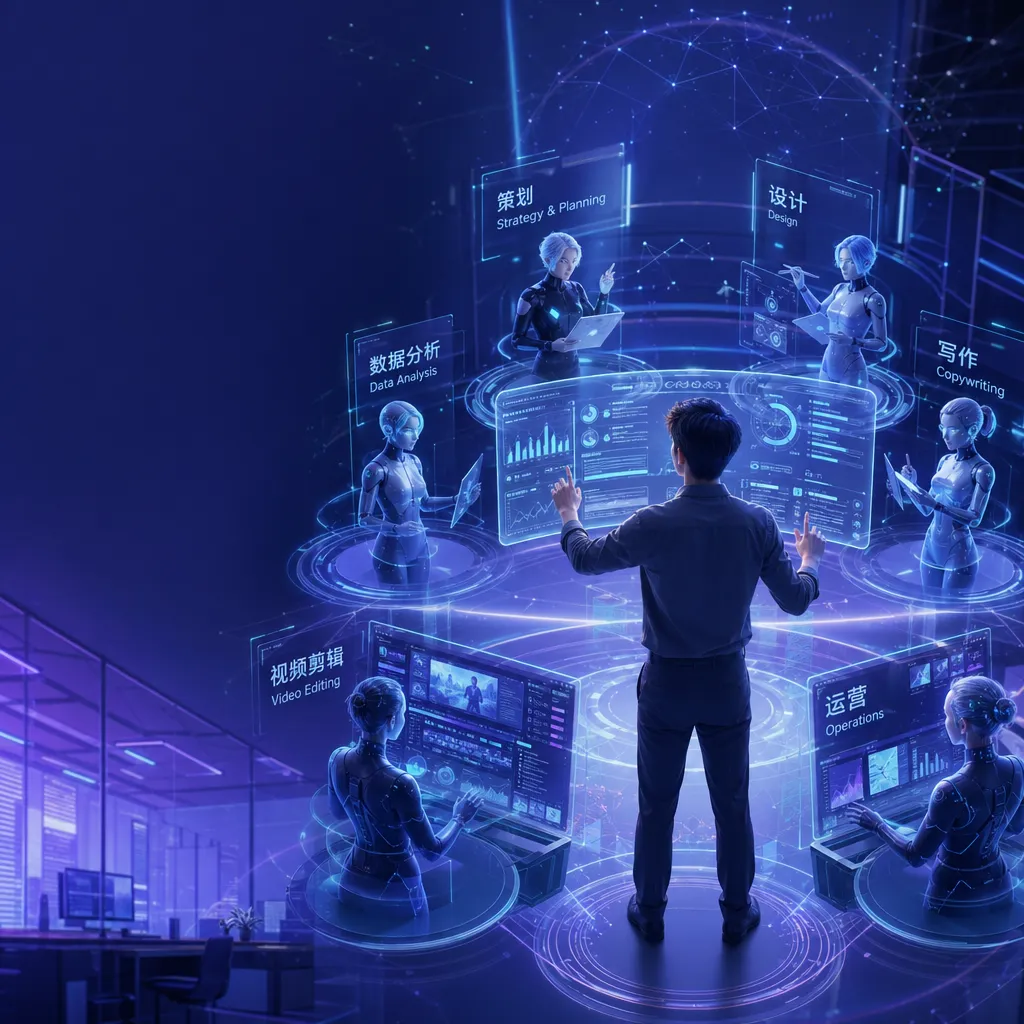
Meitu RoboNeo launches the Image Creation Agent Teams, enabling full-process creation from script to finished video through multi-Agent role-based collaboration. It simultaneously integrates Seedance 2.0 video generation capabilities, reducing the time to replicate viral cross-border e-commerce videos from half a day to just 5 minutes.
Meitu RoboNeo Major Update: Agent Teams Let One Person Do the Work of a Whole Team
Today (April 29), Meitu released a major version update of RoboNeo. The core move is the launch of "Visual Creation Agent Teams"—integrating previously separate creative functions into a multi-agent collaborative intelligent team. At the same time, RoboNeo announced integration with ByteDance’s Seedance 2.0 video generation model, filling a key gap in video creation capabilities.
The target user profile for this update is clear: independent media creators, small content teams, and the growing number of “one-person companies.” Simply put, those creators who need to write scripts, design visuals, and edit videos—all at once—and wish they could split into five versions of themselves.
What Problem Is Agent Teams Solving?
Let’s start with the pain points.
Current general-purpose large models are powerful, but there’s an obvious issue—they know everything, but they don’t know you. Every time you start a new conversation, you have to remind the model what your brand tone is, who your target audience is, and what your visual style preferences are. Repeating background information means that brand assets can’t accumulate—this is an enormous drag in high-frequency creative scenarios.
A more practical issue is toolchain fragmentation. Producing a short video might involve the following: brainstorming a script → generating a storyboard → making visuals → adding voiceovers and music → editing the final cut. Each stage may use different tools, with repeated revisions, parameter adjustments, format matching, and asset searching in between. Creators spend the majority of their time on “glue work” rather than the creative process itself.
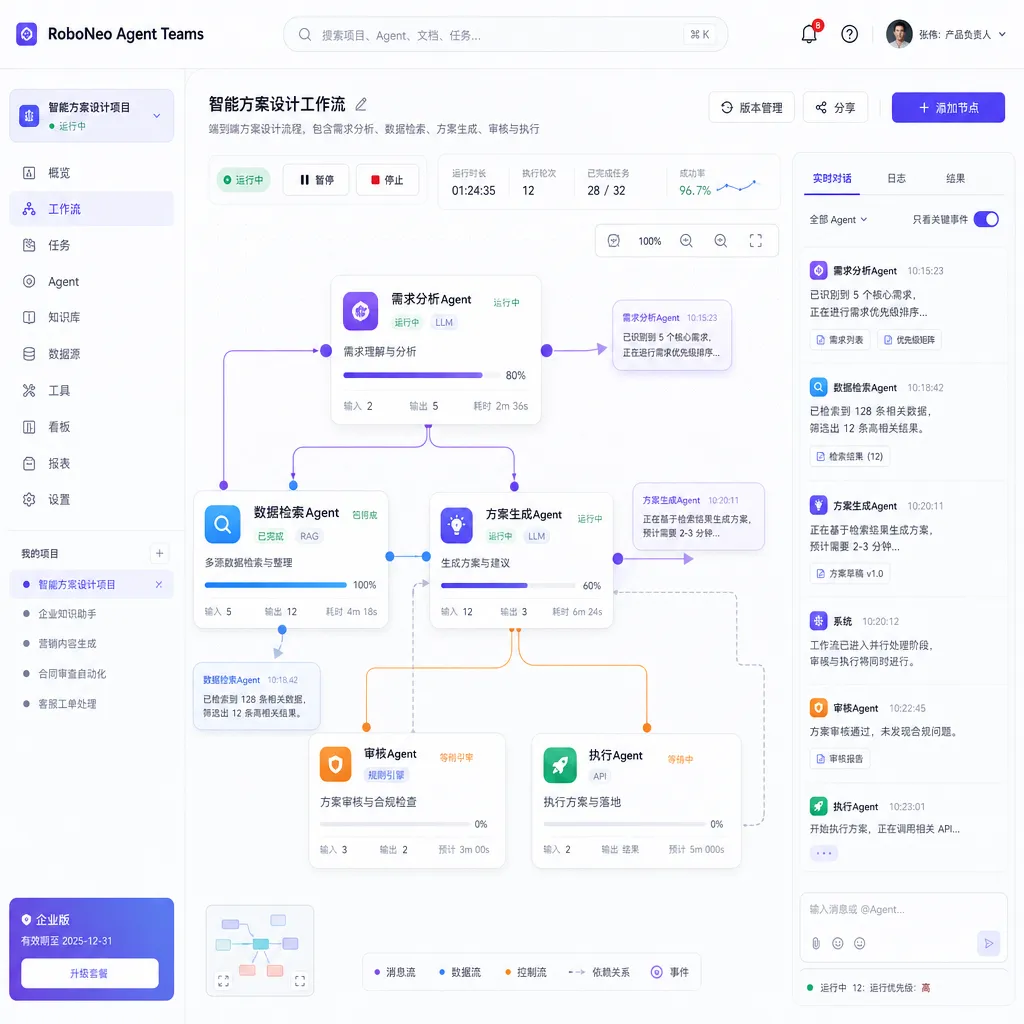
RoboNeo Agent Teams’ concept is: divide the whole process into different Agent roles, each taking care of its specialization while collaborating to complete the entire creative workflow.
Users only need to describe their creative idea in natural language. Agent Teams then autonomously decompose the task and assign sub-tasks to different Agents—for needs understanding, content generation, detail refinement, and so on—ultimately producing a complete work. In this process, the user goes from being an “operator” to a “director”: you focus on the creative vision and decision-making, while the Agents handle execution.
Three Scenarios: See How It Works in Practice
Talking about concepts is easy—let’s look at real-world use cases.
AI Short Drama Creation
This is one of the hottest directions in content right now. In a traditional workflow, creating a short drama—from character setup and scriptwriting to storyboard design and post-production—can still take days, even for experienced small teams. RoboNeo Agent Teams integrates this chain end-to-end: input a story concept, and the Agents can autonomously complete character building, script generation, storyboard design, and video output in a seamless process.
The key here is not just about “doing,” but about “coherence.” Different Agents share context so that character appearances, scene styles, and narrative pacing remain consistent without jarring transitions.
Self-Media Content Creation
For independent creators who post daily or frequently, the pain point isn’t content quality—it’s production efficiency. In this scenario, Agent Teams can simultaneously generate cover images, copywriting scripts, and animated intros—solving the “what should I publish today?” problem in one go.
More importantly, there’s the memory bank feature—RoboNeo can store your brand’s visual guidelines, commonly used design elements, and IP characters as core assets to be reused automatically in future work, so you don’t need to recalibrate from scratch each time. For creators with a strong brand identity, this is highly valuable.
E-Commerce Content Creation
This scenario offers concrete numbers: according to testing by the Beijing News, cross-border e-commerce sellers using RoboNeo to replicate trending product videos reduced production time from half a day to under five minutes.
Half a day to five minutes—that’s an order-of-magnitude improvement. Of course, “replicating viral content” and “creating original hits” are two different things, but for the high-speed, high-volume demands of cross-border e-commerce, raw speed itself is a major competitive advantage.
Integration with Seedance 2.0: A Critical Complement for Video Capabilities
Another key move in this update is the integration of Seedance 2.0.
Seedance, a video generation model under ByteDance, has made clear improvements in continuity and controllability in its 2.0 version. With this integration, RoboNeo gains three core video creation capabilities:
- One-Click Multi-Shot Generation: Generate sequences of narratively coherent shots, not just fragmented clips
- Synchronized Audio-Visual Output: Video and audio are generated together—no more manual syncing of lip movements and voiceovers
- Smart Consistency Control: Maintain visual continuity for the same characters and scenes across different shots
These three address the most criticized issues with AI video generation today. While AI image generation is already quite mature, at the video level, shot-to-shot continuity, character consistency, and audio-visual synchronization have been major bottlenecks. The integration of Seedance 2.0 removes RoboNeo’s previous weak spot in the video creation process.
Expert Skills Library: Deep Adaptation for Vertical Scenarios
In addition to Agent Teams and Seedance 2.0, RoboNeo now includes a multi-domain Expert Skills Library, covering e-commerce, short dramas, advertising, animation, and more.
The idea behind this design deserves mention. The problem with general-purpose large models is that they can “do everything, but not expertly.” The Skills Library builds on general capabilities by adding industry-specific knowledge and best practices, improving output quality and industry alignment for Agents in targeted contexts.
For example, the e-commerce Skill understands key techniques such as refining product selling points, structuring promotional language, and adhering to platform content standards. The short drama Skill grasps narrative pacing, hook design, and emotional flow. These are not things that can be achieved through prompt engineering alone.
Memory Bank: Long-Term Retention of Brand Assets
There’s another practical but easily overlooked capability—the memory bank.
RoboNeo’s memory bank can store a user’s brand visual guidelines, design materials, and IP images for persistent retention and reuse.
This solves a real problem: after training the AI to understand your brand style, you shouldn’t have to start from scratch for every new project. The memory bank preserves these “fine-tuning results,” allowing Agent Teams to automatically reference them in future work, maintaining consistency in brand output.
For teams with mature brand systems, this could be even more valuable than Agent Teams themselves.
How to Interpret This Update
A few thoughts:
First, the direction of Agent Teams is right.
Moving from a single AI assistant to a collaborative team of Agents represents a paradigm shift in the AI application layer. No single Agent, however powerful, can handle every task across a complex workflow. Decomposing tasks, letting each specialized Agent do its part, and connecting them via a collaboration mechanism is a smarter architecture.
Meitu’s choice to first apply Agent Teams in visual creation is a fitting entry point—image and video production naturally involve multiple stages and skills, making it ideal for multi-Agent collaboration.
Second, the “half day to 5 minutes” efficiency claim deserves skepticism.
That figure comes from a specific scenario (duplicating viral e-commerce videos) and official testing. In actual use, results will vary significantly based on task complexity, user experience, and quality demands. But even if we discount the claim, compressing hours into minutes is still a meaningful improvement for high-volume, time-sensitive e-commerce content.
Third, integrating Seedance 2.0 is a pragmatic move.
Meitu has strong technical grounding in image processing, but video generation is a different magnitude of challenge. Choosing to integrate ByteDance’s Seedance 2.0 instead of developing from scratch shows Meitu’s clear positioning—as an application-layer integrator and experience optimizer rather than a base model competitor. Given today’s rapid convergence of model capabilities, this strategy makes sense.
Fourth, watch the competition.
Meitu isn’t the only player in the AI visual creation space. Adobe’s Firefly ecosystem continues to expand, Canva is accelerating its AI integration, and domestic contenders like JiMeng and KeLing are pushing forward in video generation. Meitu’s edge lies in its long-standing accumulation and user base in consumer imaging tools—but whether it can maintain that lead under the new multi-Agent paradigm depends on future product iteration and ecosystem building.
What It Means for Developers
If you’re developing content creation tools, e-commerce SaaS, or short video products, RoboNeo’s update offers several takeaways:
- Multi-Agent Collaboration Product Design: How to organize multiple AI Agents into a cooperative team, design inter-Agent communication, and manage task delegation—RoboNeo’s Agent Teams offer a solid product reference.
- Memory Bank Design Pattern: Persistent brand asset storage, user preference learning, and cross-session context retention—RoboNeo’s memory implementation can inspire similar capabilities.
- Vertical Skills Structuring: The layered approach of combining generic abilities with vertical Skills is emerging as the mainstream solution to the “general vs. specialized” tension in AI applications.
That said, RoboNeo currently targets consumer users, accessible via the PC web version. For developers seeking to integrate similar capabilities into their own products, its main value lies in product design and architectural reference.
If you’re building your own AI creative workflow and need multi-model connectivity, check out API aggregation platforms like OpenAI Hub, which give you access to GPT, Claude, Gemini, DeepSeek, and other major models with a single key—saving you the hassle of multiple integrations.
Summary
Meitu’s RoboNeo update is fundamentally about upgrading “from an AI tool to an AI team.” Multi-role collaboration with Agent Teams, video capabilities via Seedance 2.0, vertical depth from the Expert Skills Library, and persistent brand assets in the Memory Bank together form a comprehensive visual creation solution.
Can it really give a “one-person company” the output power of a full team? It’s too early to say—but directionally, Meitu is on the right track. It’s not just giving users a more powerful AI tool; it’s giving them a coordinated AI team.
That approach may bring us closer to the true endgame of AI applications than any single technological leap.
This article references reports from domestic media, published on April 29, 2026.


