
Codex Raw Image Generation Quota System Exposed: Two Ledgers, One Trap
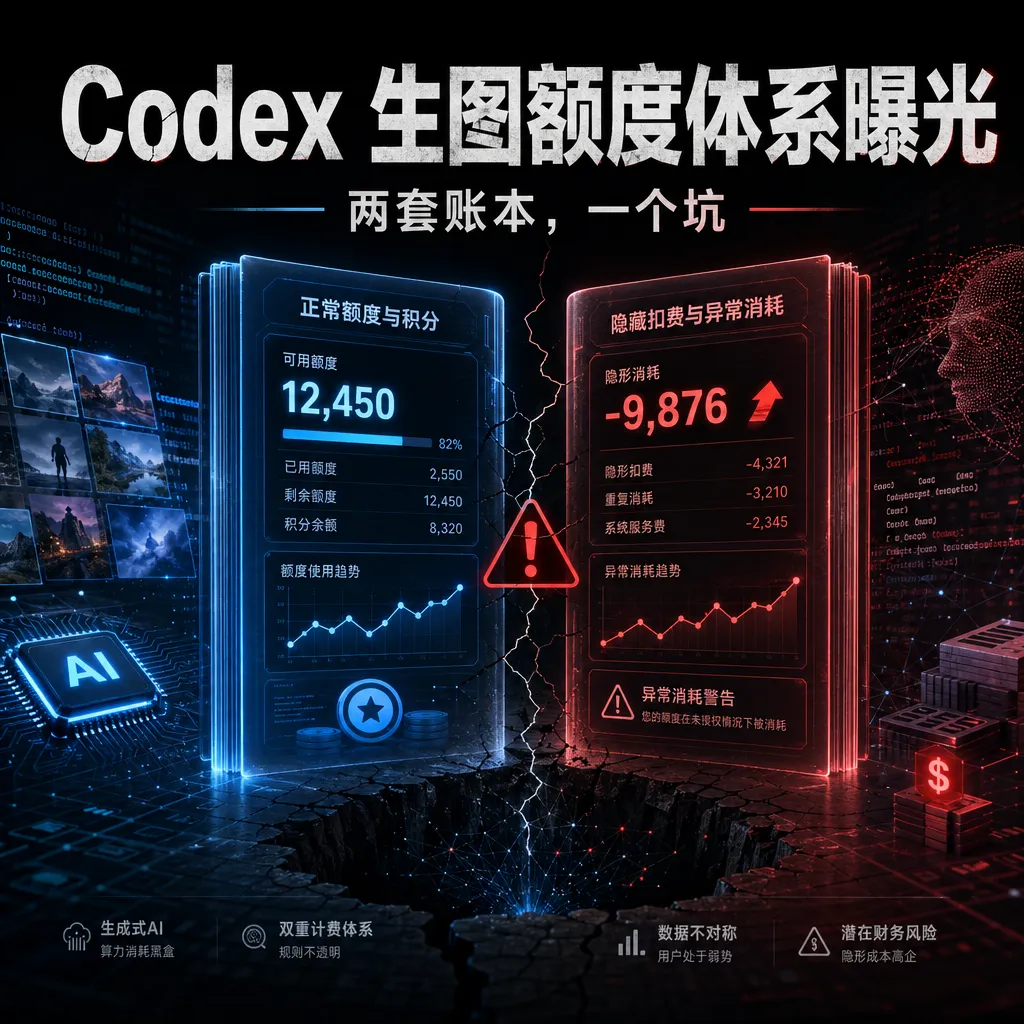
Community developers discovered through reverse engineering that ChatGPT’s image generation actually has two separate quota systems: one for the web version and one for Codex. Free users cannot use Codex image generation at all, while paid users’ Codex image generation consumption is 3–5 times higher than normal usage.
Codex Image Generation Quota System Exposed: Two Ledgers, One Trap
In Short: What You Thought Was “One Quota” Is Actually Two
Recently, a technical analysis post on the developer community Linux.do regarding GPT account image2 quotas sparked wide discussion. By inspecting network packets and API responses, the author uncovered a fact that OpenAI has never officially clarified — behind ChatGPT’s image generation capability actually run two completely separate quota accounting systems.
This is not a minor detail. For developers using Codex for coding assistance while also relying on GPT’s image generation, this means your usage may be consumed much faster than you think.
Two Paths, Two Sets of Rules
Let’s start with the conclusion. GPT’s image2 (its latest image generation capability) can be invoked in two ways:
- Web Chat Image Generation: Triggered via the
/f/conversationendpoint — that is, when you ask ChatGPT to draw an image directly in the web or app interface. - Codex Tool-Call Image Generation: Triggered via the
/codex/responsesendpoint — this is when the Codex programming assistant autonomously decides to call an image generation tool while performing a coding task.
The key point: these two paths are billed separately, with their quotas not shared.
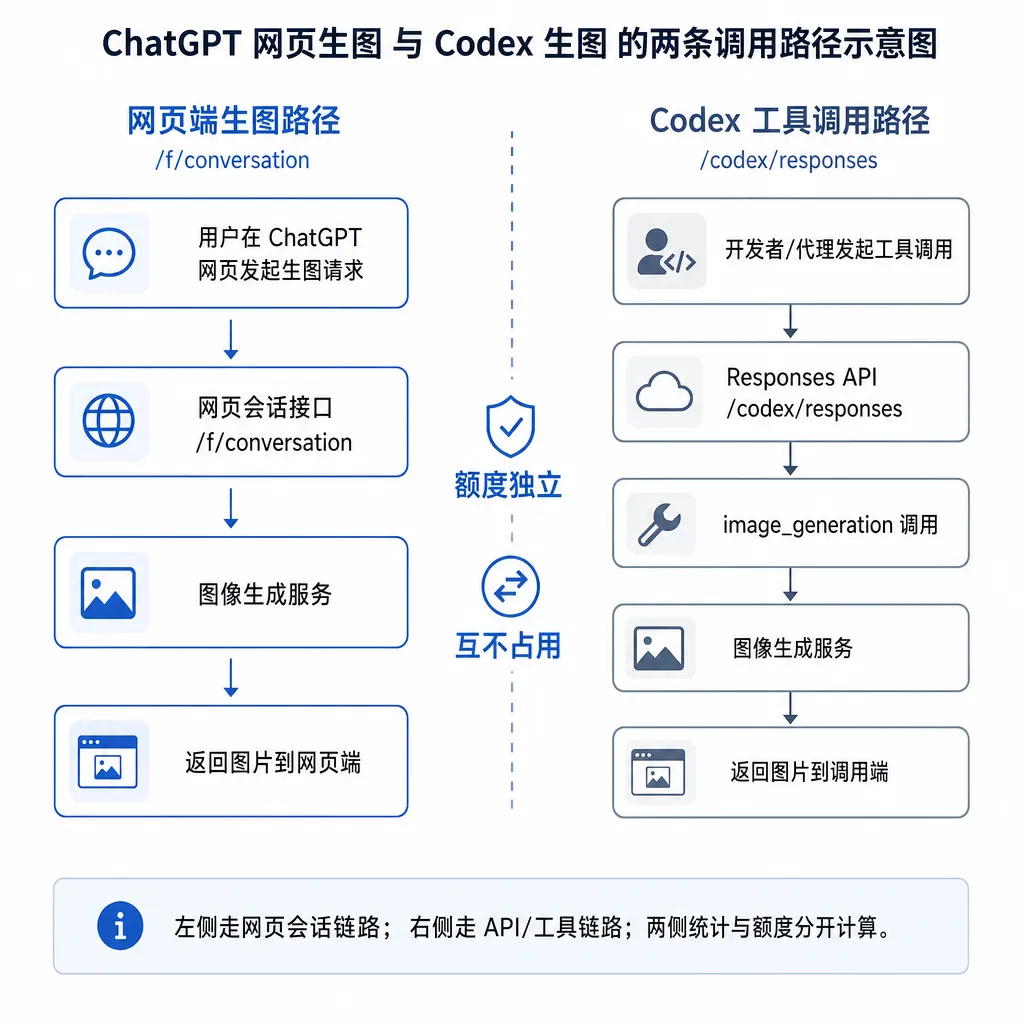
Using an imperfect but easy analogy: it’s like you get a credit card, assume online and offline spending share one limit — then find out they actually have separate limits, and offline purchases cost three to five times more.
Free Users: Codex Image Generation? Not for You
One of the clearest findings from the post concerns limits on free accounts:
GPT Free accounts have web image generation quota, but do not have Codex image generation quota.
What does this mean? If you’re a free ChatGPT user, you can ask GPT to draw images in the web interface (within usage limits). But when using Codex, even if Codex determines during execution that it needs to generate an image, the request will fail due to missing quota.
From a business standpoint, this makes sense — Codex is an advanced function for developers, and OpenAI clearly doesn’t want free users exploiting Codex’s tool-calling mechanism to get image generation for free. The issue is that this restriction isn’t clearly documented. Many free users trying to run Codex workflows involving images may experience unexplained errors, not realizing it’s due to the split quota system.
Paid Users: Usable, But Not Cheap
Non-free accounts (Plus, Pro, Team, Enterprise, etc.) have both web image quotas and Codex image quotas. Sounds good, but there’s a subtle cost:
Codex image generation is counted toward Codex usage and consumes about 3–5× more than normal Codex operations.
That multiplier deserves attention. Codex usage is already costly. According to OpenAI’s official pricing page, Codex billing is based on task complexity and token consumption. When Codex calls the image generation tool during a process, that call consumes 3–5 times the usual quota.
For example: suppose you ask Codex to build a front-end page and it automatically generates several placeholder or UI mockup images. It feels trivial, but each image eats your Codex quota 3–5× faster. If your workflow frequently uses image generation, your Codex credits may drain faster than expected.
This raises a strategic issue: Should developers deliberately avoid letting Codex call image generation tools automatically?
For quota-sensitive users, the answer might be yes. If you need images, it may be wiser to separate that step out — generate the images in the web interface using that quota instead of letting Codex trigger them automatically inside its toolchain.
Technical Details: Image Generation via Tool Use
From an implementation perspective, Codex image generation works through Tool Use / Function Calling — a core paradigm in large-model capabilities. The model itself does not perform the operation but invokes an external tool to complete it.
Within Codex, image generation is wrapped as a callable tool. When Codex determines an image is needed, it makes a tool call request through the /codex/responses endpoint, not the web /f/conversation one.
This design makes sense. Tool Use is central to AI agent capabilities — enabling Codex to autonomously call image generation, code execution, file operations, etc., is essential for building a genuinely useful coding assistant. The issue lies in billing transparency — when a tool call costs 3–5× more than normal operations, users deserve to know that before it happens.
Simplified, the two invocation paths differ as follows:
Web Image Generation Path:
POST /f/conversation
→ user message contains image intent
→ model generates image
→ consumes web image quota

Codex Image Generation Path:
POST /codex/responses
→ Codex determines image needed during a task
→ triggers a tool_use call
→ calls image generation tool
→ consumes Codex quota (3–5× multiplier)
While both paths may ultimately invoke the same underlying model (very likely DALL·E or a variant), their billing points differ completely. Such “same capability, different entry, different price” setups are common in cloud services — but usually much more clearly labeled.
Why This Matters
Superficially, this looks like just a billing detail. But on a deeper level, it reflects broader trends worth watching:
1. AI Product Billing Complexity Is Soaring
Early ChatGPT billing was simple: free users had limits, Plus users paid monthly for higher caps. But now, with Codex, image, voice, video, and other multimodal capabilities added, the pricing system is becoming tangled. Different capabilities, paths, and multipliers intertwine — making it nearly impossible for regular users to fully grasp where their quota is going.
This isn’t unique to OpenAI. Anthropic’s Claude faces similar transparency challenges after adding Tool Use, and Google’s Gemini has different billing between AI Studio and Vertex AI. Still, as industry leader, OpenAI’s pricing design sets precedents for everyone else.
2. Codex Is Evolving from “Coding Assistant” to “AI Agent”
Codex’s ability to autonomously call the image generation tool shows it’s no longer a mere code completion assistant. It’s evolving into an AI Agent — one that understands goals, plans execution steps, and autonomously calls tools to accomplish complex tasks.
As this evolution continues, cost management of tool use will become increasingly critical. Today, image generation costs 3–5× more; tomorrow, code execution, web searches, and file operations might each have their own multipliers. Developers must build an AI-agent cost awareness mindset, managing AI operations just as they manage cloud resources.
3. The Value of Community Reverse Engineering
This quota architecture was uncovered by community developers through network analysis, not disclosed by OpenAI. This again shows the importance of developer communities in improving transparency of AI products. When official documentation lacks detail, community reverse engineering and shared experience become vital bridges across the information gap.
What Developers Should Do
Based on current known information, here are a few practical tips:
For Free Users:
- Don’t expect Codex to generate images — it won’t
- Handle all image generation in the web chat, within its quota limits
- If your tasks depend heavily on image generation, consider upgrading to a paid plan
For Paid Users:
- Monitor your Codex usage closely, especially image-heavy tasks
- Consider splitting image generation out of your Codex workflow and use the web quota instead
- Explicitly tell Codex in your prompt not to auto-generate images (if you don’t need them) to avoid unnecessary depletion
- Watch OpenAI’s official pricing page for updates — quota rules might change anytime
For API Developers:
- Currently, this split mainly affects ChatGPT product-side users, not API users, whose billing logic remains mostly separate
- But as the Responses API and Tool Use features spread, similar multi-tier billing may extend to the API side
- Using aggregator platforms like OpenAI Hub can make it easier to compare costs across models and choose the best fit for your use case
Wait — Still Some Unanswered Questions
Although the community has revealed the structure of this quota system, some open questions remain:
- What are the specific quota limits for web and Codex image generation respectively? We know they’re separate, but not their caps.
- Is the 3–5× multiplier fixed or dynamic? Does it depend on factors like image complexity or resolution?
- Do different paid tiers (Plus vs Pro vs Team vs Enterprise) have different Codex image quotas? The official pricing page doesn’t yet explain this.
- Will future Codex tool calls (e.g., code execution, web search) also have similar multipliers? If so, Codex use may be far costlier than it seems.
These answers will likely require either official clarification or further community investigation.
Final Thoughts
Pricing transparency is becoming a defining issue for AI products. As models evolve from simple text chat into multimodal, multi-tool, multi-path ecosystems, users have the right to know where every cent goes.
The exposure of Codex’s dual image quota system is fundamentally a problem of information asymmetry. OpenAI has designed a fine-grained, layered billing mechanism — but hasn’t explained it clearly. Community developers filled the gap using technical means, which is commendable. Still, the better approach would be official proactive disclosure.
After all, what developers hate most isn’t paying —
it’s paying without knowing where the money went.
References
- About GPT Account Image2 Quotas – Linux.do — A reverse-engineering analysis by community developers on ChatGPT’s image generation quota system, the core source for this article.


