
SenseTime fully open-sources SenseNova U1: One brain for both understanding and generation

SenseTime has released and fully open-sourced the SenseNova U1 series of multimodal unified models. Based on its self-developed NEO-unify architecture, it abandons traditional concatenation-style designs, enabling the 8B configuration to rival some closed-source commercial models.
SenseTime Fully Open-Sources SenseNova U1: No Stitching, No Translation, One Unified Model for Understanding and Generation
On April 28, SenseTime officially released and open-sourced the SenseNova U1 series models. This is a native multimodal unified model—not the kind of "unified" design that simply stitches together a vision module and a language module, but one that integrates language and vision into the same representation space from the very foundation of the architecture.
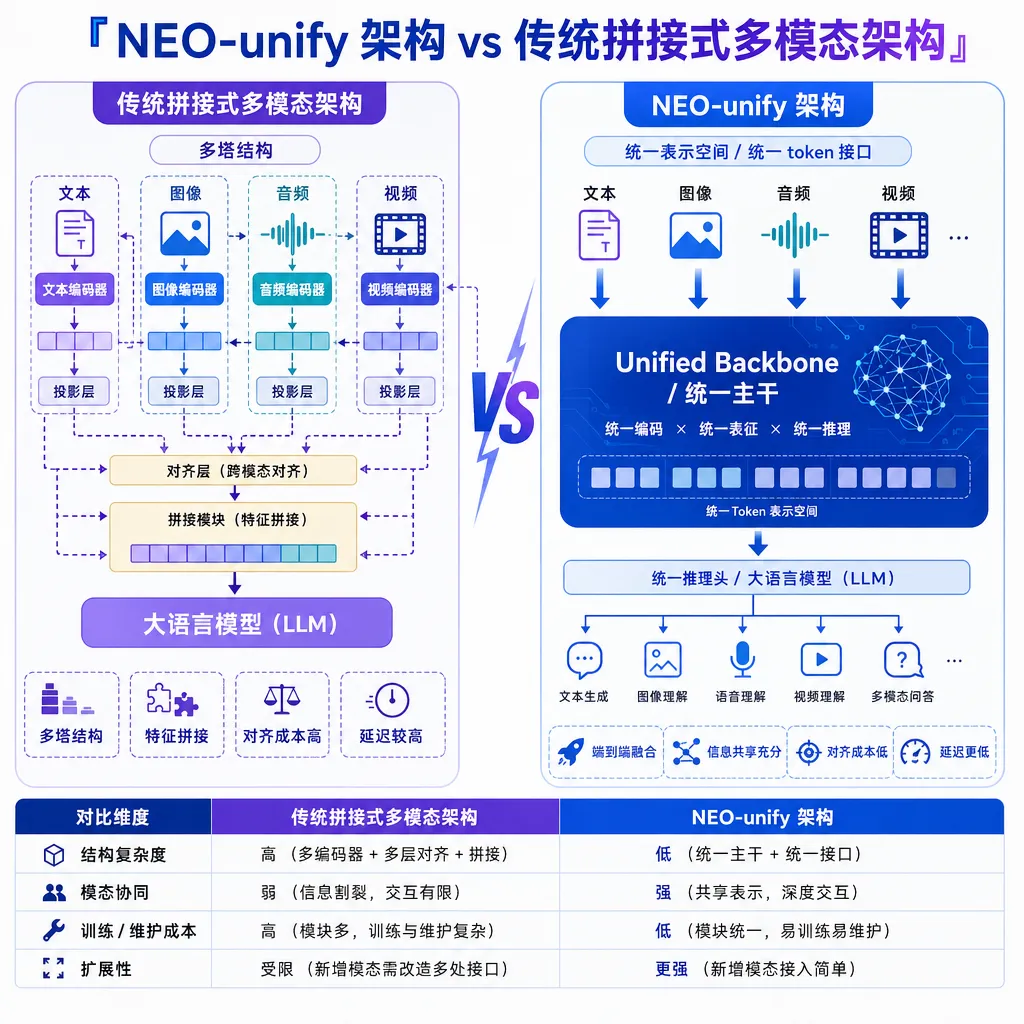
The reason this is noteworthy is simple: most current multimodal models are essentially based on "translation"—images are first encoded into features by a vision encoder, then fed through an adapter into a language model; when generating images, the process runs backward through a VAE decoder. Each cross-modal transfer loses information. Larger models can mask this loss, but at the cost of much greater computational demand. SenseTime’s approach this time is: don’t translate at all.
NEO-unify Architecture: What Exactly Changed
The key to understanding SenseNova U1 lies in its underlying NEO-unify architecture, a proprietary framework SenseTime developed in March this year.
Traditional multimodal architectures consist of three parts: a vision encoder (VE) that compresses images into feature vectors, a language model that handles understanding and reasoning, and a variational autoencoder (VAE) that reconstructs features into pixels. These components communicate via bridging adapters. It’s like an international meeting—some speak English, others spoke Chinese, and there’s a translator in between. Communication works, but efficiency suffers.
NEO-unify removes both the VE and VAE. There’s no separate vision encoder or image decoder. Language tokens and visual tokens are modeled directly in the same representation space. Each layer of the Transformer processes text and image information simultaneously—there’s no serial flow of “read text first” or “see image first then translate to text.”
In technical terms: it builds a unified representation space where language and vision signals are isomorphic, and the model treats them essentially the same. This is not wrapping an LLM with a visual shell—it’s a model that “thinks” about text and images simultaneously from the first to the final layer.
This brings several direct benefits:
- Less information loss: with no cross-modal translation steps, semantic meaning isn’t compressed or distorted in transfer
- Higher parameter efficiency: no need to pile on parameters to make up for cross-modal loss
- Faster inference: removing encoding-decoding steps reduces end-to-end latency
What’s Been Open-Sourced: Two Lightweight Models
The open-sourced models are from the SenseNova U1 Lite series, including two variants:
| Model | Backbone | Features | |--------|-----------|-----------| | SenseNova-U1-8B-MoT | Dense network | Fully activated parameters; 8B scale | | SenseNova-U1-A3B-MoT | MoE (Mixture of Experts) | ~3B active parameters; larger total size but lighter inference |
Both models are open-sourced on GitHub and Hugging Face, with weights and code available. SenseTime stated that a detailed technical report will follow, as well as larger U1-series models.
A notable detail: the name “MoT” (Mixture of Tokens) suggests token-level mixing rather than traditional expert-level routing as in classical MoE. Combined with the unified representation design, this implies that visual and text tokens may share the same expert-routing mechanism instead of using separate paths. Technical confirmation will come from the forthcoming report.
Benchmarks: The 8B Model Outperforms Some Closed-Source Giants
SenseTime’s benchmark results cover image understanding, image generation and editing, spatial intelligence, and visual reasoning. The conclusion: U1 Lite achieves overall SOTA among open-source peers, and the “small” 8B-MoT model matches or even surpasses certain large commercial closed-source models on some tasks.
Highlights from the comparisons:
- Image generation quality: In general generation tests, U1 Lite matches closed-source models like Qwen-Image 2.0 Pro and Seedream 4.5, while offering faster inference
- Complex infographic generation: A long-standing weakness for open-source models—creating images with lots of text, tables, or charts often leads to garbled text or broken layouts. U1 Lite achieves commercial-level performance on infographic benchmarks like BizGenEval and IGenBench
- Spatial intelligence & visual reasoning: The model comprehends complex spatial relationships in the physical world—crucial for embodied intelligence applications
Of course, benchmarks are just numbers; real-world experience still needs community validation. Nonetheless, data shows a clear advantage in parameter efficiency: achieving better results with fewer parameters—a core value proposition of the NEO-unify architecture.
Continuous Image-Text Creation: More Than Just Generating a Single Image
Beyond single-step understanding and generation, SenseNova U1 demonstrates an interesting extra ability: continuous image-text creative generation.
What does that mean? In traditional multimodal creation, the workflow goes like this: a language model generates text, that text is sent to an image generator, and for multiple images, prompt engineering is needed to manually maintain style consistency. It’s essentially a chain of models—inefficient and prone to visual drift between images.
SenseNova U1 handles the entire process in a single call with a single model. Because text and images are modeled within the same context window, previously generated visual data naturally remains in context, letting subsequent generations “see” earlier results. It’s like a painter continuously working on the same canvas instead of switching artists at each stroke.
SenseTime showcased two examples:
Example 1: How to Cook Medium Steak. The model first plans the steps, then generates images for each. Crucially, all step illustrations stay stylistically consistent—same kitchen, same steak look, same lighting style—no abrupt shift from realism to cartoon midway.
Example 2: Iron Man Pattern Drawing. Starting from a scanned sketch, the model refines it step by step, eventually producing a polished final result. Structure and details remain precise across iterations—lines, proportions, and colors evolve smoothly.
This ability changes AI-assisted creation from "stitching multiple tools" to "a single model’s coherent thought." For workflows needing many stylistically consistent visual-text outputs—like manuals, tutorials, or marketing materials—it’s a major efficiency boost.
Technical Assessment: Is Unified Architecture the Right Direction?
Frankly, the “unified multimodal architecture” direction is not unique to SenseTime. Google’s Gemini emphasized native multimodality from the outset; Meta’s team is pursuing similar ideas. However, in open source, most multimodal models—including the LLaVA series, Qwen-VL, and InternVL—still follow the stitched approach.
The stitched design’s appeal lies in its simplicity: plug a vision encoder into a pre-trained LLM and add an adapter—done. But it has a clear ceiling: limited fusion depth between modalities, unavoidable information loss, and separate modules for understanding vs. generation.
Unified architecture training is much harder. When language and vision share one representation space, balancing dataset ratios, designing loss functions, and tuning learning rates across modalities become far more complex. This explains why most teams have taken the safer stitched route so far.
SenseTime’s results show that unified architecture indeed delivers real parameter-efficiency gains. An 8B model performing on par with some closed-source giants isn’t just from more data or longer training—it’s intrinsic architecture efficiency. If this is reproducible by the community, it could significantly influence the trajectory of multimodal model development.
That said, limitations remain: only Lite versions are released so far. Whether larger-scale U1 models retain these gains remains unknown. Also, the technical report hasn’t been published yet; details on training strategy, data ratios, and tokenization are unclear. Broader adoption will need more transparency.
What This Means for Developers
If you’re working on multimodal applications, SenseNova U1 offers several points of interest:
1. Lower deployment cost. With 8B and 3B-active-parameter variants, single-GPU deployment is feasible—no multi-GPU setup required. That’s a practical advantage for smaller teams.
2. Consistent text-image generation. For multi-image scenarios requiring consistent styles (tutorials, product shots, marketing assets), U1’s continuous creation may outperform “LLM + image generator” pipelines.
3. Complex infographic generation. Long a tough problem—having AI produce infographics with accurate text and rational layout. If U1 performs as benchmarks suggest, it could directly benefit many B2B applications.
4. Potential for embodied intelligence. SenseTime notes that U1 could serve as a “cognitive brain” for robots—performing perception, reasoning, and execution loops inside a single model. Though early, unified architectures are naturally better suited for such tightly coupled visual-action reasoning.
To try it yourself, code and weights are available here:
- GitHub:
https://github.com/OpenSenseNova/SenseNova-U1 - Hugging Face:
https://huggingface.co/collections/sensenova/sensenova-u1
SenseTime has also released a SenseNova Skills toolkit—including prompt templates and samples for infographic generation—to help users get started quickly.
Competitive Landscape: A New Variable in Open Multimodality
Placed within the current open-source multimodal ecosystem:
- Qwen-VL series (Alibaba): a leading open multimodal reference, but still stitched
- InternVL series (Shanghai AI Lab): also stitched, strong on understanding tasks
- DeepSeek-VL (DeepSeek): MoE design emphasizing efficiency, but again stitched
- Janus series (DeepSeek): attempts unifying understanding and generation, but still retains separate vision encoding paths
SenseNova U1 is one of the most thorough attempts at native unification in the open-source community today. Rather than incremental tweaking, it proposes a new paradigm. This “build from scratch” approach carries higher risk—but potentially higher reward if successful.
For SenseTime itself, this open release is a strategic move. Though not a first-tier player in foundation models, the company has deep expertise in vision and multimodality. By fully open-sourcing along a distinctive unified-architecture direction, it builds technical branding and leverages community iteration power.
In Closing
Multimodal models are shifting from “stitched” to “unified.” The transition won’t happen overnight—stitched architectures still offer engineering maturity and ecosystem support. But SenseNova U1’s open release proves unified design can work efficiently and effectively.
For developers, this adds a new option worth serious consideration. Wait for the technical report, then test against your own tasks. Good benchmark scores are one thing; real usability is another.
SenseTime plans to continue scaling up, releasing larger U1 models. If those retain parameter-efficiency advantages, the unified-architecture story will become even more convincing. We’ll be watching closely.
References
- Fully Open-Sourced! SenseTime SenseNova U1 Released, Ushering in a Unified Understanding–Generation Era – Linux.do — Community discussion thread with full release info
- SenseNova-U1 GitHub Repository — Code and weights
- SenseNova U1 Hugging Face Collection — Model pages on Hugging Face


