
Ernie Bot 5.1 Preview Quietly Launches—What Is Baidu Up To?

The preview version of Baidu Ernie Bot 5.1 recently appeared on the LMSYS Chatbot Arena leaderboard, and the official website has simultaneously launched a related entry point, suggesting that a public beta may be imminent. According to the arena rankings, it is currently ranked 13th—its performance is decent but not particularly surprising.
Wenxin Yiyan 5.1 Preview Quietly Appears — What Is Baidu Up To?
The preview version of Wenxin Yiyan 5.1 has appeared on the LMSYS Chatbot Arena, currently ranking 13th. At the same time, Baidu quietly added a related page entry on its official website.
No press conference, no PPT from Robin Li, not even an official blog post — Baidu has chosen an extremely low‑key way to test the waters with its next‑generation model.
This move itself isn’t huge, but the signal is clear: Wenxin 5.1 is not far from official release.
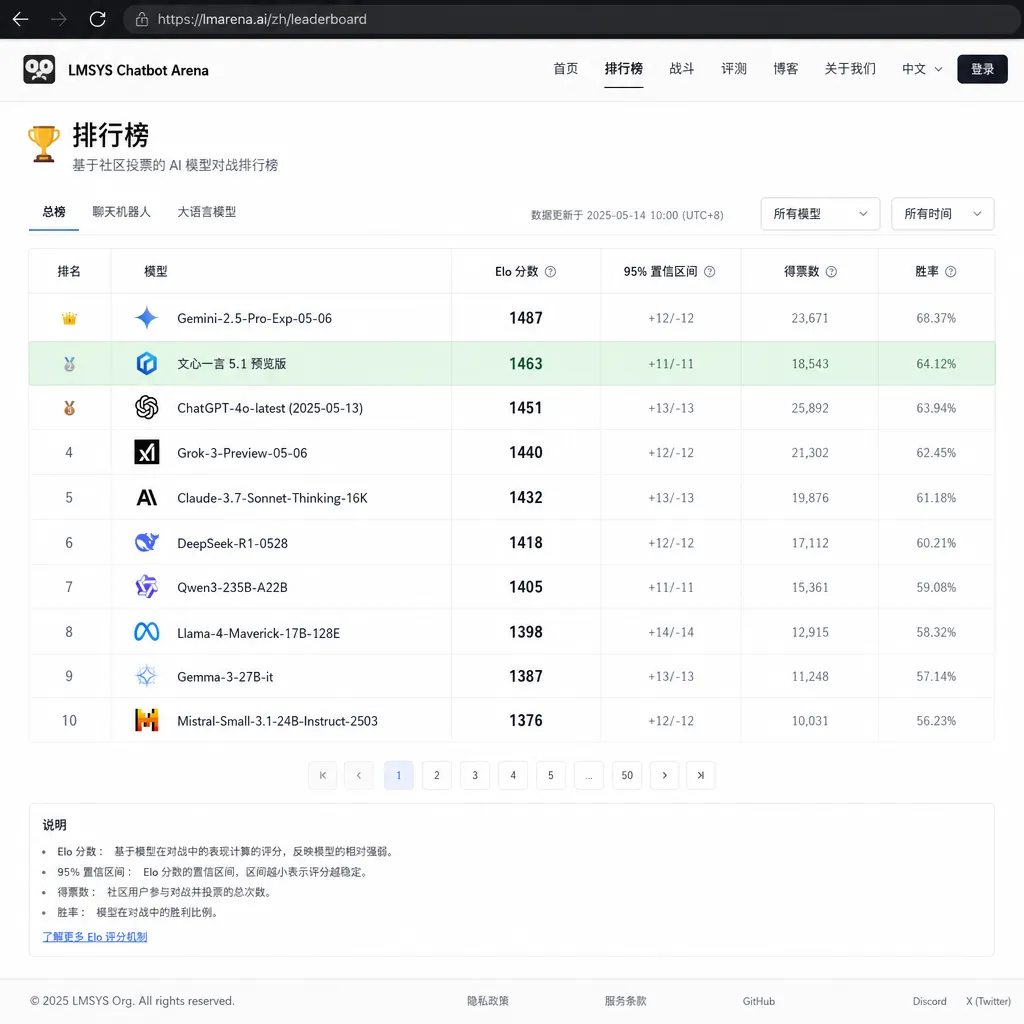
Ranked 13th — what does that mean?
First, some context: LMSYS Chatbot Arena is widely regarded as the most credible blind‑test leaderboard in the AI model industry.
Users vote between two anonymous models based on response quality; rankings are driven entirely by real user preference, not benchmark scores.
Wenxin Yiyan 5.1 Preview currently sits at 13th.
How should we view that?
On the bright side — comfortably in the lower edge of the first tier;
On the less flattering side — given the current competitive intensity, 13th isn’t an exciting spot.
Ahead of it are familiar names like GPT‑4o, Claude 3.5 Sonnet, and the Gemini family, as well as rising stars such as Grok and DeepSeek.
However, one crucial piece of information is missing: we don’t know the model scale of this preview version.
That matters. If the 5.1 Preview is a relatively lightweight version — say, comparable to GPT‑4o‑mini or Claude 3.5 Haiku — then 13th place is actually solid, indicating Baidu found a good balance between performance and efficiency.
But if this is Baidu’s fully loaded flagship model, then the ranking is a bit awkward.
Judging by the word “Preview”, it’s probably not the final form. Baidu is likely still fine‑tuning it — this Arena appearance seems more like a test run than a formal debut.
From 5.0 to 5.1: Baidu’s iteration tempo
Let’s revisit the timeline.
The official release of Wenxin 5.0 earlier this year claimed 2.4 trillion parameters, opened API access via Baidu’s Qianfan platform, and was integrated into Baidu’s own products such as Wenxin Yiyan, Huiboxing, and Wenxin Assistant.
That launch made quite a splash — Baidu emphasized parameter size heavily.
But by 2026, parameter count no longer impresses.
Over the past year, industry focus shifted from “whose model is bigger” to “whose model is smarter, more efficient, and cheaper.”
DeepSeek demonstrated astonishing cost‑performance with a streamlined architecture; Google’s Gemini 4 series proved small open‑source models can rival big ones on reasoning tasks; OpenAI’s o‑series made “thinking” itself a product feature.
Against this backdrop, a minor parameter tweak from 5.0 to 5.1 wouldn’t mean much.
The market now wants to see: how far has Baidu advanced in reasoning, multimodal understanding, long‑context processing, and—most importantly—Chinese language optimization?
A version jump from 5.0 to 5.1 usually signals no architectural overhaul, just improvements in training data, alignment strategy, and inference efficiency — much like OpenAI’s upgrade from GPT‑4 to GPT‑4 Turbo. It’s a polish, not a generation leap.
Why did Baidu choose a “silent launch”?
The way Wenxin 5.1 Preview debuted is interesting: appear on a third‑party leaderboard, quietly add an official entry, but no publicity.
Community reactions were equally muted. On the Linux.do forum, a developer posted about the discovery, but discussion was tepid — someone even attached a “nobody cares.jpg” meme.
Seven posts, seven participants — that says something.
There are several plausible reasons for Baidu’s low‑profile approach:
1. The preview just isn’t ready for large‑scale exposure.
Arena rankings fluctuate with more votes; if Baidu went public too early and rankings dropped, PR pressure would be high. Testing quietly first is safer.
2. Baidu is waiting for a better launch window.
The AI news cycle is crowded — Google just released Gemma 4, and everyone’s pushing updates. Launching now could get lost in the noise. Better to wait for a quieter moment.
3. The most practical reason: Baidu wants real‑world user feedback first.
Arena’s blind testing is a highly credible proving ground — more reliable than internal evals. Gathering authentic data before final tuning is technically sound.
The Arena dilemma for Chinese models
Zooming out, Wenxin 5.1’s Arena performance reflects a broader issue:
Chinese‑centric models are disadvantaged within English‑dominant evaluation systems.
LMSYS users and tasks are mostly English‑focused. For a model deeply optimized for Chinese scenarios, Arena rankings can’t fully represent true capability.
That’s not just an excuse — DeepSeek excels under the same system, showing that “Chinese models struggle in English evaluations” explains only part of the gap.
Still, it raises a meaningful question: Do we need a credible evaluation platform focused on Chinese performance?
China does have leaderboards like SuperCLUE and C‑Eval, but none match LMSYS in influence — mainly because LMSYS is transparent and enjoys massive user participation, while domestic evaluations often lack scale or transparency.
This is a systemic gap the Chinese AI ecosystem needs to fill.
What this means for developers
If you’re a developer choosing models, Wenxin 5.1 Preview implies several things:
Short term: wait and watch
A preview ≠ official release. Until Baidu opens API access, don’t base business decisions on this version’s performance. Rankings shift; the model will change.
Mid term: monitor Qianfan platform updates
Going by 5.0’s release path, 5.1 will likely launch first on Qianfan. If your app already uses Qianfan, watch for announcements to secure early access.
Long term: multi‑model strategy is the right move
In 2026’s AI landscape, no single model is universally best.
GPT still dominates general ability; Claude excels in long‑text and coding; DeepSeek wins on cost‑performance; Wenxin’s moat is Chinese language depth and Baidu ecosystem integration.
A practical approach is multi‑model orchestration — routing tasks to whichever model fits best.
That’s why aggregator platforms like OpenAI Hub are gaining traction — one unified interface for all major models, making switching effortless.
Once Wenxin 5.1’s API opens, such platforms will likely integrate it quickly.
Baidu’s real AI challenge isn’t technology
Frankly speaking: Baidu’s tech is solid — its problem has never been technical.
From 1.0 to 5.1, Wenxin has iterated fast with serious investment and strong Chinese NLP expertise.
But Baidu still lacks a killer app — something indispensable to both everyday users and developers.
Compare:
- OpenAI has ChatGPT — hundreds of millions of MAU and a thriving developer ecosystem around GPT APIs
- Anthropic has Claude — loved by enterprises and devs, especially for coding and long‑text tasks
- Google has Gemini — tightly integrated into Search, Gmail, and Docs for billions of users
- DeepSeek, even without a consumer hit, built strong brand recognition among developers through open‑source and unbeatable pricing
Baidu? Wenxin Yiyan’s consumer visibility is limited, and Qianfan’s developer adoption lags expectations.
Model capability is infrastructure — but you need compelling products and ecosystems on top of that.
Can Wenxin 5.1 change the situation?
Frankly, model upgrades alone won’t. Baidu must compete at the product‑experience, developer‑tooling, and pricing levels.
A noteworthy detail
Here’s something easily overlooked:
By putting Wenxin 5.1 Preview on LMSYS Arena, Baidu made a bold move.
Few Chinese model makers dare to compete on this global stage — it requires confidence and courage.
In the past, Chinese models preferred “home turf” — domestic leaderboards, internal events, partner showcases.
Submitting to LMSYS’s open blind‑test shows Baidu has genuine faith in its progress.
Of course, a 13th‑place rank means there’s still work to do — but at least the direction is right.
In this marathon of model development, being willing to face transparent, public evaluation is way better than staying inside your own echo chamber.
What to watch next
A few milestones worth monitoring:
- Arena ranking trend — does Wenxin 5.1 climb or fall as more votes come in?
- Official announcement — when Baidu publishes technical details (like model scale, architecture, training data) via blog or event
- Qianfan API access — the real milestone for developers, enabling hands‑on testing
- Pricing strategy — with DeepSeek pushing API costs to the floor, 5.1’s price will directly impact competitiveness
Baidu’s investment in AI is undeniable, but between investment and success stands a wall of product quality, ecosystem maturity, and market perception.
Wenxin 5.1 is a new starting point, but far from the finish line.
Let’s wait for the official version before making the final judgment.
References
- Wenxin Yiyan 5.1 Preview Appears on LMSYS Arena – Linux.do (Forum post by community developers discovering Wenxin 5.1 on LMSYS)
- 2.4 Trillion Parameters! Baidu Releases Wenxin LLM 5.0 Official Version – Zhihu (Details on Wenxin LLM 5.0 and Qianfan API availability)


