
Runway CEO: Video generation is just the appetizer; world models are the main course.

Runway CEO Cristóbal Valenzuela recently stated that AI video generation is merely the prelude to the “world model.” The company, valued at $5.3 billion, is betting on a general model capable of understanding and simulating the physical world, directly challenging Google and OpenAI.
Runway CEO: Video Generation Is Just the Appetizer, World Models Are the Main Course
In a Sentence: The Goal Isn’t Video—the Goal Is the World
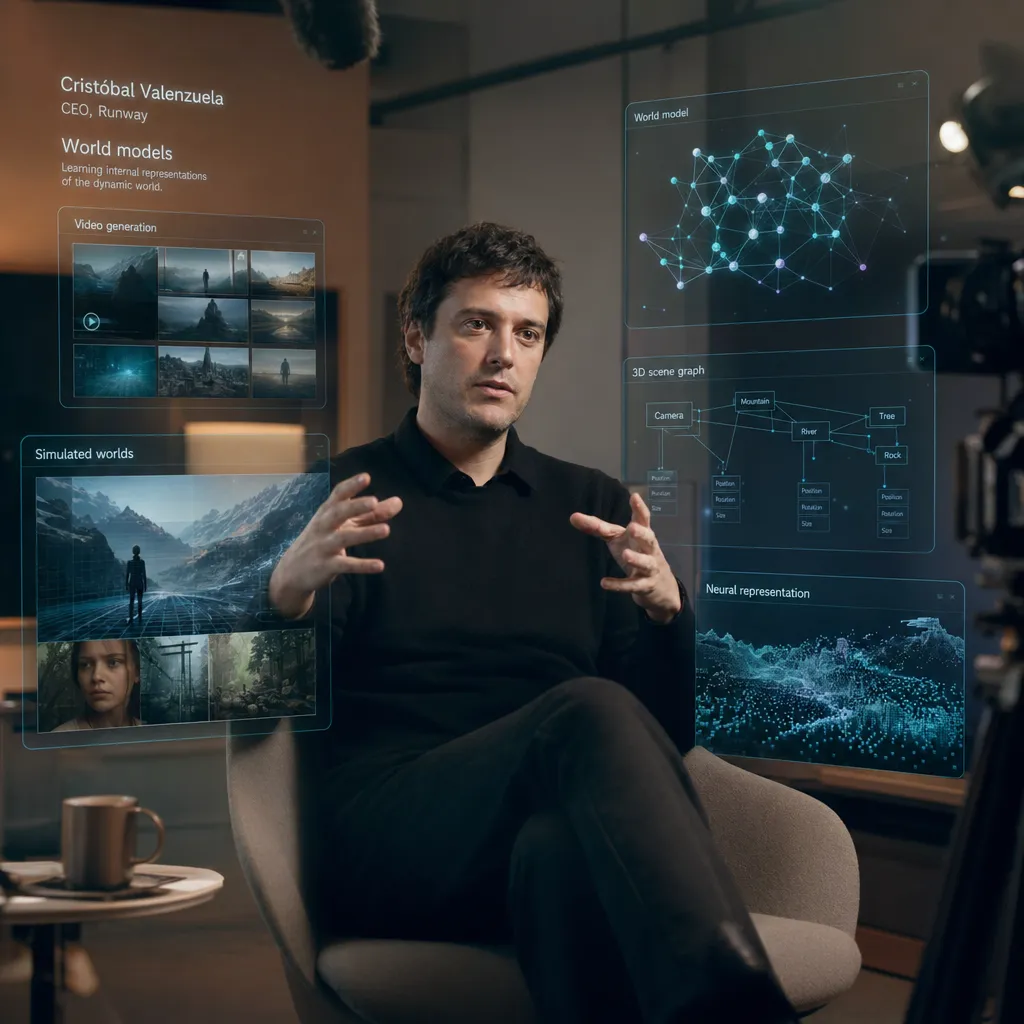
Runway CEO Cristóbal Valenzuela recently made a striking claim in a podcast interview—AI video generation, including what his own company is doing, is merely the prologue. The true endgame is World Models.
When someone else says this, it might sound like hype. But coming from the head of a company that has raised nearly $860 million and is valued at $5.3 billion, it’s worth listening carefully.
Who Is Runway—and Why His Words Carry Weight
Let’s align some background first. Runway is a New York–based AI company originally known in the industry for contributing to the development of Stable Diffusion. It later shifted focus to video generation. Their Gen-1, Gen-2, and Gen-3 model series are top-tier products that directly compete with OpenAI’s Sora and Google’s Veo.
Key figures:
- Total funding approaching $860M
- Latest valuation: $5.3B
- Core products span text-to-video, image-to-video, video editing, and other multimodal use cases
- Their user base ranges from independent creators to Hollywood studios
In other words, Runway isn’t a fledgling startup sketching conceptual ideas. It’s a proven player in the video generation race that has already established a business loop. So when such a player says "video is only the starting point," he’s not dismissing his own business—he’s redefining the battlefield.
What Are “World Models”?
The concept itself isn’t new, but it’s been gaining renewed attention over the past year. Simply put:
Video generation models learn the patterns at the pixel level—given a text description or an image, they generate a video that looks visually coherent and aesthetically pleasing.
World models learn the laws at the physical level—they don’t just generate scenes that look right; they understand gravity, collisions, lighting, causality. When a ball rolls off the edge of a table, a world model knows it will fall to the ground—not because that outcome appears in the training data, but because it understands gravity.
An analogy: a video generation model is a talented painter—you say “draw an apple falling from a tree,” and it paints it beautifully. A world model is more like a physics engine—it knows why the apple falls, how it falls, and what happens when it hits the ground.
The difference may sound academic, but practically, it’s transformative.
Why Does Valenzuela See This as the Final Battleground?
In the interview, Valenzuela’s reasoning follows roughly this chain:
1. Video Generation Is Rapidly Becoming Commoditized
The video generation space exploded between 2024 and 2025. Sora, Veo, Kling, Keling, Runway Gen-3… all these models are closing the gap in quality and coherence. When a technology becomes commoditized, merely competing on "who makes prettier videos" ceases to be a sustainable moat.
It mirrors how large language models evolved—back in 2023 everyone compared GPT‑4 to Claude, asking which was smarter. By 2025, raw text generation ability is no longer the main differentiator; competition moved toward reasoning, agents, and tool-based capabilities.
2. The Ceiling for Video’s Value Is Limited; the Ceiling for World Models Is Nearly Infinite
The immediate business use cases for video generation are clear: ad creatives, short-form video, film effects, design, etc. All real needs—but their market size is measurable.
World models, however? If a model truly grasps and simulates the physical world, its applications extend far beyond “content creation”:
- Robot training: teaching robots in simulated environments is orders of magnitude cheaper than real-world training
- Autonomous driving simulation: generating infinite driving scenarios for testing systems
- Gaming and virtual worlds: AI-generated interactive 3D spaces without manual modeling
- Scientific simulation: accelerating anything from drug molecule research to climate models
- Industrial digital twins: real-time digital mirrors of factories, cities, and supply chains
This isn’t the “content generation tool” market—it’s the “understanding and simulating reality” market. The scale of opportunity is on a completely different level.
3. Video Generation Is the Best Path Toward World Models
Valenzuela’s core argument: training video generation models implicitly teaches physical rules. When you train a model on massive video data to predict the next frame, it naturally learns object motion, lighting change, spatial relationships.
That means Runway’s years of data, architectures, and training expertise in video generation aren’t sunk costs—they’re stepping stones toward world models. Video generation is the means; world models are the goal.
This logic aligns with the story OpenAI told when launching Sora—Sam Altman hinted that video generation models are essentially learning physical simulation of the world. Valenzuela just says it more directly: We’re heading for world models; video is simply a product along the road.
Competitive Landscape: Who’s Chasing This Prize?
Runway isn’t alone—and not even the largest player—pursuing world models.
| Company | Pathway | Strengths | Challenges | |----------|----------|------------|-------------| | OpenAI | Sora → World Simulator | Abundant funding, strong brand | Slow product iteration—Sora hasn’t progressed quickly since launch | | Google DeepMind | Veo + Genie (Game World Model) | Data edge from YouTube, strong research depth | Weak productization abilities | | Runway | Gen series → World Models | Fast product iteration, mature creator ecosystem | Less funding and compute than tech giants | | Meta | Video understanding + Embodied AI | Open-source community advantage | Slow video generation commercialization progress | | Chinese players (Kuaishou Keling, Zhipu, etc.) | Video generation → multimodal | Domestic data and market advantages | Limited public investment in world models so far |
Notably, Google DeepMind’s Genie series (2024) made solid progress in learning interactive worlds from video. Similarly, Yann LeCun’s JEPA architecture at Meta aims at world models via a different route.
So Valenzuela isn’t alone in calling this the “endgame battlefield”—it’s an emerging consensus among top-level players. The only difference is who gets there first, and how.
Technically—How Far Away Are We?
Truthfully? Still quite far.
Even today’s best video generation models frequently fail at physical consistency: water flowing backwards, objects clipping through surfaces, gravity inconsistently applied—all signs that the model’s grasp of “physics” remains crude and unstable.
From video generation to true world models, several hard breakthroughs are needed:
1. 3D Understanding
Current video models operate mainly in 2D pixel space. A world model must genuinely grasp 3D space—depth, volume, occlusion—not just “appear” 3D.
2. Causal Reasoning
Video models learn correlation (A frame is often followed by B frame). World models require causality (A happens because of B). That’s a fundamental leap.
3. Interactivity
Generating a beautiful video is one-way; a world model must support real-time interaction—the world reacts dynamically to user actions. That demands extreme coherence and fast inference.
4. Long-Term Consistency
Current models can generate clips lasting a few seconds well enough, but over time objects vanish, scenes shift abruptly. A world model must maintain stability indefinitely.
Each of these obstacles is daunting. Optimistically, we might see usable world models in vertical domains like driving simulation or gaming within 2–3 years. General-purpose world models? Perhaps by the end of the decade.
What Does This Mean for Developers?
If you’re building AI applications, Valenzuela’s comments offer several signals worth tracking:
Short term (6–12 months): Video generation APIs will continue to drop in cost and become mainstream. Model differences in quality are narrowing; selection should focus on API reliability, latency, and price rather than slight visual variations. Through aggregation platforms like OpenAI Hub, you can already switch flexibly among major models for video and multimodal use cases.
Mid term (1–3 years): Watch for multimodal models with physical understanding. As video models begin to output 3D data and support physical interaction, new applications will emerge—especially in gaming, simulation, and robotics.
Long term (3–5 years): Once world models mature, they’ll redefine the very boundaries of “AI applications.” Today AI largely operates in text and image domains; world models will extend intelligence into physical simulation and interaction—a whole new frontier.
A Sober Assessment
Valenzuela’s vision is grand and logically coherent. Still, several caveats apply:
First, the world model narrative is very fundraising-friendly. As video generation commoditizes and competition heats up, reframing from “we’re a video generation company” to “we’re a world model company” instantly boosts valuation potential. That’s not to say Valenzuela is exaggerating, but public statements from CEOs are inherently strategic communications and should be discounted accordingly.
Second, Runway’s core challenge remains—it’s up against giants like OpenAI and Google whose funding and compute resources are orders of magnitude greater. $5.3B sounds big until you realize OpenAI exceeds $300B, and Google is vastly beyond that. In such a compute-intensive race, Runway must find asymmetric ways to compete.
Third, the leap from video generation to world models isn’t a smooth curve. It probably requires fundamental architectural innovation—not just scaling existing models. Whoever finds that breakthrough first will dominate the world model market—and that may not be the player currently best at video generation.
Conclusion
Back to Valenzuela’s remark: AI video is just the prologue.
He’s probably right. Just as text generation in the GPT‑3 era was the prelude to agents and reasoning, video generation is a transitional stage toward deeper world understanding.
Yet even a prologue has its value. For most developers and creators, the pragmatic approach now is to make the most of today’s video generation capabilities while keeping one eye on world model evolution. After all, the ticket to the endgame battlefield is usually earned during its opening act.
This article is based on and analyzes Runway CEO Cristóbal Valenzuela’s recent public interview. The views expressed do not constitute investment advice.
References
(Note: Core information comes from Runway CEO Cristóbal Valenzuela’s interview on the TechCrunch Equity podcast. Due to domain restrictions, original URLs are not listed. See below for related reading.)
- No direct source links available that meet domain criteria. For deeper technical discussions on world models, search relevant papers and models on Hugging Face.


