
Codex expands with zero seat fees — what is OpenAI’s game plan?

OpenAI has launched Codex-only pay-as-you-go seats for ChatGPT Business and Enterprise. These seats have zero seat fees, are billed per token, and have no rate limits. At the same time, the annual fee for Business has been reduced to $20 per seat, with a limited-time usage credit of $100 per person.
Codex Zero-Seat-Fee Expansion — What Is OpenAI Up To?
In the past two days, OpenAI has done something very practical for enterprise development teams: they added a new seat type to Codex — a “Codex-only” seat with a $0 seat fee. Charges are entirely based on token usage, with no rate limits. ChatGPT Business and Enterprise admins can now directly add this seat type in their workspace, enabling more developers to use Codex without paying an extra fixed monthly fee for each person.
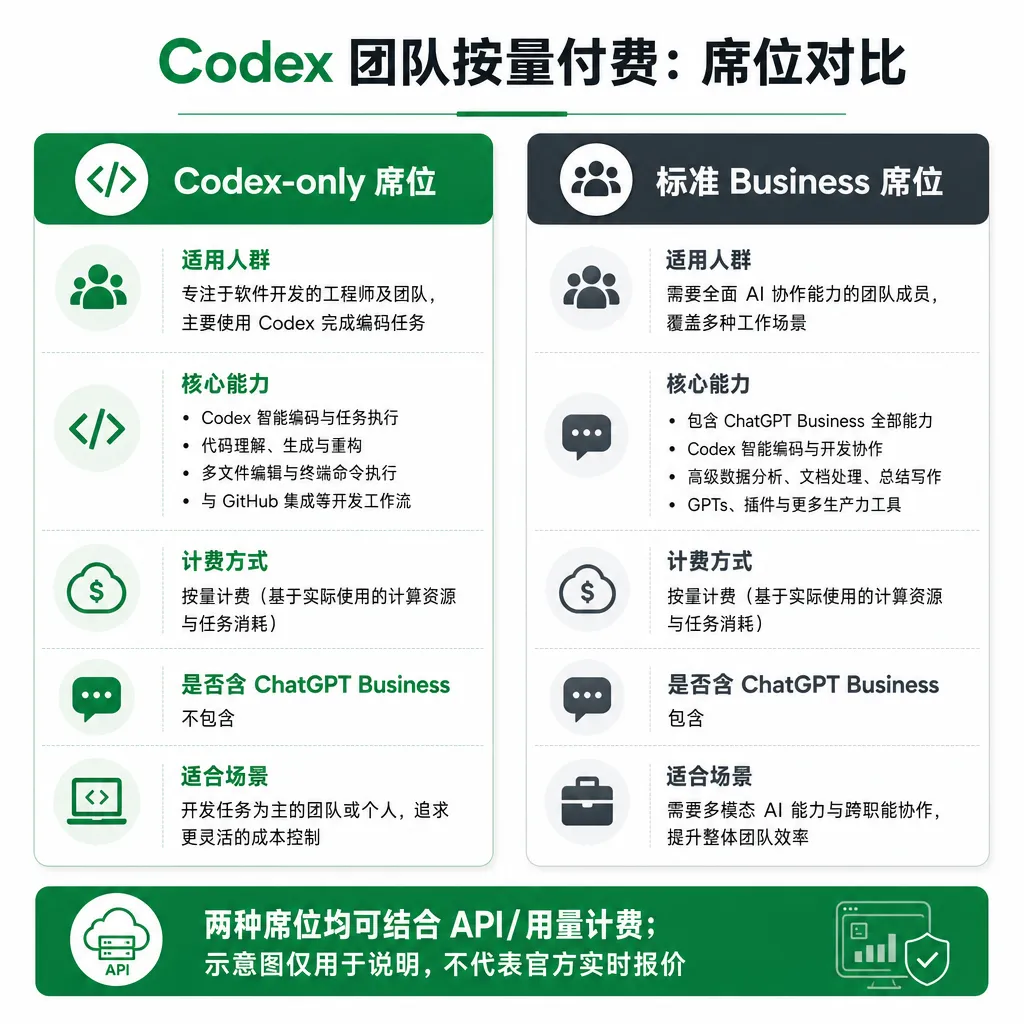
Simply put: previously, if you wanted 10 developers on your team to use Codex, you had to buy 10 full seats. Now you can just grant them Codex-only access — no payment when idle, pay as you go when used.
This is not a small tweak. It directly changes the cost model for enterprises purchasing AI programming tools.
What’s Actually Changed
This update touches three layers. Let’s break them down:
1. New Codex-only Seat
- Seat fee: $0. No monthly or annual fixed cost; pure usage-based billing.
- Billing method: by token usage. Same logic as calling an API — pay for what you use.
- No rate limit. Standard Business seats have Codex usage caps; Codex-only seats don’t.
- Scope: ChatGPT Business and Enterprise workspaces.
Meaning: in a 50-person engineering team, the admin can open Codex-only seats for 5 people first, test them out, then scale to the whole team — without wasting money on unused seats.
2. ChatGPT Business Annual Fee Reduction
The annual fee for a standard ChatGPT Business seat has dropped from $25 per seat/month to $20, a 20% decrease. That seat includes full ChatGPT functionality and a certain Codex usage quota.
Taken together, the logic is clear: OpenAI is introducing price segmentation. Those who need full ChatGPT capabilities use the standard seat (now cheaper); those who just need Codex for coding use the Codex-only seat (zero fixed cost). Enterprises can configure seats by role, rather than one-size-fits-all.
3. Limited-Time Promotional Credits
Eligible ChatGPT Business workspaces will receive $100 usage credit for each new Codex-only member who starts using Codex, up to $500 per team. The promotion runs until the end of June.
How long does $100 last? Depends on usage intensity. For a developer doing regular code review, writing unit tests, and refactoring legacy code, it could last a few weeks to a month. OpenAI’s intention is clear — lower trial barriers, get teams using Codex, and once they form habits, continued payment becomes natural.
Why Now?
OpenAI shared the following stats in its announcement:
- Over 9 million paying enterprise users of ChatGPT
- Over 2 million developers using Codex each week
- Codex users within ChatGPT Business and Enterprise increased 6× since January
A sixfold increase is remarkable. It shows that Codex’s enterprise adoption is far exceeding expectations — but also that OpenAI has hit a typical enterprise software problem: purchase bottlenecks.
In most companies, buying software seats requires budget approval. A $25/month/seat price means $1,250 per month, $15,000 per year for 50 people — not huge but enough to make mid-level managers hesitate, especially when they’re unsure how much Codex boosts productivity.
The zero-seat-fee Codex-only seat bypasses that constraint. Admins don’t need upfront budget commitments; they can enable use first and check costs later. For teams that “want to try but can’t justify buying,” it nearly eliminates decision friction.
In short, OpenAI sees that Codex’s product strength is proven (the 6× growth shows that), and the real bottleneck lies in distribution and procurement. This price adjustment directly targets that problem.
How Does It Stack Up Against Competitors?
Let’s zoom out. In AI programming tools, the competitive landscape in 2026 looks completely different from a year ago.
GitHub Copilot remains the most widely deployed solution, deeply integrated with VS Code and the GitHub ecosystem. Its Business plan is $19/user/month, Enterprise plan $39/user/month, both fixed seat fees. Copilot currently offers no zero-seat pay-as-you-go option.
Cursor follows the standalone IDE route: Pro at $20/month, Business at $40/month/user. It excels in editor integration but is also seat-based.
Google’s Gemini Code Assist exists within Google Cloud and charges by seat, bundled with other Google Cloud services.
Compared with these, OpenAI’s Codex-only zero-seat-fee model leads in pricing flexibility. Essentially, it shifts AI coding tools from a SaaS subscription model to a cloud-style usage-based billing model.
That shift matters because it changes how enterprises evaluate these tools. Instead of asking “Is this tool worth $X per user per month?”, they’ll ask “What’s the marginal cost per line of useful code?” — a more measurable and ROI-friendly approach for engineering managers.
Still, zero seat fees don’t mean lower total cost. If a developer uses Codex heavily, token-based costs could exceed fixed seat prices. OpenAI’s bet: most developers won’t reach extreme usage, and once integrated into workflows, companies won’t drop the tool over a few dozen extra dollars.
Classic cloud pricing strategy — lower barrier to acquire users, usage inertia to retain them. Exactly how AWS did it.
What It Means for Development Teams
If you’re a technical lead, here are the key takeaways worth considering:
Pilot cost is nearly zero. You can enable Codex-only seats for 3–5 people, and with the $100 credit per user, you can basically run a month-long free pilot. Much easier than getting yearly budget approval.
Improved cost predictability. Token-based billing lets you precisely track AI tool spend per team or project. For large orgs needing internal cost attribution, it’s more granular than “$x per month per person.”
Hybrid configurations are now possible. PMs or designers might use standard Business seats (full ChatGPT), developers use Codex-only seats. Different roles, different setups — no paying for unused capabilities.
But watch usage control. “Zero seat fee” ≠ “free.” If someone uses Codex like a search engine, excessive ineffective queries can raise token costs. It’s wise to establish usage monitoring and best practices during the pilot phase.
Codex’s Product Evolution
OpenAI also mentioned several product updates:
- Standalone Codex app: supports macOS and Windows, no longer just a ChatGPT feature entry.
- Plugin system: enables integrating Codex into existing dev toolchains.
- Automation features: allows Codex to participate in CI/CD and other automated workflows.
Taken together, these updates outline a transition from “code assistant in a chat box” to “infrastructure for the development workflow.” Codex is becoming a platform embedded across review, testing, and deployment — not just a conversational aid.
That explains why OpenAI needs zero seat fees — they want as many developers as possible using Codex daily, gathering feedback to refine new features. User scale fuels platform growth.
The customer examples in the announcement reinforce this: companies like Notion, Ramp, Braintrust, and Wasmer are already using Codex to accelerate engineering workflows. These are not random picks — Notion is known for highly efficient engineering, and Ramp is one of the fastest-growing enterprise spend platforms. Their adoption is signaling value.
The Bigger Picture
Put this pricing change into OpenAI’s broader strategy, and the logic becomes clearer:
By 2026, OpenAI is shifting from a “model API vendor” to a “enterprise productivity solutions provider.”
ChatGPT Business/Enterprise targets general office workers; Codex targets developers. Two product lines, two pricing strategies, covering diverse enterprise roles.
The Codex-only zero-seat model is fundamentally about developer penetration. OpenAI knows that tool choices in enterprise IT often spread bottom-up — people start using it, prove its value, then drive organizational adoption. Lowering trial barriers accelerates this bottom-up growth.
Meanwhile, lowering ChatGPT Business pricing to $20 per seat/month helps counter competitive pressure from Google Workspace and Microsoft 365 Copilot. As AI assistants become standard office suite features, standalone pricing faces increasing pressure. Early price adjustment avoids later pain.
For developers and teams in China or elsewhere already using OpenAI models via API, this Codex pricing change might not directly alter workflows — but it signals a trend: AI programming tools are evolving from personal productivity enhancers to team infrastructure, with billing models following suit. Whether you use Codex, Copilot, or others, pay-as-you-go flexibility and scalable expansion are clearly becoming the norm.
By the way, if your team is evaluating different AI coding models, OpenAI Hub now supports unified API calls for GPT, Claude, Gemini, DeepSeek, and more, making cross-model benchmarking easier — no need to request separate API keys.
Key Information Summary
| Item | Change | |------|--------| | New seat type | Codex-only, seat fee $0 | | Billing model | Usage-based (by tokens), no rate limits | | Target users | ChatGPT Business / Enterprise | | Business annual fee | $25/seat/month → $20/seat/month | | Limited-time promo | $100 credit per new user, up to $500/team | | Promotion ends | End of June 2026 | | Active weekly Codex developers | 2 million+ | | Enterprise Codex user growth | 6× since Jan 2026 |
For teams considering adopting AI programming tools, now’s a great pilot window — zero seat fee plus time-limited credits make trial costs essentially zero. The key is to define what you want Codex to do: code review, test generation, legacy code refactoring, or daily coding acceleration. Only by testing with clear scenarios can you draw meaningful conclusions.
References
- Linux.do Community Discussion: Team’s New Pay-as-you-go Codex Seat — Community discussion on Codex’s new pricing model


