
Apple LaDiR: Teaching Large Models to “Think in Multiple Threads”

Apple and UCSD jointly released the LaDiR framework, which integrates the parallel exploration capability of diffusion models into the LLM inference stage. This allows the model to follow multiple reasoning paths simultaneously and then select the optimal output, significantly surpassing existing methods in mathematical and code generation tasks.
Apple LaDiR: Teaching Large Models to "Think in Multiple Threads"
Apple released a paper today that’s worth reading carefully.
In collaboration with the University of California, San Diego (UCSD), Apple proposed a generalizable reasoning enhancement framework in their new paper “LaDiR: Latent Diffusion Enhances LLM Text Reasoning.” The core idea isn’t complicated: before providing a final answer, let the LLM explore multiple reasoning paths in parallel, and then output the optimal result in an autoregressive manner.
This is not a new model. It’s a framework that can be layered on top of existing models—it changes how the model thinks, not what it thinks with.
First, clarifying the problem
The reasoning style of current mainstream LLMs is essentially “single-threaded.”
Because autoregressive generation only works token by token, the model cannot correct itself if it strays early when solving complex math problems or multi-step reasoning tasks—it must continue down the path it already chose. It’s like being in a maze where you can only take one route, and you can’t turn back after a wrong turn.
Industry solutions do exist. Chain-of-Thought (CoT) prompts models to write out reasoning steps, Best-of-N sampling selects the best result from multiple generated outputs, and Tree-of-Thought explores a branching search process during reasoning. However, all these methods have a common limitation: they either diversify results only at the output stage (by generating multiple complete answers then selecting one), or they unfold reasoning serially, making computational cost grow exponentially with the number of branches.
In short, current methods are either not deep enough (diversity at the result level only) or not efficient enough (serial search is too slow).
LaDiR aims to solve this exact issue: can a model explore multiple reasoning paths in parallel during reasoning, while maintaining enough diversity among those paths?
The Core Design of LaDiR: Diffusion for Reasoning, Autoregression for Output
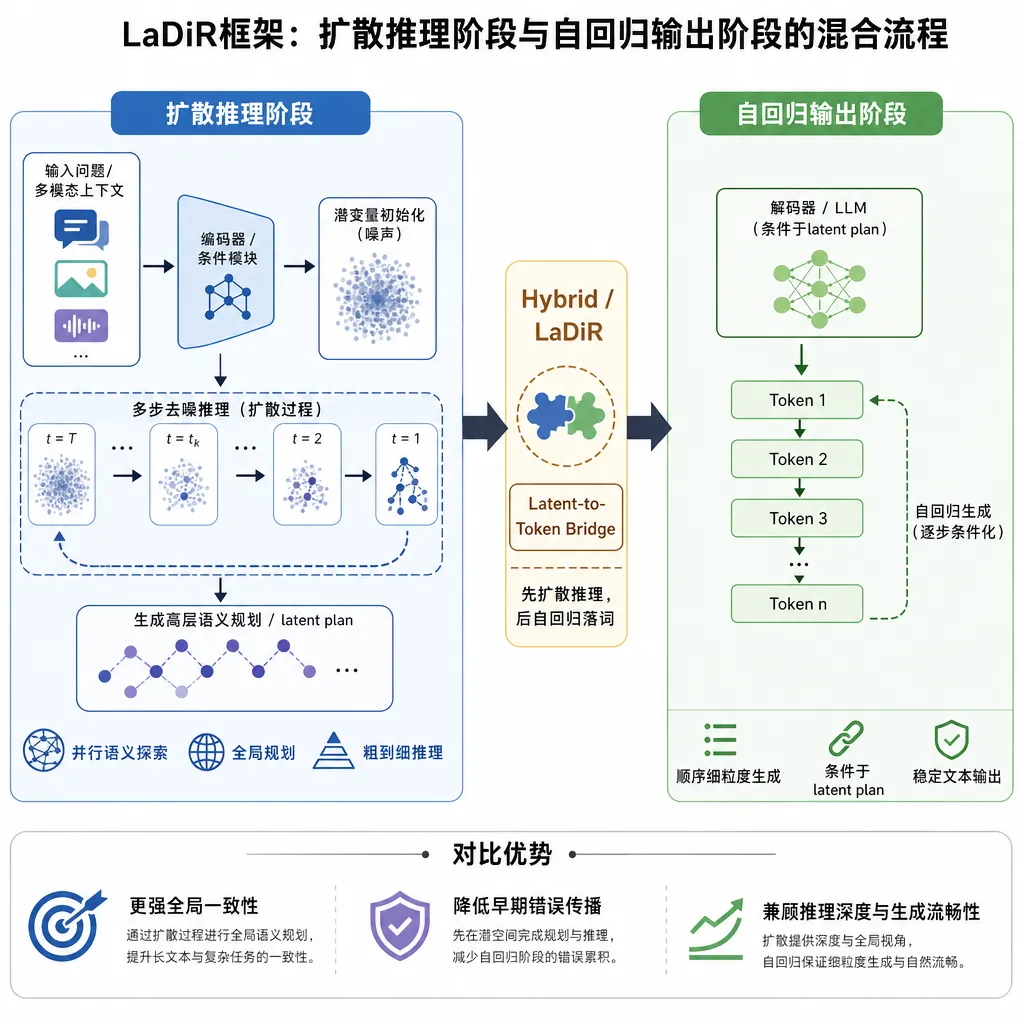
The design principle can be summarized in one sentence: use a diffusion-model-style process for the reasoning phase, and an autoregressive model for the output phase.
It’s a rather elegant combination.
Why use diffusion for reasoning?
Diffusion models have already proven their power in image generation. Their core strength lies in starting from random noise and iteratively denoising toward the target distribution. This process is naturally parallelizable—you can start from multiple noise seeds simultaneously and obtain different outputs.
Applying this idea to text reasoning: each reasoning path starts from a random noise vector, gradually denoising in latent space into a coherent reasoning chain. Multiple paths can proceed simultaneously, independent of each other.
This is far more efficient than autoregressive serial search. An autoregressive model must generate N sequences serially to explore N paths, while a diffusion model can handle them all in parallel.
Why still use autoregression for output?
Because autoregressive models still produce the most fluent, coherent text. Diffusion models excel at structuring reasoning in latent space, but converting those latent plans into high-quality natural language is still best handled by autoregressive decoders.
Put simply: the diffusion model “figures out the solution,” and the autoregressive model “writes out the solution.” Each does what it does best.
How does it work concretely?
LaDiR’s workflow includes several key steps:
- Encoding phase – map the input question into latent space.
- Diffusion reasoning phase – start multiple reasoning paths from random noise, iteratively denoising them into coherent reasoning plans.
- Diversity maintenance – use a repulsion mechanism to prevent all paths from converging on the same solution.
- Selection and decoding – pick the best reasoning path and feed it to an autoregressive decoder to produce the final textual output.
The third step is one of the most critical innovations of this framework and deserves a closer look.
Diversity Encouragement Mechanism: Preventing “All Roads Lead to the Same Answer”
Parallel reasoning sounds great, but if all paths converge to the same answer, then parallelization adds no value. It’s like having five people solve a problem but all using the same method—you haven’t expanded the search space.
LaDiR solves this using a repulsion mechanism. During the denoising process, the framework measures similarity between paths. When two paths come too close in latent space, a “repulsive force” pushes them apart.
The design takes inspiration from particle physics—like Coulomb forces that prevent same-charge particles from clustering. In LaDiR, this ensures that each reasoning path explores a distinct approach, leading to a truly diverse pool of candidate answers.
This is far more elegant than simple temperature sampling. Temperature sampling increases randomness, while LaDiR increases diversity: the former can make outputs nonsensical, the latter encourages systematic exploration of multiple reasonable possibilities.
Experimental Results: Performance on Math and Code Tasks
The team tested LaDiR on two base models—Meta’s LLaMA 3.1 8B and Alibaba’s Qwen3-8B-Base. They chose 8B-scale models to demonstrate that the framework is effective even at moderate sizes—no need for colossal models.
Mathematical Reasoning
On standard math benchmarks, LaDiR achieved higher accuracy than existing methods. More notably, it performed well on out-of-distribution (OOD) tasks—the hardest problems that were unseen during training.
This suggests the improvement isn’t just “score padding,” but a genuine reasoning ability gain. On in-distribution tasks, results may look similar, but for OOD problems, true reasoning strength makes the difference. Here, the advantage of parallel multi-path exploration becomes clearest: when problems are complex and the correct solution is elusive, parallel exploration naturally increases the chance of finding it.
Code Generation
On the HumanEval code benchmark, LaDiR produced more reliable code, especially for difficult problems, outperforming standard fine-tuning.
Code generation is a great testbed because correctness is objectively measurable—the code either passes tests or not. LaDiR’s success here indicates that parallel reasoning paths help models find more correct implementations.
Puzzle Planning
For puzzle-solving and planning tasks, LaDiR could explore a wider search space, yielding a higher probability of correct solutions than all general baseline models.
However, the paper honestly notes a limitation: LaDiR still underperforms specialized models in single-pass accuracy (pass@1). This is expected—general frameworks trade some task-specific optimization for broader adaptability. It’s the classic generality vs. specialization balance.
Technical Highlights Worth Noting
It’s a Framework, Not a Model
This point cannot be emphasized enough. LaDiR doesn’t require training a new model from scratch—it can be added on top of existing LLMs. That means:
- Existing model investments are preserved.
- As base models improve, LaDiR’s results should theoretically improve too.
- Deployment costs remain manageable—no need to replace the entire inference stack.
For teams already deploying LLMs in production, this “plug-and-play” characteristic is more appealing than introducing a new architecture entirely.
Latent-space Reasoning vs. Text-space Reasoning
Traditional CoT reasoning occurs in text space—each reasoning step is written in natural language. LaDiR operates in latent space, offering two main advantages:
- Higher efficiency – latent representations are more compact and computationally efficient.
- Higher flexibility – reasoning isn’t constrained by natural-language form, allowing more abstract relationships.
Of course, this also reduces interpretability—unlike CoT, you can’t literally “read the model’s thoughts.” It’s an important trade-off.
Considerations of Inference Cost
Parallel multi-path reasoning inevitably adds computational overhead. The paper doesn’t give detailed latency or cost numbers, but we can infer that more paths mean higher cost.
In practice, this means finding a balance between reasoning quality and cost. Simple problems might only need one path, while complex ones benefit from multiple. Dynamically adjusting the number of reasoning paths could be an important engineering challenge ahead.
Broader Context
Placing LaDiR in the broader landscape of AI reasoning research reveals several implications:
First, reasoning enhancement is becoming a new frontier. OpenAI’s “o” series, DeepSeek-R1, and Anthropic’s Claude—all point toward reasoning improvement beyond model-size scaling. LaDiR is Apple’s significant step in this direction.
Second, diffusion models are moving from vision to text. Over the past two years, diffusion has dominated image and video generation, but its role in text had been limited. LaDiR shows that diffusion’s core principle—iterative refinement from noise to structure—also adds value to text reasoning. This may inspire more NLP research grounded in diffusion ideas.
Third, Apple’s AI strategy is becoming clearer. Apple, often seen as a “latecomer” in large models, is carving its own path. From Apple Intelligence to LaDiR, their strategy focuses on reasoning efficiency and quality rather than building the largest models. This aligns with Apple’s long-standing “on-device first” approach—achieving big-model quality with smaller, efficient models makes on-device AI far more practical.
Fourth, hybrid architectures may be the future. Purely autoregressive or purely diffusion-based systems each have limits. LaDiR’s hybrid scheme points to a new paradigm—letting different generative approaches play to their strengths in different stages. This sort of “combinational innovation” could prove more fruitful than maximizing any single paradigm.
What It Means for Developers
If you build LLM applications, LaDiR is still research-stage for now, so it won’t affect workflows immediately. But several trends are worth watching:
- Inference-time compute is gaining importance. Evidence keeps growing that investing more compute at reasoning time beats simply scaling model parameters. LaDiR is another instance of this pattern.
- Multi-path reasoning may become standard. Future LLM APIs may expose parameters like “number of reasoning paths,” letting developers scale paths by task complexity.
- Framework-level innovation matters. Not all progress comes from bigger models. Frameworks like LaDiR may yield significant capability gains at far lower cost.
For developers tracking the frontier, once models integrated with LaDiR-style optimization launch, they can be quickly tested via aggregation platforms like OpenAI Hub—saving the hassle of separate integrations.
Limitations and Outlook
Objectively, LaDiR still faces open challenges:
- Single-pass accuracy gap: Its pass@1 remains below specialized models, showing room for improved one-shot correctness.
- Inference cost: Multi-path reasoning raises computational load, needing clearer quantification.
- Interpretability: Latent-space reasoning acts as more of a black box than text-space reasoning.
- Engineering hurdles: Significant practical work remains to bring this from paper to real-world deployment.
Still, the direction is right. Letting models “think through multiple routes before answering” is an intuitively sound idea—now with a concrete, systematic method. The next question is how far Apple and the broader research community can take it.
References
- Apple Releases AI Framework LaDiR: Breaking Single-Track Thinking via Parallel Multi-Path Reasoning – IT Home (original report with framework mechanisms and experimental details)
- Fixing LLM Autoregressive Reasoning Flaws! Apple and UCSD Propose LaDiR: Latent Diffusion Enhances Text Reasoning – Zhihu (technical deep dive with discussion of repulsion mechanism and diverse reasoning)


