
Ali launches digital employee QoderWake — whose jobs is AI going to take?

On April 30, Alibaba launched the digital employee platform **QoderWake**, which supports various roles such as software engineers, operations specialists, and analysts. Both individuals and enterprises can apply for invitation-based testing. This marks the first time a major domestic tech company has introduced a **multi-agent collaboration** system to the market in the form of a “digital employee” product.
Alibaba Launches Digital Employee QoderWake — Whose Jobs Will AI Take?
Today (April 30), Alibaba officially launched its digital employee product QoderWake along with the Qoder mobile app for personal use cases. The positioning of these two products is clear: QoderWake is an enterprise‑grade multi‑role AI Agent platform, while the Qoder mobile app focuses on personal productivity scenarios. QoderWake is now open for invitation‑based testing, and both individuals and enterprises can apply through the official website.
This isn’t just another chatbot or Copilot. Alibaba’s ambition this time is bigger — it wants AI to enter enterprise workflows directly as an “employee.”
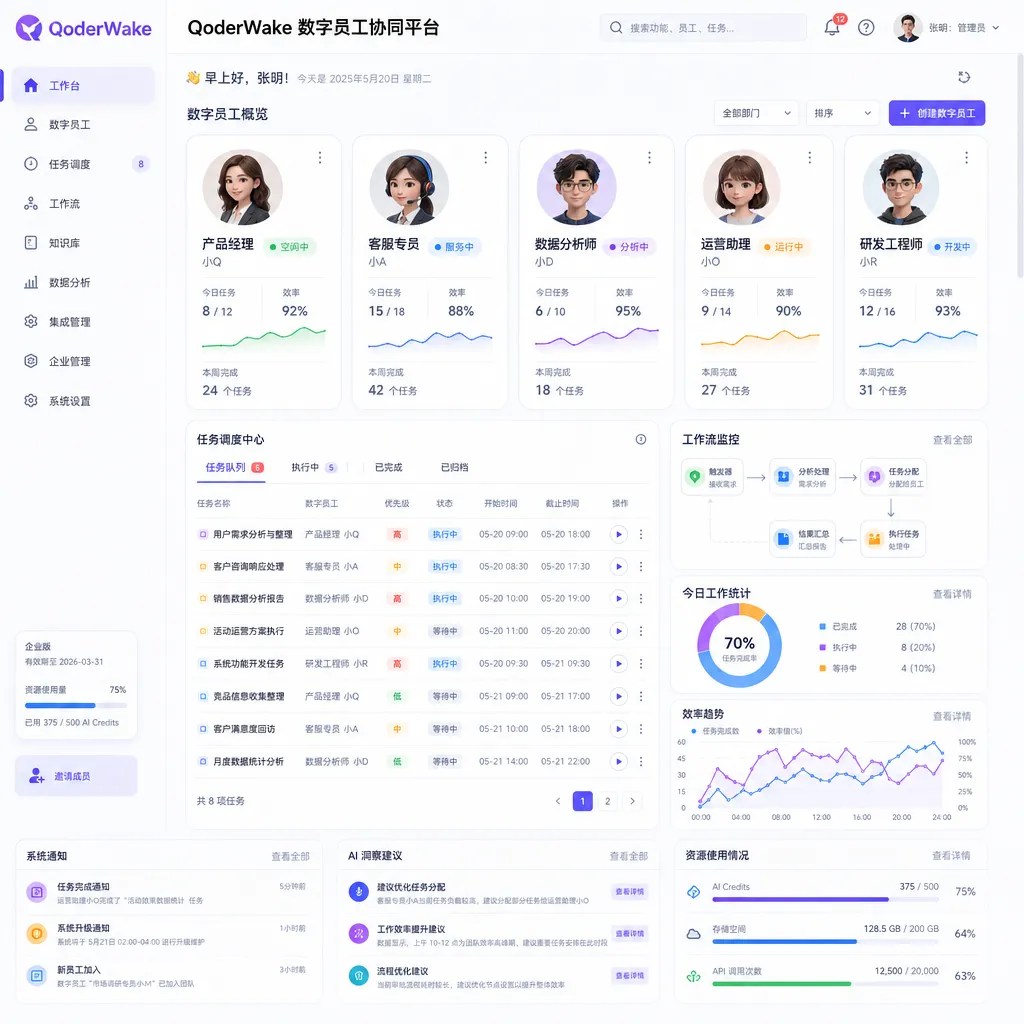
Not an Assistant, but an “Employee”
Over the past two years, AI product narratives have gone through several iterations: from chatbots to Copilots to Agents. Now Alibaba has escalated this to the concept of a “digital employee.”
What’s the difference?
A Copilot is your co‑driver — you say “turn left,” and it helps steer. An Agent can plan the route and drive part of the way itself. A “digital employee,” on the other hand, means — you give it a job description, and it shows up for work on its own.
Currently, QoderWake supports roles such as:
- Software Engineer: understands requirement documents, breaks down tasks, writes code, and runs tests
- Operations Specialist: handles content production, data processing, and campaign planning
- Data Analyst: connects to data sources, generates analysis reports, and outputs visualized insights
- Sales Assistant: organizes customer information, generates sales scripts, and sends follow‑up reminders
Enterprises can also customize digital employee roles according to their business processes. In theory, any position that can be described procedurally can be “digitized.”
Multi‑Agent Collaboration: Not a Solo Operation
If a single Agent performs a task, QoderWake wouldn’t fundamentally differ from existing AI code assistants or writing tools. What’s truly interesting is its multi‑Agent collaboration mechanism.
According to technical materials previously shared by Alibaba Cloud, QoderWake (which appeared earlier under the name QoderWork) adopts a multi‑Agent system architecture designed to simulate real‑world team collaboration:
- User submits a request — e.g., “Develop a user feedback collection page.”
- Coordinator takes over — the scheduling Agent analyzes the task and decides which roles are required.
- Divide and execute — the task analysis Agent decomposes the work, the frontend Agent builds the page, the backend Agent codes the API, and the testing Agent runs the test cases.
- Coordinate and deliver — the coordinator handles communication among Agents, resolves conflicts, and delivers the final result.
This idea isn’t entirely new. Projects like MetaGPT and ChatDev explored similar frameworks last year. What Alibaba is doing differently is productizing and commercializing the concept, packaging it as a SaaS service directly usable by enterprises.
From an engineering perspective, multi‑Agent collaboration faces key challenges:
- Context sharing: how multiple Agents can exchange information efficiently and avoid working at cross‑purposes
- Conflict resolution: who arbitrates when two Agents generate conflicting outputs
- Quality assurance: how to guarantee delivery quality without human review
- Cost control: running multiple Agents in parallel means multiplying model‑inference costs
Alibaba hasn’t revealed QoderWake’s specific technical solutions, but judging from the product design, it’s taking a pragmatic approach — opting for human‑in‑the‑loop checkpoints rather than full autonomy. This is more realistic than an entirely automated system.
Industry Context: The Big‑Tech Agent Race
The AI Agent race has clearly accelerated in the first half of 2026.
Globally, OpenAI’s Operator, Google’s Project Mariner, and Anthropic’s Computer Use are advancing in deploying Agent capabilities. Domestically, ByteDance’s Coze Platform continues to iterate, Baidu is enhancing its ERNIE Agents, and Tencent is integrating Agent features into the WeCom ecosystem.
Alibaba’s “digital employee” angle seems to reflect several considerations:
1. Differentiated storytelling. The Agent market is overcrowded, and users are becoming indifferent. The term “digital employee” is more intuitive — a business owner doesn’t need to understand what an Agent is, only that “I can hire an employee who doesn’t need a salary.”
2. Enterprise integration. Alibaba Cloud already serves numerous enterprise clients, and DingTalk reaches tens of millions of companies. If QoderWake integrates with DingTalk and Alibaba Cloud’s ecosystem, its user‑acquisition cost will be far lower than that of stand‑alone Agent platforms.
3. Clear business model. Charging per “employee” seat is more acceptable to enterprises than pricing by API calls. Companies are used to paying per headcount — packaging AI as a headcount simplifies pricing logic.
However, there are risks.
The “digital employee” concept is catchy for marketing but tricky in practice. Enterprises expect stability, reliability, and accountability from “employees.” Realistically, current AI Agents fall short of those standards. If a tool‑assisted code has a bug, it’s “an imperfect tool”; but if a “digital employee” writes buggy code, it feels like “an incompetent employee.”
Managing such expectations will be one of QoderWake’s biggest challenges.
Technology Stack: Likely Powered by Qwen
Alibaba hasn’t detailed what models underpin QoderWake, but based on its technology stack and prior Qoder product releases, it almost certainly builds on the Qwen (Tongyi Qianwen) family of models. Different roles may use different model variants:
- Code generation: likely uses Qwen‑Coder, optimized for programming tasks
- Text analysis and operations: likely use the general‑purpose Qwen models
- Scheduling and planning: may rely on larger models with stronger reasoning ability
This “one platform, multiple models, role‑based scheduling” architecture makes sense. Different positions require different model capabilities, and relying on a single model for everything wastes compute and reduces quality.
For developers, a key question is whether QoderWake will open APIs or a plugin mechanism allowing third‑party developers to create custom digital employee roles. If the goal is platformization, that’s the logical path — and once opened, it becomes an ecosystem rather than just a product.
Qoder Mobile: Filling the Personal Use Gap
Launched alongside QoderWake, the Qoder mobile app targets personal use cases with a lighter positioning focused on everyday productivity.
Although Alibaba hasn’t fully disclosed feature details, based on the naming and context, it’s likely a personal AI assistant app integrating multiple capabilities such as:
- Schedule and task management
- Document processing and information organization
- Code‑snippet generation and debugging
- Data querying and simple analytics
The personal AI assistant market is already crowded — from ChatGPT to Kimi, Doubao, and Alibaba’s own Qwen app. For Qoder Mobile to stand out, it must either excel in a specific vertical or differentiate through integration with Alibaba’s ecosystem (Taobao, DingTalk, Alipay, etc.).
A Sober Look: The Boundaries of Digital Employees
Let’s be realistic.
The current limits of AI Agents are clear: they excel at structured, procedural tasks with objective evaluation standards, but struggle with creativity, judgment, and interpersonal communication.
A “digital software engineer” can generate standard CRUD code but still needs human engineers for architecture decisions, performance optimization, or production‑level troubleshooting. A “digital operations specialist” can mass‑produce content, but content strategy, user insight, and brand tone are still beyond AI’s reach.
Thus, QoderWake’s near‑term value is not “replacing employees” but doubling existing employees’ output — like giving each team several highly efficient interns who need explicit instructions.
That positioning alone is significant. Many enterprises don’t lack decision‑makers; they lack cheap, fast execution capacity. If QoderWake can cut “requirement‑to‑prototype” time from days to hours — even if human polishing is still required — the ROI will still be positive.
What This Means for Developers
If you’re a developer, QoderWake’s launch sends at least three clear signals:
1. Multi‑Agent collaboration is moving from research to products. This means emerging demand for engineering skills such as Agent orchestration, tool invocation, context management, and evaluation systems. If you haven’t explored Agent‑development frameworks like LangGraph, CrewAI, or AutoGen, now’s a good time.
2. AI‑native workflows are reshaping software development. When AI can generate code, test it, and deploy from requirement docs, the traditional cycle — PM writes PRD → dev schedules → coding → testing → release — compresses dramatically. Developer value will shift further toward architecture design, technical decision‑making, and quality control.
3. Commercialization of “AI + Enterprise Services” is becoming clearer. The business model is evolving from selling model APIs to selling Agent platforms, and now to selling digital employees. For developers doing AI startups, finding a concrete enterprise scenario and turning Agent capabilities into a full business solution may monetize more easily than generic tools.
Of course, if your development work involves integrating multiple large‑model APIs into your own Agent applications, API aggregation platforms like OpenAI Hub can save you substantial effort — one key to access GPT, Claude, Gemini, and Qwen models, OpenAI‑compatible, and directly accessible within China — particularly useful for multi‑model orchestration.
What to Watch Next
QoderWake is still in invitation‑only testing; real‑world performance will depend on user feedback. A few aspects worth watching:
- Rollout cadence — limited beta or large‑scale release? This indicates Alibaba’s confidence in product maturity.
- Integration depth with DingTalk — if QoderWake works natively inside DingTalk, its appeal to enterprise users will increase dramatically.
- Pricing model — charged per role, per task, or by subscription? Pricing will shape its target customer base.
- Ecosystem openness — will third‑party developers be allowed to build and distribute custom digital‑employee roles?
Alibaba hasn’t been the most aggressive player in AI products, but QoderWake’s design is conceptually strong. Packaging Agents as “employees” and translating technical ideas into business language is the right direction.
Whether these “digital employees” can truly perform as reliably as human ones — we’ll find out in the second half of 2026.
References
(Note: Core information in this article comes from 36Kr newsflash and publicly available Alibaba Cloud documentation. The following are domestic discussion links accessible within China.)
No domestic reference links currently match the selection criteria. For more details, visit the Alibaba Cloud official website or search “QoderWake” in relevant technical communities.


