
Alibaba open-sources Qwen-Scope: Equipping large models with an X-ray machine

Today, Alibaba’s Qwen open-sourced the interpretability module **Qwen-Scope**. By inserting a Sparse Autoencoder (SAE) into the Qwen3/3.5 series models, it transforms black-box parameters into human-understandable features, covering four major scenarios: reasoning control, data synthesis, training optimization, and evaluation analysis.
Large Models Can Finally Be “Understood”
On April 30, Alibaba’s Qwen team officially open-sourced Qwen-Scope—a set of interpretability modules trained on the Qwen3 and Qwen3.5 series models. In simple terms, it’s like installing an X-ray machine onto large models: it doesn’t change the model’s architecture or affect inference performance, but it translates the dense internal computations of parameters into human-understandable concepts and patterns.
This is not an academic demo. The release covers seven large models and fourteen sets of Sparse Autoencoder (SAE) weights, spanning dense models and Mixture-of-Experts (MoE) models. Each set of weights was trained using 500 million tokens sampled from the corresponding model’s pretraining data. Alibaba released the tools, weights, and technical report together—explicitly inviting the community to use them.
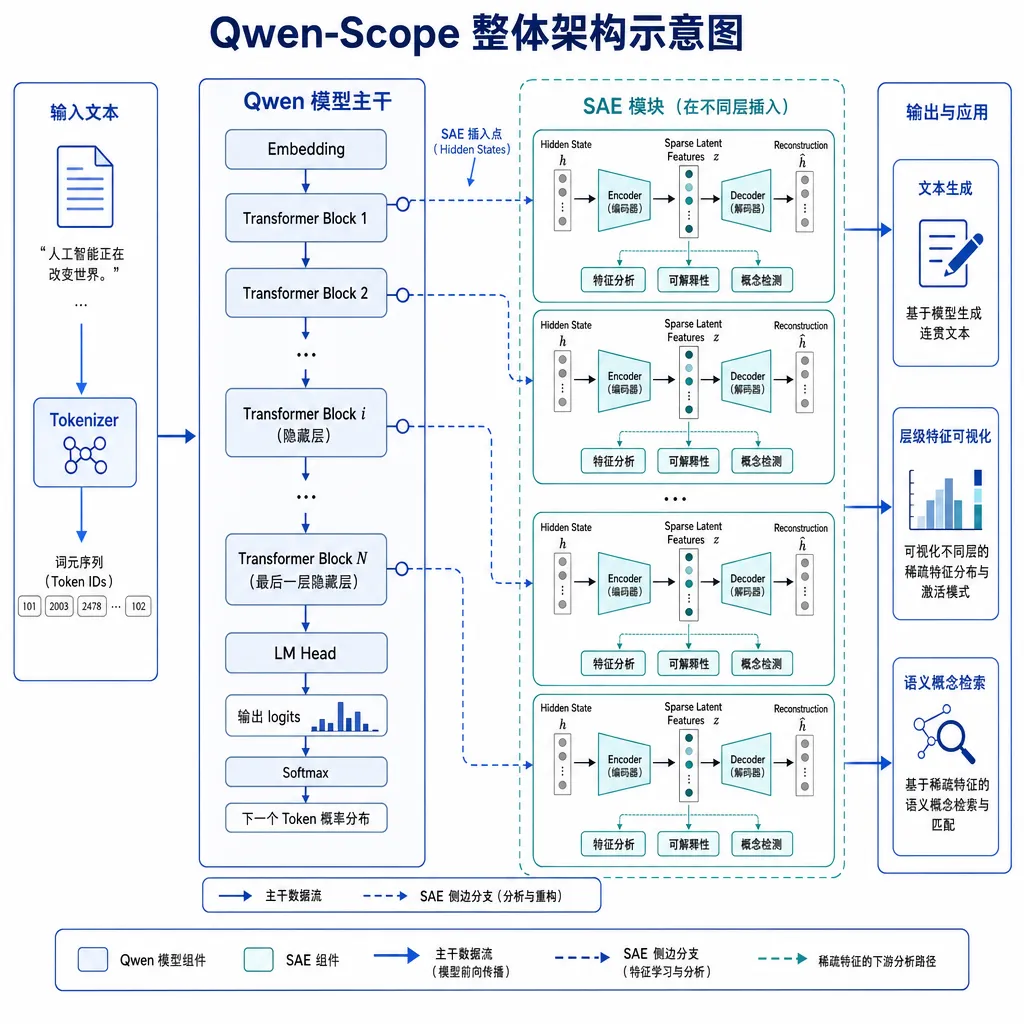
Core Principle: Using Sparse Autoencoders to Unpack the Black Box
To understand what Qwen-Scope does, you first need to grasp one issue: the hidden layer representations of large models are highly entangled. A 4,096-dimensional vector may encode dozens of kinds of information—language, emotion, facts, logic—all intertwined, making it impossible for humans to interpret.
Qwen-Scope inserts Sparse Autoencoders (SAEs) into Qwen’s hidden layers. The core idea behind an SAE is simple:
- Encoding: Map the dense hidden layer vectors into a higher-dimensional space.
- Apply sparsity constraints: Force most dimensions to be zero, keeping only a few activated features.
- Decoding: Reconstruct the original vector from these sparse features.
In analogy, the model’s internal representation used to be like a blended fruit juice—you know it tastes good but can’t tell what’s in it. The SAE separates the juice back into apple, orange, and grape juices—each identifiable, and when mixed, they still recreate the original flavor.
The “sparsity constraint” brings benefits: the extracted features are highly disentangled and low-redundancy, with each feature often corresponding to a clear semantic concept. For example, one feature might activate when the model processes “classical Chinese poetry,” another during “code generation.”
Alibaba isn’t the first to pursue this direction. Anthropic in 2024 published research using SAEs to interpret features inside Claude, and OpenAI has done similar work. But Qwen-Scope differs in that it’s not just a research tool—it’s designed for engineering use, offering a complete pipeline from analysis to optimization.
Four Key Application Scenarios: Not Just “Understanding,” But Also “Improving”
Interpretability may sound academic, but Qwen-Scope’s ambitions are clearly broader. Alibaba describes four practical directions, each addressing real pain points for developers.
1. Inference Control: Change Outputs Without Writing Prompts
This is the most intuitive and imaginative use case. By directly controlling the activation strength of SAE features, you can change the model’s output behavior without modifying the input prompt.
Examples:
- Language switching: Identify the feature controlling “Chinese output.” Increase its activation, and the model will respond in Chinese—even when asked in English.
- Style adjustment: Activate “formal/academic” related features to shift the output style from colloquial to scholarly.
- Entity replacement: Locate features for specific entities to guide the model to mention or avoid certain content in answers.
What’s the significance? Traditional prompt engineering essentially “persuades” the model with natural language—unstable and often requiring repeated tuning. Feature-level control, however, is like operating knobs inside the model directly—more precise and controllable.
This capability is valuable for fine-tuned control scenarios—such as compliance outputs in enterprise apps or language routing in multilingual customer service systems.
2. Data Classification and Synthesis: Do More with Less Labeling
Data labeling is expensive, slow, and inconsistent in quality—pain points for all model training teams. Qwen-Scope offers a clever alternative.
For data classification—take toxicity detection, for example: with only a small number of labeled toxic samples as seed data, you can analyze their feature activation patterns in the SAE to identify features strongly correlated with toxicity. These features can then be used to scan unlabeled data—no need to train a separate classifier, slashing labeling and training costs.
For data synthesis, it gets even more interesting. SAEs can find model features that are “under-activated”—often representing capability blind spots or long-tail scenarios. Using this insight, you can construct targeted training data to fill these gaps instead of blindly increasing data quantity.
It’s like giving the model a full medical exam—see exactly where it’s weak, then treat accordingly. Compared to the traditional “train → evaluate → collect more data” loop, efficiency gains are obvious.
3. Training Optimization: Locate and Fix Model “Bad Habits”
During fine-tuning, large models often develop stubborn low-level errors, such as:
- Language mixing: Chinese answers contain stray English words
- Repetitive output: Gets stuck generating the same sentence loops
- Formatting errors: Incorrect JSON output
Traditional methods struggle to locate the root cause. You know the model “made a mistake” but not why—ending up guessing with more data or hyperparameter tweaks.
Qwen-Scope can directly analyze the feature activation patterns behind these abnormal behaviors. Once the “lesion” is found, fine-tuning stages like SFT and RLHF/DPO can address them specifically, reducing recurrence of such errors.
For model training teams, this is a tangible efficiency boost. Instead of blind trial and error inside a black box, diagnose first with Qwen-Scope—then fix with clarity.
4. Evaluation and Benchmarking: Making Benchmarks Truly Useful
Large-model benchmarking has a well-known problem: many benchmark datasets overlap, repeatedly measuring the same capabilities. Teams spend heavy compute time on benchmarks but gain little new insight.
Qwen-Scope can compute similarity between feature activation patterns across samples or benchmark sets, quantifying redundancy. This enables teams to:
- Select truly complementary subsets from multiple benchmarks
- Cover more capability dimensions with fewer evaluations
- Cut evaluation costs while improving quality
For resource-limited teams, this means compute power can finally be used effectively rather than repeatedly validating known results.
Open-Source Details: Broad Coverage and Genuine Commitment
The scale of this release is noteworthy:
| Dimension | Coverage | |------------|-----------| | Model Series | Qwen3, Qwen3.5 | | Model Types | Dense + Mixture-of-Experts (MoE) | | Number of Models | 7 | | SAE Weight Sets | 14 | | Training Data | 0.5B tokens per set (sampled from pretraining data) |
Fourteen sets of weights mean that each model has SAEs for different layers—developers can choose to analyze shallow layers (syntax and vocabulary-oriented) or deep layers (semantics and reasoning-oriented).
Training data was sampled directly from pretraining corpora, ensuring the SAE learns feature distributions consistent with actual model use rather than overfitting to specific tasks—a critical detail. Mismatched data distributions would make extracted features unreliable.
Industry Perspective: Why Interpretability Suddenly Matters
Interpretability has long been an “important but not urgent” topic in AI. Everyone knows opaque black boxes are bad, but capabilities have improved so fast that few paused to ask why models behave as they do.
But the winds are shifting, driven by three converging forces:
Regulatory pressure. The EU AI Act is now in effect, requiring interpretability for high-risk AI systems. China’s Interim Measures for Generative AI Services follow similar principles. To deploy AI models compliantly, companies must be able to explain why outputs occur—interpretability is becoming mandatory, not optional.
Engineering needs. As large models move from demos to production, developers need precise debugging tools. Prompt engineering solves 80% of problems, but the remaining 20%—hallucinations, inconsistent outputs, edge-case failures—require insight into the model’s internals.
Competitive dynamics. Anthropic has heavily invested in interpretability, and its analysis of Claude’s internal features drew wide attention last year. OpenAI has parallel research. Alibaba’s timing with Qwen-Scope reflects both technical maturity and a strategic move to claim space in the open-source ecosystem.
Comparatively, Anthropic’s work is more academic—beautifully written papers but less complete tooling. Qwen-Scope’s strength lies in being engineered for practical use, with clear application paths across its four main scenarios. Its limitation, of course, is that it only supports Qwen models—not a model-agnostic framework.
What This Means for Developers
If you’re building with Qwen-series models, Qwen-Scope deserves real attention. Specific recommendations:
- Model debugging: When encountering odd outputs, analyze feature activations with Qwen-Scope—it might be more efficient than random prompt tuning.
- Data engineering: For domain-specific fine-tuning, use SAE features to assess data coverage, find blind spots, and add focused data.
- Product functionality: Feature-level output control can become a product feature—allowing users to adjust response style without hard-coded system prompts.
If you’re using non-Qwen models, the value lies in the methodology. The use of SAEs for model interpretability is being validated by top labs and is likely to become standard practice in large-model development. Understanding the principles and applications now is definitely worthwhile.
Final Thoughts
At today’s stage of large-model evolution, “capability” is no longer the only competition factor. Whoever makes models more controllable, interpretable, and trustworthy will gain the upper hand in enterprise AI.
Qwen-Scope’s open source release is Alibaba’s clear statement in this direction. It’s not perfect—it only supports their own models, and the community ecosystem will take time—but the direction is right, and the engineering level is solid.
For the broader industry, the fact that leading players are releasing interpretability tools rather than hiding them in papers is a positive signal. Large models shouldn’t remain forever as black boxes.
References
- Seeing Through Large Models’ “Inner Thoughts”: Alibaba Qwen Open Sources Interpretability Module Qwen-Scope – IT Home: Detailed IT Home coverage of Qwen-Scope’s release, including the full official introduction.


