
Owl Alpha: Yet another mysterious model suddenly appears on OpenRouter

OpenRouter launches the anonymous model **Owl Alpha**, focusing on Agent workloads. It offers a million-level context window and a maximum output of 260,000 tokens, all completely free to use. The model’s origin is unknown; the community speculates it uses INT8 quantization, and the team behind it remains a mystery.
Owl Alpha: Another Mysterious Model Drops onto OpenRouter — A Million-Token Context for Free, but Who Owns It?
OpenRouter quietly launched a new model called Owl Alpha. There was no launch event, no technical blog, no paper — not even any information about who the developers are. It just appeared in the model list out of nowhere.
Input/output price: $0. Context window: 1,048,756 tokens. Maximum output: 262,144 tokens. Positioning: agentic workloads — a foundational model designed specifically for Agent tasks.
When you put those parameters together, it’s hard not to take a second look.
Strong Specs, But Almost Zero Information
Let’s start with the hard numbers. A million-token context window is no longer rare — Gemini 1.5 Pro supports 2 million, and Qwen2.5 has a 1 million-token version — but what makes Owl Alpha special is that it also offers a maximum output of 262k tokens. What does that number mean? Most models have max outputs in the 4K–16K range, and even Claude 3.5 Sonnet only goes up to 8,192. A 262k-token output cap practically allows the model to generate the code skeleton of an entire medium-sized project or produce a multi-dozen-page analytical report in a single call.
For Agent scenarios, lengthy output capability is especially crucial. A typical coding agent workflow might require the model, within a single inference step, to: read through large amounts of code context, plan modifications, generate multiple file diffs, and include test cases. If the output window is too short, the agent must split the job into multiple requests, reloading the same context each time — slow and expensive. Owl Alpha’s 262k-token output theoretically allows many previously multi-step tasks to complete in a single call.
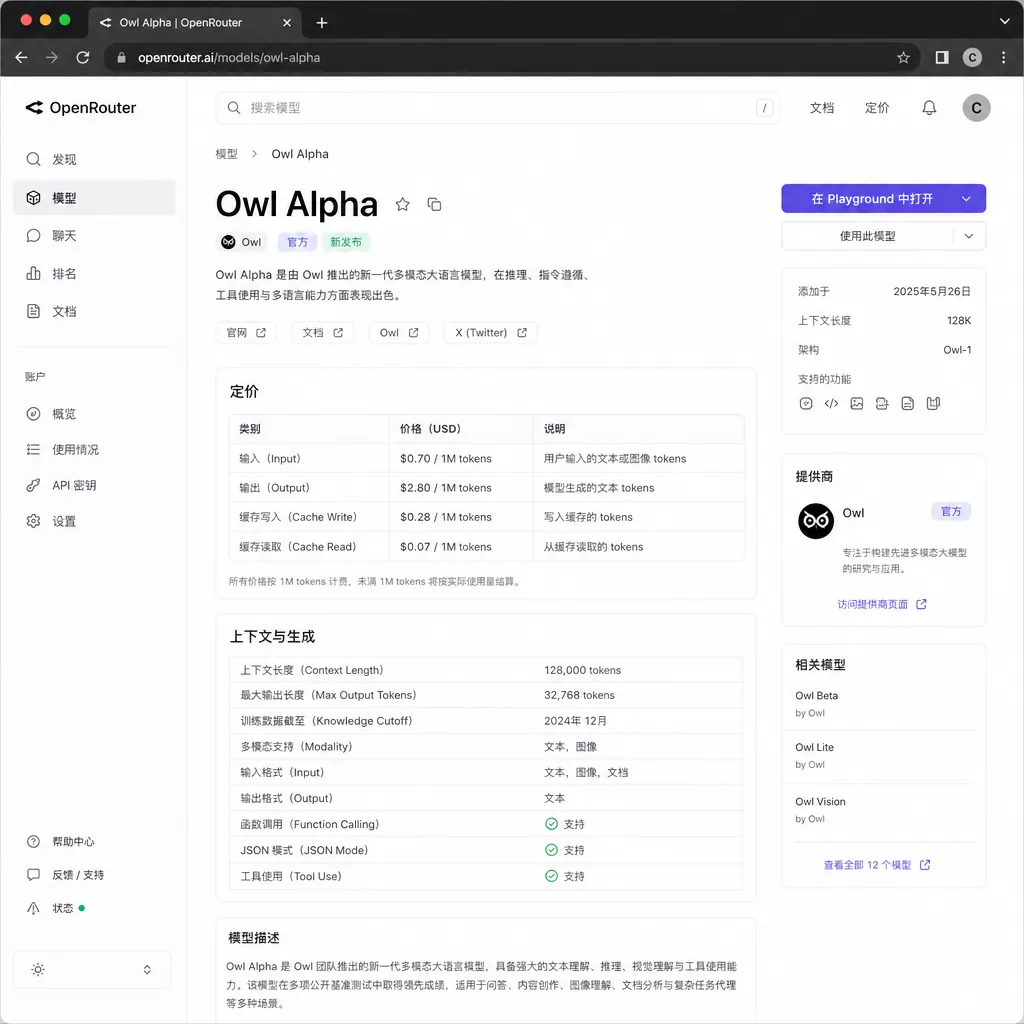
But aside from those numbers, we know almost nothing.
No model card, no architecture description, no training data details, no benchmark results. The OpenRouter page gives only a single-line introduction: “A high-performance foundation model designed for agentic workloads.” High-performance, foundational model, agentic workloads — three very broad keywords, none of them explained.
What the Community Is Speculating
After launch, discussions quickly popped up in the Linux.do community. Developers’ main question wasn’t “Is it good?” but rather “Whose model is this?”
Someone noticed a detail: based on inference behavior and response characteristics, Owl Alpha seems to run at INT8 precision. If true, that likely means it’s a quantized version of a larger model rather than being trained natively at that precision. INT8 quantization is a common compression method that significantly reduces VRAM usage and inference costs, at the expense of some accuracy on certain tasks. For a free-to-use model, INT8 inference makes perfect business sense — cheaper to run, making zero pricing feasible.
That leads to another hypothesis: Owl Alpha could be an anonymous test from a major company.
There’s precedent for this on OpenRouter. The earlier Quasar Alpha appeared in a similar way — launched anonymously, free to use, million-token context, optimized for code and Agent capabilities. Quasar Alpha was later widely believed to be a pre-release model from a top lab, though never officially confirmed. Owl Alpha’s arrival follows almost the same playbook: mysterious, free, and spec-heavy.
The naming pattern is also interesting. Quasar (an astronomical object), Owl (a creature of nature) — both evoke cosmic or natural imagery. That doesn’t sound random; possibly the same naming scheme. Of course, that’s just speculation.
What’s the Cost of “Free”?
Zero pricing is Owl Alpha’s most eye-catching feature, but experienced developers know that “free” models usually come with conditions.
First, “free” is likely temporary. On OpenRouter, anonymous preview models typically have a limited window during which they’re free to use, collecting user feedback and usage data. Once official release or tests conclude, they either start charging or get removed. Quasar Alpha went through a similar lifecycle. So, if you want to try it, now’s the best time — but don’t build your production pipeline around it.
Second, “free” doesn’t mean unlimited. OpenRouter usually enforces rate limits on free models; during peak times you might get queued, and response latency can fluctuate. It’s fine for demoing or quick comparisons, but if you need a stable SLA, this isn’t dependable.
Third — and easiest to overlook — is that the model could change anytime. Anonymous models have no version guarantees; the provider can update weights, alter system prompts, or even swap in a completely different model. What works today might not tomorrow. For applications needing consistent outputs, that’s a dealbreaker.
The Agent Model Race Is Getting Crowded
Viewing Owl Alpha in a broader context, its appearance isn’t surprising. Since early 2025, “agentic” has become one of the most overused adjectives in model releases. Nearly every lab now claims its model is Agent-ready:
- Claude 3.5/4 series: Anthropic has been betting on the Agent direction since “computer use,” emphasizing tool use and multi-step reasoning.
- GPT-4o / GPT-4.1 series: OpenAI continues iterating on function calling and structured output, with the Codex line directly targeting coding agents.
- Gemini 2.5 Pro/Flash: Google uses ultra-long context and multimodal capabilities to approach Agent applications.
- DeepSeek-V3 / R1: Representatives of the open-source camp, strong in code generation and reasoning tasks.
- Qwen2.5 series: Alibaba’s million-token context versions aim squarely at long-chain Agent tasks.
For Owl Alpha to stand out in this crowded space, big specs aren’t enough. Developers care about practical questions:
How well does it follow instructions?
In Agent workflows, strict instruction-following is critical. Models must output in exact required formats, without creativity. A model that excels in chat might frequently fail with Agents due to output inconsistency.
How reliable is tool calling?
Modern Agent frameworks (LangChain, CrewAI, AutoGen, etc.) depend on correctly formed JSON function calls. If the model’s success rate here isn’t high, the entire execution chain breaks.
Does it suffer from the “lost in the middle” problem with long context?
A million-token context sounds impressive, but many models degrade sharply in retrieving or using information from the middle of long inputs — the so-called “lost in the middle” issue. For Agents handling large codebases, this directly impacts usability.
What about inference speed and first-token latency?
Agent tasks often involve multiple calls, and latency compounds. If each call takes over ten seconds, a five-step Agent flow could exceed a minute — poor UX.
We currently have no answers. Owl Alpha hasn’t published any benchmark data, and community testing hasn’t yet produced enough results for reliable conclusions.
What This Means for Developers
If you’re working on Agent-related projects, Owl Alpha is worth half an hour of testing — but not half a day of deep integration.
Practical recommendations:
-
Run your existing Agent tasks for comparison.
Use familiar prompts and test both Owl Alpha and your current models, comparing output quality, format consistency, and response time — prioritize function/tool-calling performance. -
Test real-world long-context performance.
Don’t trust window size numbers alone. Try 500k, 800k, and 1M-token tests to see if it still accurately references earlier context. -
Check output consistency.
Run the same prompt several times and see how much variance there is. Agent contexts demand determinism far more than chat. -
Do not use in production.
This is an anonymous, free, no-SLA preview model. It might go offline, change, or start charging anytime. Treat it as a free experiment, not infrastructure.
For developers wanting stable access to mainstream models, a unified API aggregator like OpenAI Hub remains more pragmatic — one key switches between GPT, Claude, Gemini, DeepSeek, etc., without separate integrations. Once Owl Alpha’s identity and capabilities are verified, adopting it officially can wait.
A More Interesting Trend
More noteworthy than Owl Alpha itself is what OpenRouter is becoming: a testing ground for anonymous models.
From Quasar Alpha to Owl Alpha, OpenRouter has created a unique mechanism: providers can release models to real users anonymously to collect feedback. For major labs, it's a low-risk testing channel — if the model performs well, they can later reveal its identity and gain reputation; if not, they can quietly remove it without hurting the brand.
This model is a double-edged sword for developers. The good: you get early access to emerging models. The bad: you’re using a complete black box — with no one to turn to if something breaks.
At a macro level, the rise of anonymous models reflects a market reality: the performance gap among top-tier models is narrowing, making differentiation increasingly important. “Agent-specialized” has become one of the hottest marketing tags. But while a label is easy to apply, capability is harder to prove. Ultimately, what determines a model’s fate isn’t how impressive its spec sheet looks but whether developers actually use it in real projects.
Whether Owl Alpha remains anonymous or steps into the spotlight will depend on real-world community testing in the coming weeks. If it truly excels at Agent tasks, the mystery around its identity could become its best advertisement. If not, it will quietly fade into memory — like many anonymous models before it.
We’ll be following future developments closely.
References:
- Linux.do Forum Discussion: New Anonymous Model "Owl Alpha" Appears on OpenRouter — Early community discussions about Owl Alpha, including speculation about INT8 precision and other technical details.


