
DeepSeek V4 Multimodal Technology Report Analysis

DeepSeek officially released its multimodal large model technical report, introducing the “visual primitive reasoning” framework, which replaces purely textual reasoning chains with points and bounding boxes. With a compact model size, it benchmarks against GPT-5.4 and Claude Sonnet 4.6 in spatial reasoning tasks.
DeepSeek Releases Multimodal Technical Report: Rewriting the Reasoning Chain with "Visual Primitives" — A Small Model Takes on GPT-5.4
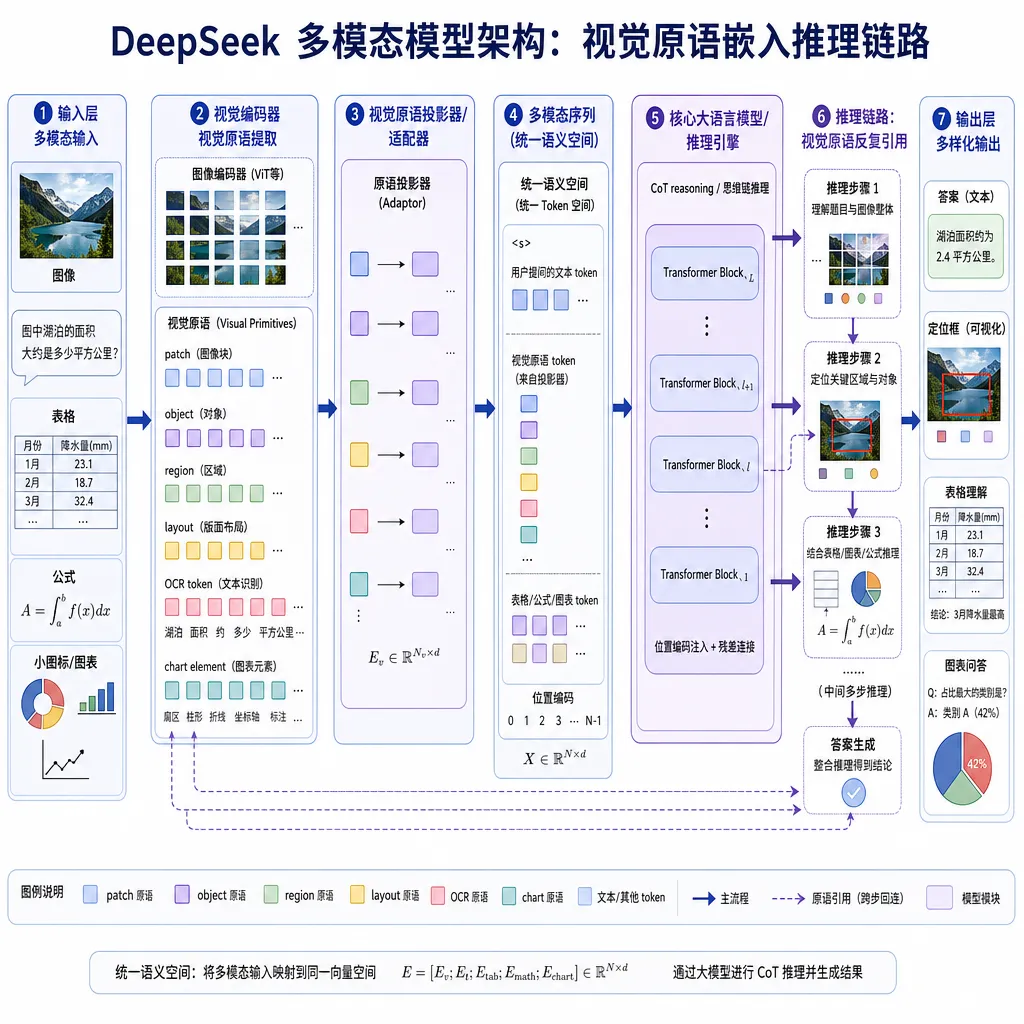
On April 30, DeepSeek officially released its multimodal large model on GitHub, along with a full technical report. The core pitch can be summed up in one sentence: pull spatial markers like points and bounding boxes from the input stage into the reasoning chain, so the model can literally “point at” the image while thinking.
This isn’t a regular model update. In its report, the DeepSeek team directly challenges the dominant technical route in multimodal research—high-resolution cropping + language-based chain-of-thought (CoT)—arguing that this approach has reached its limit. Their alternative framework is called “Thinking with Visual Primitives.”
Where the Problem Lies: Seeing Isn’t the Issue—Speaking Is
Over the past two years, the main evolution in multimodal large models has been about “seeing more clearly.” GPT-4o uses high-resolution sampling; Gemini increases visual token counts; Claude focuses on fine-grained image understanding—all tackling the same problem: the perception gap, i.e., whether a model can recognize fine details in an image.
The DeepSeek team doesn’t deny the value of this path, but they argue that most researchers have collectively ignored a more fatal bottleneck: the referencing gap.
What does that mean? For example, if you ask a model to count how many people are in a group photo, it may clearly identify each face. But during reasoning, it must use natural language like “the person to the right of the third person from the left”—a description that’s inherently ambiguous. As the number of people increases, the precision of these language references drops exponentially, causing the reasoning chain to break midway.
The model isn’t stupid—it’s using the wrong tool. Doing spatial reasoning with language is like describing a circuit diagram in words—technically possible, but it collapses once things get complex.
The technical report gives a vivid comparison: in counting tasks that require precise spatial referencing, traditional CoT methods suffer a cliff-drop in accuracy as the object count increases. The model doesn’t fail to see the objects—it simply loses track of their positions during reasoning.
Visual Primitives: Enabling the Model to "Think While Pointing"
DeepSeek’s solution is straightforward—if language isn’t enough, don’t rely on language alone.
The core operation of the “Thinking with Visual Primitives” framework is: elevate points and bounding boxes—two fundamental spatial markers—from mere visual-input annotations to first-class citizens in the reasoning process.
Specifically, the model’s reasoning trace may look like:
“There are several people in the image. Mark the first person [point: (142, 305)], the second person [point: (267, 298)], the first person holds an object in the right hand [bbox: (158, 340, 203, 412)], the second person holds an object in the left hand [bbox: (241, 332, 289, 405)], the two objects are adjacent in space...”
Every reasoning step is anchored to the physical coordinates of the image. No longer does the model need to say things like “the thing next to the person on the left”—it can simply point by coordinate.
This design has three implications:
- Disambiguation: Coordinates are precise—no confusion over “the third person on the left.”
- Traceability: Every reasoning step can be verified on the original image, enabling error localization.
- Composability: Points and boxes can combine into more complex spatial relations—containment, adjacency, overlap.
If you know computer vision history, this approach might feel familiar—early object detection models (YOLO, Faster R-CNN) used bounding boxes as basic output units. DeepSeek is essentially moving this “point-to-locate” paradigm from perception to reasoning.
Architectural Efficiency: Small but Mighty
The most surprising data point in the report isn’t accuracy—it’s efficiency.
DeepSeek’s multimodal model uses significantly fewer model parameters and image tokens than its counterparts, yet achieves parity with GPT-5.4, Claude Sonnet 4.6, and Gemini-3-Flash on benchmarks for counting and spatial reasoning—two of the hardest multimodal tasks.
The report deliberately says “matches” rather than “surpasses,” a modest phrasing that still carries deep implications:
| Dimension | DeepSeek Multimodal | Benchmark Models | |------------|--------------------|-----------------| | Model Scale | Compact (exact size not fully disclosed) | GPT-5.4 / Claude Sonnet 4.6 / Gemini-3-Flash | | Image Token Budget | Significantly lower | Industry standard | | Counting Tasks | Matching | State-of-the-art | | Spatial Reasoning | Matching | State-of-the-art |
Achieving the same result with fewer visual tokens means lower inference cost and latency—a major advantage for deployment.
According to previous V4-series architecture details, V4-Pro has 1.6T total parameters, 49B active; V4-Flash has 284B total, 13B active—both using MoE (Mixture of Experts). V4 applies aggressive token compression plus a custom DSA sparse attention mechanism. Official data shows that under 1M context, V4-Pro uses only 27% of V3.2’s per-token FLOPs and 10% of its KV cache. V4-Flash is even leaner—only 10% of FLOPs and 7% of KV cache.
Combining this efficiency with the visual primitives framework points toward one goal: performing more precise multimodal reasoning with less computation.
Why This Direction Matters
Competition in multimodal large models is entering a subtle new phase.
Phase one was “Can the model see images?”—by 2024, all major players cleared that bar. Phase two was “How accurately can it see?”—high resolution, fine granularity, and so on. We’re now in phase three: Can it think after seeing?
This is what DeepSeek calls “System-2-level multimodal intelligence.” System-1 is fast intuitive recognition (seeing a cat and knowing it’s a cat), while System-2 is slow deliberate reasoning (looking at a floor plan and finding the shortest path from room A to room B). Most current multimodal models remain at the System-1 stage—they can recognize, but not reason.
The visual primitives framework targets that gap. Its value isn’t just in today’s benchmarks—it proposes an expandable reasoning paradigm:
- Primitives are extensible: Currently points and boxes; future versions could add lines, polygons, even 3D coordinates.
- Compatible with reinforcement learning: Visual primitives serve as verifiable intermediate steps—well-suited to RLHF/RLVF.
- Cross-task transfer: The same primitive mechanism can support counting, spatial reasoning, chart understanding, document analysis, etc.
In the Context of the V4 Series
Since early March, DeepSeek has gradually revealed details of the V4 series; now, with the official release of this technical report, the picture is complete.
Let’s recap V4’s core upgrade dimensions:
- Programming capability: Tops open benchmarks in Agentic Coding; internally adopted as the default code model; outperforming Sonnet 4.5 in feedback.
- Long context: 1M-token support by default; 83.5 on MRCR 1M.
- Multimodality: The newly announced visual primitives framework, a natively multimodal architecture.
- World knowledge: 57.9 on SimpleQA-Verified, surpassing Opus 4.6 Max (46.2) and GPT-5.4 xHigh (45.3).
All four directions advance simultaneously, and none simply by “scaling up parameters”—each features architectural innovations. Programming leverages agentic adaptation, long context relies on DSA sparse attention, multimodality on visual primitives, and knowledge on optimized pretraining data balance.
This “distinct story per domain” approach contrasts interestingly with OpenAI and Google’s “one giant model for all tasks” strategy. It’s too early to declare a winner, but DeepSeek’s efficiency-first path is certainly compelling.
What It Means for Developers
If you’re building multimodal applications involving spatial understanding—document layout analysis, industrial inspection, map/blueprint interpretation, retail shelf recognition—the visual primitives framework merits your attention.
Traditional solutions follow a two-step process: “multimodal model for recognition + post-processing script for spatial logic.” The visual primitives approach internalizes spatial logic within the model’s reasoning process, potentially simplifying pipelines and reducing end-to-end failure rates.
Of course, there’s still some distance between report and real-world usability. DeepSeek has already launched an online “image mode,” alongside “fast” and “expert” modes, enabling multimodal recognition. API-level multimodal endpoints are expected to roll out with full V4-series release.
Developers wanting early access to DeepSeek V4’s multimodal capabilities can already invoke its models through OpenAI Hub; new models usually follow shortly after launch.
In One Sentence
The biggest contribution of DeepSeek’s technical report isn’t topping leaderboards—it’s revealing a structural blind spot in multimodal reasoning: language isn’t a universal thinking tool—some problems require visual reasoning. And it proposes an engineerable path forward. If validated and adopted widely, this idea could reshape not just DeepSeek’s architecture, but the design philosophy of multimodal models overall.
References
- ITHome: DeepSeek Releases Multimodal Model Technical Report — first coverage with summary of key report details
- Zhihu: DeepSeek-V4 Technical Report Deep Dive — detailed analysis of the native multimodal architecture
- Zhihu: DeepSeek-V4 Technical Report Breakdown – From Architecture to Infra — dual design (Pro/Flash) and performance data analysis


