
Cloudflare Opens Its Doors to AI Agents

Cloudflare announced that AI agents can autonomously complete the entire process—from account registration and domain purchase to paid subscription and code deployment—with only a single authorization from a human. This marks the official arrival of the “agent-native” era for cloud infrastructure.
Cloudflare Opens Its Doors to AI Agents: From Account Registration to Domain Purchase and Deployment, All in One Go
Today (April 30), Cloudflare announced an ambitious update on its official blog: AI agents can now act as Cloudflare “customers,” autonomously completing the entire process—creating an account, activating a paid subscription, registering a domain, obtaining an API Token, and deploying code. Humans only need to grant authorization once at the beginning; the rest is handled entirely by the agent itself.
This is far more than a simple API opening. It means that Cloudflare is exposing its entire business pipeline—registration, payment, resource activation, and deployment—to non-human entities. At a time when cloud providers are racing to call themselves “AI-native,” Cloudflare is the first to actually turn “treating agents as customers” into a real, product-level feature.
What Exactly Is Being Opened Up?
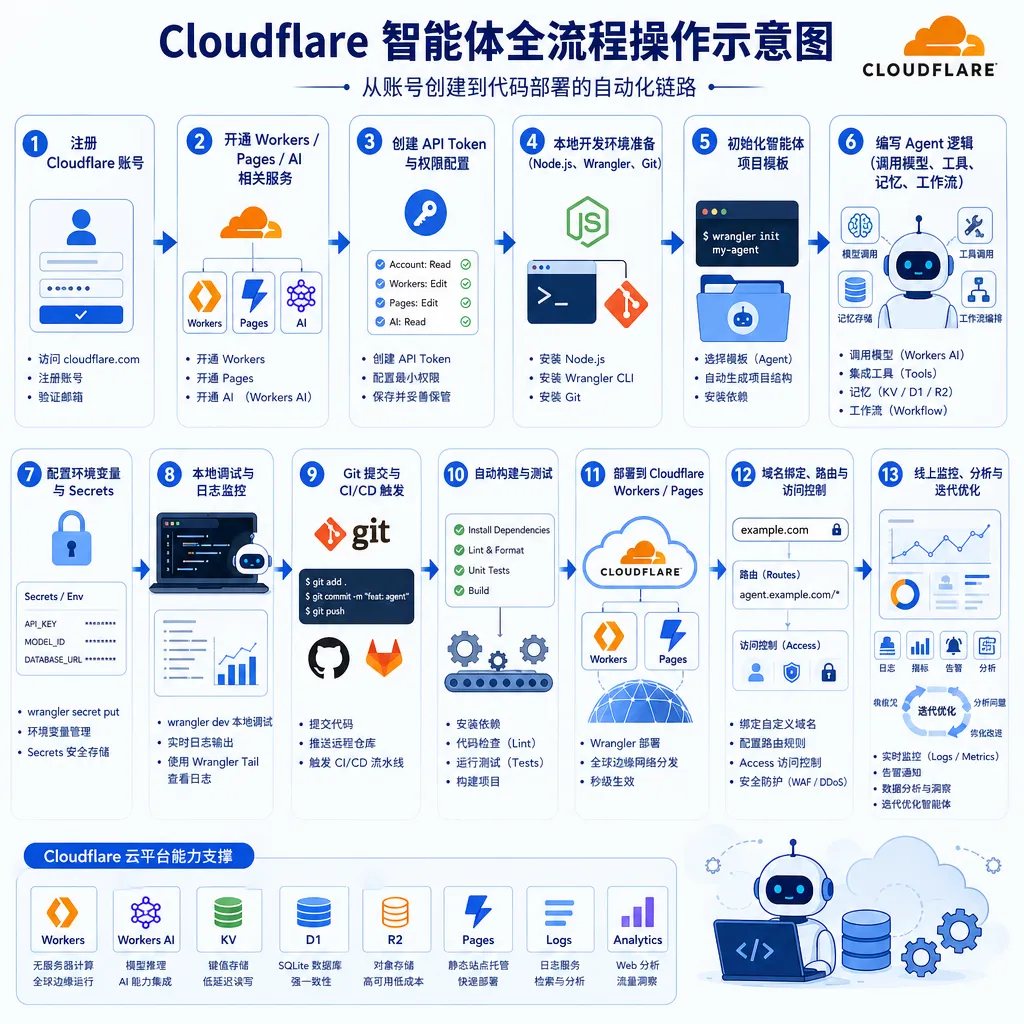
Let’s break down the process. Traditionally, a developer deploying a project on Cloudflare goes through roughly these steps:
- Register an account, fill in an email, set a password
- Choose a plan and bind a payment method
- Register or connect a domain
- Configure a Workers/Pages project
- Obtain an API Token and deploy the code
Each step required human clicks in a browser. Now, Cloudflare has opened all five of these as callable interfaces for agents. A coding agent—built on GPT, Claude, or another model—can receive a command from a user like “build me a blog and deploy it to xxx.com,” and automatically execute the entire process.
A critical detail: the payment step is powered by Stripe. The integration with Stripe solves the “last mile” of agent autonomy—within a preauthorized spending limit, the agent can complete payments autonomously, without requiring a human to intervene with a credit card.
Why Does This Matter?
At first glance, this looks like just more APIs. But looking deeper, Cloudflare is addressing an industry-level issue: existing cloud infrastructure is designed for humans, and agents hit walls everywhere.
For example, when you ask a coding agent to build a web app, it can write beautiful code locally, but when it reaches the “deploy” step—it gets stuck. It has no Cloudflare account, can’t register a domain, can’t configure a CDN, and definitely can’t pay for services. The developer must step in manually, breaking the “automation” chain right at the end.
This pain point has become especially apparent since the rise of coding agents in late 2025. Tools like Cursor, Windsurf, Devin, and OpenAI Codex have made “AI writing code” routine, but “AI deploying code” remains a barrier. Cloudflare’s announcement today effectively fills that gap.
The deeper signal: cloud providers are beginning to treat agents as first-class citizens. This isn’t a console for humans with an API wrapper—it’s a full redesign from accounts, billing, and permissions so that agents can traverse the entire commercial flow just like human users.
Cloudflare CEO Matthew Prince put it bluntly: “The way software is built is undergoing a fundamental shift. We are entering an era where agents write and execute code.”
More Than APIs: The Full Agent Cloud Platform
Focusing only on “agents can register accounts” underestimates Cloudflare’s ambition. Alongside that, Cloudflare also introduced an entire infrastructure stack built for agents—a complete ecosystem.
Dynamic Workers: An Agent Runtime 100x Faster Than Containers
This is the technical centerpiece of the update. Dynamic Workers is a runtime based on isolate mechanisms, specially designed to run AI-generated code safely inside sandboxes.
Compared with traditional containers, the differences are clear:
| Dimension | Traditional Containers | Dynamic Workers | |------------|------------------------|-----------------| | Cold start | Seconds | Milliseconds | | Secure isolation speed | Baseline | ~100× faster | | Concurrency | Requires warm-up scaling | Millions of concurrent runs, no warm-up needed | | Cost | Per container instance | A fraction of container cost |
Why does this matter? Because agent code execution patterns differ greatly from traditional apps. An agent may frequently execute small fragments of code—call an API, transform data, chain tools together—each run lasting only tens of milliseconds. Spinning up a container every time is unacceptable overhead. Dynamic Workers’ millisecond startup and tiny cost perfectly fit this “high-frequency, short, fragmented” execution model.
This echoes how AWS Lambda once disrupted servers—but this time Cloudflare is targeting agents, not human developers, as the primary executors.
Artifacts: A Git Repository for Agents
Agents running long tasks need a place to persist code and data. Artifacts fulfills that role—a Git-compatible storage primitive supporting tens of millions of repositories, forkable from any remote source, fully accessible via standard Git clients.
Think of it as GitHub for agents. Agents can push generated code to Artifacts repositories, then pull, modify, and deploy it across sessions. For multi-session, long-term projects, this persistence is essential.
Sandboxes: Full Linux Environments
Some tasks can’t be handled within Workers’ lightweight sandboxes—such as cloning a large repo, installing Python dependencies, or running build scripts. Sandboxes provide persistent, isolated Linux environments with Shell access, file systems, and background processes, letting agents operate just like human developers.
Together, these three layers cover all use cases from “light” to “heavy” workloads:
- Lightweight tasks → Dynamic Workers (millisecond-level, ultra-low cost)
- Code storage → Artifacts (Git-compatible, persistent)
- Heavy tasks → Sandboxes (full Linux environments)
Think: An SDK Framework for Long-Running Tasks
Think is an SDK framework for building persistent agents. It addresses a core pain point: most current frameworks only handle single request-response cycles, while real workflows are multi-step and long-running. Think lets developers build agents that persist across multiple steps and sessions—more workflow engine than chat responder.
Cloudflare Mesh: A Secure Network Layer for Agents
Cloudflare Mesh provides secure, private network access for agents. Integrated with Workers VPC, it allows developers to authorize agents to access private databases and internal APIs without exposing those resources publicly.
It’s an easily overlooked, yet crucial piece. For agents to be truly useful, they must access enterprise systems—databases, internal APIs, private services. Without a secure networking layer, no company would allow agents near production systems.
After the Replicate Acquisition: Expanded Model Catalog
Cloudflare had previously announced its acquisition of AI deployment startup Replicate. Today, the results went live—an expanded AI model catalog. Developers can now select models directly within Cloudflare’s dashboard, including OpenAI’s GPT-5.4 and various open-source options.
Switching model providers takes just one line of code—no juggling multiple API keys or billing systems. The idea is similar to OpenAI Hub and other model aggregation platforms: reduce model switching costs and avoid vendor lock-in. The difference is that Cloudflare builds this at the infrastructure level, not as an API gateway abstraction.
For developers already using Cloudflare Workers AI, this expanded catalog removes the need to sign up for additional providers to access specific models.
How Does Cloudflare Compare to Competitors?
Casting a wider view, let’s see what others are doing in “agent infrastructure”:
- AWS: Bedrock Agents focus on orchestration, still built on Lambda + containers, with no agent-optimized runtime.
- Google Cloud: Vertex AI Agent Builder emphasizes enterprise agent creation and management, but doesn’t yet enable autonomous commercial operations for agents.
- Vercel: Competes directly with Cloudflare Pages for front-end deployment, embraces AI, but hasn’t opened workflows like account registration or domain purchasing to agents.
Cloudflare’s differentiation lies in two aspects:
1. End-to-end integration.
It’s not just APIs for deployment—it opens the entire commercial chain to agents, from account registration to payment, domain purchase, and deployment. That’s a first in the industry.
2. Runtime-level native optimization.
Dynamic Workers’ isolate-based design fits agent behavior far better than containers. It’s not a patch—it’s a runtime built for agent use cases.
That said, Cloudflare still lags behind AWS and GCP in raw compute and ecosystem breadth. For GPU-heavy inference or large-scale data processing, it’s not the best fit yet. But for web application deployment, Cloudflare’s approach clearly leads.
Security and Governance: Challenges Ahead
Letting agents register accounts and spend money autonomously sounds cool—but raises practical concerns:
- Permission boundaries: What if an injected prompt makes an agent go wild creating accounts or buying domains?
- Spending limits: Who’s financially responsible once authorization is granted?
- Auditing and traceability: Can agent actions be reviewed and rolled back?
Cloudflare’s announcement mentions allowing “humans in the loop to grant permission,” but details like permission granularity, spending caps, and audit mechanisms remain to be seen. Stripe’s integration should theoretically handle spending control through preauthorization, but whether it scales for large agent populations remains uncertain.
This is an industry-wide challenge: as agents evolve from “assistants” to “autonomous actors,” authentication, authorization, and compliance frameworks must be rethought. Cloudflare has taken the first step—yet governance may prove harder than the technology itself.
What Does This Mean for Developers?
If you’re building a coding agent or automation workflow, Cloudflare’s update offers an extremely compelling deployment pipeline:
- Your agent can autonomously complete the full “write code → buy domain → deploy live” cycle, with no human steps
- Dynamic Workers’ millisecond startup and low cost suit frequent short executions
- Artifacts provides Git-compatible persistence for cross-session code management
- The expanded model catalog lets you switch models within Cloudflare easily, cutting provider overhead
Of course, this mainly targets web-app scenarios. For back-end services, data pipelines, or ML inference workloads, Cloudflare isn’t yet sufficient.
In Closing
Looking back, Cloudflare’s core message is clear: the users of cloud infrastructure are expanding from humans to agents—and existing cloud systems must be reimagined for them.
Matthew Prince says Cloudflare spent nine years building its foundation with Workers, now aiming to become “the definitive platform of the agent network era.” There’s marketing flare in that, but the direction is sound—when AI agents become the primary executors of software creation and deployment, whoever makes them feel “at home” first gains a huge advantage.
Cloudflare’s move today is less a product release and more a signal to the entire cloud industry: agents aren’t just applications running on your platform—they’re your customers. And that conceptual shift may prove more meaningful than any single technical feature.
References
- Cloudflare: AI can now create accounts, enable paid subscriptions, register domains, and deploy applications on behalf of users — Linux.do community thread summarizing the Cloudflare blog
- Overview of Cloudflare’s New Agent Cloud Toolset — Zhihu column covering Cloudflare AI Search creation and demo


