
OpenAI Restricts GPT-5.5 Cyber: The safety model isn’t available to everyone

OpenAI announced that it will roll out **GPT-5.5-Cyber** to key network defense organizations in the coming days. This is another security-focused model following **GPT-5.4-Cyber**, but access remains strictly limited. Previously, OpenAI had criticized Anthropic for restricting access to **Mythos**.
OpenAI Restricts GPT-5.5 Cyber: Security Models Aren’t for Everyone
On April 30, OpenAI CEO Sam Altman announced that the company would begin rolling out GPT-5.5-Cyber—a cutting-edge model designed specifically for cybersecurity scenarios—to “critical cyber defenders” in the coming days.
Here’s what makes this interesting: not long ago, OpenAI publicly criticized Anthropic for restricting access to its Claude Mythos model. Now, OpenAI is doing exactly the same thing.
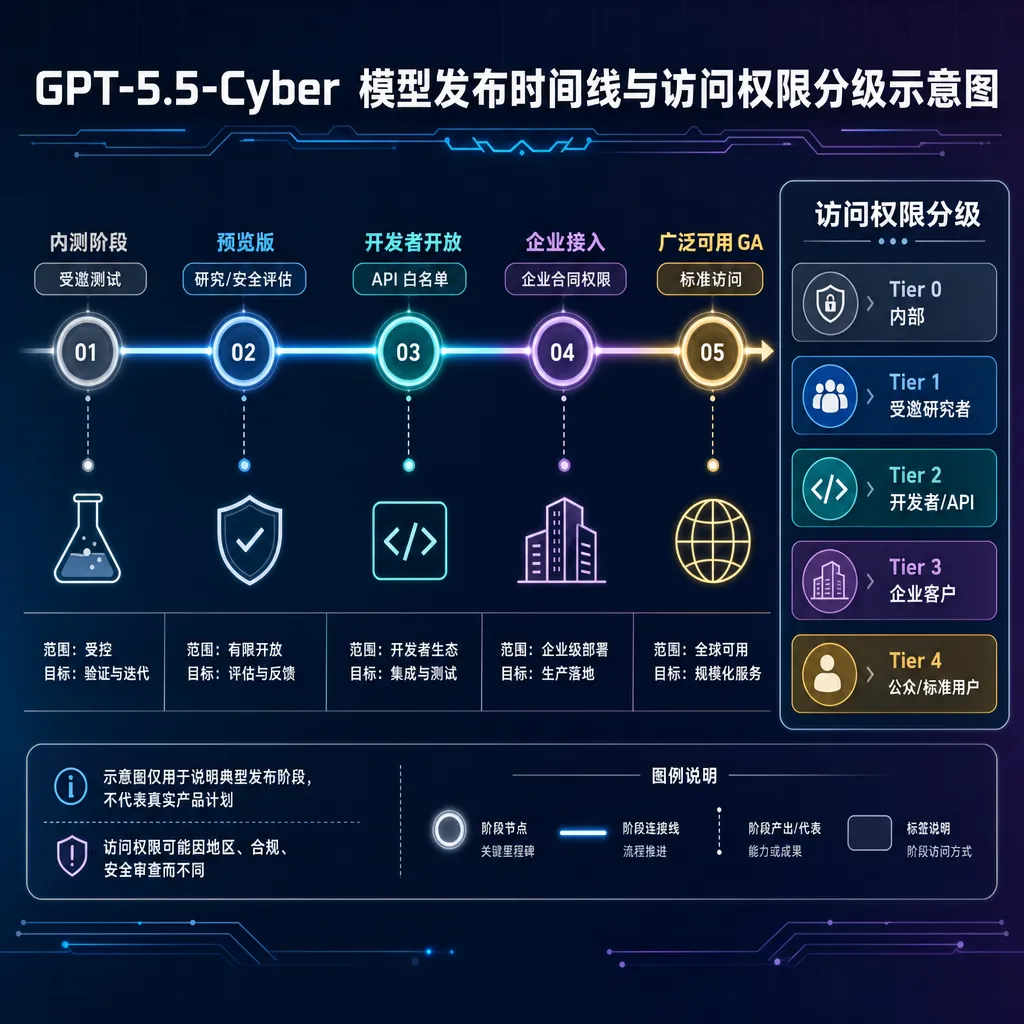
From 5.4 to 5.5: What the Cyber Series Is Doing
To understand GPT-5.5-Cyber, we need to look back at its predecessor.
In February, OpenAI introduced the “Trusted Access for Cyber” (TAC) framework. In short, it’s a stratified trust system: who you are, what organization you’re in, and what you plan to do determine how deeply you can access the model’s capabilities.
In mid-April, under that framework, OpenAI released GPT-5.4-Cyber—a fine-tuned version of GPT-5.4 optimized for cybersecurity defense scenarios. The key differences were twofold:
- Lowered refusal thresholds in defense contexts: The standard model frequently rejects requests related to vulnerability analysis or reverse engineering, while the Cyber version relaxes these restrictions for certified security researchers.
- Enhanced specialized capabilities: For example, binary reverse engineering—determining whether a piece of software is malicious or vulnerable without source code—is essential for security researchers.
Now, GPT-5.5-Cyber is the next step in that path. Altman hasn’t shared many technical details, but based on its name and timing, it’s likely fine-tuned from the GPT-5.5 base model for security scenarios, with a higher performance ceiling than version 5.4.
For cybersecurity professionals, that means better vulnerability detection assistance, more accurate threat intelligence analysis, and deeper malicious code reverse-engineering capabilities.
Who Can Use It? Most People Can’t
GPT-5.5-Cyber won’t appear in ChatGPT’s model selector and won’t be available directly via API.
OpenAI’s phrasing is clear: “critical cyber defenders”—which, in plain terms, means rigorously vetted security vendors, government cybersecurity agencies, and specific research organizations.
Access controls follow the TAC framework’s tiered logic:
- Basic level: Individual users verified via automated identity checks gain limited access for security research with standard models.
- Institutional level: Partnered security institutions gain more open model capabilities.
- Top level: Organizations passing the highest certification can apply for access to the Cyber-specialized versions.
Even with access, it’s not total freedom. OpenAI notes that in certain scenarios—like Zero Data Retention mode or when calling via third-party platforms—access may be further restricted. The reason is simple: distributing the model through third parties reduces OpenAI’s visibility into user identity and use cases, making risk control harder.
Awkward Moment: The Criticism of Anthropic Is Still Fresh
The most intriguing part of this story isn’t technical—it’s the timeline.
Anthropic previously launched Claude Mythos, also with restricted access—not everyone could use it; users had to be vetted. OpenAI openly criticized this approach at the time, arguing that restricting model access is detrimental to the development of the security ecosystem.
Then it turned around and did the same thing.
Of course, if you look closely, there are differences in their logic. Anthropic’s Mythos aims at “building more controllable intelligent systems,” where restricted access is part of its security philosophy. OpenAI’s Cyber series is more about “creating more capable security tools,” where restrictions exist because the tools are too sharp and could be misused.
But in the end, the outcome is the same: only a select few get access.
It’s not hypocrisy—it’s reality teaching idealism. Once your model is capable of deep vulnerability discovery and binary reverse engineering, it’s hard to say “sure, everyone can use this.” Offense and defense are two sides of the same coin—a model that helps defenders find vulnerabilities can just as easily help attackers find them.
The Dilemma of Security AI
This touches on a fundamental tension in AI security: the more powerful a security model is, the more dangerous it becomes.
Traditional security tools—like Metasploit, Burp Suite, or IDA Pro—face similar issues, but at a completely different scale. These tools require users to have significant expertise, and that expertise serves as a natural filter.
AI models are different. A language model fine-tuned for cybersecurity scenarios can turn reverse engineering tasks that once took years of experience into simple conversations. It doesn’t just lower efficiency barriers—it lowers knowledge barriers.
That’s the root reason OpenAI has to limit access.
OpenAI acknowledged this in its blog post:
For models trained specifically for cybersecurity contexts, and which relax usage restrictions, stricter deployment procedures and corresponding controls are required.
Future models’ capabilities are likely to surpass today’s most advanced specialized models, so stronger and more comprehensive protective frameworks must be built.
In other words, GPT-5.5-Cyber’s restricted access isn’t the end—it’s the beginning. As models grow more powerful, this “tiered trust and gradual release” approach will likely become standard in the field of security AI.
What This Means for Developers
If you’re an ordinary developer, GPT-5.5-Cyber doesn’t directly concern you for now. It won’t appear in public APIs, and you’re unlikely to get access through regular channels.
But there are several indirect implications worth noting:
1. Security capabilities will gradually trickle down
OpenAI’s strategy is “validate in small groups first, then expand gradually.” Experience from GPT-5.4-Cyber will feed back into public models. So future versions of GPT will likely perform increasingly well on security-related tasks—just without the “no holds barred” freedom of the Cyber editions.
2. The TAC framework may become an industry template
The idea of tiered trusted access isn’t just for cybersecurity. Any domain involving sensitive capabilities—biology, chemistry, financial risk control—may follow a similar path. If you develop in those areas, it’s worth understanding TAC’s design logic early.
3. The security professionals’ toolchain is being reshaped
For developers in the security industry, this is a clear signal: AI-assisted security analysis is evolving from “a bonus” to “core infrastructure.” If you’re building security products, now’s the time to seriously evaluate how to integrate AI model capabilities into your workflows.
GPT-5.5-Cyber API Usage
Although GPT-5.5-Cyber is currently accessible only to vetted security organizations, at the API level it follows the standard OpenAI interface format. For qualified organizations, the call process is identical to standard models—only the model name differs.
Here’s a basic call example (requires TAC-certified API key):
from openai import OpenAI

client = OpenAI(
    api_key="your-api-key",
    base_url="https://api.openai-hub.net/v1"  # OpenAI Hub compatible interface
)

response = client.chat.completions.create(
    model="gpt-5.5-cyber",  # Requires TAC authentication
    messages=[
        {
            "role": "system",
            "content": "You are a cybersecurity analyst specializing in binary reverse engineering and vulnerability assessment."
        },
        {
            "role": "user",
            "content": "Analyze the following disassembly output and identify potential buffer overflow vulnerabilities..."
        }
    ],
    temperature=0.2  # Low temperature recommended for security analysis
)

print(response.choices[0].message.content)
Once GPT-5.5-Cyber officially launches, it can also be accessed via OpenAI Hub using a compatible interface. For security teams already using OpenAI-format APIs, migration costs will be virtually zero.
The Bigger Picture: The Security Dimension of the AI Arms Race
Zooming out, the release of GPT-5.5-Cyber is a microcosm of the AI security arms race.
The current landscape roughly looks like this:
| Company | Security-specific model/project | Strategy | |----------|-------------------------------|-----------| | OpenAI | GPT-5.4-Cyber → GPT-5.5-Cyber | Tiered trusted access, gradual release | | Anthropic | Claude Mythos | Restricted access, controllability focus | | Google | Security capabilities integrated into Gemini | No dedicated security model so far | | Microsoft | Security Copilot | Productized approach, integrated into security suite |
We can see that OpenAI and Anthropic are pursuing “specialized model” strategies, while Microsoft follows a “product integration” approach. Google hasn’t yet made a dedicated push in this area, but given the existence of Mandiant (a Google-owned security company), it’s likely only a matter of time.
This competition isn’t mainly about who has the stronger model—though that matters—but about who can better balance “capability openness” and “risk control.”
OpenAI’s TAC framework is a promising attempt. It avoids extremes: neither total openness (too risky) nor total lockdown (meaningless). Tiered trust, gradual validation, continuous monitoring—the logic holds up theoretically.
But implementation won’t be easy. What defines a “critical cyber defender”? What are the certification standards? How are organizations in different countries incorporated? These questions remain unanswered.
In Closing
Return to the “awkward contradiction” from the start. OpenAI criticized Anthropic for restricting Mythos, then restricted Cyber itself—not a joke, but a sign that industry consensus is forming.
When two companies with the greatest philosophical divide in AI safety ultimately agree that “restricted access” is necessary, it suggests this direction is probably right—not because restriction is inherently good, but because for now, there’s no better alternative.
For developers, the focus shouldn’t be on GPT-5.5-Cyber itself—most won’t use it—but on the trend it represents: AI capability distribution is shifting from “everyone equally” to “graded trust.” And that change won’t stop at cybersecurity.
In the future, as models become powerful enough, what model you can call and to what extent may depend not only on how much you’re willing to pay—but on who you are and what you intend to do.
Is that good or bad? It depends on where you stand.
References:
Due to limited availability of direct sources, the information in this article draws mainly from OpenAI’s official blog and foreign media coverage. Related discussion resources include:
- Reddit discussions — Community posts on GPT-5.5-Cyber and AI security model access restrictions
- Hugging Face security model section — Collection of open-source security models and related research resources


