
the assistant Security Public Beta Launch: AI Automatic Code Vulnerability Auditing
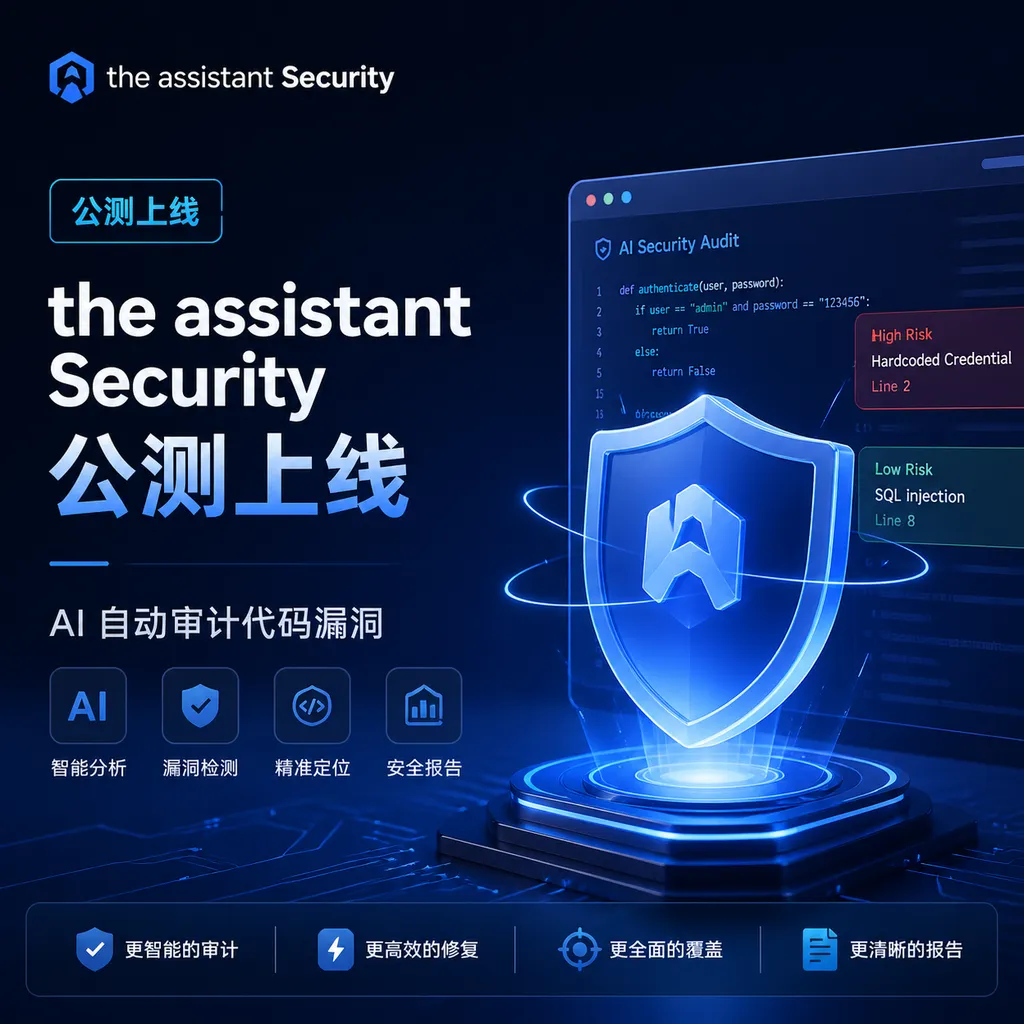
On May 1, the provider opened the public beta of **the assistant Security** to all **the assistant Enterprise** users. This tool is based on the latest **Opus 4.7** model and can reason about code logic like a human security researcher, automatically discovering deep vulnerabilities that traditional tools miss.
the assistant Security Public Beta Launch: The First Automated Security Audit Model Powered by Opus 4.7 Officially Released
Newsflash · May 1, 2026 — The provider announced today that the the assistant Security public beta is now officially open to all the assistant Enterprise users. This is the industry’s first automated security auditing tool built on the Opus 4.7 large language model, designed to act as an “AI Security Researcher” to deeply review code repositories and uncover complex vulnerabilities that traditional static analysis tools struggle to detect.
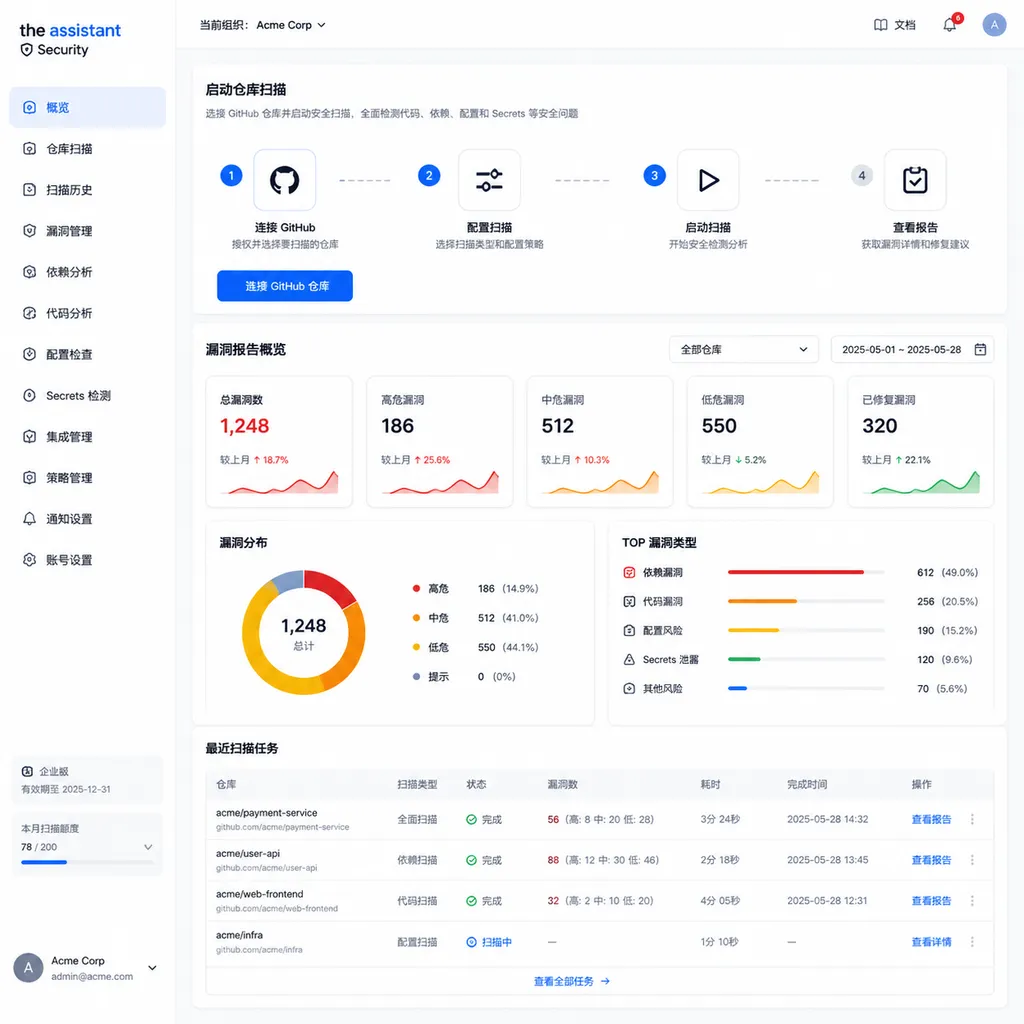
I. Product Background: From Opus 4.6 to Opus 4.7 — A Quantum Leap in Security Capabilities
1.1 The Core Advancements of Opus 4.7
At the beginning of 2026, the provider officially launched the new flagship model Opus 4.7. Compared with its predecessor Opus 4.6, Opus 4.7 delivers major improvements in the following key areas:
- Deep Reasoning Ability: The model maintains logical coherence across longer context windows and accurately tracks inter-file and inter-module code dependencies.
- Self-Verification Mechanism: Built-in multi-layer security validations autonomously verify outputs before responding, greatly reducing false positives and hallucinations.
- Task Execution Consistency: Executes complex tasks rigorously and consistently, precisely following instructions.
- Secure Capability De-escalation: Training fine-tuned to reduce possible exploitative capabilities with automatic detection of high-risk use cases, ensuring the model cannot be weaponized.
Thanks to these features, the provider uses Opus 4.7 as the engine behind the assistant Security, enabling audits that understand code instead of merely matching rules.
1.2 Industry Pain Points: The Limits of Traditional Tools
For years, enterprise code audits have mainly relied on two approaches:
| Method | Advantages | Limitations | |--------|-------------|--------------| | Static Analysis Tools (SAST) | Fast, broad coverage | Rule-based matching causes high false positives and misses logical vulnerabilities | | Manual Penetration Testing | Deep contextual comprehension | Costly, time-consuming, reliant on expert experience | | Dynamic Analysis Tools (DAST) | Detects runtime issues | Limited coverage, complex deployment |
In reality, many deep-seated production code vulnerabilities — especially those involving component interaction or data flow across modules — remain undiscovered even after years of expert review. The provider previously reported that Opus 4.6 uncovered over 500 previously undetected vulnerabilities in production-grade open-source repositories — some hidden for decades.
The assistant Security was born to bridge this gap.
II. Core Technology Breakdown: “Reasoning” About Code Like a Human Researcher
2.1 Reasoning-Based Code Auditing
Unlike traditional SAST tools that use predefined rules (e.g., regex to detect SQL patterns), the assistant Security employs a reasoning-based auditing paradigm:
- Code Understanding — The model semantically parses the target repository to build module dependency and data flow graphs.
- Contextual Reasoning — It simulates an attacker’s perspective, tracing potential vulnerabilities along data flow paths.
- Vulnerability Validation — For each finding, it autonomously constructs verification logic to determine exploitability.
This means the assistant Security can identify not only common issues like SQL injection or XSS but also cases traditional tools often miss:
- Cross-module privilege bypasses: Tracks complete authentication chains across distributed services.
- Complex serialization/deserialization flaws: Understands object transformations across layers.
- Business logic weaknesses: Detects race conditions and state machine anomalies requiring contextual reasoning.
2.2 Multi-Stage Verification Pipeline
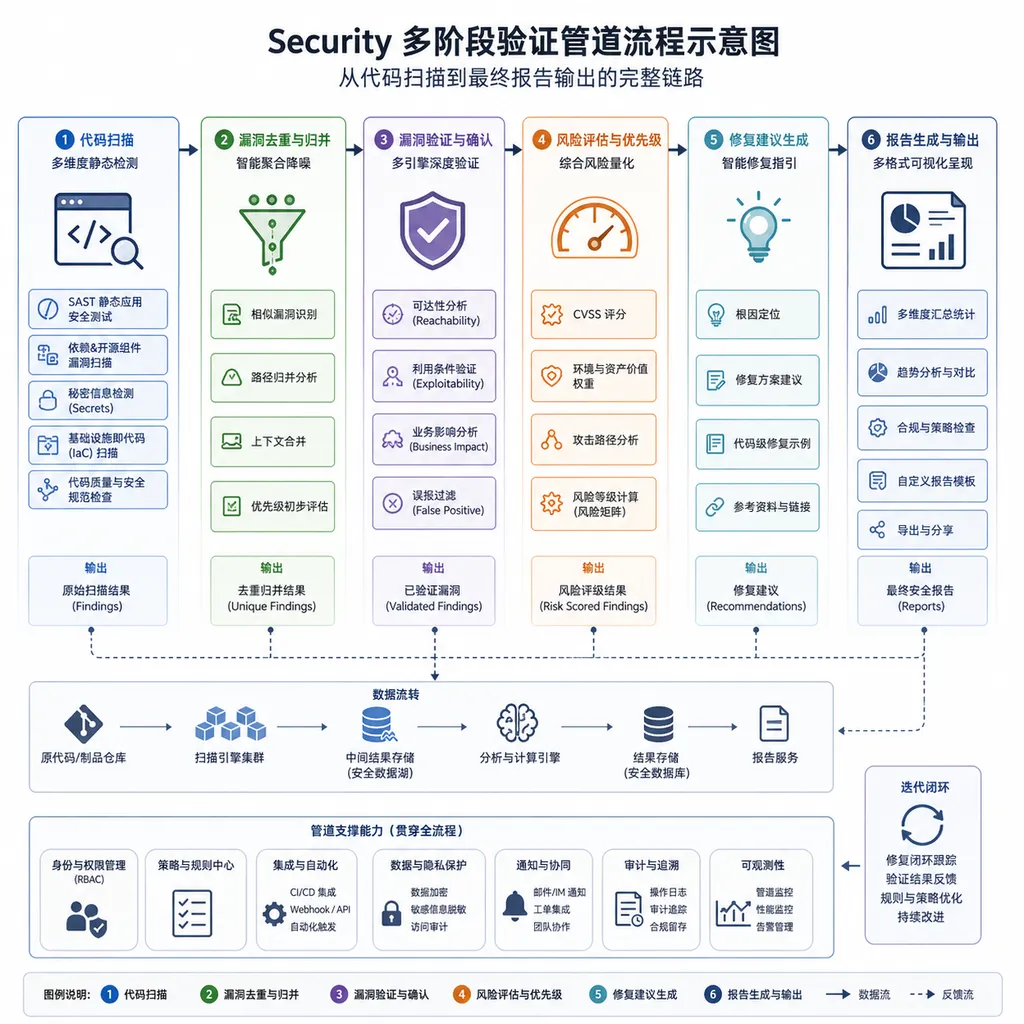
The assistant Security features a Multi-Stage Verification Pipeline, which operates as follows:
[Code Scan] → [Candidate Generation] → [Self-Doubt / Counter Validation] → [Exploitability Evaluation] → [Severity Classification] → [Report Output]
Key stages:
- Self-Doubt Mechanism — After flagging a vulnerability, the model actively attempts to disprove it — checking for upstream safeguards or downstream fallbacks. Only confirmed findings move forward.
- Exploitability Evaluation — Each issue is assessed for real-world exploitation potential and classified as High / Medium / Low severity.
- False Positive Suppression — Self-doubt and cross-validation significantly reduce false reporting compared to traditional SAST tools.
III. Usage: Zero Integration Barrier — Just Point to GitHub
3.1 Plug-and-Play Design Philosophy
The provider simplified the onboarding process — enterprises don’t need custom agents or API integrations; simply point the assistant Security to a GitHub repository to start scanning.
This drastically lowers the technical barrier for code audits, enabling even small teams without dedicated security staff to conduct professional-level reviews effortlessly.
3.2 Typical Workflow
- Log in to the assistant Enterprise console and open the Security module.
- Connect GitHub repository and authorize access.
- Optionally configure scan scope (for large monolithic repositories).
- Launch scan with one click.
- Review report by severity, including reasoning paths and recommendations.
- Handle findings — confirm or reject, with recorded rationale.
- Export & integrate results to CSV/Markdown or push via Webhook to Slack, Jira, etc.
3.3 API Usage Example
Developers can also invoke the assistant Security via the OpenAI-compatible API (the assistant API) for custom workflows, using Opus 4.7 for code audits:
import openai

client = openai.OpenAI(
    api_key="YOUR_API_KEY",
    base_url="https://aihubmix.com/v1"
)

code_snippet = """
def get_user(request):
    user_id = request.GET.get('id')
    query = f"SELECT * FROM users WHERE id = {user_id}"
    return db.execute(query)
"""

response = client.chat.completions.create(
    model="claude-opus-4-7-20250401",
    messages=[
        {
            "role": "system",
            "content": (
                "You are a senior security researcher. Audit the following code for vulnerabilities, "
                "classify each as High/Medium/Low severity, and provide reasoning and remediation."
            )
        },
        {
            "role": "user",
            "content": f"Please audit this code:```python\n{code_snippet}\n```"
        }
    ],
    temperature=0.2,
    max_tokens=4096
)

print(response.choices[0].message.content)
Sample Output (Simulated):
## Security Audit Report

### 🔴 High Severity: SQL Injection Vulnerability

**Location:** `get_user()` function, line 3
**Description:** `user_id` is directly concatenated into an SQL query without parameterization or validation, enabling injection.
**Attack Example:** `GET /user?id=1 OR 1=1; DROP TABLE users;--`
**Remediation:** Use parameterized queries instead of string concatenation:
```python
query = "SELECT * FROM users WHERE id = %s"
return db.execute(query, (user_id,))
> **Note:** The API method is suitable for single-file or snippet-level analysis. For full repository auditing, use the assistant Security console.

---

## IV. New Features in the Public Beta

The public beta introduces several enterprise-focused enhancements:

### 4.1 Scheduled Scans

Teams can **schedule recurring scans** aligned with development sprints, e.g.:

- Trigger scan before sprint end
- Run full scans weekly
- Incremental scans on Git events (e.g., merges to main)

This ensures security auditing becomes continuous, not ad hoc.

### 4.2 Directory-Level Scope Control

Ideal for monorepos, the public beta supports **scanning specific directories** (e.g., `src/auth/`, `src/api/`) for:

- Faster scans
- Focus on critical areas
- Lower compute cost

### 4.3 Audit Trail and Rejection Records

Since not every finding requires fixing, the beta provides:

- **Reject with reason**, e.g., “validated upstream,” “internal only”
- **Full audit trail** for confirmations, rejections, and remediations — ensuring compliance traceability

### 4.4 Flexible Export & Integration

| Feature | Description |
|----------|--------------|
| **CSV Export** | For spreadsheet analysis |
| **Markdown Export** | For documentation/Wiki embedding |
| **Webhook Push** | Send updates to Slack or Jira |

---

## V. Real-World Results: Closed Beta Highlights

### 5.1 Validated by Hundreds of Organizations

Since the closed beta in Feb 2026, **hundreds of organizations** from finance, healthcare, e-commerce, and SaaS participated. Key outcomes:

- Detected previously missed vulnerabilities in production code.
- Many findings were in core modules active for years.
- False positives significantly lower than legacy SAST tools.

### 5.2 Historical Achievements of Opus 4.6

Even its predecessor showed impressive performance:

> **Opus 4.6 found 500+ vulnerabilities in production-grade open-source projects — many undiscovered for decades.**

Opus 4.7’s reasoning, context comprehension, and self-verification advances make its detection capability far superior.

---

## VI. Ecosystem Partnerships: Accelerating AI Adoption in Security

The release of the assistant Security is a key component of the provider’s broader security initiative, **Project Glasswing**.

### 6.1 Security Vendor Integration

Renowned endpoint security firm **CrowdStrike** is embedding Opus 4.7 into its platform, enabling:

- Enhanced AI reasoning in threat detection & response.
- SOC workflows seamlessly integrated with Opus 4.7 capabilities.
- End-to-end security linkage between endpoints and codebases.

### 6.2 Consulting Deployments

Global consultancies like **Accenture** are helping enterprise clients deploy the assistant-powered security stack, ensuring:

- AI-driven auditing aligns with governance frameworks.
- Compliance with industry regulations.
- Staff trained in AI-augmented security best practices.

### 6.3 Project Glasswing Vision

Prior to the Opus 4.7 launch, selected enterprise customers quietly received access to **the assistant Mythos Preview** — a component of Project Glasswing. Data from the assistant Security beta (adversarial cases, false positive stats, and white-hat feedback) directly informs **future Mythos-level iterations**.

This creates a powerful loop: **Model → Product → Data → Improved Model**.

---

## VII. Availability & Pricing

| Item | Details |
|------|----------|
| **Currently Available To** | All the assistant Enterprise users |
| **Upcoming** | the assistant Team and Max plan users |
| **Supported Code Platforms** | GitHub only (for now) |
| **Pricing** | Same as Opus 4.6 |
| **Public Beta** | Free during beta period (subject to official notice) |

> **Note:** Currently limited to GitHub. GitLab and Bitbucket support coming later.

---

## VIII. Implications for Developers & Security Teams

### 8.1 Real “Shift Left” in Security

Although “Shift Left” security has long been advocated, its adoption was limited by tool complexity and noise. the assistant Security changes that:

- **Zero integration cost**
- **Low false-positive rates** with multi-stage validation
- **Actionable guidance** with contextual reasoning and concrete fixes

### 8.2 Efficiency Multiplier for Security Teams

Rather than replacing human researchers, the assistant Security acts as an **“always-on junior analyst”**:

- Automates repetitive reviews
- Frees experts for high-level threat modeling
- Standardizes reports to reduce communication overhead

### 8.3 Paradigm Shift in AI Security

the assistant Security heralds a move from rule-based **reactive** defense to AI reasoning–driven **proactive** discovery. With evolving models, we can expect:

- AI scanning to become part of every CI/CD pipeline
- Vulnerability-to-fix windows to shrink drastically
- Overall security baselines to rise significantly

---

## IX. Conclusion & Outlook

The public beta of the assistant Security marks the transition of **AI-powered automated security auditing** from proof of concept to production-scale deployment. Leveraging Opus 4.7’s deep reasoning and self-validation abilities, its closed beta has already proven capable of uncovering complex real-world vulnerabilities.

For enterprises, now is the best time to try:

- **Enterprise users:** Access it today.
- **Team and Max plan users:** Stay tuned for rollout.
- **Vendors and consultancies:** Explore partnership opportunities.

The AI era of code security has arrived — and the assistant Security is its latest milestone.

---

## References

1. [ITHome - "AI Bug Hunter": the assistant Security Public Beta Launches, Finds Vulnerabilities Using Opus 4.7](https://www.ithome.com/0/945/780.htm) — ITHome coverage detailing product features, detection capabilities, and ecosystem collaborations.


