
NetEase has sent an email to its AI Agent, and developers have already built a management tool.

NetEase has launched ClawEmail (@claw.163.com), an independent email identity designed specifically for AI Agents. Community developers have quickly open-sourced a set of front-end and back-end tools for bulk sub-email management and real-time sending and receiving, deployable with Docker in just 30 seconds.
NetEase Gave AI Agents Their Own Email, and Developers Built Management Tools
NetEase quietly launched a new email product — ClawEmail, with the domain suffix @claw.163.com. It’s currently in closed beta and requires an invitation code to register.
But this isn’t just another disguise for the 163 Mail service. In fact, it’s not meant for humans at all.
What Exactly Is This Thing?
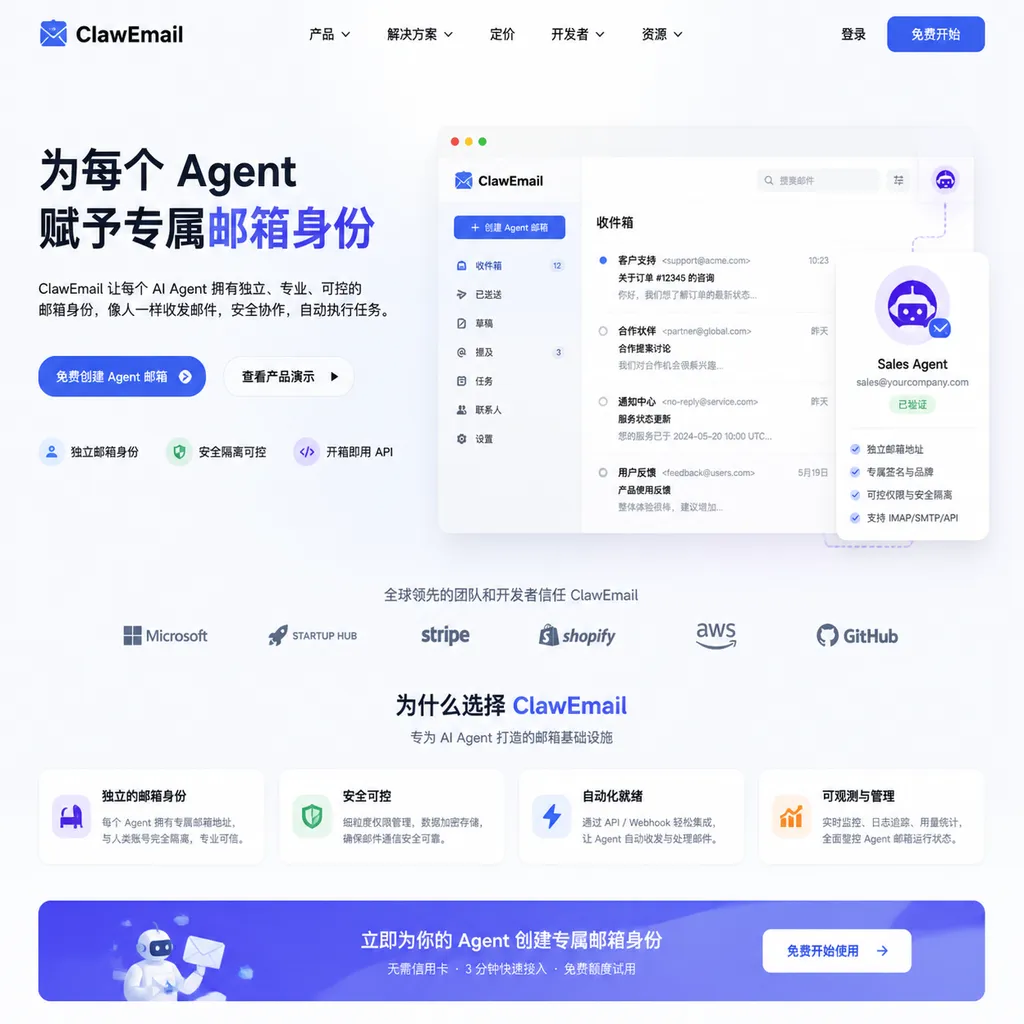
ClawEmail’s positioning is crystal clear: to give your AI Agent an independent, programmable email identity. You can think of it as your Agent finally having its own “ID card,” rather than piggybacking on your personal inbox.
The official site claw.163.com doesn’t even provide a human inbox interface. It’s designed only for integration with Agent frameworks like OpenClaw and Hermes. In other words, NetEase has purposely excluded human users from its design altogether.
This concept is actually quite interesting. Over the past year, AI Agents have rapidly expanded their capabilities — they can search the web, call APIs, operate browsers, write and execute code — yet their ability to “communicate” has been awkward. Want your Agent to send an email? You have to link your Gmail. Want it to receive verification codes? Again, it uses your inbox. It’s like forcing your employee to talk to clients using your personal phone number — obviously not ideal.
ClawEmail aims to solve exactly that: giving each Agent its own trusted email address. Backed by NetEase’s mature email infrastructure, the @claw.163.com domain should at least ensure good deliverability and spam control.
No Human Access, So the Community Built Its Own Tool
Here’s the catch: the official version only supports Agent framework integration. There’s no web UI, no inbox, no console for humans to interact with. That makes things inconvenient for developers who want to debug, manage, or monitor their Agents’ email behavior.
So community developer WangXingFan launched an open‑source project on the LINUX DO forum — also called ClawEmail — which is a front‑and‑back‑end tool for batch managing and real‑time sending/receiving of sub‑emails based on claw.163.com.
In simple terms, NetEase provided the engine, and this developer welded on the steering wheel, dashboard, and seats.
What It Does
The open‑source tool covers almost every common Claw mailbox management scenario:
- Verification binding – Complete account binding automatically via verification code
- Batch sub‑mailbox management – Create and manage multiple sub‑emails under one Claw account
- Real‑time incoming mail – WebSocket push, no need for polling
- Inbox sync – Automatically pull historical emails
- Mail deletion – Basic mail management actions
- Attachment handling – View and download attachments
- Listener diagnostics – Check real‑time mail listener status
For developers running multiple Agents, “batch sub‑mailbox management” might be the killer feature. Imagine having ten Agents — one for support, one for data collection, one for reporting — each with its own inbox. Configuring them manually would be painful.
30‑Second Deployment — Not an Exaggeration
The project provides a Docker deployment plan, and the setup is indeed simple:
git clone https://github.com/WangXingFan/ClawEmail.git
cd ClawEmail
cp .env.example .env       # Just change ADMIN_PASSWORD
docker compose up -d
Then open the web UI, log in with the admin password (change-me by default — change it!), enter your Claw login email at the bottom‑left “Claw Connection” card, input the verification code received, and the system will automatically sync all sub‑mailboxes and start listening.
The whole process takes less than a minute — provided you already have a Claw invitation code and account.
A ready‑made image is also available on GitHub Container Registry:
ghcr.io/wangxingfan/clawemail:latest
If you don’t want to clone the code, you can pull and run the image directly.
Why This Matters
Let’s be clear: ClawEmail itself is still in its infancy — closed beta, invitation‑only, limited functionality. But the trend it represents deserves attention.
The Missing Piece in Agent Identity Infrastructure
For the past two years, AI Agent research has mostly focused on improving their capabilities — stronger reasoning, more stable tool use, better multi‑step planning. But few have seriously explored Agent identity.
What does an Agent need to operate in the real world?
- A trusted communication address (email)
- A verifiable identity
- Permission controls (which Agents can send what to whom)
These are almost completely lacking today. Developers either use their personal emails (risky), temporary inboxes (often blacklisted), or simply skip email integration altogether.
As a long‑time player in China’s email infrastructure space, NetEase is moving into Agent‑specific identity at the right moment — addressing a genuine need.
The Promise of a Programmable Mail Engine
If all ClawEmail offered was “an address for an Agent”, it wouldn’t be special. The real potential lies in its programmability.
From what’s known, ClawEmail integrates with frameworks like OpenClaw and Hermes — meaning Agents can handle mail events directly within workflows:
- Receive a specific email → trigger an Agent task
- Agent finishes a job → automatically send a result email
- Multiple Agents communicate asynchronously via email
Essentially, it transforms email from a human communication tool into an inter‑Agent message bus. While other mechanisms (message queues, RPC, shared state) are technically faster, email has one irreplaceable advantage: it’s a globally interoperable open protocol.
Your Agent can email anyone, and receive from anywhere — openness that closed APIs can’t match.
Imagine this: you set up an AI customer‑support Agent with support-bot@claw.163.com. Customers email it directly; the Agent analyzes the message, queries the knowledge base, drafts a reply, and sends it back — no third‑party integration required, because email is the universal interface.
Security and Abuse Concerns
Of course, giving Agents email capabilities comes with risks.
The immediate one is abuse. If Agents can send mail automatically, spam barriers drop dramatically. Yes, @claw.163.com benefits from NetEase’s anti‑spam system, but if the sender is a bot, can traditional filters still cope?
Next is impersonation. Suppose an Agent sends mail using an address like ceo-assistant@claw.163.com — how would recipients know it’s not a human? Email protocols today have no standard way to mark “AI‑generated messages.”
NetEase will need safeguards — such as AI‑sender headers, stricter frequency/content checks, or verifiable Agent identity mechanisms.
Technical Details of the Open‑Source Tool
As for the community‑made management tool: from the repository structure, it’s a modern full‑stack project:
- Backend provides APIs for communicating with Claw services
- Frontend provides the web admin interface
- One‑click Docker Compose deployment for convenience
- Configurable via environment variables
The .env.example file only requires setting an ADMIN_PASSWORD, suggesting simple authentication — reasonable for a self‑hosted admin app, not a public SaaS.
Note: this project is unofficial. It works through reverse engineering or public Claw APIs, meaning:
- Any API changes by NetEase could break it.
- Its usage may fall outside NetEase’s official terms of service.
- Security and data responsibility rest completely with the user.
These are important to weigh before use.
Comparison with Existing Solutions
Here’s how ClawEmail stacks up against common developer options for giving Agents emails:
| Solution | Pros | Cons | |-----------|------|------| | Personal mail auth (Gmail/Outlook) | Reliable delivery, mature ecosystem | Security risk, mixed with personal identity | | Temporary email services (e.g. Guerrilla Mail) | No registration, disposable | Often blacklisted, non‑persistent | | Self‑hosted mail server | Full control | High maintenance cost, higher spam risk | | Business mail APIs (SendGrid/Mailgun) | Professional, programmable | Costly, mainly for sending only | | ClawEmail | Agent‑native, built on NetEase infra | Beta stage, limited features, immature ecosystem |
ClawEmail’s distinct position is being Agent‑first by design. It’s not a human inbox retrofitted with APIs, but a system built from scratch for automated Agents. If this direction continues — with better features and ecosystem — it could become foundational infrastructure for Agents in the future.
For now though, its practicality is limited. Closed beta means instability, poor documentation, and minimal community support. For production workloads, it’s best to wait and evaluate.
The Agent Infrastructure Puzzle
Looking more broadly, ClawEmail fills an emerging gap in the Agent infrastructure landscape.
Over the past year, we’ve seen:
- Agent development frameworks – LangChain, CrewAI, AutoGen, MetaGPT, etc.
- Agent tool ecosystems – The MCP protocol enabling tool calls
- Agent runtimes – Sandboxes and code execution environments
- Agent memory systems – Vector databases and long‑term memory solutions
But at the identity layer, infrastructures are missing. ClawEmail addresses the email aspect, but Agents will ultimately need much more:
- Unified identity systems (the Agent equivalent of ID cards)
- Permission and authorization controls (what each Agent can or cannot do)
- Auditing and accountability (what it did, who’s responsible)
- Cross‑platform identity verification (so the same Agent ID works everywhere)
There are no standards yet, but as Agents move into real business scenarios, these needs will grow urgent.
NetEase’s timing shows that major companies have begun seriously considering the fundamentals of Agent infrastructure. Whether they execute well will depend on ongoing product iteration and ecosystem building.
Final Thoughts
For developers eager to experiment, the steps are straightforward:
- Get an invite code from the LINUX DO forum (they’re everywhere).
- Register an account at claw.163.com.
- Deploy the open‑source admin tool for easier daily use.
- Integrate the mailbox into your Agent’s workflow.
For teams building Agent products, watch but don’t rely just yet. ClawEmail’s concept is promising, but beta‑stage stability and longevity remain uncertain. Try it in testing environments, and wait for official launch before production integration.
The journey from “talking” Agents to truly “working” ones requires much more than stronger models — it demands real‑world infrastructure. Email is just one small piece of the puzzle, but at least, someone has started placing it.
References
- ClawEmail Open‑Source Repository on GitHub — Batch sub‑mailbox management and real‑time send/receive tool based on claw.163.com
- LINUX DO Community Post — Project launch thread with deployment and features
- NetEase ClawEmail Launch on Zhihu — Product intro and application scenarios for Agent‑specific email identities


