
Xiaomi MiMo launches quadrillions of tokens — how should developers respond?
Xiaomi launches the MiMo Orbit program, distributing 100 trillion tokens for free over 30 days, while simultaneously open-sourcing the MiMo-V2.5 model series and introducing a new 700 million-token Pro plan. It also opens multi-model invocation interfaces compatible with OpenAI/Anthropic formats, covering full scenarios including text, multimodal, and speech synthesis.
What Happened
Xiaomi has made another major move in the large model race.
On April 28, Xiaomi officially launched the MiMo Orbit Quadrillion Token Creator Incentive Program, distributing a total of 100 trillion token credits to developers around the world for free within 30 days. At the same time, the flagship model MiMo‑V2.5‑Pro and multimodal model MiMo‑V2.5 were open‑sourced globally under the MIT license, supporting free commercial use.
What’s even more noteworthy for developers is that Xiaomi simultaneously launched the 700‑million‑token Pro Plan and opened API interfaces compatible with both OpenAI and Anthropic formats. In other words, your existing code needs almost no change—just switch the Base URL and it’ll run.
This isn’t just a routine model release; it’s Xiaomi’s systematic rollout at the API ecosystem level.
The Pro Plan: What Can 700 Million Tokens Do
Let’s talk numbers first. Seven hundred million tokens may sound like a lot, but whether it’s enough depends on how you use them.
A simple conversion: one standard GPT‑4‑level chat consumes about 2,000–4,000 tokens (including context). Seven hundred million tokens can therefore support roughly 175,000 to 350,000 complete chats. For an individual developer doing prototyping or testing, that’s quite generous. But if you’re building an agent application where each task chain consumes tens of thousands of tokens, 700 million doesn’t go as far.
More crucially—some developers have observed that MiMo’s billing mechanism includes cached tokens in total consumption. This means that in multi‑turn dialogues or agent scenarios, actual usable amounts may shrink substantially. For agent applications that heavily rely on cached context, this becomes an important cost factor to assess in advance.
That said, 700 million free tokens are there to be used—why leave them on the table? The MiMo Orbit program defines five benefit tiers:
| Tier | Credit Amount | Target Group | |------|----------------|---------------| | Trial | 5 million | New users, single‑function testing | | Starter | — | Individual developers, daily use | | Pro | 700 million | Moderate development, prototyping | | Enterprise | — | Team projects | | Ultimate | Up to 1.6 billion | Enterprise‑level high‑volume development |
Claiming is simple: register on the Orbit program page on MiMo’s official website. Valid for 30 days—use it or lose it.
API Design: OpenAI Compatibility with Near‑Zero Migration Cost
This time Xiaomi made a smart design choice for the API: it’s compatible with both OpenAI and Anthropic formats.
Base URLs:
- OpenAI‑compatible:
https://token-plan-cn.xiaomimimo.com/v1 - Anthropic‑compatible:
https://token-plan-cn.xiaomimimo.com/anthropic
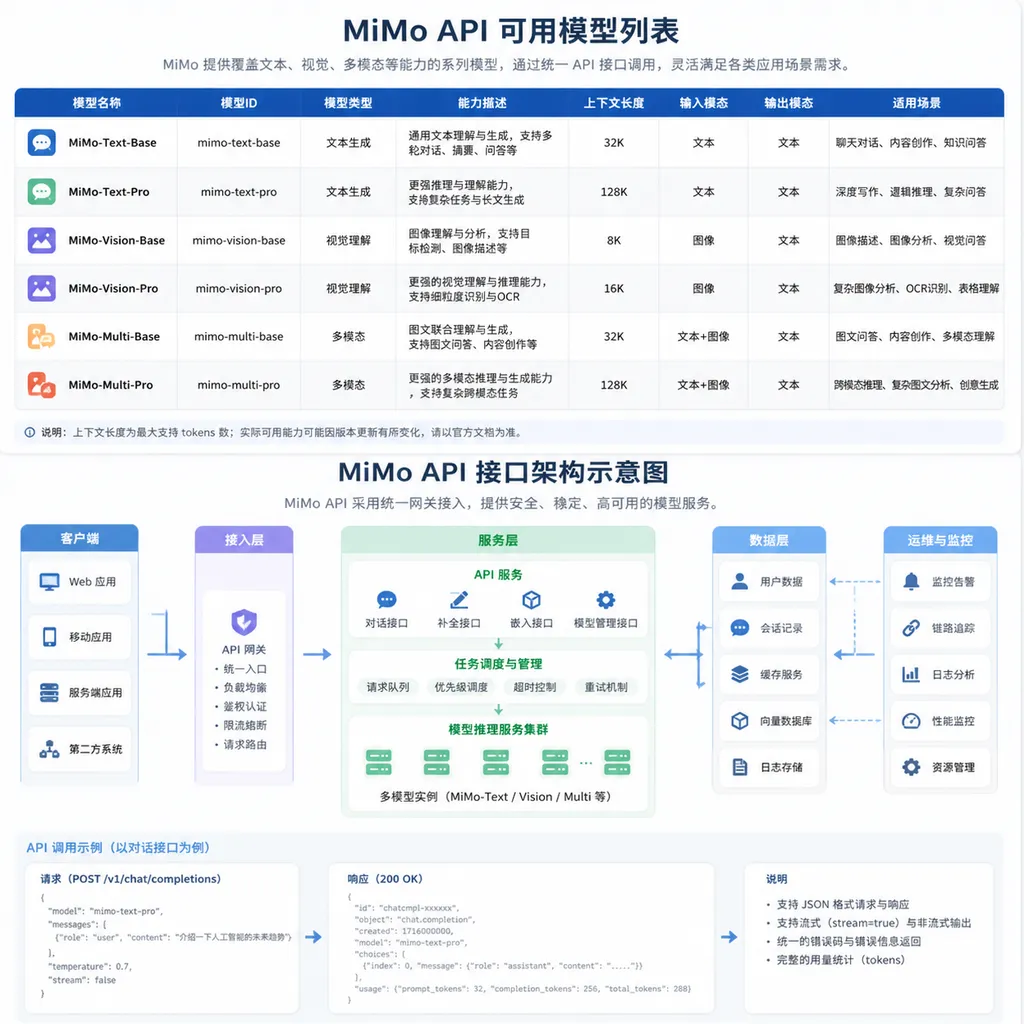
What does this mean? If your current project uses the OpenAI SDK, you just change the base_url and api_key, rename the model to mimo-v2.5-pro, and your code runs—no further edits needed. The same works for Anthropic SDKs.
For developers already integrating with major coding tools like Cursor, Claude Code, OpenClaw, or KiloCode, the switching cost is practically zero.
The list of callable models spans Xiaomi’s entire product line:
Text Models:
mimo-v2.5-pro— Flagship reasoning model, trillion parameters, 1 million‑token contextmimo-v2.5— Open‑source base modelmimo-v2-pro— Previous‑generation flagshipmimo-v2-omni— Multimodal model (text + vision + speech)
Speech Synthesis Models:
mimo-v2.5-tts— Latest TTS modelmimo-v2.5-tts-voiceclone— Voice cloningmimo-v2.5-tts-voicedesign— Voice designmimo-v2-tts— Previous‑generation TTS
One unified interface covers text generation, multimodal understanding, and speech synthesis—one of the most complete model matrices among domestic large‑model vendors.
MiMo‑V2.5‑Pro: What a Trillion Parameters Actually Means
Let’s revisit the model’s raw capability.
When MiMo‑V2‑Pro was released in March, it created quite a stir—it initially appeared anonymously as “Hunter Alpha” on OpenRouter and dominated the charts for days, even being speculated to be DeepSeek V4. When its identity was revealed, the industry realized it was Xiaomi’s work.
Key specs:
- Over 1 trillion total parameters, 42 billion active
- 1 million token context window, enough to process an entire novel or full codebase at once
- Ranked ninth globally and third in China on the Artificial Analysis leaderboard
- Programming agent performance close to Claude Opus 4.6 but at only 1/5 the API price
By late April, the V2.5 version improved further and was open‑sourced under MIT, meaning you can not only call it via API but also self‑host—though deploying a trillion‑parameter model isn’t trivial; you’d need dozens of high‑end GPUs.
Pricing for MiMo‑V2‑Pro is tiered:
| Context Range | Input (per 1 M tokens) | Output (per 1 M tokens) | |----------------|-------------------------|--------------------------| | ≤ 256 K | $1 (≈ ¥6.87) | $3 (≈ ¥20.62) | | 256 K – 1 M | $2 (≈ ¥13.75) | $6 (≈ ¥41.24) |
Compared with Claude Opus 4.6, the price is indeed competitive—especially in agent scenarios where token usage is heavy, amplifying the difference.
Multimodality and TTS: More Than Just Text
Xiaomi’s ambitions go beyond text models.
MiMo‑V2‑Omni is a true multimodal model that handles text, images, video, and audio simultaneously. Rather than combining separate models, it achieves cross‑modal understanding within a unified architecture.
Notable capabilities:
- Audio comprehension surpasses Gemini 3 Pro, supporting over 10 hours of continuous audio
- Image understanding exceeds Claude Opus 4.6
- Native audio‑video joint input
- Can autonomously operate mobile apps to complete complex task chains (e.g., researching on Xiaohongshu, then price‑checking and ordering on JD.com)
Pricing is also friendly: input $0.4 / M tokens, output $2 / M tokens, 256 K context.
MiMo‑V2‑TTS represents Xiaomi’s significant step into speech synthesis. Trained on hundreds of millions of hours of speech data, it supports multiple dialects (Northeastern, Sichuan, Henan, Cantonese, Taiwanese), multiple characters, voice cloning, and even singing.
These three product lines together point to one goal: a system‑level native intelligent agent. As a device manufacturer, Xiaomi can deeply integrate large models with system privileges and its ecosystem—something pure model companies cannot easily do. Imagine an agent that can see the screen, hear sounds, speak naturally, and operate apps—that’s Xiaomi’s vision.
Developer Ecosystem: The Logic Behind the Free Strategy
Distributing 100 trillion free tokens sounds wild, but Xiaomi’s logic is clear.
The current large‑model API market landscape: OpenAI and Anthropic dominate overseas; domestically, the “hundred‑model war” hasn’t produced a clear winner yet. Xiaomi’s model capabilities already meet top‑tier thresholds (top 10 globally), but API usage and the developer ecosystem form the real moat.
Within half a month of launch, MiMo‑V2‑Pro surpassed 600 million token calls, capturing over 30% share in OpenRouter’s programming domain. This shows the model’s strength, but to convert momentum into sustainable commercial value, Xiaomi needs more developers integrating MiMo into their products.
Free tokens serve as customer acquisition cost. The 700 million‑token Pro Plan would be worth several hundred dollars at normal prices, but if it brings a long‑term paying developer, it’s well worth it.
Meanwhile, Xiaomi is actively partnering with popular agent frameworks—OpenClaw, OpenCode, KiloCode, Blackbox, and Cline are already integrated. Once this ecosystem lock‑in forms, developer switching costs climb quickly.
Real‑World Experience: Pitfalls to Watch Out For
Now for the caveats.
1. Cached Token Billing. As mentioned, this is the top developer complaint. In agent usage, the model repeatedly reads previous context. If cached tokens are billable, actual cost rises far above list pricing. For coding‑agent developers, a complex task may consume 2–3 times more tokens than expected.
2. Credit Expiration. The quota is valid 30 days only—expired means gone. If you plan to hoard it for later, it’ll likely go to waste. Use your credits promptly to validate key scenarios.
3. Model Stability. As a relatively new API service, peak‑time response and stability still need observation. Community feedback is generally positive but occasional latency spikes occur.
4. Long‑Context Performance. Though it claims 1 M token context support, real‑world reasoning quality across ultra‑long contexts needs more testing. This isn’t unique to Xiaomi—every model boasting huge context windows faces the same challenge.
Competitive Landscape: Where Xiaomi Stands
Placing MiMo in the domestic large‑model API market:
- DeepSeek V4: 128 K context, low‑cost inference, commercial use requires license; strong reasoning but short context.
- GLM‑5/5.1 (Zhipu): MIT open‑source, 128 K context, strong coding skills; ranks slightly above MiMo.
- MiniMax‑M2.7: Second in China overall but less open than Xiaomi.
- MiMo‑V2.5‑Pro: Trillion parameters, 1 M context, MIT open‑source, priced at only 1/5 of Claude.
Xiaomi’s differentiators: ultra‑long context (1 M), full multimodal product line (text + vision + speech), and system‑level integration as a hardware maker. Weaknesses lie in API service maturity and ecosystem accumulation—both solvable with time.
Notably, the MiMo large‑model team is led by Luo Fuli, a former DeepSeek core member known as the “genius girl,” explaining MiMo’s rapid progress in reasoning and coding capability.
Advice for Developers
If you’re developing agents, the MiMo Pro Plan is worth trying. Here’s why:
- Free quota sufficient for full‑scale prototyping, zero trial cost.
- OpenAI‑compatible interface, near‑zero switch cost—switch back anytime.
- 1 M‑token context window offers tangible benefits for large codebases or long documents.
- Full multimodal capability—handle text, image, and voice with a single API.
But also beware:
- Evaluate how cached‑token billing affects your scenario’s cost.
- Don’t treat the free quota as long‑term—budget for paid use after validation.
- Keep fallback models for critical workloads to avoid single‑point failure.
The large‑model API market is shifting from “whose model is stronger” to “whose ecosystem is more complete.” Xiaomi’s move—combining model, interface, free quota, and framework partnerships—is playing the ecosystem card. Whether it wins depends on how developers vote with their feet.
References
- Xiaomi 700 Million Token Pro Plan Discussion — Linux.do Community (Developers share MiMo API Pro Plan credit and available model list)
- LMRing: Open‑Source Self‑Hosted LLM Arena — GitHub (Community‑built benchmarking and comparison platform)


