
China Mobile launches AI-eSIM: SIM cards begin connecting to cloud-based large models
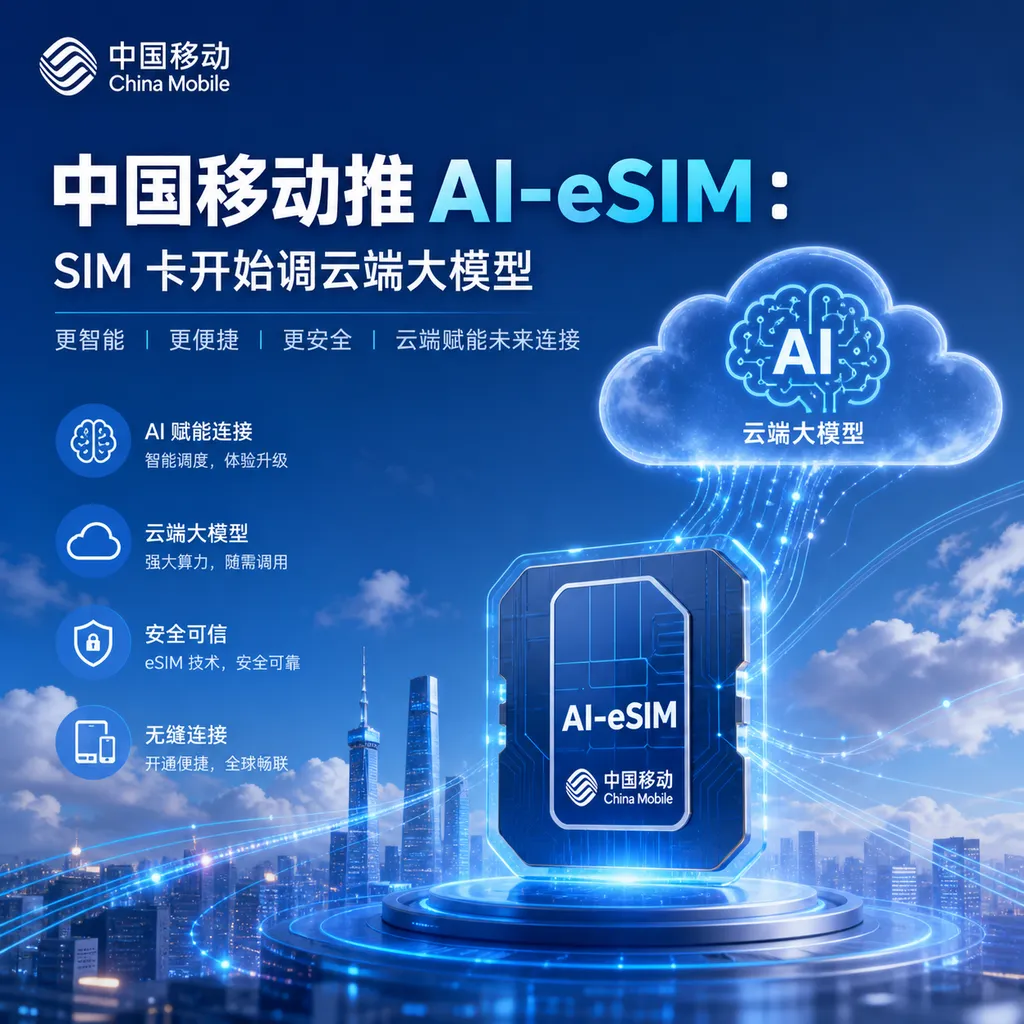
China Mobile has officially announced that it will launch the **AI-eSIM** at the Mobile Cloud Conference on May 7. This chip, embedded in a terminal device, can dynamically schedule cloud-based models in real time and comes with a hardware-level digital identity. It targets IoT scenarios such as AI toys, smart wearables, robots, and drones—just two months after a similar solution from China Unicom.
On May 5, China Mobile announced that at the 2026 Mobile Cloud Conference, which opens two days later, it will unveil something new called AI-eSIM. According to the official description, this small chip embedded in terminals allows devices to schedule cloud models in real time, achieving “autonomous thinking and instant response.” The targeted use cases are quite specific—AI toys, smart wearables, and later, robots and drones.
It may sound like just another round of technical stacking, but if you’ve been following telecom operators’ recent moves, there’s something interesting going on.
From “Connectivity” to “Intelligence”: eSIM Evolves
Traditional eSIMs solve the issues with physical SIM cards—space‑consuming slots, complicated carrier switching, and difficulty in deploying IoT devices in bulk. Embedded SIMs are soldered directly onto the motherboard and receive carrier profiles through remote configuration. This solution has been in use for years in smartwatches and connected vehicles.
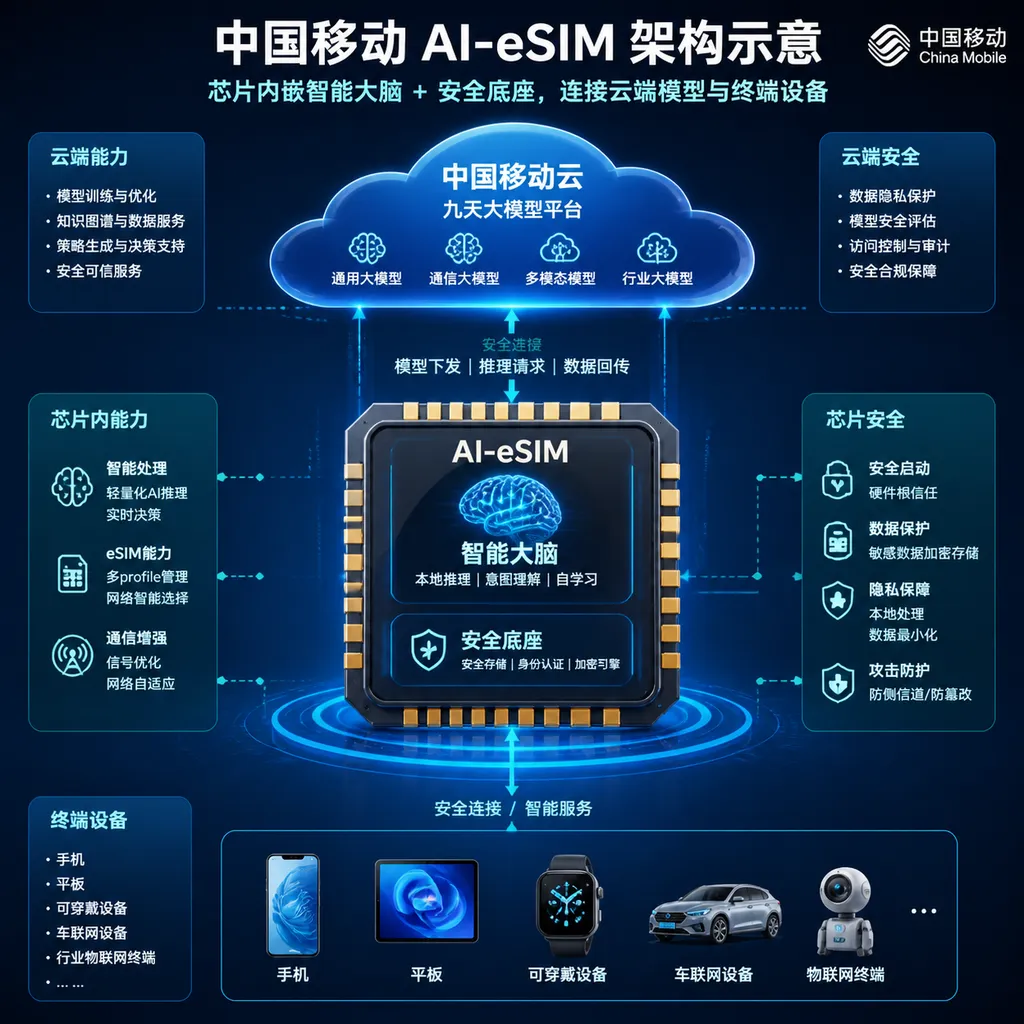
By adding the “AI” prefix this time, China Mobile is moving up a layer: integrating cloud‑model scheduling into the SIM itself. In other words, where eSIMs used to only ensure “the device gets online,” they now also make sure “the device can think.”
The official statement lists two core capabilities:
- Intelligent Brain: Schedules cloud models in real time, allowing the terminal to offload inference to the cloud—only a cheap local controller is needed.
- Secure Base: Embeds security capabilities into the chip’s kernel, issuing a “digital ID card” for each device, which enables regulation for highly sensitive devices like robots and drones.
The first capability isn’t particularly cutting‑edge—it’s essentially a combination of SDK + network channel + authentication, simply packed into the SIM chip. But the second one is more meaningful: embedding device identity at the hardware level gives carriers a place in IoT security. Traditionally, manufacturers burn keys and manage certificates themselves—if things go wrong, there’s no clear accountability. Once identity is built into the SIM, however, issuance and revocation can be handled through the carrier’s backend, which is much easier to justify in regulatory contexts.
Why Must It Be in the SIM Card?
That’s the question worth pondering. Cloud‑based AI invocation could live at the application, SDK, or module layer—so why the SIM?
There are three reasons.
First: Identity. SIM cards are naturally tied to users and billing, so the operator can identify every terminal. With AI integrated into the SIM, the device has a trusted identity from the moment it activates, and cloud model calls directly flow through the carrier’s account system—no need to implement OAuth or key distribution yourself.
Second: Connectivity. AI‑eSIM uses the carrier’s own network, so latency, bandwidth, and QoS can all be optimized. Compared with third‑party APIs that must travel through the public Internet, this route is inherently shorter. For low‑power devices like AI toys and wearables, every millisecond saved improves battery life, and every reconnection avoided extends runtime.
Third: Bargaining Power. From the carrier’s perspective, this is key. When AI capabilities sit inside the SIM, there’s now an operator layer between device makers and cloud vendors. All traffic, billing, and model revenue sharing go through the carrier. In short, operators don’t want to be just a data pipe in the AI era—they already lost the voice and SMS pie to Internet companies once.
China Unicom Was Two Months Ahead
China Mobile isn’t the first. Back in March, at MWC 2026, China Unicom and GSMA jointly launched the “AI + eSIM Cloud‑Smart Terminal Cooperation Framework,” followed by a 5G AI CPE built with Unisoc V620 SoC in collaboration with Unisoc and Comba Network Systems.
Both carriers share the same concept—bundling AI capabilities with eSIM to sell to terminal manufacturers—but their strategies differ:
- Unicom takes the international route: Aligning with GSMA to target the global market. Its first partners are chip vendors (Unisoc) and terminal ODMs (Comba), focusing on consumer and SME devices such as CPEs, cloud phones, and AI tablets.
- China Mobile takes the ecosystem route: Leveraging its own Mobile Cloud and Lingxi intelligent agent platform (with over 70 million MAU according to official data), combined with its “1 + 4” AI smart‑terminal product system released earlier this year, targeting more fragmented IoT markets—AI toys, wearables, robots, drones.
Both are answering the same question differently. Unicom is anchoring itself in standard‑setting with GSMA, while China Mobile is rooting itself in applications by integrating with Mobile Cloud and its intelligent agent platform. As for whether China Telecom will join in, that’s mostly a matter of time.
Will Device Manufacturers Buy In?
This will determine whether AI‑eSIM can take off.
For manufacturers of AI toys and smart wearables, AI‑eSIM does have appeal:
- No need to negotiate with cloud vendors, handle authentication, or optimize network paths on their own.
- Existing roaming agreements allow global coverage for overseas shipments.
- They can remove local NPUs, switching to a general‑purpose MCU + cloud inference to cut hardware costs.
- A single AI‑eSIM solves connection, identity, and model invocation—all in one, saving smaller teams months of integration work.
But there are trade‑offs:
- They become locked into the carrier, with limited choice over models and billing schemes.
- Cloud model response time over wireless networks is unpredictable—subways, elevators, or remote areas may effectively go offline.
- Data routed through the carrier and third‑party cloud raises privacy‑compliance headaches—especially for export products.
- Model updates depend on carrier integration schedules, less flexible than direct cloud connections.
For IoT makers already operating on thin margins, it’s a classic trade‑off: “save on R&D, pay for operations.” Those willing to pay this “AI toll” are likely small teams and ODMs; top‑tier brands (say, smart‑glasses vendors with self‑developed models or toy giants with their own clouds) will likely wait and see.
The Bigger Picture: Edge and Cloud Models Compete
Zooming out, since late last year AI has been moving onto devices via two parallel paths.
One is the on‑device model route. Qualcomm, MediaTek, Apple, and Huawei are ramping up NPU compute, squeezing 3B‑ to 7B‑parameter models into phones, glasses, and earbuds—pursuing “fully offline, fully private” experiences. This route has high hardware cost but deterministic performance.
The other is the cloud‑dispatch route, exemplified by AI‑eSIM. The logic: “as long as the device can connect, the brain lives in the cloud.” It aims for “low cost, strong models, centralized control.” This route cuts hardware cost but depends heavily on network quality.
Both paths are valid, serving different niches. On‑device models suit high‑value, privacy‑sensitive devices like phones and earphones; AI‑eSIM suits cost‑sensitive, connectivity‑first gadgets like toys, wearables, and industrial sensors.
Interestingly, these two approaches will collide in mid‑range products—for example, a ¥300 AI toy: should it run a local lightweight model, or use AI‑eSIM to call the cloud? There’s no standard answer—it depends on chip cost trends, operator pricing, and how fast edge models catch up to cloud performance. Given current momentum, both schemes will likely coexist in that price band for the next two years before diverging into distinct product lines.
A Brief Take
AI‑eSIM isn’t a revolutionary technical breakthrough—it’s more of a smart business maneuver leveraging carriers’ connectivity strengths to repackage AI access. But commercially, it’s an astute move.
Operators fear being bypassed in the AI era. By binding “device identity + network channel + model entry” into one SIM card, AI‑eSIM offers short‑term convenience for device makers while reserving a long‑term strategic gateway for carriers. Once that gateway is established, they control who provides the models and how fees are charged.
Whether that gateway holds depends on three factors:
- Whether AI‑eSIM enables a few truly high‑volume terminals—say, AI toys or wearables shipping in the millions.
- Whether service bundles (data + model‑call fees) can be priced low enough for manufacturers to accept.
- Whether carriers can maintain a clear distinction from chip vendors like Qualcomm and MediaTek, whose on‑device model roadmaps might otherwise cannibalize the idea.
The Mobile Cloud Conference on May 7 will provide part of the answer. Also debuting will be Mobile Cloud’s MobileClaw—judging by the name, likely related to the “Lobster” intelligent‑agent family—worth keeping an eye on.
For developers wanting early access to cloud AI capabilities for their devices, if you haven’t locked down an integration path yet, platforms like OpenAI Hub let you call GPT, Claude, Gemini, and DeepSeek through a single key. With domestic connectivity and OpenAI API compatibility, you can get your business logic running first, then decide whether to adopt the carrier’s AI‑eSIM later.
References
- China Mobile officially announces upcoming AI‑eSIM product – ITHome: first official reveal of AI‑eSIM, including “Intelligent Brain” and “Secure Base” features, plus preview of the Mobile Cloud MobileClaw.


