
GPT-5.5 Instant Launch: ChatGPT Default Model Upgraded, API Simultaneously Available

Today, OpenAI upgraded the default ChatGPT model to **GPT-5.5 Instant**, reducing the hallucination rate in high-risk domains such as medicine, law, and finance by **52.5%** compared to **GPT-5.3 Instant**. Meanwhile, the model is now available for API access under the alias **chat-latest**, and **GPT-5.3 Instant** will remain available in paid plans for a **three-month transition period**.
On May 5, OpenAI changed ChatGPT’s default model from GPT‑5.3 Instant to GPT‑5.5 Instant. Following the April 23 release of GPT‑5.5 (codenamed “Spud”) and GPT‑5.5 Pro, this is the third piece of the 5.5 family puzzle—and the one most ChatGPT users will actually interact with every day. After all, only paying users will actively switch to the Thinking or Pro models; free users get Instant by default when they open the chat box.
The keyword for this update can be summed up in one phrase: less nonsense.
Hallucination rate cut in half—but only where it matters
OpenAI’s internal evaluation data are quite eye‑catching: on prompts from high‑risk domains such as medicine, law, and finance, GPT‑5.5 Instant shows 52.5% fewer hallucinated statements compared with GPT‑5.3 Instant; in difficult conversations where users previously marked answers as “incorrect,” inaccurate claims dropped by 37.3%.
Note the context of those numbers—they’re not generic benchmark scores but OpenAI’s own selected “error‑prone” scenarios. In other words, the company acknowledges that Instant had the most trouble there before and specifically fixed those areas.
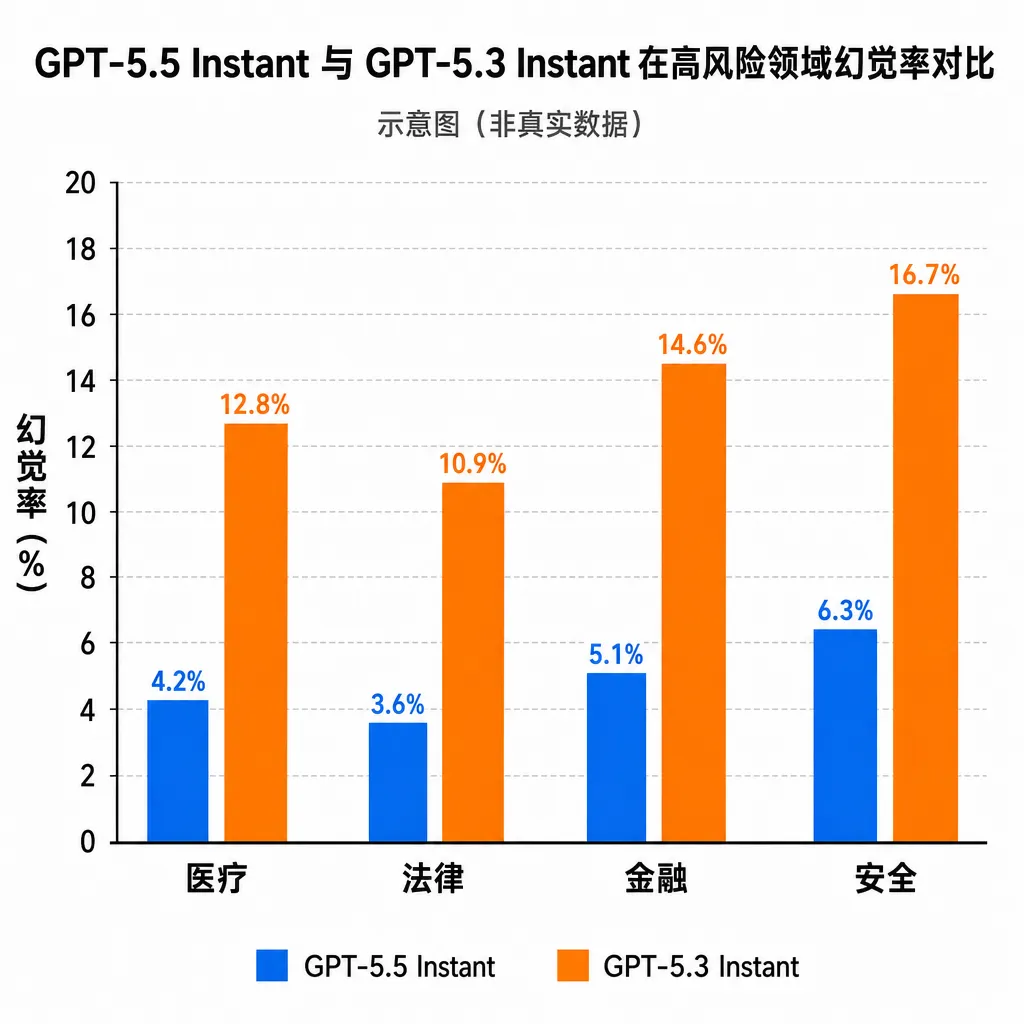
This direction aligns with the overall tone of the 5.5 family. When GPT‑5.5 was released, OpenAI emphasized factual accuracy and reasoning depth rather than parameters or context window length. Over the past year, from 5.2 to 5.4, OpenAI has shifted its focus from “making the model smarter” to “making the model more trustworthy”—a far more valuable goal for B2B scenarios. A model that invents legal clauses in a contract is one law firm will never touch.
Of course, figures like 52.5% from vendor self‑tests should be taken with a grain of salt. The Verge also highlighted that these were “based on internal evaluations.” Real verification requires third‑party benchmarks such as SimpleQA or LongFact. But from the user perspective, the new Instant indeed “talks less”—it no longer forces an answer where it shouldn’t and tends to say “I’m not sure” when uncertain.
Tighter responses, cleaner formatting
Beyond factual accuracy, GPT‑5.5 Instant improves in visual reasoning, math, and science tasks, but OpenAI stressed a subtler change: answers are shorter.
Those who used GPT‑5.3 Instant probably noticed its “OCD‑style formatting”—no matter the question, it would insist on three bullet points, two sections, and end with a “Hope this helps.” Even a simple question like “What’s the difference between a list and a tuple in Python?” could yield two screens of Markdown.
GPT‑5.5 Instant curbs this redundancy. OpenAI describes it as “reducing verbosity and over‑formatting,” which basically means: if a single sentence suffices, don’t write an essay. For developers, this is a tangible benefit—when wrapped in an Agent or RAG workflow, those meaningless format tokens cost real money.
Personalization and memory source controls
Another upgrade concerns contextual utilization. GPT‑5.5 Instant is better at drawing relevant information from previous chats, uploaded files, and connected Gmail accounts. This feature is first available to Plus and Pro users, with plans to expand later.
Alongside it comes a new feature called memory source controls, allowing users to see which data sources the model used for personalization and to disable them manually. This directly addresses criticism surrounding the memory feature over the past year. ChatGPT’s memory has long sat in a “convenient but unsettling” gray zone—now at least there’s a visible switch showing what the model “remembers.”
From a product design perspective, OpenAI’s step here is cautious and deliberate. Memory was a black box; now the box has been opened. This mirrors Anthropic’s recent “conversation context auditing” in Claude—both recognizing that enterprise and privacy‑conscious users will not accept an AI that “thinks for you” without explaining why.
API side: what chat-latest means
For developers, the more valuable news is that GPT‑5.5 Instant is simultaneously available via API with the model identifier chat-latest.
It’s worth explaining this naming scheme. OpenAI’s API uses two kinds of model naming: version‑locked (e.g., gpt‑5.5‑2026‑04‑23) and rolling aliases (e.g., chat‑latest). The alias chat‑latest always points to the current Instant model used in ChatGPT—today that’s GPT‑5.5 Instant, but it will automatically shift to the next when minor updates arrive.
This alias fits two main scenarios: (1) you want your online application to stay in sync with the ChatGPT experience, and (2) you don’t want to manually update model names with each release. However, if your production environment demands strict consistency, you should lock the model version, as chat-latest can change without notice.
Below is a minimal example of calling GPT‑5.5 Instant through OpenAI Hub. OpenAI Hub is an AI API aggregation platform accessible from within China; one key can call GPT, Claude, Gemini, DeepSeek, and other mainstream models, fully compatible with the official OpenAI API format:
from openai import OpenAI

client = OpenAI(
    api_key="your-openai-hub-key",
    base_url="https://api.openai-hub.net/v1"
)

response = client.chat.completions.create(
    model="chat-latest",  # equivalent to the current GPT‑5.5 Instant
    messages=[
        {"role": "system", "content": "You are a rigorous medical literature assistant. Always note uncertainty in answers."},
        {"role": "user", "content": "What is the evidence grade for combining metformin with SGLT2 inhibitors in the eGFR 30–45 range?"}
    ],
    temperature=0.2
)

print(response.choices[0].message.content)
If you want to lock a specific version, simply replace model with the dated version number provided officially. The ability to connect directly without routing traffic abroad simplifies deployment for many teams.
Three‑month grace period for GPT‑5.3 Instant
OpenAI isn’t cutting off GPT‑5.3 Instant immediately—paid users can continue selecting it in the model picker for the next three months. This transition period is crucial for teams that rely on specific output characteristics, especially those with fine‑tuned prompts, since changing models often means rewriting prompts.
But judging by OpenAI’s pace in the past two years, three months means exactly that. By early August, GPT‑5.3 Instant will likely disappear from the ChatGPT interface (though the API endpoint usually remains longer). Teams with technical debt should start migration testing soon.
A broader look at the 5.5 family
Zooming out, the GPT‑5.5 lineup currently looks like this:
- GPT‑5.5 Pro – the strongest, at $30 / $180 per million tokens, targeting complex reasoning and long‑chain tasks
- GPT‑5.5 (Thinking) – the standard edition, at $5 / $30 per million tokens, twice the price of GPT‑5.4
- GPT‑5.5 Instant – launching today, the low‑latency version that handles ChatGPT’s main traffic
This tiering mirrors Anthropic’s Opus/Sonnet/Haiku and Google’s Pro/Flash, though OpenAI’s pricing is more aggressive—GPT‑5.5 Standard doubles 5.4’s price, matching Claude Opus 4.7 on input and exceeding it by 20% on output. In comparison, Gemini 3.1 Pro is 60% cheaper for contexts under 200 K. OpenAI clearly believes its performance premium justifies the cost, while Google still trades price for market share.
The Instant API pricing hasn’t yet been officially announced (documentation is still updating), but historically Instant versions cost significantly less than standard ones—likely keeping or slightly lowering GPT‑5.3 Instant’s rates. If so, GPT‑5.5 Instant could become the best price‑performance option for support bots, content generation, and light‑weight Agent use cases—benefiting from improved factual accuracy without paying the reasoning premium of the Thinking model.
Final thoughts
GPT‑5.5 Instant isn’t the kind of release that grabs headlines—it brings no flashy new capabilities, no leap in benchmarks, and isn’t even a standalone launch, but rather a natural continuation of the April 23 GPT‑5.5 line. Yet it affects the largest user base: everyone who opens ChatGPT without switching models starts using it today.
Thus, the real value of “halving hallucinations” lies not in the numbers but in it happening on the default path. One major reason AI tools haven’t fully entered doctors’, lawyers’, or financial advisors’ daily workflows is that default models weren’t reliable enough—you can’t expect a doctor to manually switch to a “more accurate” version before each query. OpenAI putting reliability in the default option is the right move.
As for real‑world results, as always, we’ll wait for third‑party evaluations and developers’ field reports before drawing final conclusions. For teams eager to try it firsthand, just call chat-latest via OpenAI Hub—the API is already live.
References
- LINUX DO – OpenAI updates ChatGPT’s default model to GPT‑5.5 Instant: community discussion on release day, includes summary of internal evaluation data
- Zhihu – OpenAI releases GPT‑5.5 and GPT‑5.5 Pro models: Chinese‑language report from the family launch, includes plan for rollout across subscription tiers


