
GLM-5V-Turbo Paper Revealed: Zhipu Provides a Native Solution for Multimodal Agents

Zhipu’s latest paper reveals the technical roadmap of GLM-5V-Turbo: directly integrating visual perception into the reasoning chains of Coding and Agent, achieving leading performance in multimodal programming and long-range tasks with a smaller model size, while not compromising pure text capabilities.
Zhipu has laid all the cards of GLM‑5V‑Turbo on the table. The arXiv paper “GLM‑5V‑Turbo: Toward a Native Foundation Model for Multimodal Agents,” which circulated around April 30, satisfied about half of the public’s curiosity about the model—the other half will have to wait for benchmarks and real‑world use.
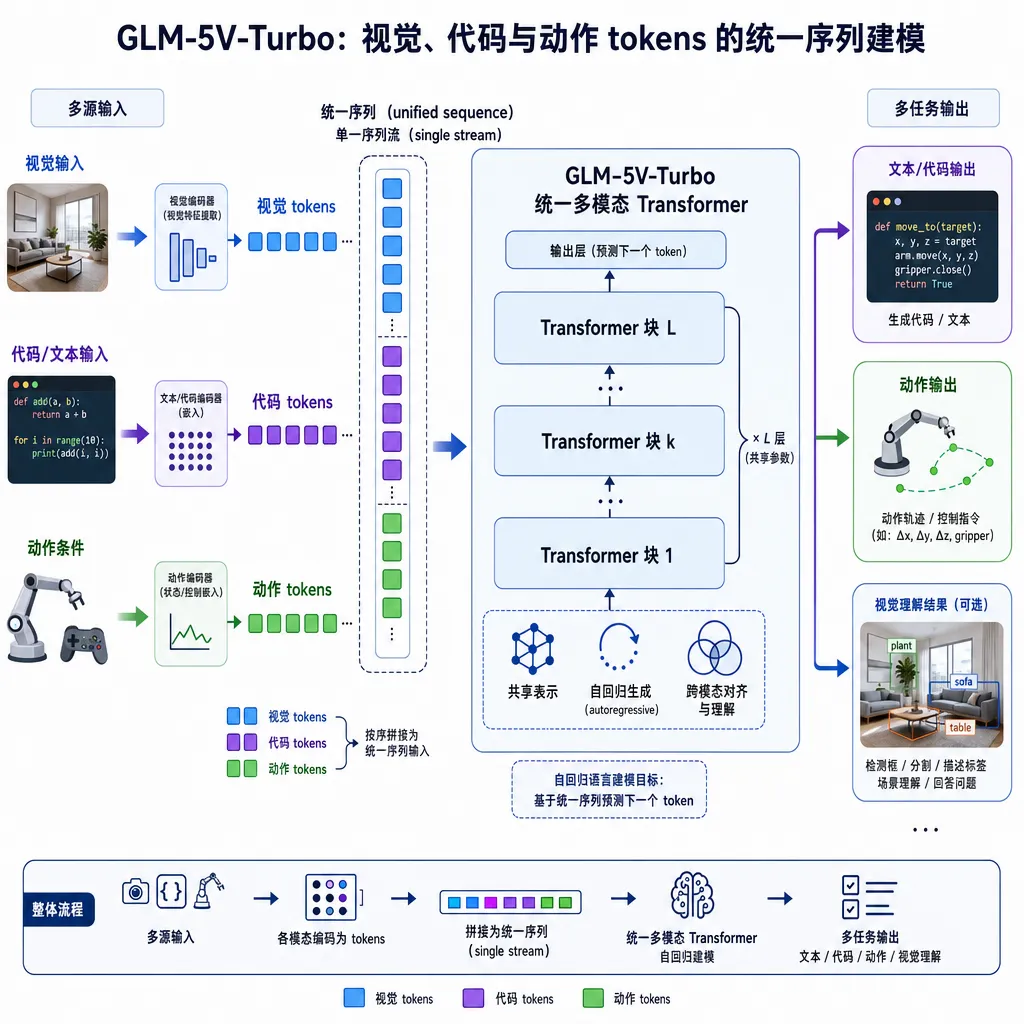
This isn’t a routine multimodal upgrade. Zhipu’s angle this time is clear: stop viewing a VLM as a text model with a visual plug‑in attached on the outside. Instead, start from pretraining with a single reasoning backbone shared by vision, code, and action execution. Put simply, most previous multimodal models were like attaching a pair of glasses to a brain that’s good at writing; GLM‑5V‑Turbo aims to make that brain born with eyes.
Why “Native”
In today’s industry, multimodal coding approaches generally split into two camps.
One is the plug‑in camp: after training a text model, map visual features into the text space via a vision adapter. The advantage is low transformation cost; the downside is that by the time visual information reaches the reasoning layer, it’s already compressed. For delicate tasks like “write runnable code by looking at this design mockup” or “generate a backtesting script by watching a K‑line chart,” important details often fall through.
The other is the end‑to‑end camp: mix images, video, text, and code together from pretraining so the model learns cross‑modal habits at the token level. Zhipu has chosen this costlier route. The repeated emphasis on the word native in the paper means one thing: visual tokens aren’t guests—they’re family.
That choice isn’t cheap. Data balance for multimodal pretraining, training stability, and cross‑modal interference are all deep pits. The benefit is that higher‑level applications can access a coding brain that truly understands “seeing,” rather than a text model parroting image captions.
Technical Route: Unified Multimodal Training
The paper has gained an apt nickname—“All‑in‑one Pot Multimodal Training.” From what’s disclosed so far, GLM‑5V‑Turbo has several noteworthy points.
Unified multimodal tokenization. Images, video frames, code, and text are flattened into the same sequence at the input layer and processed by a single Transformer. This allows the model to directly “point” to a specific button or K‑line in an image when generating code, instead of first describing the image and then coding—a failure mode common to early GPT‑4V versions.
Agent capability embedded in pretraining. Traditionally, agent abilities are added later via SFT and RL. GLM‑5V‑Turbo incorporates tool invocation, long‑term planning, and action‑execution patterns directly into the pretraining corpus. That means the model doesn’t need to be “taught” tool use—it has already seen countless call chains and planning trajectories in pretraining. This greatly improves stability in long tasks; anyone who’s built Agents knows that when planning ability is patched on post‑hoc, long chains quickly break down.
Vision not traded for text. This is one of the paper’s most commendable points. Multimodal training often harms text performance—especially code and mathematical reasoning. GLM‑5V‑Turbo claims equal performance in pure‑text coding and reasoning compared with same‑generation text‑only models. If reproducible, this basically solves a long‑standing problem for multimodal coding deployment: heavy Claude Code users have little reason to switch to a visual model when pure‑text performance usually drops.
Size and Performance: A Small Model Playing Big
According to the disclosures, GLM‑5V‑Turbo “achieves leading performance in multimodal coding and agent benchmarks at smaller scale.” The exact parameter count isn’t detailed, but “Turbo” implies it’s not a flagship giant—more of a mid‑sized, cost‑effective model.
That’s a smart positioning. Multimodal capabilities at the flagship level are now dominated by GPT‑5, Claude 4.5, and Gemini 3; open or semi‑open models can’t realistically win the parameter race. Yet the mid‑sized native multimodal‑coding niche remains open: DeepSeek‑VL leans general‑purpose, Qwen2.5‑VL focuses on visual understanding, and few models treat coding and agents as first‑class citizens.
Practically speaking, mid‑sized models fit better in latency‑sensitive settings—inside IDEs, browser extensions, or desktop agents. Even a superb flagship is overkill—and painfully slow—if it must scan the screen every few seconds.
OpenClaw Lobster and Claude Code Integration
Beyond the paper, one key sign of adoption is that GLM‑5V‑Turbo deeply integrates with Claude Code and Zhipu’s own OpenClaw “Lobster” environment.
OpenClaw is Zhipu’s new desktop‑agent product. With GLM‑5V‑Turbo, it gains true visual capabilities—not reading the DOM or accessibility tree, but actual pixels on the screen. For everyday users the difference seems minor, but for developers it’s a distinct paradigm: DOM reading relies on web structure and breaks on irregular layouts; pixel‑level vision can theoretically operate any app, even closed‑interface desktop software.
The Claude Code adaptation is straightforward: acknowledge that Anthropic’s coding‑agent interaction protocol has effectively become a standard, and embrace compatibility rather than reinventing it. The message to developers: you can keep your Claude Code workflow, swap in GLM‑5V‑Turbo as the backend, and gain native handling of screenshots, design drafts, and charts.
What It Means for Developers
Hype aside, if GLM‑5V‑Turbo truly meets its paper’s claims, several kinds of developers stand to gain:
- Front‑end and full‑stack developers: feed Figma designs or competitor screenshots and get code out directly—a long‑awaited dream. GPT‑4V and Claude are still shaky here. A model that treats vision as a mother tongue could push WYSIWYG coding a big step forward.
- Quantitative and data analysts: generate backtests or analysis scripts straight from K‑line charts or dashboard screenshots, skipping manual description.
- Desktop / browser agent builders: previously held back by vision models’ accuracy and latency; a mid‑sized native multimodal model is a pragmatic fix.
- RPA and test‑automation engineers: screen‑based scripting is far more robust than DOM‑based approaches.
Of course, paper benchmarks and real‑world results rarely align—especially for long‑chain agent tasks. A good score doesn’t guarantee production stability. Community reproduction and field testing in the coming weeks will be the real exam.
GLM‑5V‑Turbo is now accessible via Zhipu’s MaaS platform. Developers accustomed to OpenAI’s API format need no heavy adaptation. Aggregators like OpenAI Hub usually add new models quickly, enabling easy cross‑comparison among GLM, Claude, and Gemini with a single key—making model selection far smoother.
A Bit of Assessment
Zhipu’s trajectory over the past two years has become clear: rather than fighting head‑to‑head on parameter count, it’s betting heavily on the intersection of native multimodality + coding + agent. GLM‑5V‑Turbo embodies this strategy: instead of a general VLM that “does a bit of everything,” build a foundation where vision, code, and action are welded together.
Whether that’s the right path will depend on what AI‑native applications look like a year from now. But if you believe future agents must see the screen, write code, and execute long‑term plans step by step, GLM‑5V‑Turbo is at least a serious answer from a Chinese team.
References
- GLM‑5V‑Turbo Release: Multimodal Coding Foundation Model – Zhihu Column: Zhipu’s official explanation of GLM‑5V‑Turbo’s positioning and capabilities, the source of the phrase “native multimodal coding foundation.”


