
iOS 27 loosens up: Siri can finally be powered by a different brain
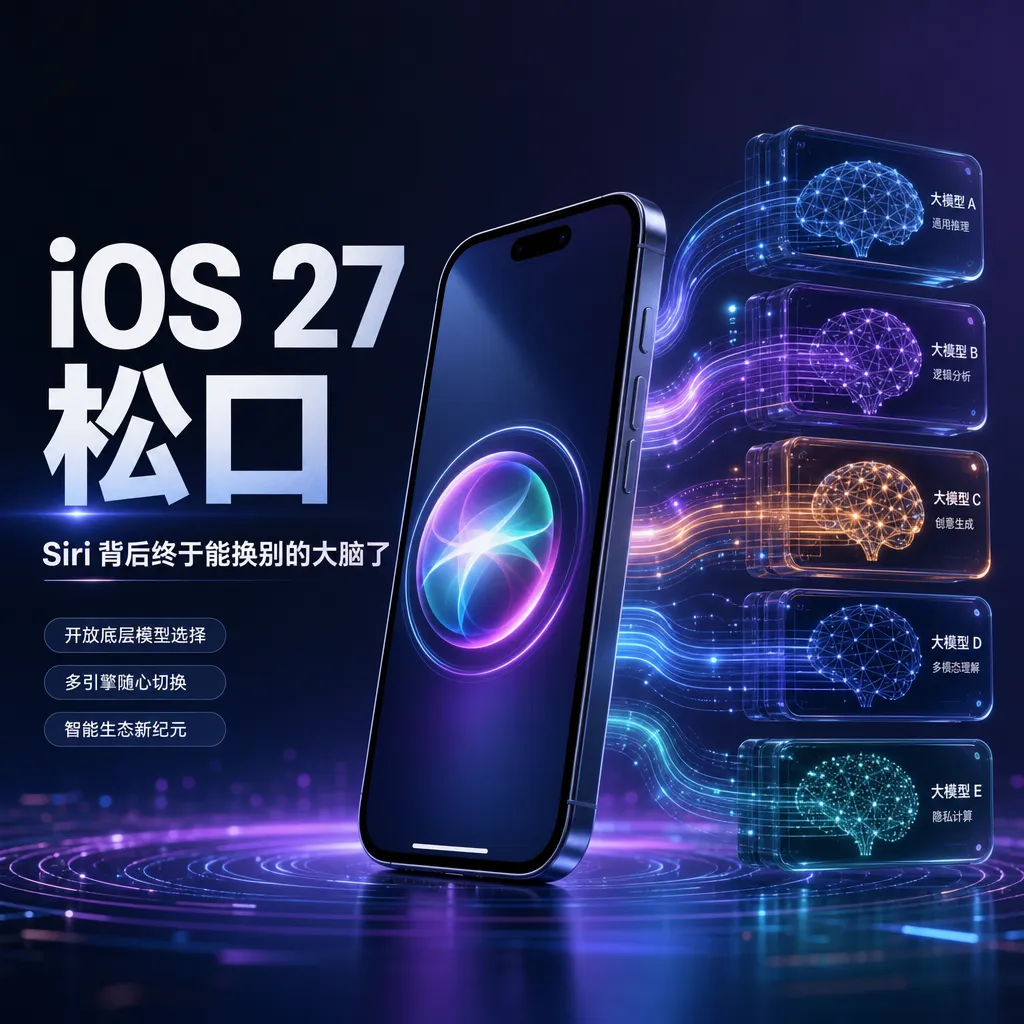
Bloomberg reports that Apple will open system-level third-party AI integration in iOS 27 this fall, marking the end of ChatGPT’s exclusive era. Claude and Gemini will also be able to take over Siri as well as writing and image tools. Less than a month remains until WWDC 2026.
iOS 27 Loosens Up: Siri Can Finally Swap Out Its Brain
Less than a month before WWDC 2026, Apple has accidentally let a major surprise slip.
Mark Gurman from Bloomberg revealed last weekend that Apple plans to allow third-party large models to plug into Apple Intelligence as system-level Extensions in this fall’s releases of iOS 27, iPadOS 27, and macOS 27. This means that Siri’s “brain” will no longer be limited to Apple’s own model plus ChatGPT—Claude, Gemini, or any AI app listed on the App Store and properly adapted can take over. Moreover, not just Siri: AI features scattered across the system such as Writing Tools and Image Playground will also be opened up.
If Gurman’s report is accurate, this would be the most significant shift in Apple’s AI strategy since Apple Intelligence debuted at last year’s WWDC.
How It Will Open Up
According to Gurman and follow‑up reports from several media outlets, the mechanism works roughly as follows:
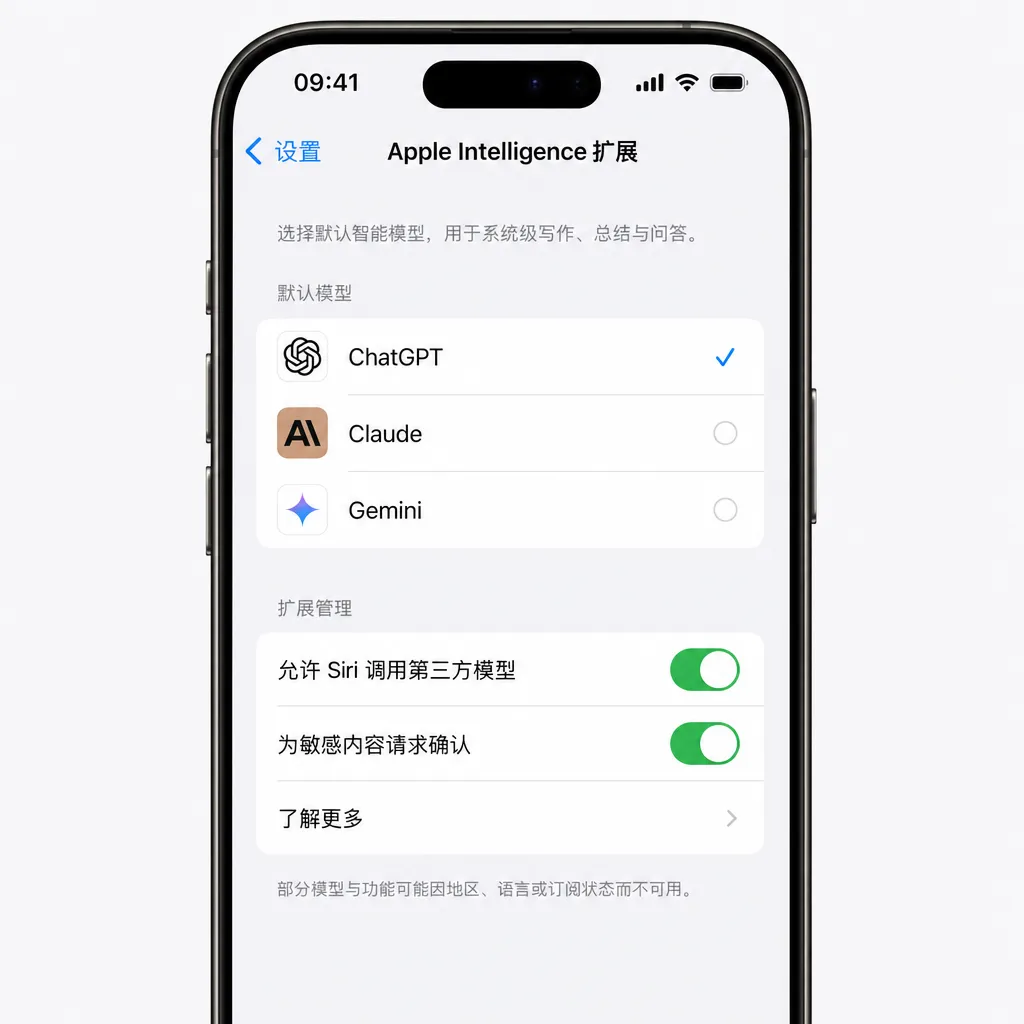
- Under Apple Intelligence and Siri in system “Settings,” there will be a new “Extensions” entry.
- Once users install third-party apps like Claude, Gemini, or ChatGPT, they can assign one of them to serve as Siri’s default backend.
- The extension panel will also include App Store links for easy installation of other AI apps.
- A finer detail: different AI models can use different Siri voices—so when you switch to Claude, Siri’s voice can differ from when you use ChatGPT.
- The App Store will feature a dedicated section for AI chatbots, though its approval guidelines remain unclear.
These bullets contain more signal than they seem on the surface.
Over the past year, Apple’s partnership with OpenAI meant that Siri would ask whether you wanted to “ask ChatGPT” when it couldn’t respond. That was a cautious, fallback-style integration—ChatGPT was an add-on, not a replacement. The iOS 27 extension mechanism hands users the right to choose which brain powers Siri. Once you select Claude, the moment you press the side button to summon Siri, a different “person” begins speaking.
There’s another subtle point: Writing Tools and Image Playground also join the extension framework. As of now, Writing Tools still relies on Apple’s small in-house models and performs poorly—especially in Chinese text tasks. Image Playground has been mocked as the most useless system app. If Claude takes over Writing Tools and Gemini takes over image generation, these features could shift overnight from “barely usable” to “used daily.”
Why Apple Loosened Up
The answer isn’t hard to guess—Apple Intelligence hasn’t taken off.
At last year’s WWDC, Apple positioned Apple Intelligence as being “personalized, on-device first, backed by Private Cloud Compute,” seemingly addressing AI’s biggest pain points. But a year later, the experience tells another story: Siri’s promised upgrades to “understand on-screen context and invoke actions across apps” have repeatedly been delayed to iOS 26 and partly postponed again; Writing Tools’ rewrites pale next to any casual ChatGPT conversation; and Image Playground’s sticker-like art has users wondering if Apple intentionally kept quality low.
Meanwhile, the outside world has moved forward. Claude’s Sonnet models have become developers’ default choice for long-text and coding tasks. Gemini 2.5 has pushed multimodal real-time understanding to new heights. Even domestic players like DeepSeek and Qwen have outpaced OpenAI’s older models in reasoning and Chinese contexts. Apple’s own small 3B on-device model and slightly larger Private Cloud versions simply aren’t in the same league.
Rather than stubbornly sticking to doing it all in-house, Apple seems to have accepted reality—it excels at devices, systems, and distribution. Letting the most competitive models in the market handle the AI part is, ironically, the more “Apple” move. Historically, Apple has paid for its “only use our own” stance in maps, search, and payments. It looks like the company has learned its lesson.
There’s also external pressure. Elon Musk’s xAI sued Apple and OpenAI months ago over alleged monopolization of the iPhone’s AI entry point. Musk has repeatedly demanded that Grok come to the iPhone. Breaking exclusivity is both a business decision and a way to reduce legal risk.
What It Means for Developers
This is the part developers will care about most.
In the past, to give an AI app any system-level presence on iOS, you had only two options: make a standalone app that users manually open, or rely on Shortcuts as a workaround. Now, as long as your app meets Apple’s extension specs, it can theoretically be mounted behind Siri, Writing Tools, or image generation interfaces. It’s not just another traffic channel—it turns “users have to remember you” into “users automatically use you when they use iPhone.”
Apple hasn’t revealed the detailed Extensions API yet, which usually appears after the WWDC keynote during the Platforms State of the Union and related sessions. Based on current leaks, developers will likely face:
- A manifest describing the model’s capabilities—what tasks it supports (chatting, rewriting, summarizing, image generation, etc.) so the system can route requests.
- A voice response spec for Siri—whether to use Apple’s TTS or register custom voices.
- Possible Private Cloud Compute integration—if third-party models want partial on-device context (such as screen awareness), they must pass Apple’s privacy review.
- Billing. Apple will very likely take a cut from AI subscriptions made through App Store in-app purchases—its commercial incentive to open up.
That last point is already controversial. Gurman noted Apple plans to earn a share from third-party AI subscriptions, treating them as a new growth line in its Services division. For companies like Anthropic and Google, which already run mature subscription businesses, going through App Store means losing another slice of revenue. Whether they can negotiate external payment options, as Spotify and Netflix did, is a crucial question.
Impact on Major Model Companies
OpenAI loses exclusivity but won’t immediately suffer. ChatGPT remains the most recognized AI assistant among consumers, and inertia will keep a portion of users on it. The real challenge is proving it’s still the best choice beyond Siri’s voice conversation feature—especially once Claude handles writing and Gemini handles images.
Anthropic stands to gain the most. Claude has lacked a widely used consumer gateway like ChatGPT; a system-level spot on iPhone removes that barrier. Given Claude’s reputation for writing quality, it may become the default replacement for Writing Tools.
Google receives a complicated gift. Gemini finally gains system-level access on iPhone, but only under Apple’s rules and revenue cut. For Google, it’s more a defensive move—to keep iPhone users within its AI orbit.
xAI and domestic players may find their biggest opportunity here. With no whitelist in the extension mechanism, Grok, Qwen, DeepSeek, Doubao, and Kimi can join as long as they meet the specs. For Chinese developers, a key question is whether the China version of iOS 27 will also allow installation of any App Store-listed AI apps.
This need to switch among models is becoming an infrastructure issue—connecting directly to each API is costly. Some API aggregation services (such as OpenAI Hub, which lets developers invoke GPT, Claude, Gemini, and DeepSeek through one key) are already meeting that demand. Once iOS 27 opens up, such gateway-type platforms will have clearer use cases.
A Forming “AI App Store”
Viewed together—the Extension panel + dedicated App Store AI section + subscription revenue share—Apple’s plan becomes obvious: it’s not just opening an interface; it’s recreating an App Store for the AI era.
Back in 2008, when iPhone 3G launched the App Store, Apple brought developers on board under its own rules, taking a 30% cut and shaping the next decade of mobile internet. Now the same model is being redeployed for AI: Apple’s own models handle basic experience and privacy, third-party models bring specialized capabilities, users pay subscriptions, and Apple collects tolls.
The long-term impact may be even bigger than expected. Once users get used to choosing their AI model in Settings, that very act of “selecting a model” could become standardized—and other OS developers will likely follow. Gemini on Android and Copilot on Windows are currently monopolistic setups; Apple’s move could usher the entire industry into a “plug-and-play model” era.
Remaining Questions
As of May 5, WWDC 2026 is approaching, but several critical questions remain unanswered:
- How wide will the opening be? Only for major companies (OpenAI, Anthropic, Google, xAI), or for any AI app following the specs? Where does Apple draw the line for “AI app”?
- How will privacy be balanced? Apple emphasizes on-device and Private Cloud Compute processing, yet most third-party models run on their own clouds. How will data be sanitized, and when must Apple’s own model handle tasks? The details here will heavily affect user experience.
- Will the Chinese version differ? Given how Apple Intelligence partnered with local model providers in China, iOS 27’s extension mechanism in the mainland could have its own whitelist and approval process.
- What’s the commission rate? Will the traditional 30% still apply to AI subscriptions? If yes, how will companies react—raising prices, downgrading iOS features, or refusing to integrate like Spotify?
The WWDC keynote, about an hour long, will likely answer the first two questions. The business terms, true to Apple’s style, won’t appear on stage but in later developer documentation.
For more than a year, Apple Intelligence has felt conflicted—eager yet underperforming, wanting to open yet hesitating. If iOS 27 indeed follows Gurman’s predicted path, Apple finally seems to have chosen a realistic stance: not to make the best AI, but to make the best AI distribution platform. For both users and developers, that’s far better than watching Siri struggle to catch up.
References
- Apple’s Latest AI Move: Siri May Fully Integrate Third‑Party AI—WWDC to Bring Major Updates (Zhihu) — A Chinese summary of details from the iOS 27 test build’s extension panel, including activation steps in Settings.


