
iOS 27 is going open: Siri will finally no longer be tied only to ChatGPT
Bloomberg’s Mark Gurman revealed that Apple plans to introduce a third-party AI extension system called **Extensions** in **iOS 27** this fall, allowing models like **Claude** and **Gemini** to take system-level control of **Siri**, writing tools, and **Image Playground**. Apple has finally loosened its grip.
Apple wants users to choose their own AI.
According to a report revealed this week by Bloomberg’s Mark Gurman and followed up by TechCrunch and The Verge, Apple plans to introduce a third‑party AI expansion mechanism called Extensions in iOS 27, iPadOS 27, and macOS 27, scheduled for release this fall. Simply put, users will be able to decide which large model powers Siri and system‑level AI features under Apple Intelligence, such as the Writing Tools, Image Playground, and others. It’s the first time Apple has handed over control of AI at the operating‑system level.
From exclusive to open: Apple’s attitude has shifted
Looking back, this turn has been a long time coming.
When Apple Intelligence debuted in iOS 18, Apple chose OpenAI as its only external partner: Siri would forward complex queries to ChatGPT. Industry consensus then was that Apple’s own large‑model development lagged behind, and OpenAI’s partnership served as a temporary bridge. By iOS 26, Apple cracked open CarPlay a little, allowing third‑party AI chatbots to plug in—but only in the car environment, more symbolic than substantial.
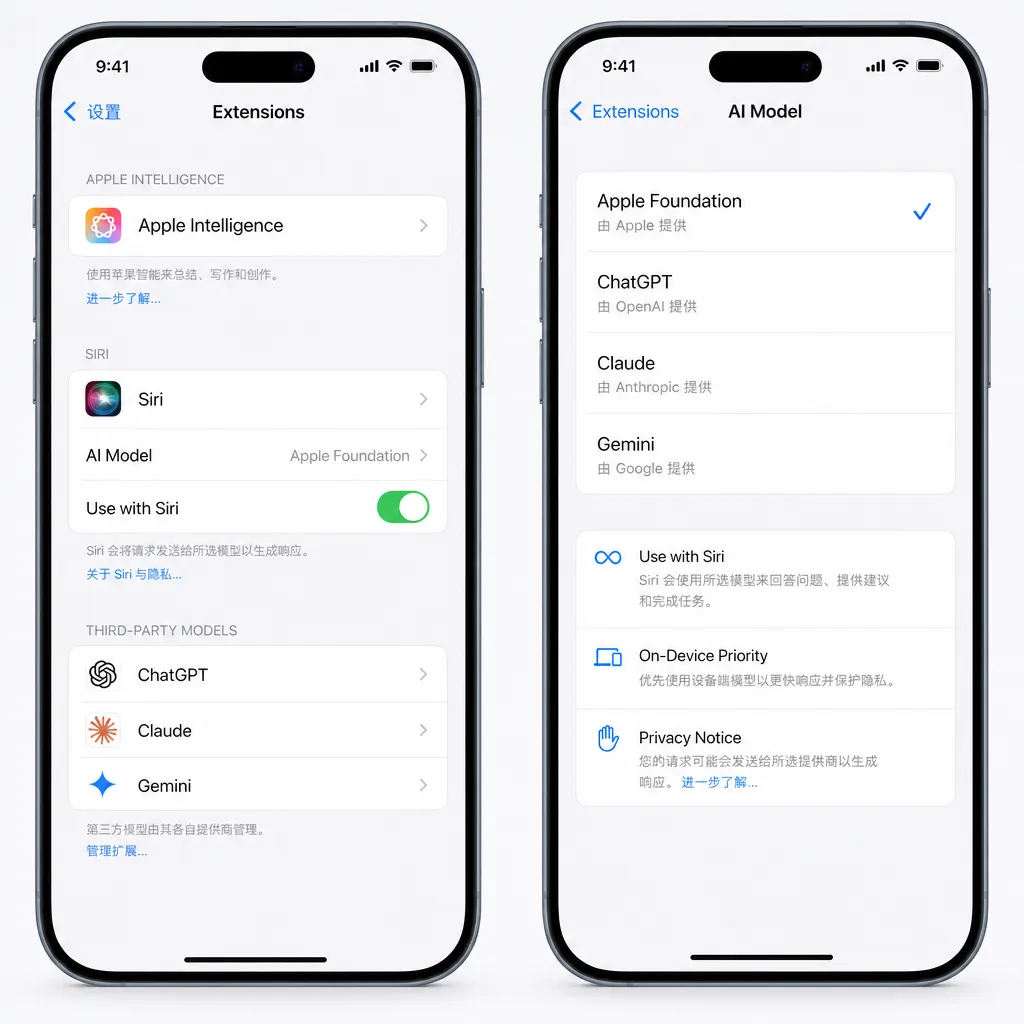
Now what iOS 27 aims to do is entirely different. It isn’t about adding one more partner—it’s about giving away the choice entirely. According to Gurman, once users install the Claude or Gemini apps, a system setting will appear where they can directly choose “who powers Siri’s brain.” For those without the apps, App Store links will be pre‑placed for one‑tap installation.
The move is very Apple—and very un‑Apple. The Apple part is that it still firmly controls entry points, interaction, and distribution; the un‑Apple part is that it’s truly letting go of the core intelligence layer.
What Extensions can actually do
From leaked test builds, Extensions appear far more capable than most expected. Three points stand out:
First, Siri is fully replaceable. Not just fallback forwarding—Siri’s actual answers can now be generated by third‑party models. System tasks like checking the weather or managing schedules still run through Apple, but open‑ended conversation, complex reasoning, and long‑text understanding can be handled entirely through Claude or Gemini.
Second, Writing Tools and Image Playground are open too. Even more interesting than Siri. Until iOS 26, those writing aids—polish, rewrite, summarize—relied purely on Apple’s own models. Now you can switch them to Claude, whose distinct writing style fans already know. Image Playground, long criticized for mediocre output, could improve drastically once it taps Gemini or other image models.
Third, different models can have different Siri voices. A small yet intriguing detail: you can pair one voice with Claude and another with Gemini, and switching models also changes the timbre. For developers, this signals Apple is treating “AI personality” as a first‑class design element.
According to 9to5Mac, Apple is also testing a standalone Siri app codenamed Campo, similar to ChatGPT’s dedicated chat interface, likewise supporting the Extensions system—an implicit admission that the old “press‑and‑hold Home/Side button” interaction is no longer enough.
Underlying partnerships unchanged—Gemini remains the backbone
A fact easy to overlook: opening up Extensions doesn’t affect Apple’s underlying deal with Google. The Gemini model will continue to power key Apple Intelligence capabilities, especially heavy cloud‑based reasoning that local devices can’t handle.
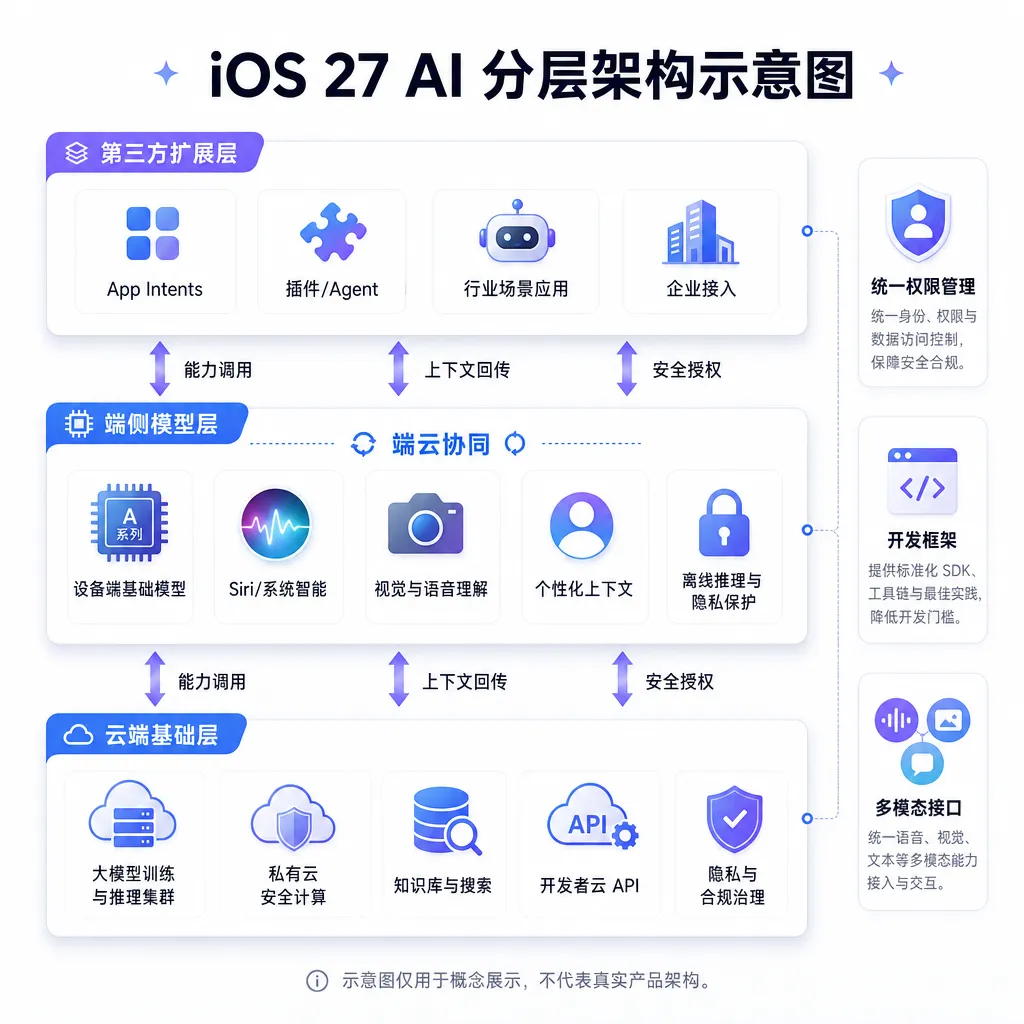
In other words, iOS 27’s AI architecture is layered:
- On‑device small models: Apple‑built, for privacy‑sensitive, low‑latency tasks
- Cloud foundation layer: Gemini as the backbone for general complex reasoning
- User‑selectable extension layer: Claude, ChatGPT, and any future model adapted for it, for user‑designated scenarios
It’s a clever structure. Apple keeps the “privacy‑first” narrative (on‑device), secures a stable backbone (Gemini), and grants choice to the user (Extensions). Each layer has its role without conflict.
Winners and losers
The biggest beneficiary is Anthropic.
Claude’s reputation among developers has surged over the past year, especially for coding and long‑text comprehension, yet it lacked a broad consumer‑facing entry point. With iOS 27’s gateway, Claude gains direct access to the AI entry built into over a billion iPhones worldwide—a milestone more valuable than any funding round.
Google is another winner, though differently: it occupies two positions—earning steady revenue as Apple Intelligence’s base supplier, while competing as an optional model under Extensions. Two layers of insurance.
By contrast, OpenAI faces an awkward spot. From iOS 18’s exclusive partner to merely “one option” in iOS 27—the downgrade is obvious. ChatGPT may still hold the strongest brand recognition, but its monopoly advantage is gone. Apples’s integration minimizes friction for users to switch to Claude or Gemini—just one tap in the settings.
Mainland Chinese model vendors have no part in this round for now. Extensions will likely follow regional App Store policies, and it’s uncertain whether the Chinese store will even show Claude or Gemini entries, let alone local model access. Still, it suggests that domestic developers wanting to distribute AI capabilities to overseas iPhones now have a new channel worth exploring early: Extensions.
What it means for developers
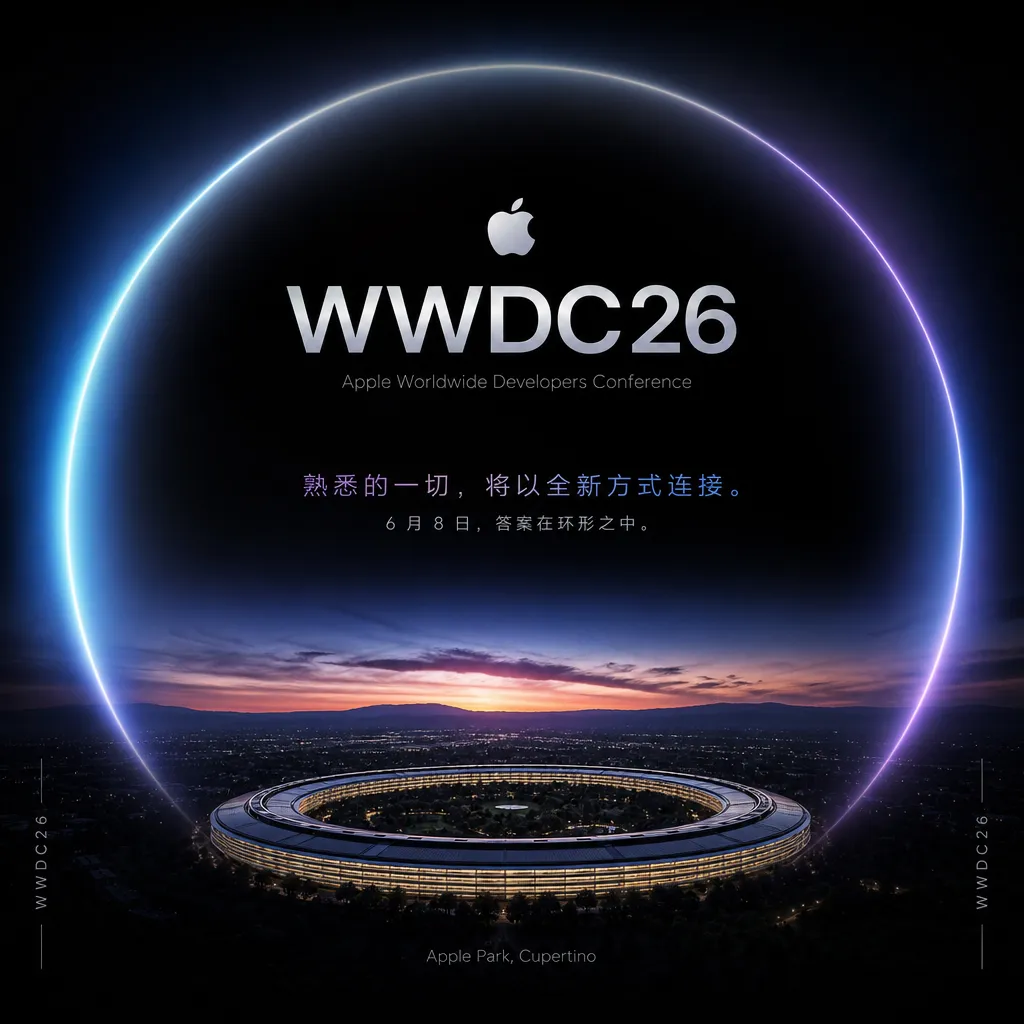
If Gurman’s leaks are accurate, Apple will unveil Extensions’ full developer specs at WWDC 26 (expected June 8). Early inferences suggest:
- Integration will likely use a declarative API similar to App Intents, where model vendors register capabilities to the system via their own app shells
- User identity and usage quotas are managed by model vendors themselves; Apple only routes requests, not billing
- Privacy boundaries will be a key review focus, with strict guidelines on what data can be sent to third‑party models and what must stay on‑device
For independent developers, short‑term opportunities are limited—Extensions are only open to large‑model vendors, not regular apps that “want to be Siri.” But long‑term, once mature, this mechanism may expand to vertical domains: legal‑expert models, coding‑assistant models, each occupying their own scenario entry points.
A bigger question: What about Apple’s own models?
Handing the core AI layer to third parties amounts to Apple admitting, indirectly, that it hasn’t caught up—and won’t in the short term—on foundational large‑model development.
That’s not necessarily bad. Hardware, system integration, and distribution are Apple’s real moats. Treating models as interchangeable components actually clarifies the boundaries of its fortress. Apple has done this repeatedly—Google Maps for maps, Google Search for web search—and now AI follows the same path.
But there’s a risk: as users increasingly equate “AI capability” with a specific external model rather than “iPhone itself,” Apple’s narrative strength in AI will dilute. Users will say, “I’m using Claude,” not “I’m using iPhone’s AI.” For a brand built on premium perception, that’s not wholly positive.
Apple evidently recognizes this, hence the defensive measures built into Extensions: Siri’s interface, voice, and invocation timing remain system‑controlled; third‑party models are just backends. The simpler the model‑switching process, the more it reinforces that the real value lies in the “shell”—and that shell belongs to Apple.
Timeline
Summarizing the key milestones:
- June 8, 2026: WWDC 26—Apple officially announces iOS 27, iPadOS 27, macOS 27; Extensions documentation released
- Summer 2026: Developer and public betas rollout; first supported models likely Claude and Gemini
- Fall 2026: Official release alongside the next‑generation iPhone launch
- Campo standalone Siri app: timing TBD—possibly with the official release or later in iOS 27.x
For teams validating products across multiple mainstream models in overseas markets, OpenAI Hub already supports unified access to Claude, Gemini, GPT, DeepSeek, and other OpenAI‑compatible interfaces—one key for all. Before Apple officially opens Extensions, it can serve as a practical tool for multi‑model switching tests.
Final thoughts
With iOS 27, Apple is essentially giving its first serious answer to the question: “What should an operating system look like in the AI era?” Not making the strongest model itself, but building the best container for models. The idea isn’t new—Apple did the same in browser and App Store eras—but applying it to AI is a first.
Whether it’s good depends on WWDC’s implementation details. But based on current information, Apple seems to have realized one truth: users don’t care who built the AI—they care whether it works well and switches easily. If Apple perfects those two aspects, operating‑system vendors will still have a place in the AI age.
That may matter more than any benchmark score of a self‑developed model.


