
Apple Relents: iOS 27 Opens to Third-Party AI, Ending ChatGPT’s Exclusivity

Mark Gurman from Bloomberg revealed today that this fall, Apple will open access to third-party AI models in iOS 27, iPadOS 27, and macOS 27. Users will be able to choose models such as Gemini and Claude to provide the underlying capabilities for Apple Intelligence. This marks the end of OpenAI’s exclusive position over the past two years.
Today (May 6), Bloomberg’s Mark Gurman dropped a heavy piece of news: Apple has decided that this fall, with iOS 27, iPadOS 27, and macOS 27, it will hand over the choice of underlying model for Apple Intelligence to users — want Gemini? Use Gemini. Want Claude? Use Claude. It will be supported at the system level, no longer limited to just Siri.
The subtext is simple: the “exclusive partnership” Apple formed with OpenAI at WWDC 2024 will end less than two years later.
The scope of openness is bigger than expected
Let’s clarify things first. For more than a year, Apple Intelligence’s “third-party AI” had only one option: ChatGPT. It appeared in Siri handoff, Writing Tools, and Image Playground. Could users switch it for something else? No.
Back in March, Gurman reported that Siri would support switching to external chatbots such as Gemini and Claude. That sounded like expanding Siri’s “handoff” menu from ChatGPT to a list—nothing more.
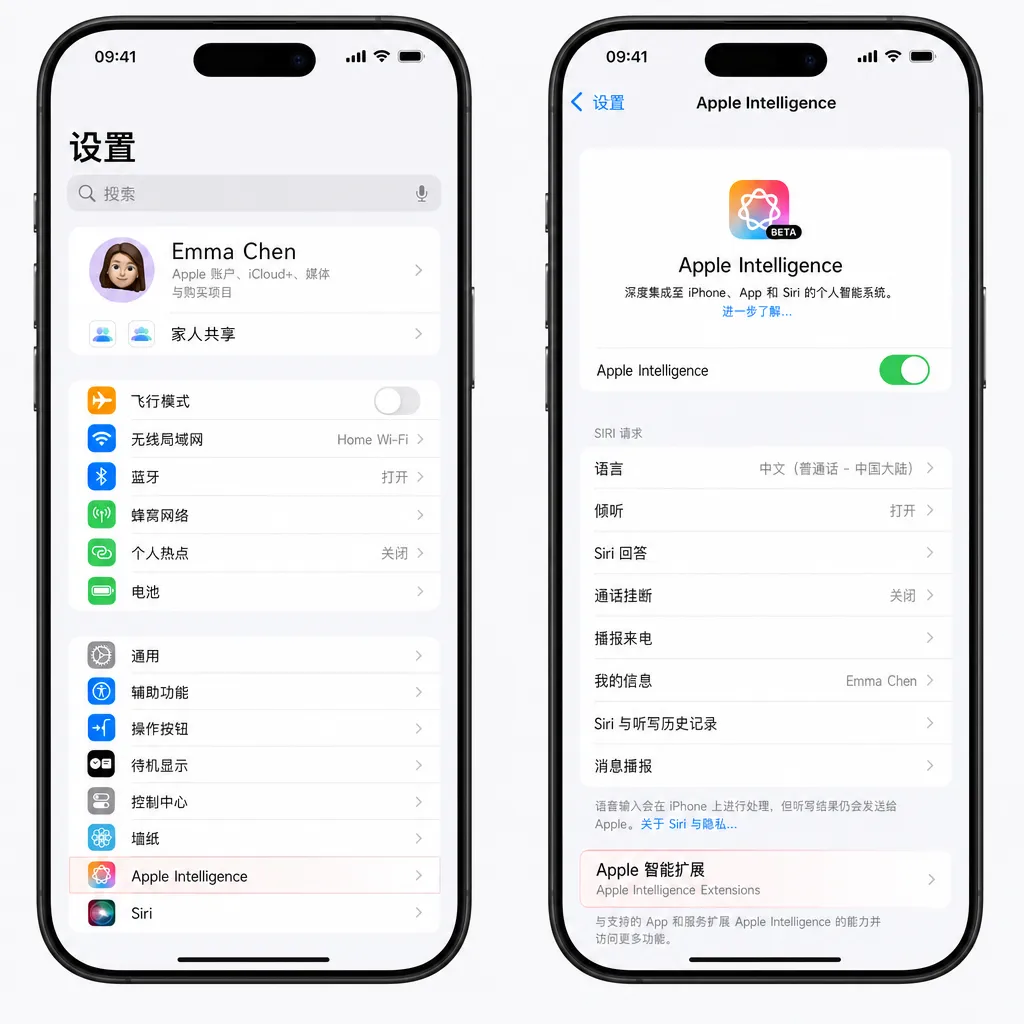
Today’s report extends the range even further. In internal builds of iOS 27, Apple has named this mechanism Extensions, and it covers not just Siri but the whole Apple Intelligence suite — rewriting and polishing in Writing Tools, image generation in Image Playground, all can run via third-party models. Developers have already found this system prompt in the test version:
“Extensions allow you to access generative AI capabilities from installed apps through Apple Intelligence features like Siri, Writing Tools, and Image Playground.”
The user flow is also straightforward: install an AI app from the App Store that supports Extensions (Claude, Gemini, etc.), then go to “Settings → Apple Intelligence & Siri → Extensions” to select your preferred model. Apple will also open a dedicated AI section in the App Store to make finding these apps easier.
A side note about Siri’s voice: Gurman says Apple will allow users to assign different Siri voices to different models—Claude could speak in one voice, Gemini in another. It’s an interesting design, giving a perceptible cue to which model is active, so users don’t get confused about whom they’re talking to.
From “exclusive” to “plugin-style,” Apple calculated this well
When Apple chose ChatGPT exclusively in 2024, there was internal debate. Former Apple AI chief John Giannandrea preferred Google, doubting OpenAI’s long-term competitiveness. Apple chose OpenAI for GPT-4’s overall experience at the time.
Two years later, the partnership hasn’t lived up to expectations. Gurman said “actual usage was below both companies’ expectations” — translation: iPhone users weren’t transferring questions to ChatGPT that often. Meanwhile, tensions between Apple and OpenAI have grown, with OpenAI poaching Apple engineers in AI hardware, turning the relationship from honeymoon to guarded.
Politically, continuing with a single exclusive partner is poorly timed. Musk’s xAI has already sued Apple and OpenAI for alleged AI market collusion, and regulators are increasingly wary of such exclusivity. Returning choice to users is the cleanest solution.
Commercially, it’s a smooth move. Apple no longer has to negotiate individually with each AI provider — previously it was about APIs, revenue shares, responsibilities. Now, it’s standardized like any other App Store integration: build your app following the Extensions framework, submit, get approved, and connect. Apple still earns its App Store cut from AI subscriptions — a more comfortable profit model than exclusive partnerships.
In other words, Apple is turning AI models into an “expandable system capability,” akin to keyboards or payment plugins.
What this means for OpenAI, Google, and Anthropic
OpenAI is the biggest loser. Losing exclusivity means it no longer gets default access to the nearly 1.5 billion iPhone users worldwide. The bright side: ChatGPT, being first in and well-established in users’ minds, will likely remain the default recommendation. But “default” and “exclusive” are different — the former can be changed with one setting.
Google and Anthropic are clear winners. Gurman says Apple is currently testing internal integrations with both. Google has another connection: Apple is reportedly working with Google to rebuild Siri’s next-generation base using the Gemini model (project codename Campo). That means Gemini in iOS 27 may play a dual role — both as a selectable Extension and as the new Siri foundation. That’s far more powerful than being just an alternative.
Anthropic getting system-level access to iPhones is a major boost. Claude, known for handling code and long text, has far fewer consumer users than OpenAI. System integration is its fastest path to closing that gap.
As for Grok, Perplexity, Meta AI, Copilot, and others — their apps already run on Apple platforms, and technically connecting to Extensions should be easy. Apple hasn’t clarified whether the approval process will include additional gates, something worth watching.
But there are several unanswered questions
First, liability. Gurman says iOS 27 will clearly notify users that Apple isn’t responsible for content generated by third-party models. Fair enough, but in practice, if a rewritten email contains factual errors or a generated image raises copyright issues, users will still blame the iPhone. The models are plugins, but the brand damage lands on Apple.
Second, privacy alignment. A key Apple Intelligence promise was Private Cloud Compute — encrypted, chip-based processing with no data retention. But when using Gemini or Claude, which servers handle requests? How are logs and training data isolated? Apple needs a unified, verifiable privacy standard; otherwise, Extensions could become a murky enclave inside Apple Intelligence.
Third, how will the default model be chosen? This is the most sensitive commercial piece. Google pays Apple billions annually to be Safari’s default search engine. Will AI Extensions follow a similar pay-to-default model? If yes, “exclusive” simply returns in a new form.
Fourth, China version. The top question among Chinese developers and users — what will Apple Intelligence use in the China edition of iOS 27? Will Extensions connect to Baidu, Alibaba, or someone else? Currently, not a word. Based on how slowly Apple Intelligence integrated Baidu before, the Chinese rollout of Extensions will likely trail the global version significantly.
Impact on developers: the system-level AI entry point opens for the first time
From a developer’s perspective, the most interesting part of Extensions isn’t “users can switch models,” but that the system-level AI entry point is open to third parties for the first time.
Previously, if you built an AI app, users had to launch your app to use it. Now, by integrating via Extensions, your model could be invoked inside any input box that supports Writing Tools. This distribution opportunity is huge — akin to when Apple opened third-party keyboard support in iOS 8, but at an even greater scale, because AI is used more frequently than typing.
Apple hasn’t yet released full documentation, but from known information, the integration will likely use a declaration-style protocol similar to App Intents: the app declares which tasks it can handle (text generation, image creation, rewriting), and the system routes requests based on user selection.
That means by the second half of 2026, after WWDC, we’ll likely see a wave of AI apps optimized for Extensions — lightweight, task-focused, and system-triggered. For indie developers, it’s another system-level opportunity window after Shortcuts, Widgets, and App Intents.
By the way, if you’re a developer wanting to test GPT, Claude, Gemini, DeepSeek, and other models in one interface to see which best fits your product — OpenAI Hub (openai-hub.com) does exactly that. One key accesses all major models, direct from within China, compatible with the OpenAI format, sparing you multiple sign-ups and integrations. Before iOS 27 launches, it’s wise to get your model evaluations done.
A broader takeaway
Apple’s pivot here acknowledges one thing: it can’t beat the top players in general-purpose model development anytime soon. Rather than forcing its own, Apple’s making this layer pluggable — focusing instead on protecting its strengths in device, privacy, distribution, and user experience.
It’s not Apple’s first time taking this route. It didn’t build its own search engine; it partnered with Google. It built Maps, but allows third-party integration. Now AI models are following the same pattern.
The difference is that AI isn’t just another feature — it’s the foundation of operating systems for the next decade. By handing part of that foundation to others, Apple shows both pragmatism and concession. The real spotlight will be this fall’s WWDC, when the stand-alone Siri app and new interactions debut — that’s what Apple aims to safeguard.
iOS 27’s Extensions are just the appetizer.


