
Microsoft launches E7 Suite: AI billed by token for the first time

Microsoft officially released Microsoft 365 E7 Enterprise Edition, which bundles Copilot, the Entra suite, and Agent 365 on top of E5, starting at USD 99 per user per month. After the base allowance is exceeded, billing is based on token and resource consumption. This is the first time Microsoft has introduced a “subscription + metering” model into the Office family.
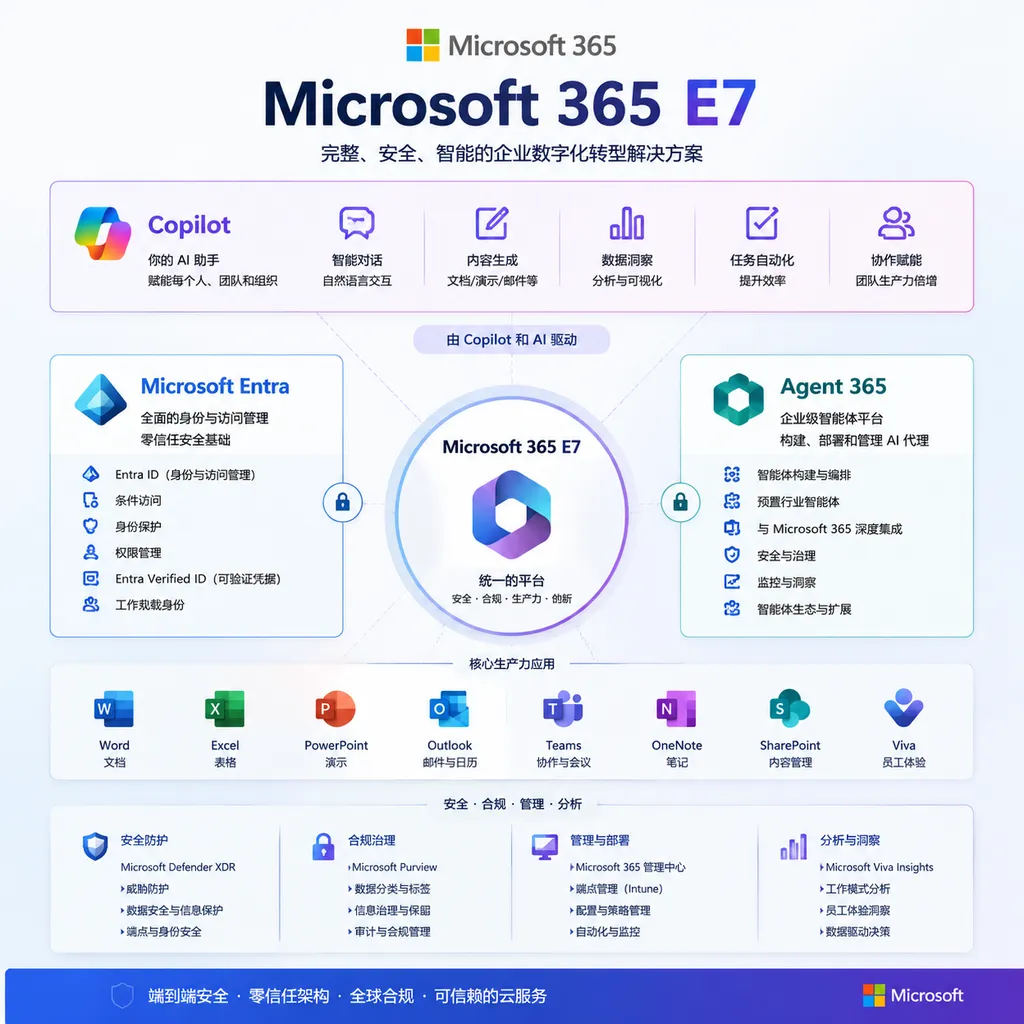
On May 6, Microsoft officially launched sales of Microsoft 365 E7 Enterprise Edition. This is a new SKU one level above E5, bundling Microsoft 365 Copilot, the Microsoft Entra suite, and the newly launched Agent 365 platform. The version including Teams costs $99 per user per month, while the version without Teams costs $90.45. Agent 365 can also be purchased separately for $15 per seat.
More noteworthy than the price is the billing model: E7 is no longer a flat rate. Beyond the base seat fee, any overage is billed separately according to token usage and resource consumption. Microsoft calls this "enabling enterprises to flexibly purchase seat licenses and agent consumption capacity", which in plain terms means—a subscription plus metering model, a first for Office.
From E5 to E7: Skipping a level wasn’t a typo
The Microsoft 365 Enterprise lineup has always been E1, E3, and E5, with E5 currently around $57 per user per month. This time, Microsoft jumped straight to E7—the missing E6 is deliberate, signaling that Microsoft wants to bundle AI capabilities into a brand-new price tier instead of just doing incremental upgrades to E5.
Going from $57 to $99 means about a 70% price increase. So what do you get for that?
- Microsoft 365 Copilot: formerly a separate $30/month/user subscription, integrated into Word, Excel, Outlook, and Teams
- Microsoft Entra Suite: an advanced identity and access management bundle with ID Protection, Verified ID, Internet Access, etc.
- Agent 365: Microsoft’s AI agent management platform, handling identity, permissions, compliance, and observability for agents
- All E5 features: including Defender, Purview, Power BI Pro, Phone System, and more
The combined value of these components bought individually would far exceed $99. The pricing logic behind E7 follows the typical "bundle discount to gain user stickiness" approach. For enterprises already on E5, the upgrade cost looks modest; for those still on E3, the jump feels steep.
Agent 365: This is what Microsoft really wants to push
Peeling back the layers of E7, Copilot is familiar, the Entra suite serves longtime enterprise IT customers, but the truly new thing here is Agent 365.
Microsoft described its positioning plainly during the announcement: “Active Directory for AI agents.” Enterprises now run not just human employees but increasing numbers of AI agents—those that write code, handle support tickets, run data analysis, auto-book meeting rooms—all of which need identities, permission boundaries, audit logs, and cost attribution.
This platform addresses some very concrete problems:
- Identity and access: each agent gets an addressable identity integrated with Entra, managed just like human users
- Observability: what APIs the agent called, what data it processed, how many tokens it consumed—all traceable
- Compliance: Purview’s DLP and sensitive data protection also apply to agent inputs and outputs
- Interoperability: manages not only Microsoft’s own agents but can integrate third-party ones built under MCP, A2A, etc. protocols
This is Microsoft’s response to an industry reality: agents are evolving from toys into infrastructure, yet enterprise IT teams lack management tools for them. Salesforce’s Agentforce, Google’s Agentspace, and ServiceNow’s AI Agents all tackle similar ideas. Microsoft’s advantage is that it already controls the enterprise identity backbone—Entra/Active Directory.
The separate $15 subscription for Agent 365 also signals Microsoft’s intent to grow it as an independent revenue stream, not just a Copilot add-on.
Token-based billing: The first crack in the subscription model
The most important takeaway from E7 isn’t the $99, but that phrase: “Usage beyond the base quota will be billed based on token consumption and resource usage.”
Since its inception, Microsoft 365 has followed the standard SaaS model: a flat per-seat, per-month fee regardless of usage. But this model breaks in the AI era—inference costs scale directly with usage. A data analyst using Copilot heavily and an admin using it occasionally cost Microsoft vastly different amounts on the backend to OpenAI (or Azure OpenAI).
There have historically been two approaches to this issue:
- Salesforce’s approach: Agentforce is purely consumption-based, $2 per interaction, no subscription
- Google’s approach: Gemini for Workspace increased seat prices across the board, with Google absorbing the risk
Microsoft chose a hybrid approach—stable revenue from a base seat rate plus token-based metering to shift marginal cost to heavy users. For CFOs, this means AI expenses now enter budgeting models; for IT, it means thinking about how to allocate token quotas by department or project—something that Agent 365 conveniently provides.
A closed loop: while selling E7, Microsoft is also selling the tools to monitor its costs.
Developer perspective: What this all means
For developers building systems inside enterprises, E7 has several direct implications:
- More Copilot extension points: Agent Builder and Copilot Studio will deeply integrate with Agent 365, giving first-party publishing, hosting, and billing channels for custom agents
- The role of Graph API grows: agents need to access emails, documents, calendars, Teams messages—all through Microsoft Graph; fluency here will directly affect implementation efficiency
- Cost observability becomes mandatory: token costs are no longer just an R&D concern; once integrated into Microsoft 365, they must align with Agent 365’s quota and billing systems
- Model choice remains fragmented: E7’s Copilot defaults to OpenAI models, but Microsoft is adding Anthropic model options; enterprises will increasingly want model routing capabilities
It’s worth noting: E7 usage is tied to the Microsoft ecosystem. If your agent architecture mixes models like Claude, Gemini, or DeepSeek, or calls external APIs beyond Microsoft’s ecosystem, it’s still easier to use a model aggregation layer—for example, OpenAI Hub, which connects GPT, Claude, Gemini, DeepSeek, etc. via a single API key, compatible with OpenAI format and useful for cross-model comparisons and routing. E7 solves “how enterprises manage AI,” not “how developers call multiple models conveniently”—the two are not contradictory.
Is $99 expensive? Depends how you count it
Market reactions are split. Supporters argue that at $99, E7 is cheaper than buying the components separately (E5 ~$57 + Copilot 30 + Entra 12 already near 99), and for large enterprises that already subscribe to them, E7 practically “throws in Agent 365 for free.”
Critics focus on two main pain points:
- SMBs are excluded: E7 is enterprise-only; business-tier products (Business Premium, etc.) don’t qualify, and mid-sized companies must buy Agent 365 standalone for $15
- Unpredictable token billing: some sysadmins on Reddit’s r/sysadmin complain they can’t explain “how much next month will cost” to their boards, conflicting with traditional SaaS procurement workflows
From a broader view, E7 marks a clear stance for Microsoft in the enterprise AI market: not the cheapest, but the most “enterprise-grade.” Copilot might not be the smartest AI assistant, but combined with Entra’s identity, Purview’s compliance, and Agent 365’s governance, the package is explainable, auditable, and accountable. In an era of generative AI abundance, this seemingly “boring but solid” value proposition is real currency.
What to watch next
E7 is already on sale, but the real test will come over the next two quarters:
- Token billing details: base quotas, overage rates, and monthly/yearly discount structures are yet to be fully disclosed—expect detailed SKU documentation mid-May
- The Agent 365 ecosystem: adoption by third-party agent providers, especially complex competitors/partners like Salesforce, Workday, and ServiceNow
- E5 upgrade rates: a key metric Microsoft’s earnings calls will highlight, and a litmus test for whether E7 is a necessity or a premium toy
In Microsoft’s Q3 earnings report, paid Copilot seats have already reached near 10 million. E7 aims to shift that growth curve from “selling seats one by one” to “selling entire enterprises.” Whether it works will become clear this procurement season.
Reference Links
- Microsoft launches Microsoft 365 E7 Enterprise Suite subscription: bundles multiple AI features, from $90.45 per user per month – IT Home: First Chinese report detailing E7’s launch and pricing
- Microsoft announces Microsoft 365 E7 with new agentic AI capabilities - Reddit: Sysadmin community feedback and pricing discussions on E7


