
Doubao Seed-2.0-lite Upgrade: The Small Model Surpasses Its Own Pro Version
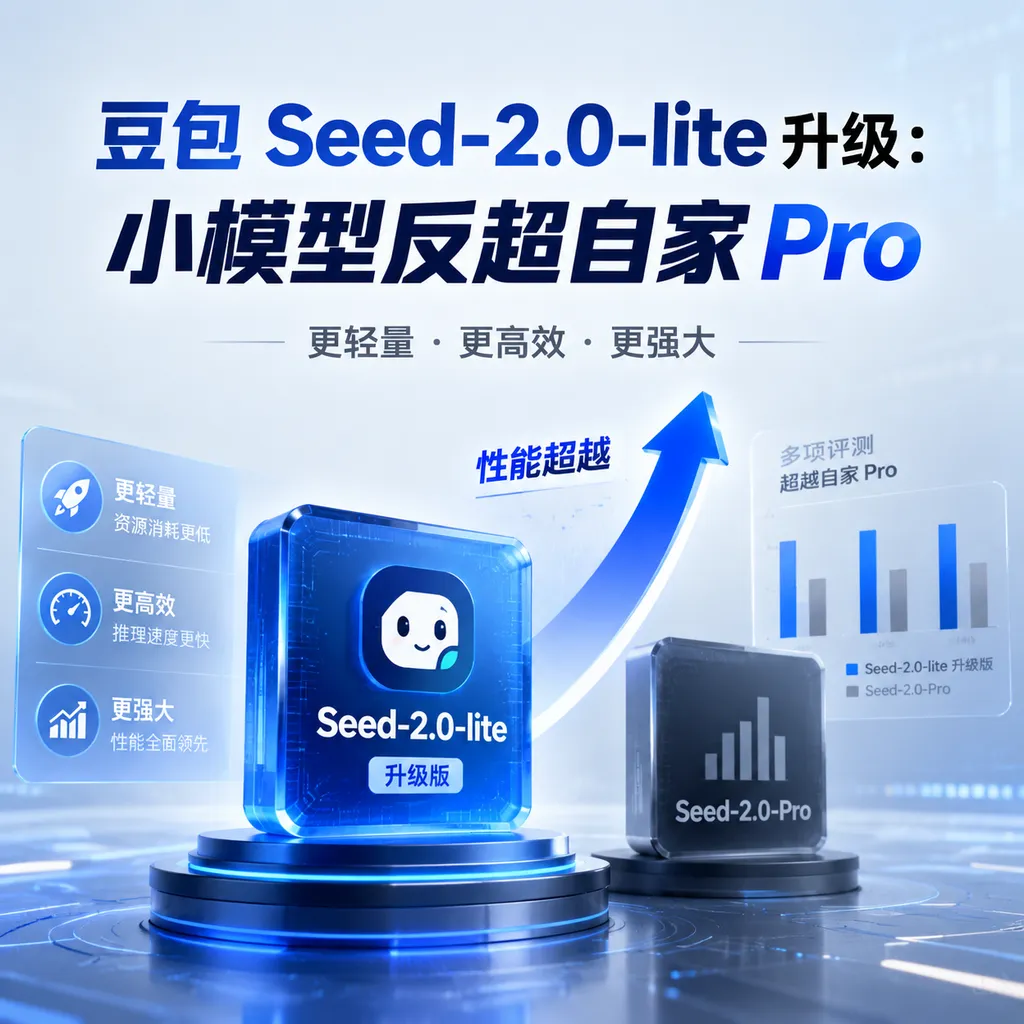
ByteDance today upgraded Doubao-Seed-2.0-lite, making it the first fully-modal understanding model in the Doubao family. It natively unifies comprehension of video, images, audio, and text. In certain advanced subject reasoning benchmarks, it surpasses the 2.0-pro released in February, and is now live on Volcano Ark.
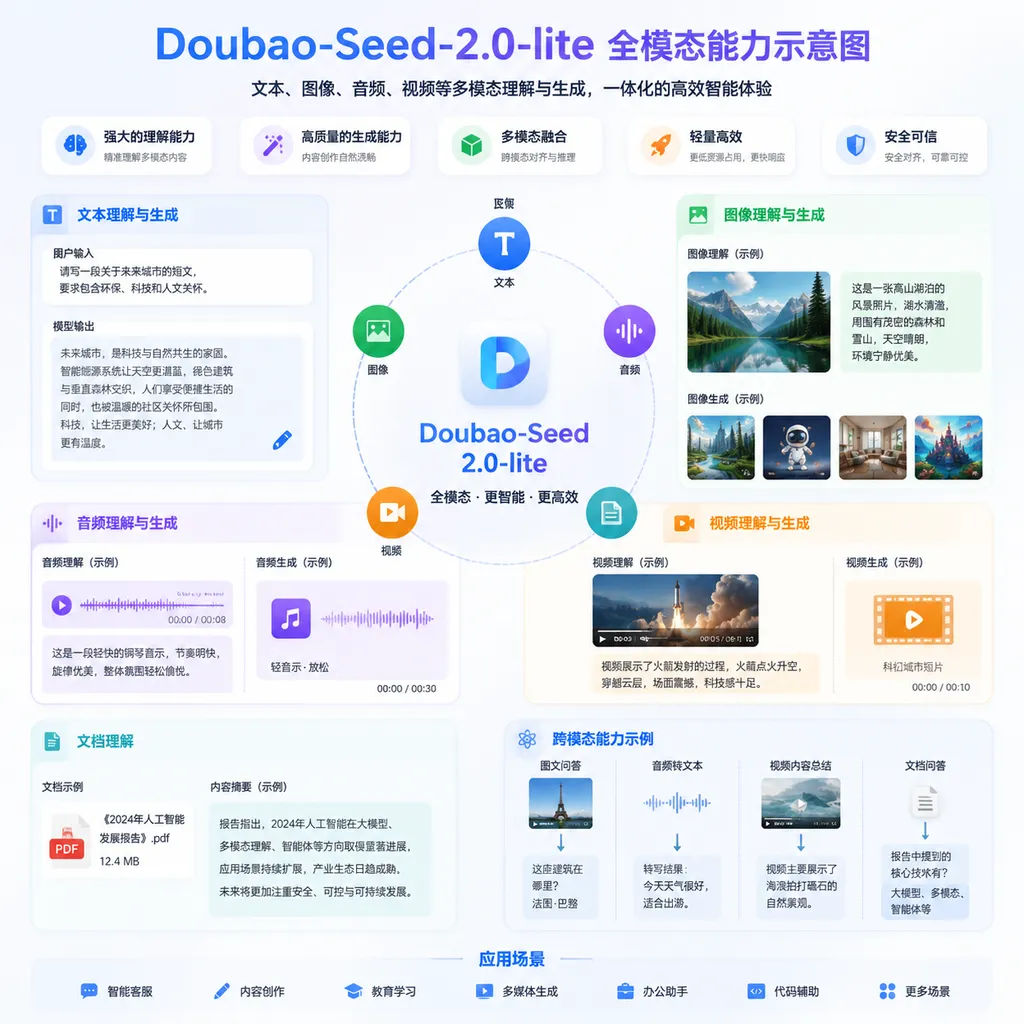
ByteDance today (May 6) rolled out a major upgrade for Doubao-Seed-2.0-lite — the lite-positioned model has now become the first fully modal comprehension model in the Doubao large model family, enabling native unified understanding across video, image, audio, and text, while refreshing Agent, Coding, and GUI capabilities. The new version is already available on Volcano Ark and can be used directly via API calls.
ByteDance defined the keywords for this upgrade as "full modality" and "cost-effectiveness." The former represents a breakthrough in capability; the latter is aimed at enterprise users — the term lite here is no joke. Pricing starts at ¥0.6 per million input tokens and ¥3.6 per million output tokens, positioning it as a model tier optimized for large-scale inference scenarios among domestic multimodal models.
A lite version outperforming its own pro in some benchmarks
The most noteworthy detail in this upgrade: the new Doubao-Seed-2.0-lite delivers significantly better performance than the Doubao-Seed-2.0-pro released in February, especially on advanced reasoning benchmarks in physics (HiPhO) and medicine (MedXpertQA).
That statement might prompt two reactions: one — “lite beating pro, is the naming system messed up?”; or two — “pro was from three months ago, so it’s reasonable that lite surpasses it now.” Both are valid.
The real signal is this: ByteDance doesn’t iterate according to model tier, but by capability stack. When pro was released in February, full modality wasn’t fully integrated yet. By May, ByteDance chose to embed full-modality capabilities first into lite — effectively making lite the launch vehicle for the new-generation architecture. For developers, that’s good news — you get inference power beyond the last-generation pro at lite pricing, especially for complex subject-specific reasoning.
The new version achieved SOTA levels on fine-grained perception (BabyVision, WorldVQA) and embodied understanding (ERQA) benchmarks. These datasets share a trait: they go beyond traditional “what’s in the image” shallow VQA tasks, requiring the model to discern subtle visual differences or combine spatial and physical logic for reasoning. These are precisely the areas where multimodal models often struggle — and what enterprises critically need when deploying visual models into production.
Full modality isn’t just stitching models together
“Full modality” has been talked to death over the past two years, so it’s worth clarifying what Seed-2.0-lite actually achieved this time.
Its approach is native unified understanding, not plugging in an external ASR and feeding text to a language model, nor sampling a few frames from a video to pass through an image branch. Video and audio are analyzed jointly in this upgrade — the model can watch the visuals, listen to the sound, and answer questions that require combined “audio-visual” reasoning.
One official example illustrates the point well: determining if what’s seen and heard in a video match. That may sound simple, but in real business applications, it corresponds to lip-sync detection in content moderation, prohibited speech recognition in live streams, or checking if spoken explanations match visuals in educational videos. Previously these required multiple models in a pipeline — or manual review.
Video comprehension also gained two new abilities:
- Temporal localization: locating the moment when a specific event occurs within a video based on natural language instructions
- Cross-segment tracking: extracting clues across time spans, tracking people and event progressions, and performing multi-step reasoning based on visuals
The second ability benefits long-form video understanding teams. Previously, needs were usually “summarize this video segment” — the model returns a paragraph and stops. Now it’s about “when did this person first appear, and what happened later with another person?” — requiring the model to maintain its own internal timeline.
Audio: benchmarked against Gemini
ByteDance has been frank regarding audio. The new Doubao-Seed-2.0-lite supports accurate speech transcription in 19 languages, mutual translation between Chinese, English, and 14 other languages, and can detect emotional shifts, environmental sounds, and musical details within audio.
The conclusion: on public evaluation datasets, Doubao-Seed-2.0-lite outperforms Gemini-3.1-Pro in speech recognition, translation, and other audio understanding benchmarks.
Benchmarking Google’s latest Pro-tier model is an ambitious claim. However, considering ByteDance’s accumulated experience in speech — from Doubao’s real-time voice and voice cloning features, to the massive multilingual corpus within the Douyin ecosystem — it’s not counterintuitive that a lite-scale model could rival Gemini 3.1 Pro in audio tasks. The real test, though, will be generalization performance under real-world conditions like complex accents, far-field pickup, and background noise, which developers will need to evaluate firsthand.
Agent and Coding: getting smarter with use
This upgrade highlights Agent abilities, specifically focusing on “long-horizon tasks.”
Key improvements include:
- Significant boost in adherence to multi-turn, multi-step, multi-constraint instructions
- Improved task reflection and reasoning; the model can self-decompose and self-validate in long tasks
- Strengthened multi-Agent coordination and scheduling; avoids drift and omission
- Deep integration with frameworks such as OpenClaw and Hermes Agent
- Enhanced deep search and dynamic Skill invocation, accumulating experience during execution
The phrase “getting smarter with use” in the release may sound promotional, but it corresponds to the dynamic Skill calling mechanism—wherein the model saves intermediate results as reusable capabilities. This concept aligns with Anthropic’s recent emphasis on “skills” in Claude Code — enabling an Agent to leverage previously verified solutions instead of reasoning from scratch each time.
On the Coding side, ByteDance maintains a separate Doubao-Seed-2.0-Code branch integrated with Volcano Ark’s Coding Plan subscription service, compatible with major tools like Claude Code, Cursor, Cline, OpenCode, and others. The lite model also saw upgrades in coding, focusing on “quick, lightweight development,” while more complex scenarios remain the domain of pro or dedicated Code models.
Pricing: lite is really lite
Here’s the current public pricing on Volcano Ark:
| Model | Input (¥/million tokens) | Output (¥/million tokens) | |---|---|---| | Doubao-Seed-2.0-lite | from 0.6 | from 3.6 | | Doubao-Seed-2.0-mini | from 0.2 | from 2 |
This price range aligns with the mainstream domestic lite/mini class models. The key differentiator is that full-modality capability comes bundled — video, audio, image, and text together — enabling enterprises running large-scale inference to avoid juggling three separate model pipelines and API costs.
ByteDance describes lite’s positioning straightforwardly: “a more cost-effective choice for large-scale, batch deployment of full-modality inference tasks in enterprises.” In other words: not for cutting-edge single-point capability, but to sustain high-QPS production workloads while minimizing per-token cost.
Should you switch?
A few recommendations from a developer’s perspective:
If your business involves content moderation, video comprehension, or multilingual speech recognition, this upgrade to Seed-2.0-lite merits round(s) of comparative testing — especially for teams currently using multi-model pipelines. A unified multimodal model offers clear advantages in latency and consistency.
If you handle pure text tasks, like customer service dialog, document summarization, or structured extraction, the full-modality upgrade doesn’t add much. Just compare prices and RPS; lite or mini (or similar models from other vendors) will do.
If you’re building Agent applications, the deep integrations with OpenClaw and Hermes Agent are nice perks — but note that they imply some ecosystem binding. To achieve production-grade Agents, model ability is just one element; tool invocation stability, error recovery, and observability matter more. You’ll need to test those yourself.
One last observation: From late 2024 to now, the iteration pace of Chinese multimodal models has clearly accelerated. ByteDance, Alibaba, and Zhipu are all bringing “full modality” down from flagship models into lite/mini tiers. The implication: full modality is moving from a “show-off” feature to baseline capability. That’s good news for developers — more usable models, lower prices, and far more freedom in selection than a year ago.
The new Doubao-Seed-2.0-lite is now live on Volcano Ark and can be called directly. For detailed benchmark data and the full model card, check Seed’s model homepage.
References
- ByteDance upgrades Doubao-Seed-2.0-lite to support full modality understanding - linux.do — Official upgrade announcement with benchmark details and capability list


