
OpenAI and six major companies jointly release the MRC Network Protocol

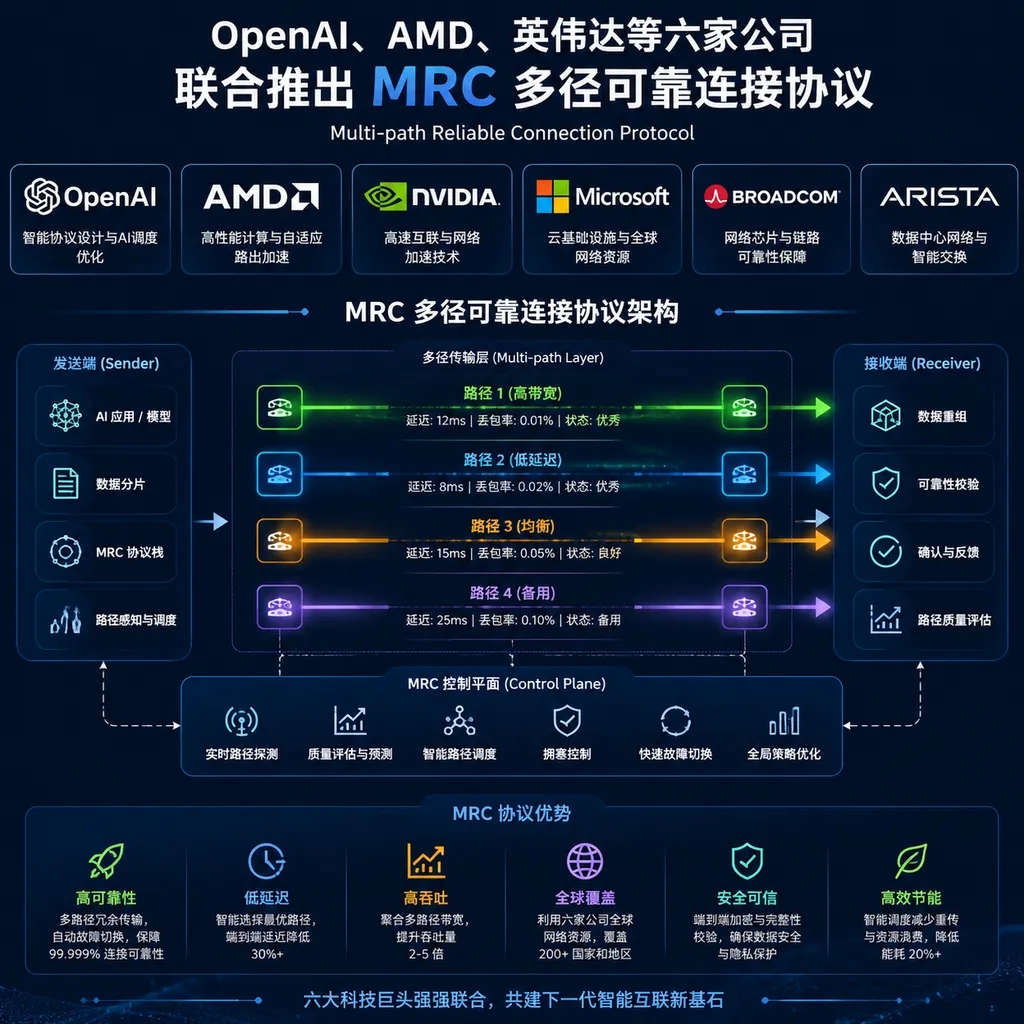
OpenAI teamed up with AMD, NVIDIA, Intel, Broadcom, and Microsoft to jointly release the MRC (Multipath Reliable Connectivity) protocol, which focuses on solving GPU network bottlenecks in large-scale training clusters, and has been made available to the entire industry through OCP.
OpenAI Teams Up with Six Industry Giants to Launch the MRC Protocol: Building a New Expressway for Multi-GPU Clusters
OpenAI today released an understated but weighty announcement on its official blog: together with AMD, Broadcom, Intel, Microsoft, and NVIDIA, it has jointly launched a new protocol called MRC (Multi-Path Reliable Connection), designed specifically to fix long-standing network issues in large-scale GPU training clusters. The protocol is open-sourced via the OCP (Open Compute Project), allowing any vendor to adopt it.
The participant list itself is quite interesting. AMD and NVIDIA sitting at the same table, joined by Intel—and Broadcom, which makes switch chips—essentially brings together the main players in today’s data center networking ecosystem. With OpenAI leading the effort, it looks much like a major client stepping in to set the standards.
GPUs Are Fed, but the Network Hasn’t Kept Up
In recent years, the most frustrating challenge in training frontier models has not been GPU compute power. With H100s, MI300Xs, and B200s stacked high, the real bottleneck is the network interconnecting all those GPUs.
The numbers are harsh. In a 10,000-GPU cluster performing an AllReduce, all cards appear to be busy in theory—but in practice, a significant chunk of time is spent waiting for communication. Gradient synchronization, parameter broadcasting, and pipeline switching all rely on network performance. As cluster size grows from thousands to tens or hundreds of thousands of GPUs, network utilization doesn’t decline linearly—it drops exponentially.
Where’s the bottleneck in traditional designs? The core issue lies in RDMA’s RC (Reliable Connection) mode. Both InfiniBand and RoCE are built on this model, which offers zero-copy, low-latency, CPU-efficient communication—why libraries like NCCL and RCCL are built atop it. But RC makes one outdated assumption: one Queue Pair (QP) follows a single network path.
That’s fine at small scale—but disastrous at massive scale:
- Link jitter equals disconnection. A brief hiccup on a physical link can throw a QP into an error state—forcing go-back-N retransmits or a full teardown. In a 10,000-GPU cluster, link failures aren’t a matter of if, but how many times per hour.
- Uneven ECMP hashing. Switches use five-tuple hashing to balance traffic. In theory it spreads flows evenly, but when elephant flows appear, congestion hotspots form—some links saturate while others idle.
- Large failure domains. A single NIC issue can stall an entire job for minutes or crash it altogether—wasting all compute time since the last checkpoint.
Over the past few years, the industry has tried many patches: NVIDIA’s Spectrum-X for enhanced RoCE, AWS’s SRD on Nitro, Google’s Falcon, and the UEC (Ultra Ethernet Consortium) effort led by Meta and Microsoft. Everyone’s reinventing a similar wheel.
What MRC Does
MRC’s key insight can be summed up simply: decouple “reliability” from “single path.”
It splits one logical connection across multiple physical paths running in parallel, performing packet-level spraying. The receiver handles out-of-order packets instead of triggering go-back-N retransmissions as in RC. If a path fails, only packets from that path are retransmitted—other paths keep flowing. To upper layers, it still looks like RC, so NCCL and RCCL need minimal changes.
Think of it like this: traditional RC is a single-lane road between two cities—one crash halts all traffic. MRC turns it into an eight-lane highway—if one lane closes, traffic keeps moving, with little loss in throughput.
The immediate benefits:
- Higher bandwidth utilization. Packet spraying flattens traffic distribution at the hardware level, no longer reliant on ECMP hash luck.
- Reduced tail latency. Large training jobs suffer from P99 latency spikes—one straggler slows the whole step. Multi-path and out-of-order delivery directly target this issue.
- Localized fault impact. A single link failure won’t trigger full connection resets; training jobs continue unhindered.
- Hardware-friendly design. The protocol accounts for NIC and switch implementation complexity—why AMD, NVIDIA, Broadcom, and Intel all signed on: each can realistically implement it.
OpenAI hasn’t yet shared performance numbers, but the protocol’s structure clearly targets 100,000-GPU scale deployments. On Stargate-class infrastructure, even a 1% difference in network efficiency translates to hundreds of H200-equivalent GPUs.
The Alliance Speaks Louder than the Protocol Itself
Looking at the participants reveals an interesting tension: NVIDIA has Spectrum-X, while AMD and Broadcom are core members of the UEC—traditionally on competing tracks. Bringing them together under MRC suggests one thing: OpenAI now has enough leverage as a major buyer to define the rules of the game.
For NVIDIA, Spectrum-X remains a commercial product, but it will need to support MRC as an open protocol—given that OpenAI is among its largest customers. For AMD and Intel, this is a rare opportunity to stand shoulder-to-shoulder with NVIDIA on a level field—since the standard is open, whoever delivers better-performing, lower-latency, cost-effective NICs wins. For Broadcom, as a switch vendor, neutrality pays—so long as the protocol runs.
Microsoft’s role is also critical. Azure is OpenAI’s largest compute provider, and its next-generation AI clusters are the likely proving ground for MRC’s large-scale rollout.
As for UEC, MRC overlaps heavily in goals but differs in scope. UEC aims to define a complete Ultra Ethernet stack, ambitious but slow-moving; MRC cuts narrower—focusing just on “multi-path reliable transport,” open through OCP, and likely to land sooner. The two may eventually merge—or coexist for some time.
What It Means for the Industry
Over the past two years, “AI factories” have become a buzzword, but engineers who’ve stared at cluster logs know the truth: whether a training job runs to completion—and how fast—depends more on the network layer than the scheduler, compiler, or even certain algorithmic optimizations.
The emergence of MRC signals convergence. A market long dominated by InfiniBand and fragmented by proprietary protocols is moving toward open standards. For cloud providers, this gives a clearer procurement target for future AI cluster upgrades; for chipmakers, a unifying spec to design toward; for training framework teams, less network jitter at the transport layer—though they’ll probably still grumble about NCCL.
There’s another subtext: OpenAI’s ambitions now go beyond models themselves. From the rumored Stargate supercluster to its own chip projects to now spearheading a network protocol, OpenAI is acting less like an AI lab—and more like an infrastructure company.
For application developers, these developments may seem distant from everyday API calls—but they ultimately affect model iteration speed. If training a GPT‑6‑scale model takes a week less, release cycles accelerate. On that note, OpenAI Hub continues to support direct domestic access to GPT, Claude, Gemini, DeepSeek, and other mainstream models with a single OpenAI-compatible key—ideal for teams seeking fast integration of the latest models.
Remaining Questions
MRC’s announcement describes the protocol layer, but actual rollout depends on several factors: when the first NICs supporting it will reach mass production (likely next-gen ConnectX from NVIDIA or AMD’s Pensando); whether Broadcom’s Tomahawk switch line will adapt; and when NCCL will merge the corresponding transport—without that, large-model training teams won’t move.
Another question is whether Chinese vendors (Huawei, Alibaba’s T-Head, Enflame, etc.) will follow suit once OCP publishes the spec. The openness of high-performance networking protocols is always an advantage for latecomers.
The formal technical specification is already live in the OCP repository—engineers can check packet formats, state machines, and retransmission logic there. It offers far more substance than the marketing language of the official blog.
References
- OpenAI joint release of MRC (Multi‑Path Reliable Connection) with several partners – linux.do: Community discussion and summary of OpenAI’s joint announcement with AMD, NVIDIA, Intel, Microsoft, and Broadcom.


