
Project Mariner Finale: Google Integrates the Browser Agent into Gemini
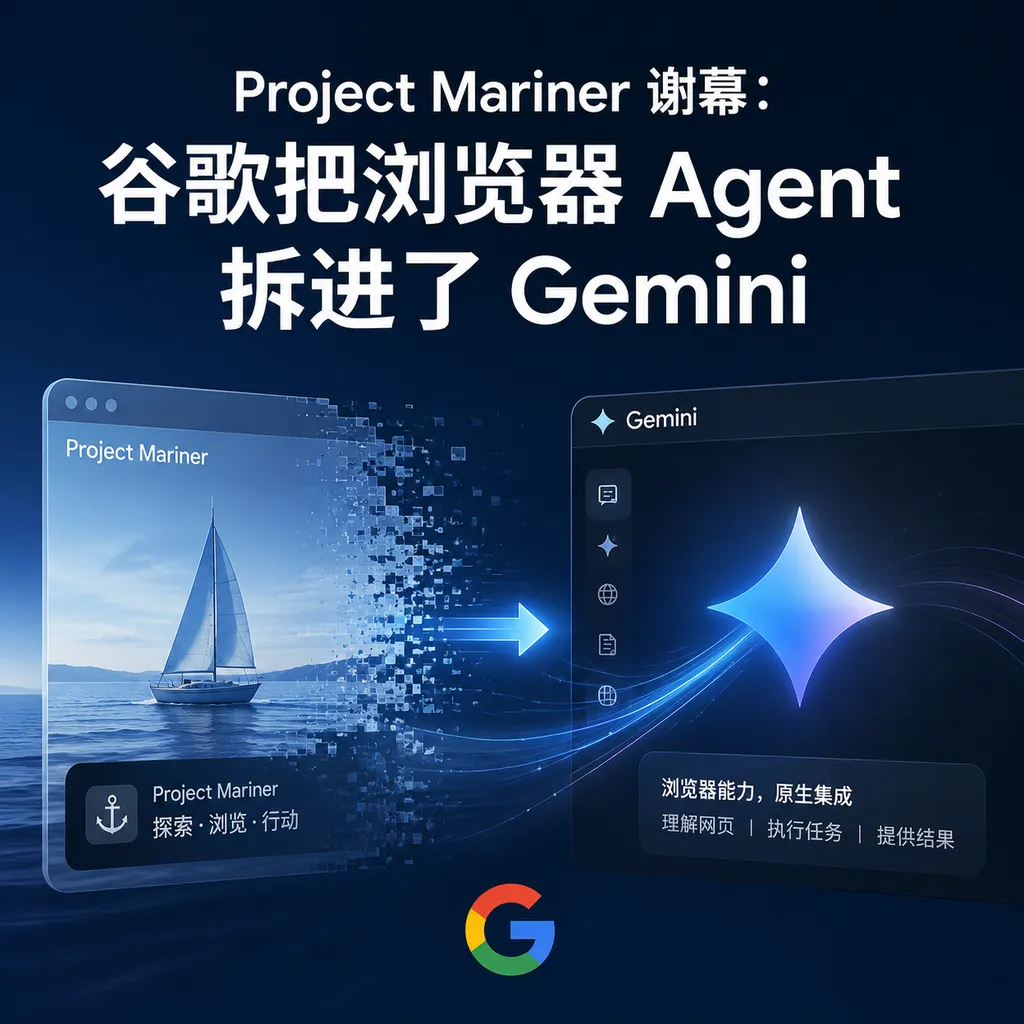
On May 4, Google officially shut down its experimental project, **Project Mariner**. Its cross-webpage automation capabilities have been split and integrated into **Gemini Agent Mode**, **Search AI Mode**, and **Chrome’s auto-browse**. This marks a significant step for Google in moving its Agent from the lab into mainstream products.
A Graceful Exit for a Laboratory Project
On May 4, Google posted a banner on the Project Mariner website: “Thank you for using Project Mariner. It was shut down on May 4, 2026, and its technology has set sail into other Google products.”
The wording is very “Google”—framing a shutdown as a voyage continuing onward. But insiders know well this isn’t a Bard-style renaming, nor a Duet AI-style vanishing act, but a clean and decisive consolidation: the Mariner name is gone, but the hard problems it cracked over the past 18 months—getting AI to truly open webpages, fill forms, compare prices, and place orders for you—have been absorbed into Gemini’s Agent Mode, the AI Mode in Search, and Chrome’s auto-browse.
If you’re building Agent applications, this move matters more than any model Google released last week. Because it finally answers a question that’s hung over the industry for a year: What form should a browser Agent take?
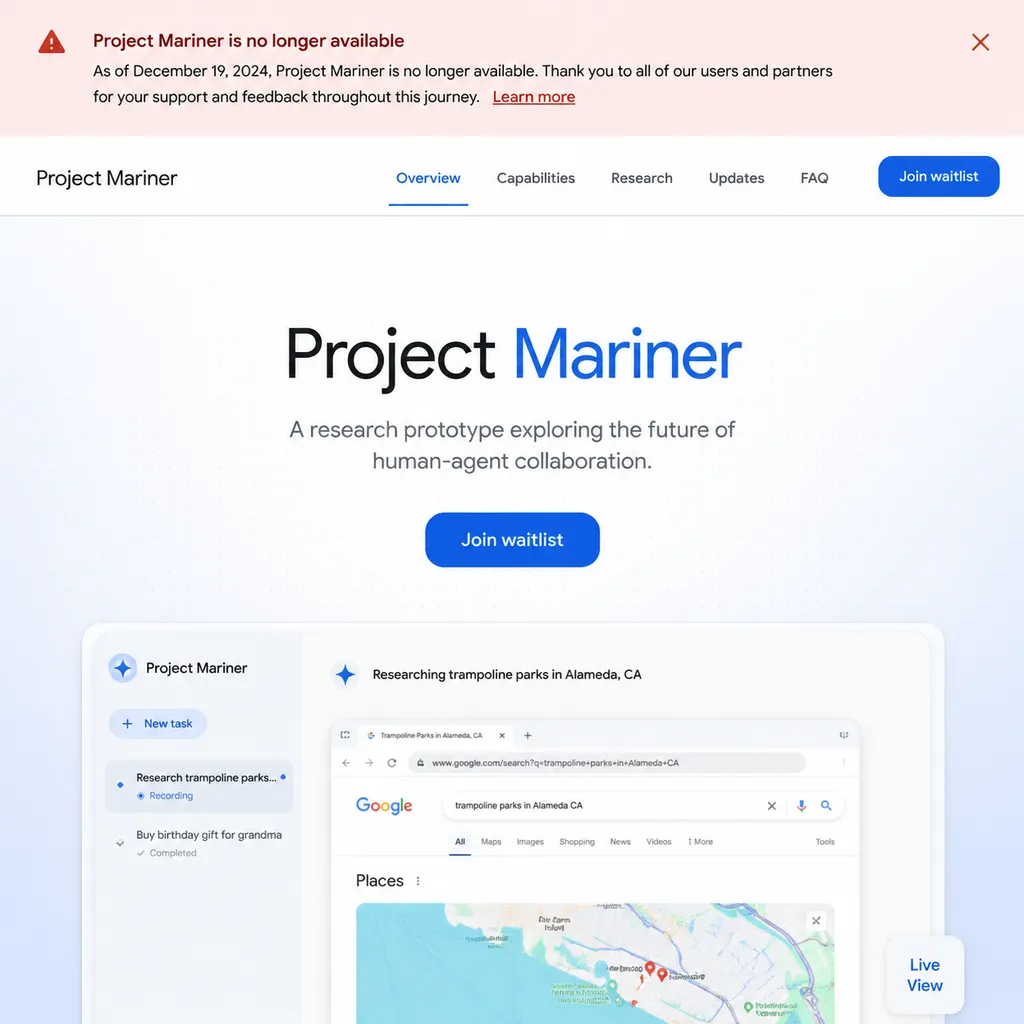
Looking Back: What Mariner Did Over 18 Months
Let’s rewind to December 2024. At that time, OpenAI’s Operator hadn’t launched yet, Anthropic had just previewed Computer Use, and Perplexity was testing its own browser agent. Google entered the scene with Project Mariner—an experimental Chrome extension designed to perform multi-step tasks across web pages. A typical example: “Help me compare the lowest prices for this graphics card across several shopping sites.”
The initial version of Mariner made several forward-thinking design choices:
- Directly manipulating the DOM instead of using screenshot-based recognition. Unlike Claude’s visual-click approach in Computer Use, Mariner relied more on structured page data, greatly improving stability in forms and list-based scenarios—though it couldn’t handle pure Canvas-rendered sites.
- User takeover. During task execution, users could take back control of the cursor at any time—a nearly mandatory feature for payment and login workflows. This later became the de facto standard for all major browser Agents.
- Concurrent execution of up to 10 tasks. Introduced in a mid-2025 update, this feature effectively silenced debate on whether Agents must operate serially.
But Mariner always had an awkward position: it was a standalone, invite-only experimental product. Low user numbers meant sparse feedback. Internally, Google had long realized—this shouldn’t be an isolated product, but a “capability” embedded into where users already are.
Three Directions, Clearly Divided
Looking at where Mariner’s capabilities ended up gives insight into Google’s Agent product landscape:
1. Agent Mode in the Gemini App: The consumer entry point
Agent Mode in Gemini’s mobile and web apps inherits the most “assistant-like” part of Mariner—booking hotels, archiving emails, tracking packages. The positioning here is personal task assistance for everyday users: “state your need in one sentence, it’ll open tabs and get it done for you.”
From the post-I/O updates this year, Agent Mode now connects Gmail, Calendar, Maps, and other first-party tools. Combined with Mariner’s cross-site browsing power, this may be one of the most user-friendly Agent experiences available today.
2. Search AI Mode: Redefining what “search” means
This direction is more imaginative—and more aggressive. AI Mode doesn’t just layer summaries atop search results; when users ask “Help me find a direct flight from Beijing to Tokyo this Friday under 5000 yuan,” it actually queries airline and OTA websites directly, returning bookable options.
Two years ago, this task belonged to Perplexity and Kayak. Now Google has folded it into its own search distribution—how hard this hits downstream OTAs and price comparison sites is uncertain, but it’s definitely not good news for them.
3. Chrome’s auto-browse: The native browser Agent
auto-browse, which Google demoed earlier this year in Chrome, builds on much of Mariner’s underlying tech. Its distinction from Agent Mode: auto-browse runs inside your active browsing session. If you’re looking at flights, it can take over and continue comparing; Agent Mode operates more like a background process.
It’s Google’s direct answer to OpenAI’s Atlas browser and Perplexity’s Comet—you don’t need a new browser to use an Agent. Chrome itself is the Agent.

Why Shut Down Now?
Two reasons—product logic and strategic logic.
From a product standpoint, Mariner has fulfilled its mission as an experimental sandbox. The purpose of such projects is to explore uncertain capability boundaries with minimal user commitment. Once those capabilities stabilize and use cases prove valid, maintaining a separate brand becomes a burden—requiring separate UI, documentation, operations, and model adaptation with every upgrade. Google has faced criticism for fragmented product lines (Bard, Duet, Gemini, NotebookLM, Project Astra, Project Mariner…). This time, they’re simplifying proactively.
Strategically, Google needs Agent capabilities within its controlled distribution gateways. Search, Chrome, and the Gemini App—these are the three traffic gates Google has guarded for two decades. By integrating Mariner into them, Google is telling the market: don’t expect a standalone “Google Agent product” to subscribe to. The Agent is search, the browser, the assistant of the future. It doesn’t cost extra—it is the service.
This differs from OpenAI’s approach. OpenAI’s Operator/Atlas treats Agents as a distinct, monetizable product category; Google views Agents as an enhancement of existing ones—using open ecosystem access to boost user stickiness. Which approach is right will depend on next year’s data.
Developer Perspective: What You Can Use
For developers, several points are worth noting:
- Gemini API’s computer-use / browser-use interfaces have gradually opened over recent months. With Mariner shut down, these underlying capabilities will become more unified and stable. The earlier gap—“Mariner works best but has no API; the API exists but performs worse”—should ease.
- A2A (Agent-to-Agent) protocol, introduced at I/O 2025, aims to let Agents from different providers call each other. Mariner’s shutdown signals Google moving away from “closed, in-house Agents,” giving A2A stronger momentum.
- Native MCP support has already landed in the Gemini API and SDK, dramatically reducing integration costs compared to six months ago.
If you’re evaluating Gemini, GPT, and Claude on Agent tasks—especially Function Calling and long-context tool usage—OpenAI Hub currently hosts all major models under one key, China-direct accessible, fully OpenAI-format compatible—saving headaches with proxies and accounts.
A Broader Implication
Mariner’s termination arguably marks the end of the “browser Agent” as a standalone product category.
Over the past year, many products emerged—Operator, Atlas, Comet, Browser Use, Arc Search... Their shared bet: that users would pay for a dedicated “AI that surfs the web for you.” Google’s consolidation of Mariner expresses the opposite view—this capability is too fundamental, too cross-cutting, and will inevitably be absorbed by existing browsers, search engines, and assistant platforms. The standalone form was transitional.
That view may not be correct—OpenAI clearly disagrees, hence Atlas—but it’s undeniable: when Chrome natively has auto-browse and the search bar itself can run Agents, convincing users to install new software or adopt new habits becomes much harder.
For startups, this means it’s nearly impossible to compete head-on with giants in “general-purpose browser Agents.” The opportunity lies in vertical sectors—legal due diligence, e-commerce operations, financial information integration—where generic Agents can’t go deep, and specialized ones can build defensible moats.
Mariner’s epitaph reads beautifully: “Its technology has set sail for other Google products.” In reality, it’s sailed into the very pages each Google user opens daily. For Google, that’s the outcome it truly wanted.
References
- ITHome: Google Shuts Down Project Mariner; Cross-Web Automation Tech Integrated into AI Mode — ITHome’s original Chinese report on Mariner’s shutdown, including timeline overview
- Zhihu Column: This AI Agent Is More Explosive Than Google I/O — An analysis of how Gemini Agent Mode inherited Mariner’s capabilities and real-world experience


