
Sub2API quietly added an auditing feature, but the default model has left domestic developers stumped.
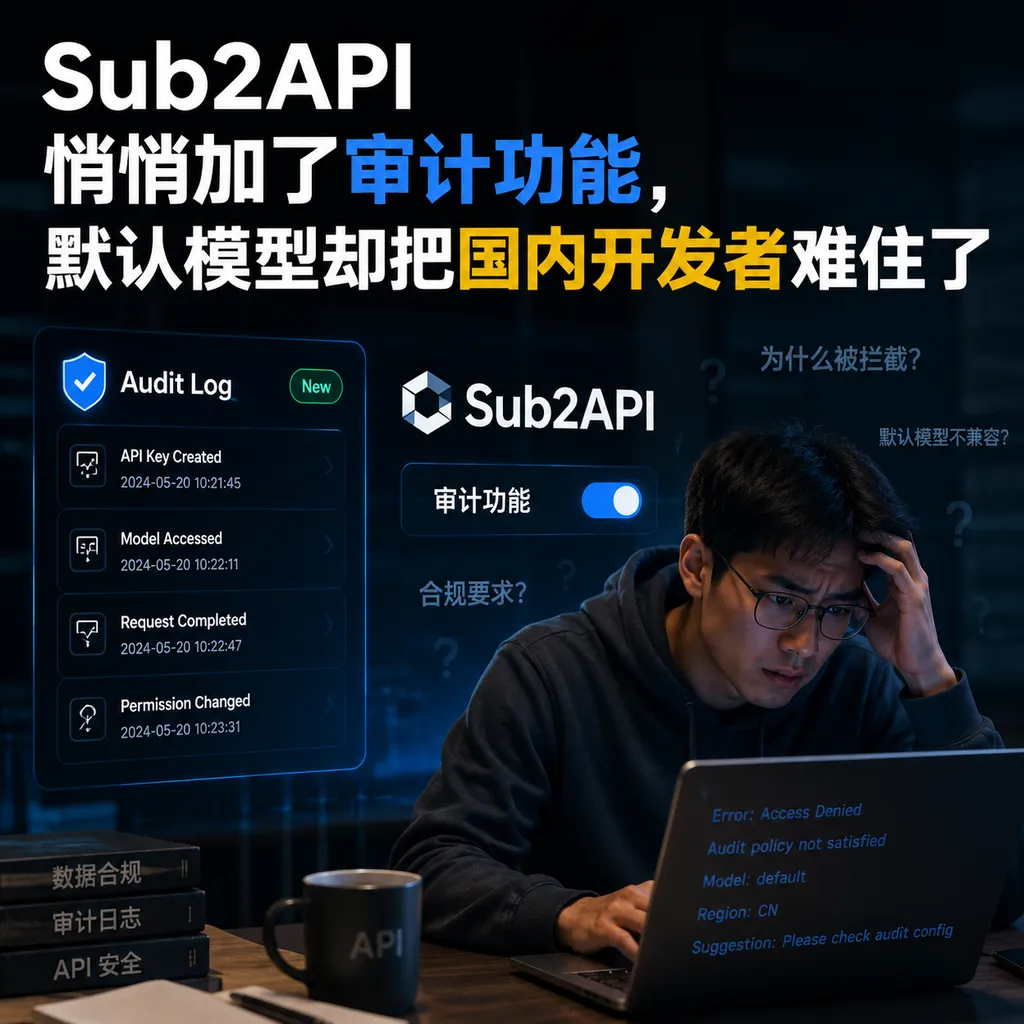
The latest update to Sub2API has added auditing capabilities. By default, it uses OpenAI’s **omni-moderation-latest**—free, but requires a credit card. This invisible barrier has shut out a group of users and also exposes a long-standing minor issue within the domestic toolchain ecosystem.
Sub2API Added an Audit Feature, but Developers Are Blocked by OpenAI’s Card-Binding Threshold
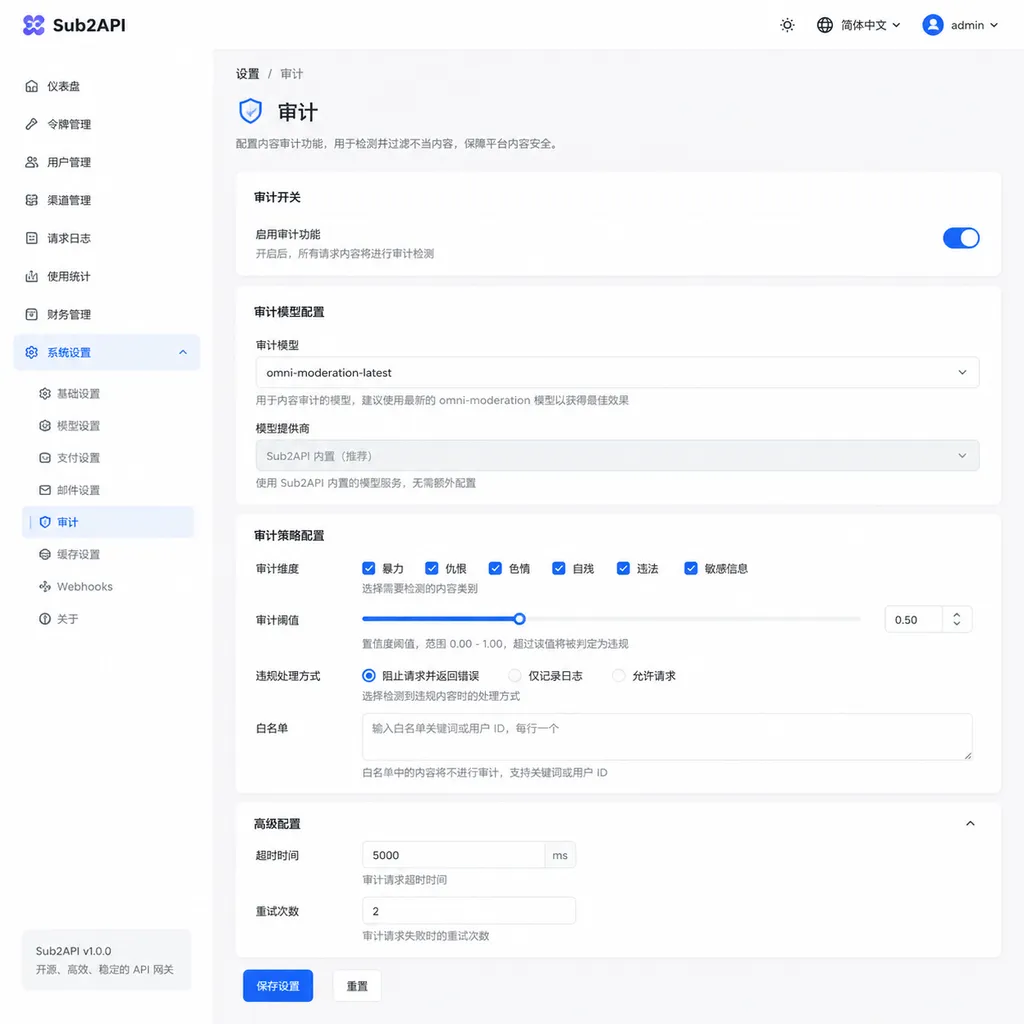
In today’s update, Sub2API quietly introduced an audit feature, with the settings panel defaulting to OpenAI’s omni-moderation-latest. The price field says “Free,” which sounds low-barrier, but in practice, you need an OpenAI API Platform account and a bound payment card — and those two steps are roadblocks for developers in China. A post quickly appeared on linux.do asking, “Does anyone have a way to access this model?” The question itself is short, but it reflects a long-standing quirk of the domestic AI toolchain ecosystem: middleware is getting more sophisticated, but the foundational models it relies on are becoming harder to access.
What Exactly Changed in This Update
Sub2API is a typical API proxy/subscription management tool. Its job is to aggregate scattered upstream APIs and expose a unified OpenAI-compatible interface. Previously, it focused mainly on model routing, authentication, rate limiting, and usage stats. The new audit (moderation) feature extends into compliance — a predictable move. Any API distribution platform with a growing user base can’t ignore compliance review. Without moderation, if an upstream model provider detects policy violations, the entire API key could be revoked.
The audit function sits in the middle of the request path: user requests first go through a moderation model, which rejects or tags sensitive content before forwarding to the downstream LLM. This model isn’t Sub2API’s invention — Cloudflare AI Gateway, LiteLLM, and some one-api forks use similar designs. The key difference lies in which moderation model you choose.
Sub2API chose omni-moderation-latest as the default. Launched by OpenAI in late 2024 and continuously updated since, it’s a multimodal moderation model with two major selling points:
- Multimodal: Handles both text and image inputs — a must-have for modern applications involving visual input.
- Free: OpenAI doesn’t charge for moderation API calls; usage is unlimited and costs $0.
It’s an excellent choice for middleware defaults. Free means no cost burden for platform owners, and multimodal means broad coverage. Most API gateway developers would likely make the same choice.
What Exactly Is omni-moderation-latest
In short, it’s OpenAI’s multimodal upgrade from the old text-only text-moderation model. It detects categories such as violence, self-harm, sexual content, hate, harassment, and illegal activity, each with fine-grained subcategories (e.g., minors in violent content). Each category returns a confidence score (0–1) plus a Boolean label.
OpenAI hasn’t disclosed architecture details, but behaviorally it seems to be a multitask classifier sharing a vision encoder. The response is fast — typical P95 latency under 300 ms — and much cheaper than a GPT-4o pass (in time and tokens).
Its purpose is clear: not for content generation or as an application’s “moral judge.” OpenAI documentation emphasizes that moderation API output should serve as a signal, while applications determine final policy — thresholds, handling methods, human review, etc.
In Sub2API’s case, this fits perfectly: the platform doesn’t need to judge right vs. wrong precisely — it just needs a “checked” layer for accountability if an upstream provider objects. omni-moderation-latest is free, fast, and comprehensive — ideal for this use.
Why “Free” Turned Into a Problem
The post’s line — “It’s free, but you need an OpenAI API account with a bound payment card” — hits the core issue.
To directly use OpenAI’s API from China, developers must overcome more than technical barriers:
- Account registration requires a non–Mainland China, non–Hong Kong phone number.
- Payment card binding needs a foreign or supported virtual card — and OpenAI blacklists some providers.
- IP restrictions mean all calls must use stable, unrestricted IPs, or the account risks flags.
- Account bans are still possible even after passing all that; usage can end abruptly with key invalidation.
For someone just wanting to run moderation in middleware, maintaining this setup costs far more than the “free model” benefits. End result: the more “free” the foundational tool, the more you need to pay a proxy platform to access it. Counterintuitive but true.
Under that linux.do post, multiple users searched for “omni-moderation channels.” That shows that after Sub2API’s update, many newcomers to moderation suddenly needed the model — but they weren’t the type to deal directly with OpenAI. For them, the brand doesn’t matter — what matters is “the dropdown in Sub2API’s settings must actually work.”
Practical Alternative Options
Since direct access to OpenAI is difficult, the community has developed various workarounds, each with trade-offs.
Use an API aggregation platform.
The simplest approach. Services like OpenAI Hub let you use one key for GPT, Claude, Gemini, DeepSeek, etc., all OpenAI-compatible and China-accessible. They typically support moderation endpoints too; you just change Sub2API’s base_url to that platform. For most users wanting Sub2API’s moderation feature to function, this has minimal friction.
Use other moderation models instead.
Now there are many more choices than a year ago:
- Azure Content Safety – Microsoft’s moderation service for text and images, with classifications similar to OpenAI’s. Available domestically, pay-per-call.
- Perspective API – Google Jigsaw’s toxicity-based service, broad free quota but less detailed categories.
- Llama Guard 3 / 4 – Meta’s open-source moderation models, self-hostable; version 4 adds multimodal support. Full local control and predictable cost.
- Qwen / GLM specialized moderation variants – Domestic Chinese models, often better in Chinese-language contexts and with more stable compliance.
For Chinese-centric applications, Llama Guard or local moderation models may perform as well or better than omni-moderation-latest. OpenAI’s accuracy outside English has always been weaker. Its harassment classifier, for instance, struggles with homophones, pinyin, or character-splitting tactics in Chinese — missing a large portion of violations.
Train your own small model.
Use lightweight architectures (BERT, DeBERTa, etc.) to train classifiers targeting your specific high-risk categories. The cost is annotation and training time; the gain is full control, lowest latency, and zero external dependency. Ideal for large-volume, real-time workloads like chat or live-stream comments, where calling external APIs isn’t feasible.
A Deeper Issue to Ponder
Sub2API’s default choice of omni-moderation-latest reflects an inertia — OpenAI’s free endpoints are still “default options” in much open-source middleware, even if they’re inaccessible for many Chinese developers. This isn’t Sub2API’s fault but an ecosystem issue: tool authors often live in environments with direct OpenAI access, so they set convenient defaults and only learn of user friction when issues arise.
Two trends worth watching:
-
Will OpenAI make the moderation endpoint paid in 2024–2025?
The free policy dates back to GPT‑3, but adding image moderation changes cost structure. Image inference is GPU‑intensive, so continuing free access is a significant subsidy. If OpenAI starts charging, tools like Sub2API will need to reconsider defaults. -
Will a truly competitive domestic “omni‑moderation” alternative appear?
Current local options are specialized — toxicity, copyright, child protection, etc. What’s missing is a unified, multimodal, low‑cost (or free) API. Once one emerges, open‑source tools will quickly migrate. It’s actually a good market opportunity — moderation APIs can attract users and lock in ecosystems.
What Developers Can Do Now
Short‑term pragmatic steps:
- To quickly enable Sub2API’s audit, switch the
base_urlto a moderation‑capable aggregation platform — done in minutes. - For production workloads or high traffic, evaluate Azure Content Safety or self‑hosted Llama Guard for better long‑term control and cost.
- For Chinese‑language businesses, don’t blindly trust omni‑moderation’s confidence scores; test against your own corpus versus domestic models — results may surprise you.
- Don’t just use OpenAI’s default 0.5 threshold; recalibrate for your recall/precision needs — the optimal value is usually much lower.
Sub2API’s update is overall positive — long‑overdue audit capability finally added. But the default model’s access barrier turned a routine upgrade into an awkward community discussion. And such discussions will likely repeat whenever the OpenAI ecosystem shifts. The problem won’t vanish — but the workarounds will keep improving.
References
- Does anyone have a channel for the omni-moderation-latest audit model? – linux.do — Community post discussing access routes after the Sub2API update.


