
A Xiaomi MiMo Key with a remaining limit of 100 million has been listed on linux.do.
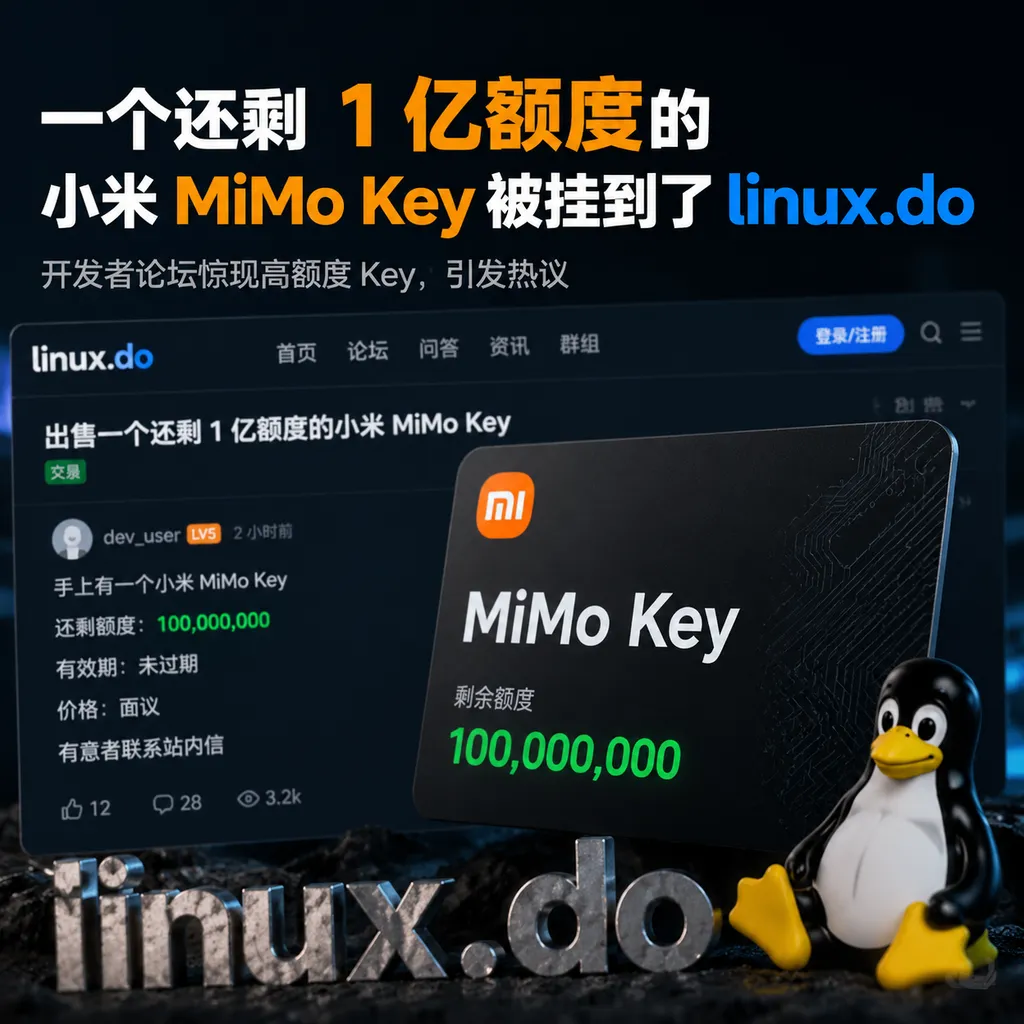
A developer publicly shared a Xiaomi MiMo Standard plan quota key on linux.do. The original quota was 200 million, and according to the post, more than 100 million remain. What’s more noteworthy is the information revealed behind this key: Xiaomi MiMo’s API service is compatible with both the OpenAI and Anthropic protocol sets.
A Key, Over 100 Million Tokens, Posted on a Forum
Late on the night of May 6, an inconspicuous post popped up on linux.do. The poster said they had a quota Key for Xiaomi’s MiMo Standard plan — originally worth 200 million tokens, with over 100 million still unused — and since they didn’t need it anymore, they were putting it up for anyone who wanted it.
Posts like this aren't new on linux.do — over the past year, everything from early test Keys for Kimi to employee benefit allocations from various companies has circulated in this community. But this particular post was worth a closer look, not because of the large quota (100 million tokens nowadays is just enough to run a mid-scale application for a week or two), but because it included two Endpoints:
OpenAI-compatible: https://token-plan-sgp.xiaomimimo.com/v1
Anthropic-compatible: https://token-plan-sgp.xiaomimimo.com/anthropic
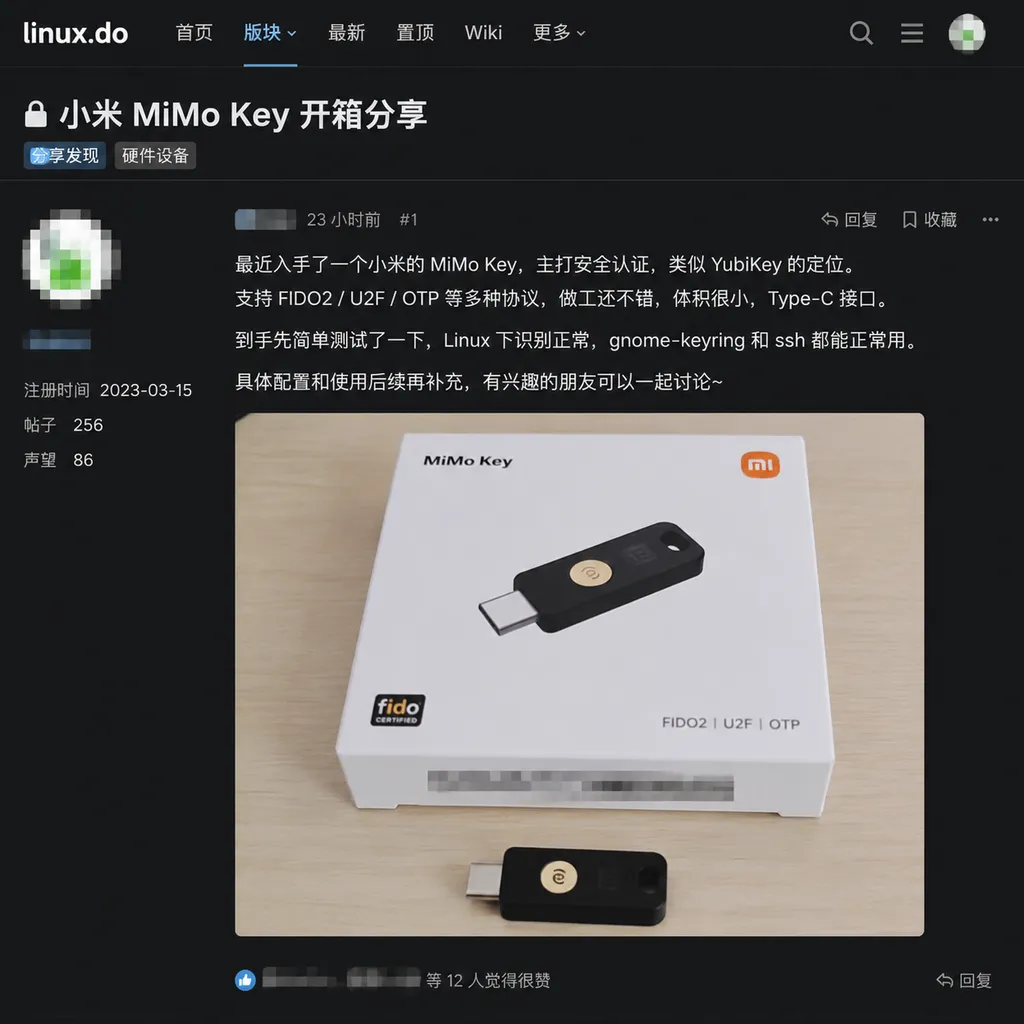
Xiaomi’s MiMo API service supports both OpenAI and Anthropic protocol interfaces. The sgp in the domain name refers to a Singapore node, and token-plan indicates that this is a token-based prepaid package system.
Dual Protocol Compatibility Is No Small Move
Over the past two years, most domestic large-model vendors’ APIs have been crowding toward “OpenAI compatibility.” The reason is simple: within the developer ecosystem, the openai SDK has become the de facto standard. Supporting it means zero migration cost for users.
But Anthropic’s protocol is another story. Claude’s Messages API follows its own format: the system field is separate from messages; content supports structured block arrays; and tool-use return objects differ from OpenAI’s. Vendors willing to implement this additional compatibility usually do so for two reasons:
- To support clients already tied to the Anthropic protocol, such as Claude Code. Since last year, Claude Code has become a daily coding tool for many engineers, and it exclusively accepts the Anthropic format. Vendors wanting their models to be used by these users must conform.
- To tap into the Agent ecosystem. Anthropic’s tool-use specifications are deeply integrated into Agent frameworks. Projects like LangGraph and Mastra have been strengthening support for Anthropic’s protocol.
Those who previously took this step include Meituan’s LongCat and xAI’s Grok API — and now Xiaomi’s MiMo has joined them. This shows one thing: for Chinese vendors, the Anthropic protocol has shifted from “optional” to “mandatory.” Only supporting OpenAI means giving up an entire fast-growing segment of Agent and coding applications.
What Level Is MiMo At?
Xiaomi’s MiMo-series models started releasing 7B-scale inference versions on HuggingFace last year, targeting edge-cloud collaboration — small enough to run on cars or phones locally, but scalable in the cloud for larger-parameter versions. In public benchmarks, MiMo‑7B‑RL performs on par with DeepSeek‑R1‑Distill in mathematical reasoning.
However, small edge models and full API services are different matters. The token-plan-sgp.xiaomimimo.com endpoint now exposed represents a complete commercial API backend. Offering 200 million tokens upfront for the Standard plan says a lot — this isn’t a proof-of-concept trial; it’s an actual prepaid commercial product.
Notably, Xiaomi is using its overseas node (SGP) as a main access point instead of focusing solely on the domestic market — showing real ambition. Considering Xiaomi’s strong market share in Southeast Asia and India, a dual-track approach combining edge devices and cloud APIs in these regions makes logical sense.
Why Offer 200 Million Tokens in One Plan?
What does 200 million tokens mean? Assuming MiMo is priced similarly to comparable models (around ¥2 per million input tokens), this package’s cost is only a few hundred RMB. But for a newly launched API service, what’s being given away isn’t money — it’s user habits.
This has been the standard approach in China’s API market over the past two years:
- DeepSeek broke the price structure of Tongyi and Wenxin by offering extremely low prices.
- ByteDance’s Doubao adopted a free + enterprise edition strategy.
- Alibaba’s Bailian and Tencent’s HunYuan use large trial quotas to lock in developers.
Xiaomi MiMo joined this game rather late, so the giveaways had to be even more aggressive. The Standard plan with 200 million tokens is essentially using quota as distribution, enticing developers to integrate the API first — and once integrated, migration becomes difficult.
How Do Vendors View Shared Keys?
Coming back to the linux.do post itself — a Key being publicly shared is a headache for the vendor:
- Unclear quota ownership. If a plan Key isn’t protected by IP whitelists or caller fingerprints, once it leaks, anyone can consume it.
- Auditing difficulties. When multiple users share one Key, logs show a single identity making heavy calls, making it hard to distinguish normal usage from abuse.
- Damage to commercial narrative. The intention behind giving out quota is to let one developer test it; when the Key ends up used by hundreds of people on a forum, budgets burn faster and conversion data becomes unreliable.
A more mature approach is the OpenAI model: an Organization + Project + Key three-level structure, where Keys can be restricted by model, spending cap, or IP source. Anthropic and Google have similar mechanisms. From what this incident shows, Xiaomi MiMo’s Key system is still quite basic — likely just a token string tied to one quota pool without finer controls. That’s fine for early-stage growth, but it will need improvement as scale increases.
Developer Perspective: Should You Use It?
If you’re a developer who just heard about this from this article, my advice is — don’t use it, or at least don’t use it for production.
For simple reasons:
- It could be revoked at any time. Once the vendor notices the leak, the Key could be canceled within minutes, instantly returning 401 errors across your services.
- Compliance risks. Using someone else’s paid quota is clearly against compliance rules in many corporate frameworks, even if the quota was originally given out for free.
- Data security. You don’t know the traffic auditing policies behind this endpoint. If your test data runs through an unauthorized account, accountability gets complicated.
If you want to properly test MiMo, apply for an official plan or use an aggregation platform. By the way, a service like OpenAI Hub (openai-hub.com) — where a single Key lets you call all major models — is more practical for domestic developers: no need to open separate accounts, recharge, or manage quotas for each vendor, and OpenAI-compatible formatting works directly with existing code. If Xiaomi MiMo officially opens up later, it will likely be integrated into such aggregation services.
Industry Signals Behind This
Looking at this event in a broader context, three trends are unfolding simultaneously:
- Anthropic protocol becoming a de facto standard. From xAI and Meituan’s LongCat to Xiaomi’s MiMo, both domestic and international tier-two vendors are adopting dual-protocol compatibility. A year from now, APIs supporting only OpenAI formats will seem incomplete.
- Edge-device vendors moving into cloud services. Companies like Xiaomi, vivo, and OPPO — originally hardware-focused — are quietly building API services. The logic: device-side AI capability needs cloud support, and offering that compute power externally monetizes it.
- Normalization of gray-market quota sharing. Keys circulating in communities like linux.do have become an implicit distribution channel within China’s API ecosystem. Vendors tacitly allow it (as it helps spread awareness) while running risk controls privately.
The Key posted to that forum will be revoked, but the signal it sent — Xiaomi MiMo is running on a legitimate commercial track and has adopted the most mainstream dual-protocol strategy — will persist.
References
- linux.do: A Xiaomi Standard Plan Quota Key — Source post containing endpoint addresses and plan details
- chatgpt-nav README (GitHub) — A collection of domestic large-model API platforms, useful for comparing MoE architecture models’ current support for dual-protocol compatibility


