
Parloa puts GPT into the telephone: an engineering sample of a customer service agent platform
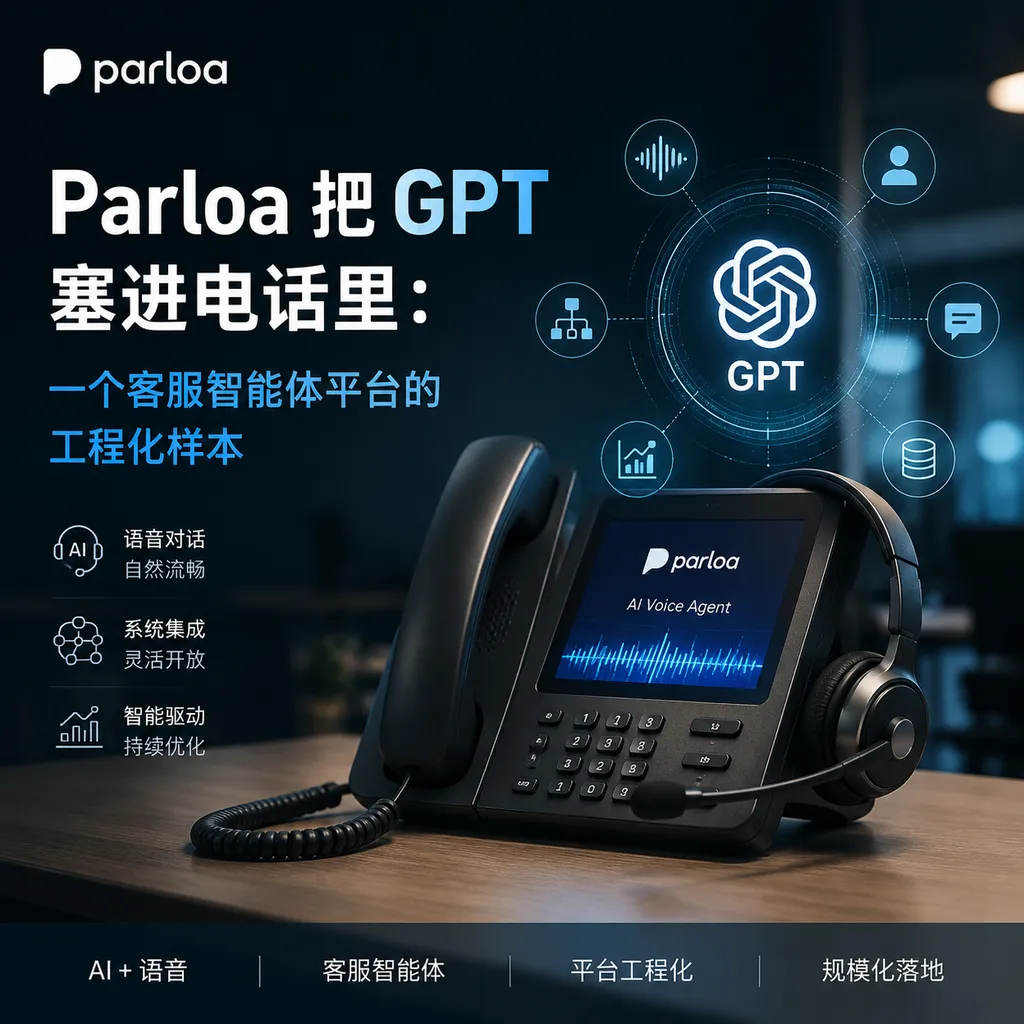
OpenAI officially disclosed details of its partnership with German AI customer service company Parloa. This startup, now valued at $3 billion, is using GPT-realtime and GPT-5.1 to reconstruct the underlying logic of enterprise voice customer service—shifting from scripted IVR to AI Agents that can simulate, be trained, and go live.
The AI Engineering Behind a Single Phone Call
OpenAI has just published a new partnership case on its official website featuring the German AI customer service company Parloa. The company completed a new round of financing last year, reaching a valuation of $3 billion, making it one of the few European players that can compete head‑to‑head with American companies in the enterprise voice sector.
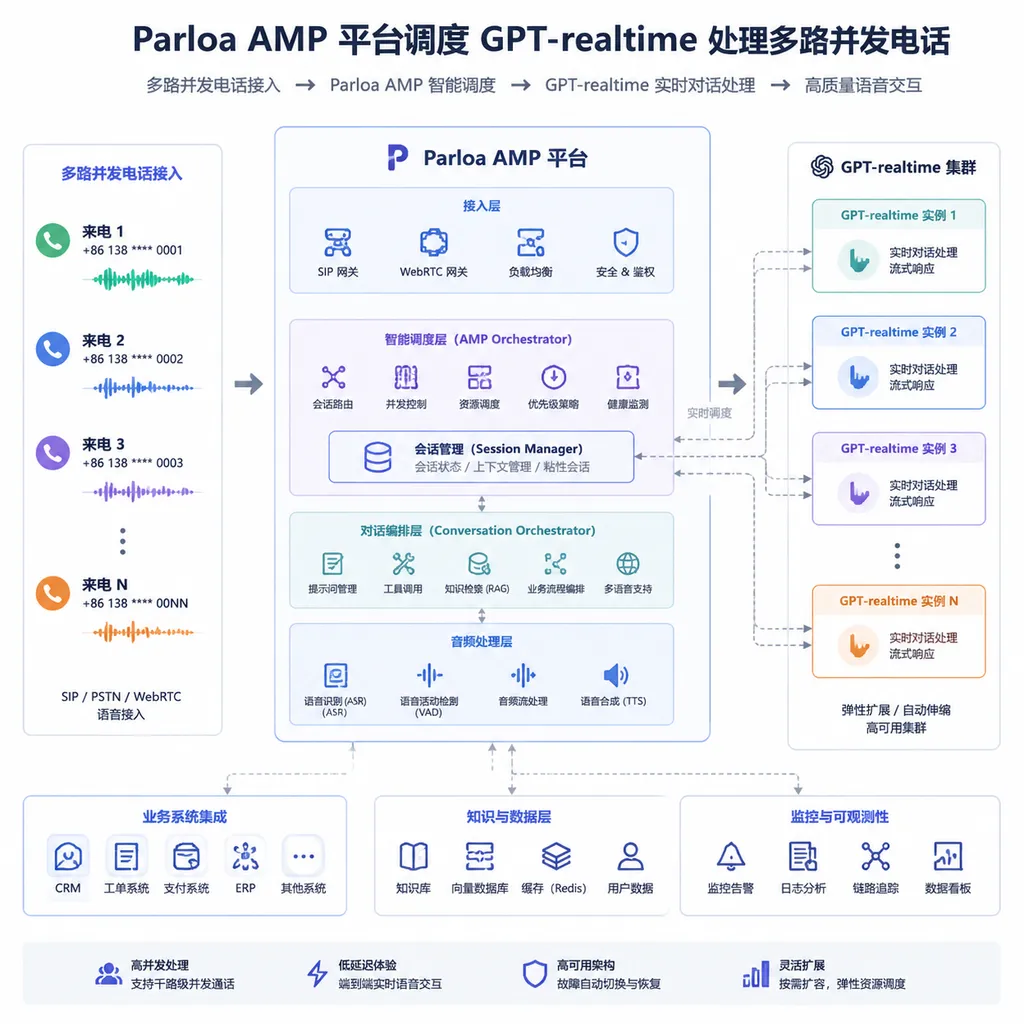
The disclosure comes packed with details: Parloa’s AI Agent Management Platform (AMP) now runs entirely on OpenAI’s model stack—gpt‑realtime handles live calls, GPT‑5.1 manages complex instruction‑following and tool calls, and the gpt‑4o‑transcribe line provides transcription backup. The combined goal is simple: to make enterprise phone customer service truly AI‑powered, not just a demo.
Frankly, the voice customer‑service track has been somewhat overhyped in the past two years. Since 2023 almost every company building LLM applications claims to be able to replace call centers. Yet very few have actually deployed in production—latency, interruptions, accents, human handovers, compliance scripts—each is a minefield. Parloa’s collaboration with OpenAI and their transparent process feels more like a rare “engineering solution case study” for the industry.
Why Parloa
Parloa, headquartered in Berlin, builds a B2B enterprise‑grade agent platform rather than a consumer voice assistant. Its client list includes several Deutsche Telekom subsidiaries, major European insurance providers, and North American retail chains. The product concept is straightforward: enterprises connect their existing service processes, knowledge bases, and CRM interfaces into AMP, which orchestrates these resources into a phone‑capable AI agent.
Its key differentiator lies in the closed loop of Agent Design – Simulation – Deployment. Traditional voice‑service vendors deliver flowcharts (IVR Designers); Parloa delivers an agent that can be repeatedly rehearsed:
- Design phase: Describe the agent’s role, constraints, and tool‑calling rules in natural language.
- Simulation phase: The platform automatically generates hundreds or thousands of “tricky customer” scenarios to stress‑test the agent.
- Deployment phase: Connect directly to the enterprise telephone system via SIP without replacing the PBX.
The prerequisite for this approach to work is robust underlying models. That’s why Parloa has consistently been among the first production users of each generation of OpenAI’s voice models.
GPT‑realtime Solved Latency, GPT‑5.1 Solved Accuracy
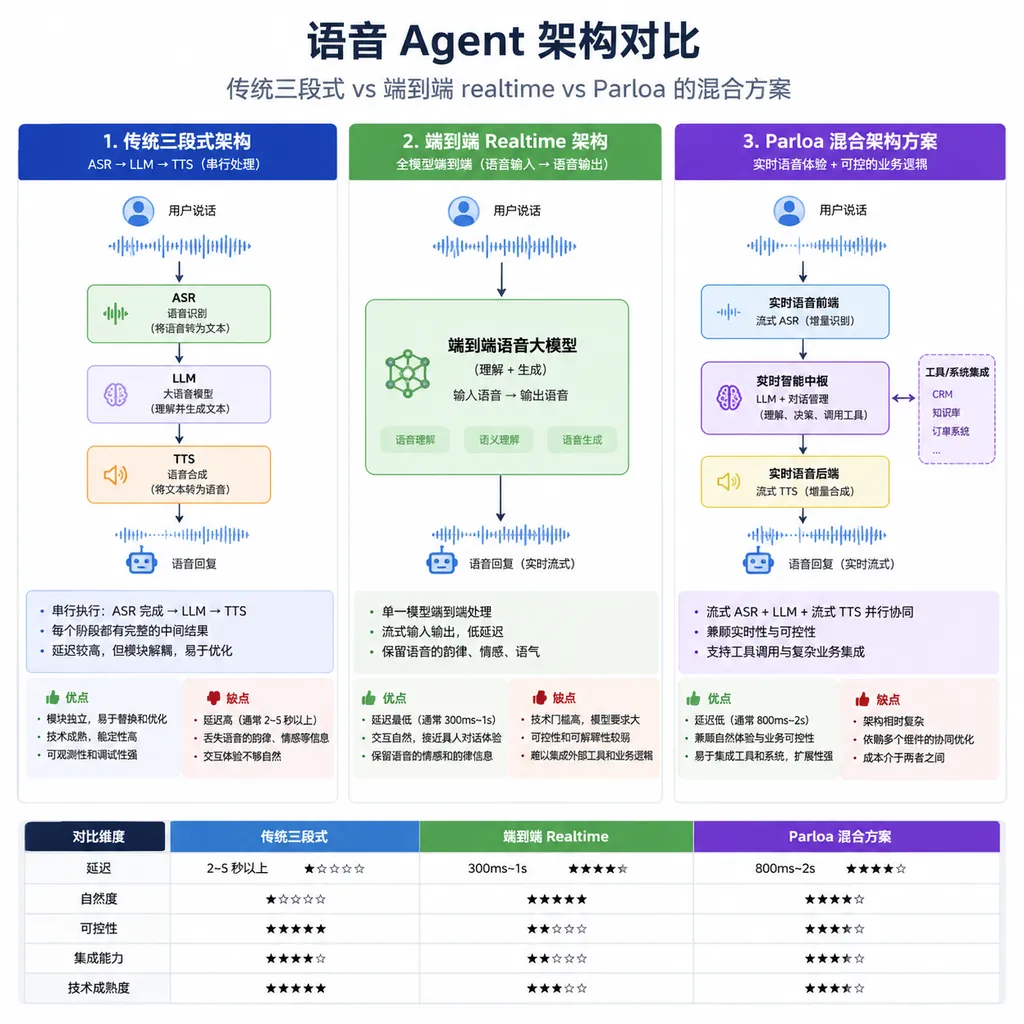
When OpenAI launched gpt‑realtime in August last year, it emphasized that this was an end‑to‑end speech‑to‑speech model, bypassing the traditional three‑stage ASR → LLM → TTS pipeline. The benefit is latency dropping from the 800 ms range to under 300 ms, while preserving nonverbal cues like laughter, hesitations, and tone—crucial for customer service, since it means the AI no longer talks over the user mid‑sentence.
However, the realtime model had a weakness: complex instruction‑following. Earlier versions often failed at tasks requiring exact compliance, such as reading a disclaimer verbatim or distinguishing letters and numbers in phone numbers. On the MultiChallenge audio benchmark, gpt‑realtime improved command‑following accuracy from 20.6 % to 30.5 %, and reasoning accuracy on Big Bench Audio from 65.6 % to 82.8 %, finally making production deployment viable.
Parloa’s engineering team also published a GPT‑5.1 evaluation report that mentioned an interesting detail:
After upgrading to GPT‑5.1, some prompts that previously worked suddenly “broke.” For example, the agent hung up when it should have asked a question. The fix was simple—add a line to the prompt: “Unless handing off to a human agent, always respond to customers with a question.”
This exposes an underestimated issue: the more precise the model, the more it amplifies flaws that older models automatically papered over. The Parloa team’s exact words: “GPT‑5.1 surfaces prompt flaws that older models simply worked around.” That sentence deserves to be posted on the wall of every team building agents.
Tool‑Calling: The Real Differentiator for Customer‑Service Agents
The biggest difference between voice customer service and ordinary chatbots is that the former must actually “get things done.” Checking orders, changing addresses, processing refunds, booking appointments—each action is a tool call, often several linked together.
On its AMP platform, Parloa implemented several key features:
- Asynchronous function calls: Long‑running back‑end queries (for instance, to a legacy SAP interface) don’t block the conversation. The agent can chat while waiting—“Please hold on while I look that up.”
gpt‑realtimesupports this natively. - MCP remote‑server access: Clients’ internal tools are exposed via the MCP protocol, allowing the agent to call them directly in session without Parloa manually integrating individual APIs. This is critical in enterprise IT environments, where large clients may have dozens of systems—writing custom adapters for each isn’t scalable.
- Cost control for long conversations: Customer calls often last ten minutes or more, with tokens piling up rapidly. Parloa leverages OpenAI’s new “multi‑turn one‑shot truncation” to intelligently prune historical context and keep long‑conversation costs down.
Why This Matters More Than It Seems
In China, “AI customer service” still conjures images of “press 1 for a human operator.” But the global call‑center market exceeds $500 billion annually, and with Europe’s high labor costs, businesses have strong willingness to pay for voice agents that actually work. Parloa’s $3 billion valuation isn’t hype—it’s based on annualized contract revenue.
For domestic developers, there are two main takeaways:
- Architecture choice: If you’re building a voice agent, a dual‑track setup—realtime model + text model—may be more stable than purely three‑stage or purely end‑to‑end. Parloa’s approach is to let realtime handle the dialogue stream while critical decisions fall back to a text model like GPT‑5.1 with stronger reasoning.
- Prompt governance: Model upgrades are not painless. Each major version bump requires its own regression‑testing framework. Parloa even uses a hierarchical Bayesian model for A/B testing of agents—this level of engineering is often the true moat for enterprise AI adoption.
How Domestic Developers Can Use It
gpt‑realtime, GPT‑5.1, and gpt‑4o‑transcribe are all accessible via OpenAI Hub, directly connectable from China, compatible with OpenAI’s native SDKs—one key can call GPT, Claude, Gemini, and DeepSeek simultaneously. Developers can build a Parloa‑like voice agent using the realtime API’s SIP integration and MCP tool configuration exactly as described in the official documentation.
Realtime API session configuration example:
POST /v1/realtime/client_secrets
{
  "session": {
    "type": "realtime",
    "model": "gpt-realtime",
    "tools": [
      {
        "type": "mcp",
        "server_label": "crm",
        "server_url": "https://your-mcp-server.example.com",
        "authorization": "{access_token}",
        "require_approval": "never"
      }
    ],
    "instructions": "You are a polite customer-service assistant. In all cases except human handoff, respond to customers with questions."
  }
}
A simple Python framework:
from openai import OpenAI

client = OpenAI(
    base_url="https://api.openai-hub.net/v1",
    api_key="your-hub-key"
)

# Text side: use GPT-5.1 for complex decisions, compliance checks, and tool orchestration
resp = client.chat.completions.create(
    model="gpt-5.1",
    messages=[
        {"role": "system", "content": "You are the decision engine of a call center, responsible for determining whether to transfer the current conversation to a human agent."},
        {"role": "user", "content": transcript}
    ],
    tools=crm_tools
)
Audio streams connect to the realtime API through WebRTC or WebSocket, while complex reasoning on the text side is handled by GPT‑5.1. This hybrid architecture essentially forms the minimal viable version of Parloa’s production setup.
A Few Thoughts
The voice‑agent market will truly diverge by 2026. On one side are general‑purpose voice assistants, gradually absorbed by major model providers’ own products (ChatGPT Voice, Gemini Live). On the other side are enterprise‑grade agent platforms, where the competition lies not in model prowess but in engineering, compliance, integration, and observability—the “boring but profitable” aspects. Parloa clearly sits on the latter track.
By spotlighting Parloa, OpenAI is sending a clear message: the realtime API story has shifted from “can it work” to “who is deploying it at scale.” For every team still stuck in demo mode, that’s a signal—the window for entry is closing fast.
References
- Comprehensive Review of OpenAI’s Voice Agent Suite – Zhihu Overview of GPT‑4o‑series voice models and pricing
- German AI Customer‑Service Startup Parloa Valued at $3 Billion After New Round – Zhihu Latest news on Parloa’s financing and business status


