
GenericAgent Field Test: A Locally Assembled Agent

Linux.do users tested the open-source framework GenericAgent and found that it has no WebUI, no onboarding, and no gateway—meaning all infrastructure must be built manually. Is this a design philosophy or an engineering oversight?
An Agent Framework That Left Users Confused
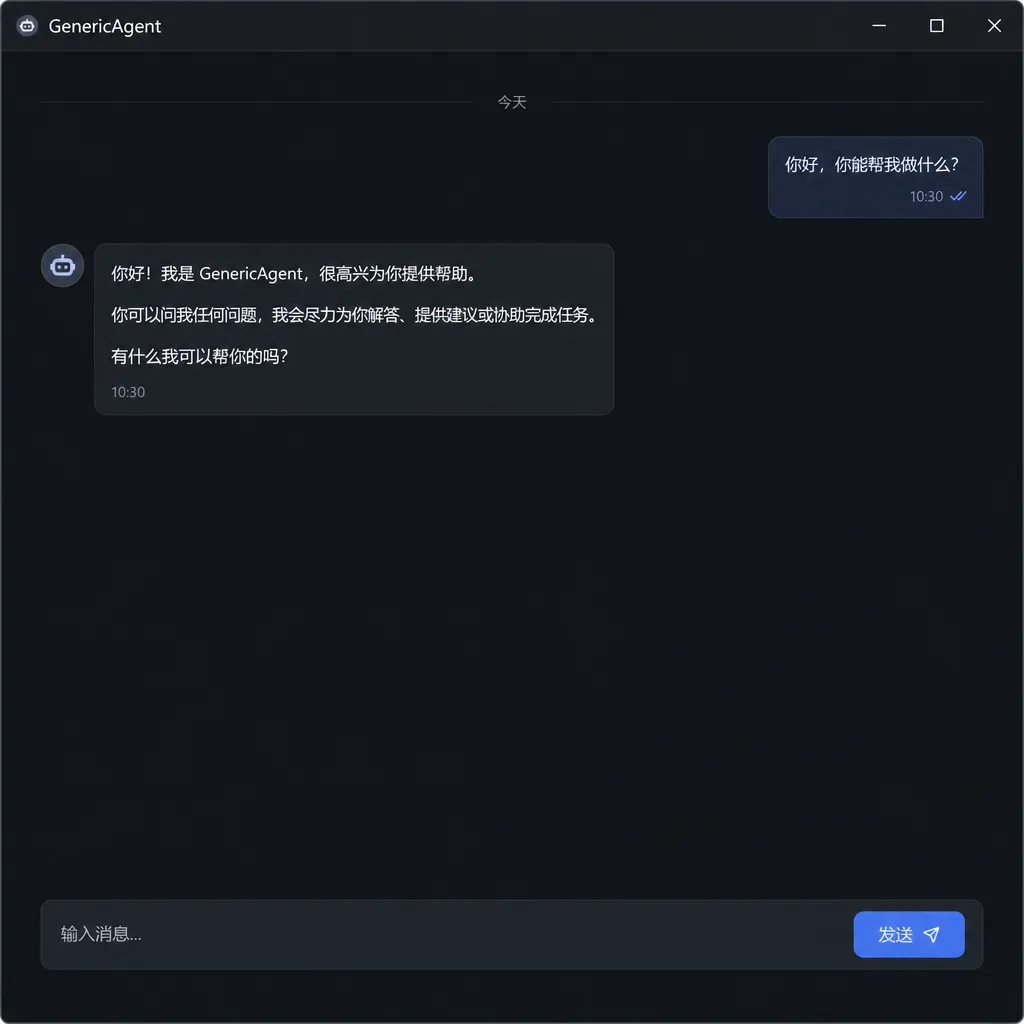
Yesterday, someone posted on Linux.do complaining about their experience installing GenericAgent (hereafter referred to as GA). This user had been using “Lobster” (the local Agent in the lobechat ecosystem with Gateway). After switching to GA, they were completely baffled: after installation, there was only a CLI chat interface; opening launch.pyw just replaced the CLI with a GUI—no WebUI, no Gateway, no onboarding wizard—“do I have to build all the basic components myself, piece by piece?”
This post actually pinpointed the core controversy around GA: is it a product, or a research prototype?
What GA Is: 3,000 Lines of Minimalism
Let’s fill in the background first. GenericAgent is an open-source Agent framework on GitHub created by lsdefine. It hit GitHub Trending in mid-April, with a bold selling point: self-evolution from 3.3 lines of seed code, growing a skill tree, claiming to consume six times fewer tokens than mainstream frameworks in several benchmarks.
The entire project contains around 3,000 lines of code—as a comparison, LangChain’s core package has exceeded hundreds of thousands of lines, while AutoGen and MetaGPT start in the tens of thousands. GA went the completely opposite route: it treats the Agent as a “seed” that can write its own code, install dependencies, and develop skills on its own—the framework itself provides only the minimal kernel.
This design is elegant academically, but when put into the hands of regular developers, issues arise.
Breaking Down the Pitfalls the OP Encountered
Back to the specific issues mentioned in the post:
1. No onboarding; you have to manually edit mykey.py
This isn’t actually a bug—it’s GA’s philosophy: configuration as code. You directly edit the Python file to fill in your API key, with no graphical wizard. Developers can tolerate this, but for people used to Lobster’s “a few clicks and it runs” setup, the gap is clear.
2. Dependencies are installed by the Agent reading code
The official GETTING_STARTED.md states this clearly: after launch, the Agent will read its own code, determine needed packages, and install them all automatically. If network issues prevent API calls from completing, you have to manually pip install requests as a fallback.
pip install requests
python launch.pyw
This “self-evolution” mechanism sounds fancy, but in practice, delegating dependency management—an inherently deterministic process—to an LLM makes debugging painful. You don’t know at which step it will get stuck, or if it installs the wrong version. It’s basically infeasible for production.
3. No WebUI, no Gateway
This was the biggest gap. The OP wanted to have the Agent running in the background and integrated into chat tools like WeChat for remote control—similar to Lobster’s Gateway, which runs as a persistent service. GA currently only provides hub.pyw, which lets you check boxes for WeChat integration, but has no built-in daemonization scheme—if you want it running in the background, you’ll need to write your own systemd unit or Windows service script.
So the OP wasn’t using it incorrectly—GA just doesn’t provide that functionality yet.
Design Philosophy or Engineering Gap?
An analysis article on Zhihu described GA as “the extreme path of less is more.” I’d agree—halfway.
The agreeable part: In today’s landscape where Agent frameworks are increasingly bloated with abstractive layers that make call stacks unintelligible, GA reducing its core to 3,000 lines is indeed a remedy. Its self-evolution mechanism—Agents generating their own tools and attaching them to a skill tree—has genuine research value at the prototype level, and its token efficiency data is impressive.
The disagreeable part: Packaging “letting the Agent install its own dependencies” and “making the user write backend services” as minimalism is somewhat misleading. This isn’t minimalism—it’s shifting engineering burden onto users. A truly mature framework can have a small kernel, but someone still needs to handle deployment, monitoring, IPC, and permissions—the messy work GA currently offloads. Right now, it’s more like the author published a research demo and left the final productization mile to the community.
That also explains why the GitHub stars skyrocketed, yet many users hit roadblocks—it shines in benchmarks and demos but falters in real-world use.
Should You Use It Now?
Depends on what kind of user you are:
- If you’re a researcher or want to dissect Agent internals: GA is absolutely worth reading. Those 3,000 lines are all substance, and its self-evolving skill tree design is inspiring.
- If you want a local assistant running in the background, connecting to IM, and providing stable service: Don’t use GA yet—stick with Lobster, Dify, or build one yourself based on LangGraph. GA is at least one major iteration away from that level.
- If you just want to tinker: Sure, try—but be ready to write daemon scripts yourself, handle dependency conflicts manually, and implement your own WebUI.
Some Deeper Questions
GA’s self-evolution mechanism has an implicit prerequisite: the underlying model must be strong enough. Whether the seed code can grow into a useful skill tree entirely depends on whether you’re using GPT-5 or some 7B local model. The OP didn’t mention which model they used, but that’s actually the key variable determining if GA can run effectively.
Another issue is reproducibility. An Agent that rewrites its own code might produce completely different outputs with each run—an absolute nightmare for debugging, version management, and team collaboration. GA currently doesn’t seem to provide robust snapshot/rollback mechanisms.
Final Thoughts
The confusion that Linux.do OP experienced reflects a common user predicament: drawn by GitHub Trending and benchmark numbers, only to realize the project sits awkwardly between a “research prototype” and a “usable product.”
GA is a thought-provoking project, and its author lsdefine has indeed taken a challenging technical path. But having great ideas doesn’t mean it’s practical—some of the complexity saved by those 3,000 lines has merely been deferred—onto the user.
In the short term, I’d rather treat GA as a research subject worth following, not a daily-use tool. Once the community fills in the missing pieces—deployment, Gateway, WebUI—then it’ll be time to consider production-level adoption.
References
- Linux.do original post: Is GenericAgent just a usage issue? — OP’s hands-on process and confusion
- GenericAgent GETTING_STARTED.md — Official quick-start guide
- GenericAgent: The Design Philosophy Behind 3,000 Lines of Code (Zhihu) — Deep architectural analysis of the project


