
Anthropic Mythos Launch: Firefox Fixes 271 Vulnerabilities at Once

Anthropic’s newly launched security auditing model, Mythos, helped Mozilla identify 271 security vulnerabilities before the release of Firefox 150 — an order of magnitude higher than the 22 found by the previous generation, Opus 4.6. The game of browser security auditing is being rewritten.
Anthropic Mythos Goes Live: Firefox Fixes 271 Vulnerabilities in One Release, AI Security Auditing Is Rewriting the Rules
On May 7, TechCrunch revealed a story that caught the entire security community’s attention: in the newly released Firefox 150, Mozilla merged 271 security vulnerability fixes at once—and most of these weren’t reported by the community or found by internal fuzzing. They were discovered during a source code audit by Mythos, a new model from Anthropic.
For comparison, three months ago in Firefox 148, Mozilla used Claude Opus 4.6 to run the same audit workflow, which resulted in only 22 findings. One release cycle later, the number has multiplied by twelve. That’s far beyond a normal iterative curve.
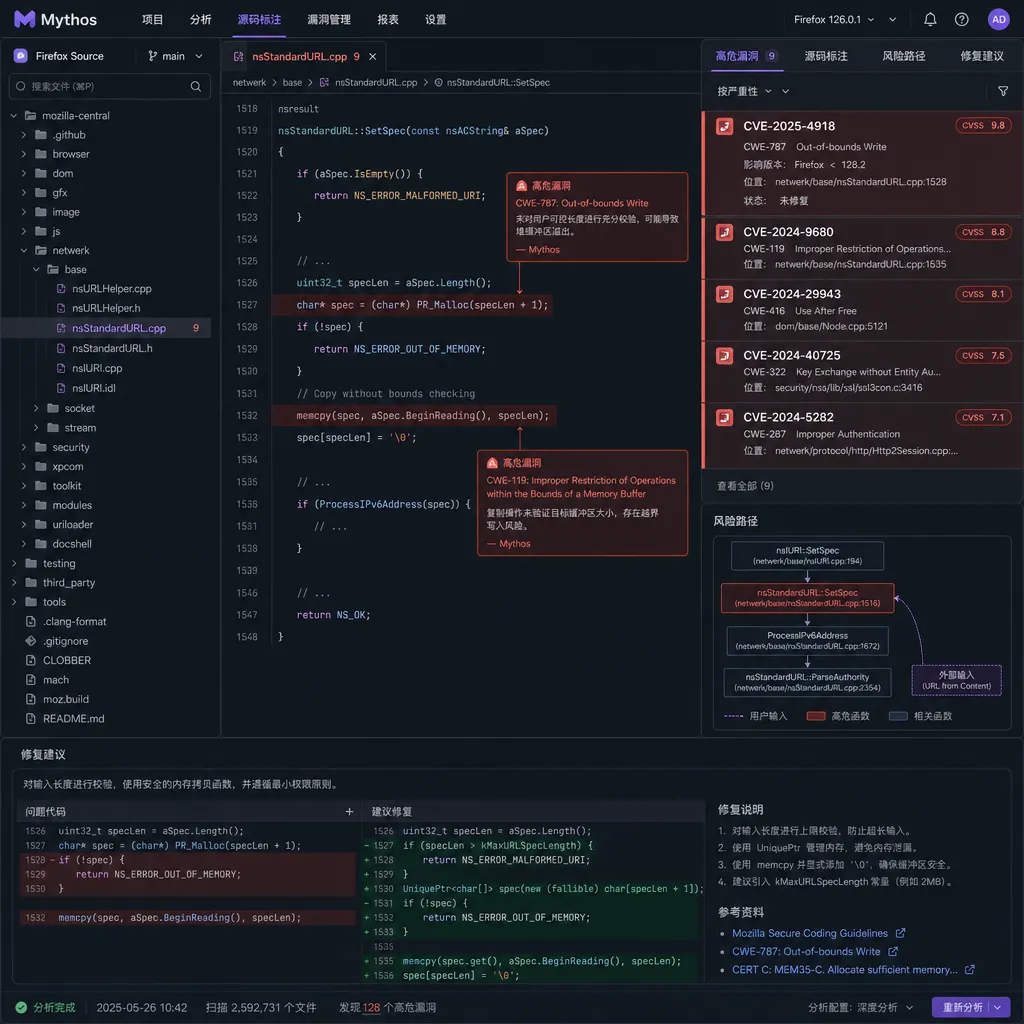
What Is Mythos: A Claude “Trained to Read Bad Code”
This time, Anthropic didn’t simply take the route of upgrading its general‑purpose models. Mythos still carries a “Preview” label, with no public API, and is available only to a select few early‑access security partners—Mozilla among the first. From publicly available information and Mozilla’s own descriptions, Mythos is clearly positioned as a specialized model for code security auditing, not another all‑purpose model.
Its differences from the main Claude models can be roughly broken down into three layers:
- Ultra‑long context + cross‑file reasoning. In a browser‑engine codebase, looking at a single function never reveals vulnerabilities. Real issues such as use‑after‑free, TOCTOU, or integer overflows often span the rendering system, IPC, and JS engine. Mythos has evidently been optimized for long‑chain call‑trace reasoning.
- Prior knowledge of vulnerability patterns. Data from the CVE database, Mozilla’s own historical Bugzilla records, and Chromium’s security advisories serve as training samples for Mythos rather than just text corpus. It knows when a pointer lifecycle “looks wrong.”
- Balancing for low false‑positive rates. Mozilla’s team noted that issues reported by Mythos have significantly higher reproducibility and exploitability validation rates compared to those from general LLMs—a critical metric in auditing. The goal isn’t to find more, but to find better.
In other words, Mythos isn’t just a Claude 4.x with a system prompt added. It’s Anthropic’s first dedicated product direction aimed at “security auditing.”
What the Number 271 Really Means
Anyone familiar with browser security knows that 271 is an extraordinary figure. A stable Firefox release typically lists only a few dozen security advisories, covering four sources: community reports, internal audits, fuzzing, and third‑party researchers. A single AI channel contributing 271 fixes is equivalent to compressing an entire year’s worth of external researcher output into one release cycle.
More crucially, the vulnerabilities were high‑quality. Mozilla’s blog kept things restrained, but TechCrunch quoted internal comments describing “a wealth of high‑severity bugs.” Low‑severity or stylistic code smells were excluded from the 271 count. On that basis, Mythos has already matched the annual output of a mid‑level human security researcher, yet likely scanned Firefox’s entire codebase in a matter of days.

It’s worth noting that a practical concern was raised on Reddit’s r/firefox: since Mythos isn’t publicly available, these vulnerabilities were found by Mozilla’s internal team under internal permissions—avoiding the “low‑quality AI report flood” that once plagued OpenSSL. Anthropic has clearly learned from the wave of GitHub bug‑bounty abuse caused by automated AI submissions, opting to start with targeted enterprise collaboration before considering wider rollout.
Why Anthropic, and Why Now
Starting from late 2025, “code + security” has become the industry’s concerted area of focus. OpenAI has strengthened secure code review abilities within GPT models, and Google’s Big Sleep project publicly demonstrated Gemini discovering a zero‑day in SQLite last year. Yet among major players, Anthropic is the first to turn this into a stand‑alone branded product.
The rationale isn’t hard to see:
- General‑purpose models have hit diminishing returns. Gaps in text, reasoning, and agent capabilities are narrowing. Specialized vertical strengths are the next competitive frontier—and security auditing directly correlates with enterprises’ willingness to pay.
- Code auditing is one of the few areas where AI can outperform humans. It demands patience, coverage, and pattern recognition—not creativity. A human researcher can’t manually read thousands of lines a day; a model can.
- Clear accountability boundaries. A vulnerability is either real or not; if it reproduces, it’s genuine. There’s no subjective hallucination problem—aligning with Anthropic’s long‑standing focus on measurable reliability.
Mozilla’s reasoning is equally clear. While Firefox’s market share continues to decline, its security reputation remains one of its last strongholds against the Chromium ecosystem. Using AI to reduce high‑severity vulnerability density is far more cost‑effective than adding new features.
Real‑World Impact on Developers and the Security Industry
In the short term, Mythos won’t immediately change the workflow of everyday developers—it’s closed to the public. But the signal is loud and clear:
- AI‑driven security auditing will become standard in CI pipelines. Even if Mythos isn’t available, current Claude, GPT, and Gemini capabilities can already detect most common issues in incremental code. Teams that haven’t built this habit will be nudged forward this year.
- Traditional SAST tools will feel the squeeze. Tools like Coverity and Fortify, driven by static rule engines, have long struggled with cross‑file and cross‑semantic vulnerabilities—the exact domains where LLMs shine.
- The bug‑bounty ecosystem will be reshaped. When a model can surface 271 high‑severity issues in a single week, human researchers’ value will shift toward “what Mythos can’t find”—logical flaws, protocol‑layer issues, and attacks requiring business context. The low‑hanging fruit are being harvested at scale.

Unresolved Questions
Mythos isn’t a silver bullet. Several open issues remain:
- Auditing closed‑source code. Mozilla is open‑source, allowing Anthropic to freely analyze the codebase. For proprietary software, how to isolate model weights from code and preserve audit logs becomes a key enterprise concern.
- Binary and reverse‑engineering scenarios. So far, disclosed capabilities focus on source code. Firmware, drivers, and obfuscated binaries represent a separate track altogether.
- Risk of misuse. Anthropic currently enforces strict control, but once such capability spreads, attackers could equally use it to scan open‑source dependencies for zero‑days—inevitably triggering an arms race where defenders must stay half a step ahead.
Final Thoughts
Since 2026, few model releases have truly stood out—Mythos is one of them. No leaderboard stunts or flashy reasoning demos: just 271 real‑world fixes in a browser release, proving to everyone the viability of purpose‑built models. Anthropic has not yet announced a public API timeline or pricing. Once it does, OpenAI Hub plans to integrate it immediately for Chinese developers to access through a unified key.
Which security battleground will AI rewrite next—Linux Kernel, Kubernetes, or OpenSSL? Chances are, we won’t have to wait long to find out.
References
- Reddit r/firefox discussion: Mozilla uses Mythos to fix Firefox vulnerabilities — first‑hand developer debate on Mythos’s closed access and vulnerability disclosure process


