
**Gemini 3.1 Flash-Lite Official Release:** Speed increased by 2.5×, price only one-eighth of Pro
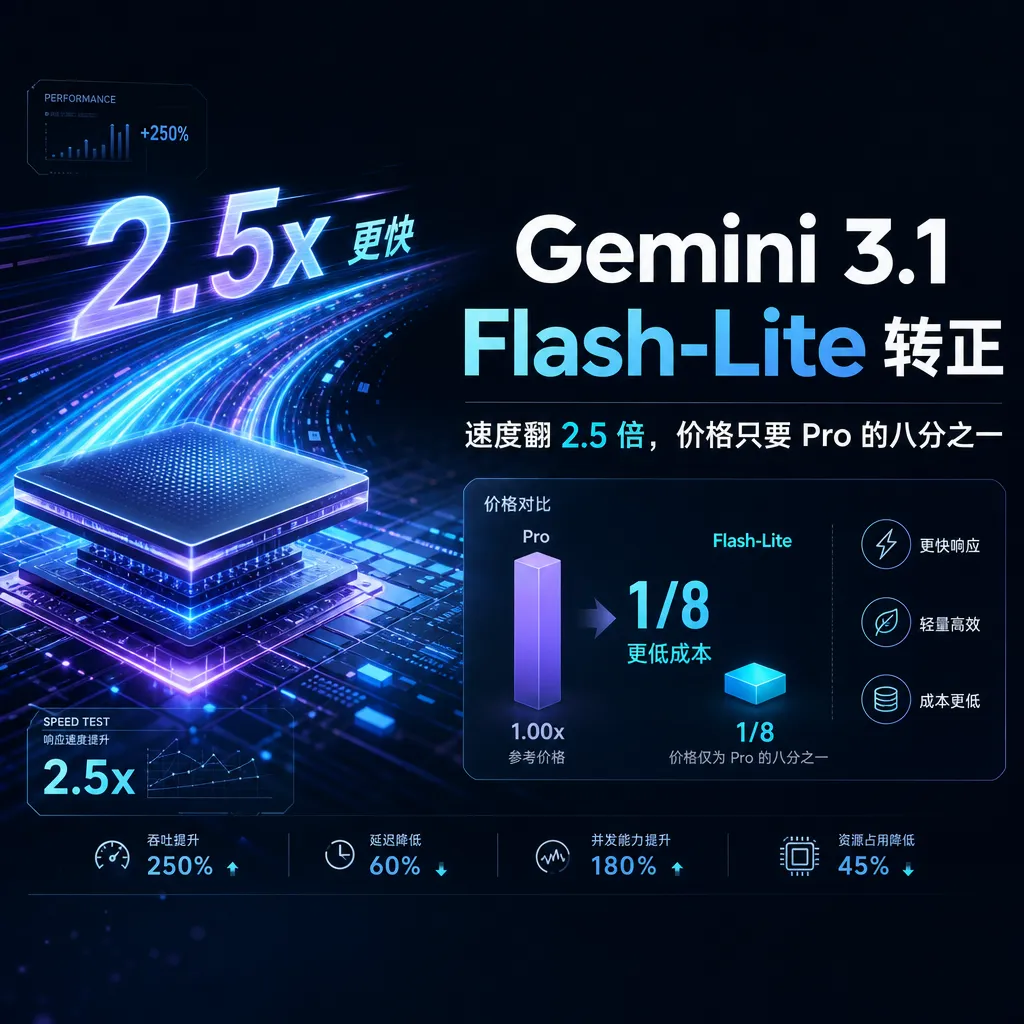
Today, Google is launching Gemini 3.1 Flash-Lite into General Availability (GA), priced at $0.25 per million input tokens and $1.50 per million output tokens, targeting large-scale inference scenarios requiring high concurrency and low cost. The Preview version will go offline on May 25.
Today (May 7), Google has moved Gemini 3.1 Flash-Lite from preview to GA status. The official model ID is now gemini-3.1-flash-lite. At the same time, Google announced that gemini-3.1-flash-lite-preview will enter deprecation on May 11 and be completely shut down on May 25 — giving teams that run the preview version in production only about a two-week migration window.
There were no flashy demos or keynotes this time. But for teams processing hundreds of millions of tokens daily, this update is far more practical than last week’s leaderboard-topping flagship releases.
In one sentence: the cheapest tier in the Gemini 3 family
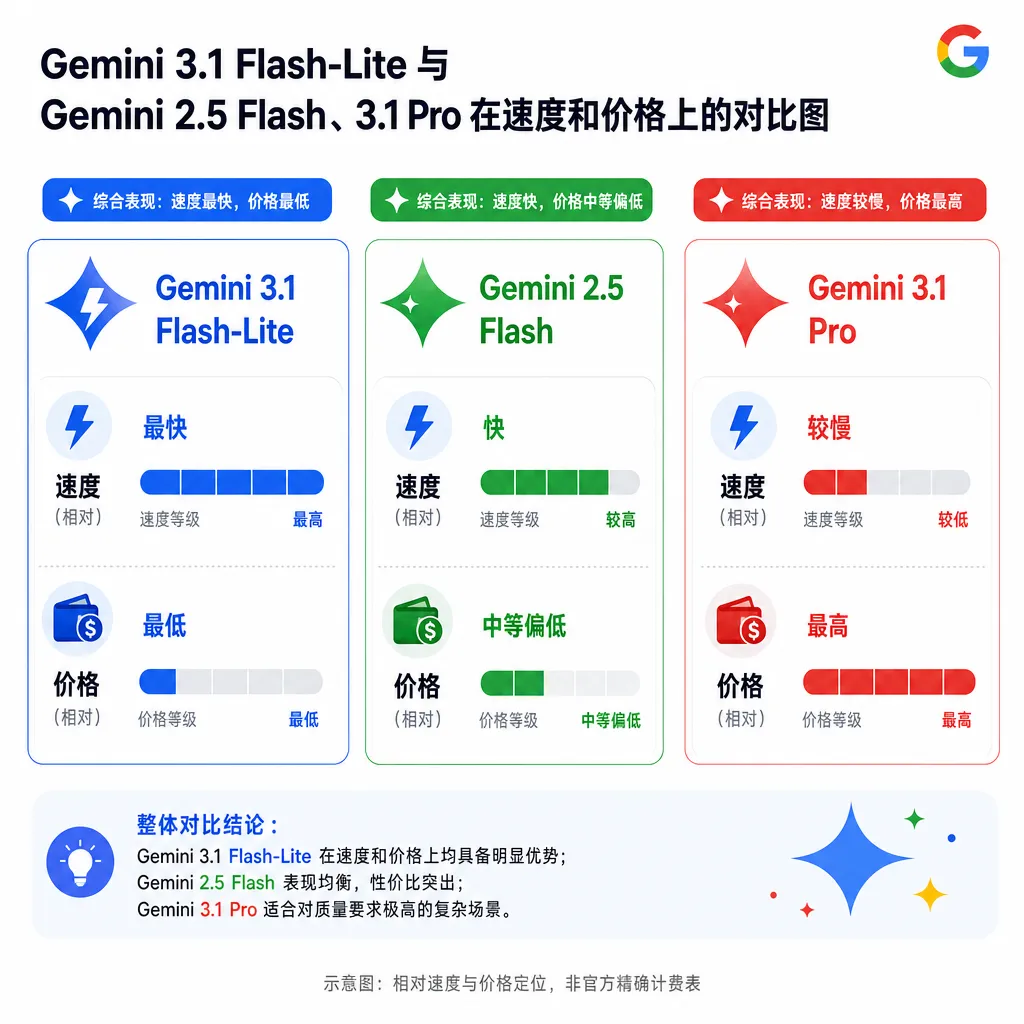
The pricing for Gemini 3.1 Flash-Lite is $0.25 per million input tokens and $1.5 per million output tokens, roughly one-eighth the cost of Gemini 3.1 Pro.
What does that mean? Take a common RAG customer service scenario: each request averages 4K input + 500 output tokens. The cost per invocation on Flash-Lite is about $0.0018 — a million such requests would cost about $1,800. On Pro, the same volume would total roughly $14,000. For use cases where “accuracy is good enough, just don’t blow up the cost,” that gap can decide whether a product makes it to production.
Performance: 2.5× faster than 2.5 Flash
Google highlighted two key performance metrics:
- Time to first token (TTFT) improved 2.5× over Gemini 2.5 Flash
- Output speed around 363 tokens/s
What does 363 tokens per second mean? GPT‑4o mini on OpenAI’s own infrastructure runs stably around 100–150 tok/s; Claude Haiku 3.5 around 150 tok/s. Flash-Lite’s figure essentially wipes the floor with competitors in its tier — as long as “thinking mode” is turned off.
For streaming UIs, TTFT matters more than total throughput. Whether users perceive the model as “fast” depends almost entirely on how quickly the first token appears. In preview tests, Flash-Lite’s TTFT commonly stayed under 200 ms, approaching the responsiveness of local small models.
Thinking Levels: making reasoning depth a dial
This generation of Flash-Lite also inherits the “Thinking Levels” feature introduced in Gemini 3 Pro. Developers can adjust reasoning intensity directly in AI Studio or Vertex AI, from the lowest setting (essentially direct answering) to High (approaching Pro’s multi-step reasoning depth).
The engineering implications are bigger than they seem. Previously, you had to choose between “cheap, fast, dumb” and “expensive, slow, smart,” often by maintaining a routing layer with a triage model — simple queries sent to Flash, complex ones to Pro. Now you can use a single endpoint and dynamically tune the reasoning per request:
- Casual chat / completion / classification: Off or Low
- Multi-turn tool use, structured extraction: Medium
- Complex reasoning, code review: High
This collapses the cost–accuracy trade‑off from “choose a model” down to “pass a parameter.” OpenAI explored similar designs with reasoning_effort in the GPT‑5 series, and Anthropic has an extended thinking toggle. Google’s difference: even the cheapest tier opens up all four levels, not just the flagship.
How to call
If you’re connecting via OpenAI Hub (OpenAI-compatible format, direct access from China), a single key can call Gemini, GPT, and Claude, with the same syntax as official SDKs:
from openai import OpenAI

client = OpenAI(
    api_key="your-openai-hub-key",
    base_url="https://api.openai-hub.net/v1"
)

resp = client.chat.completions.create(
    model="gemini-3.1-flash-lite",
    messages=[
        {"role": "user", "content": "Explain the MoE architecture in one sentence."}
    ],
    extra_body={
        "thinking_level": "low"  # off / low / medium / high
    }
)
print(resp.choices[0].message.content)
For high-concurrency batch tasks, it’s recommended to set thinking_level to off by default — single-call latency can shrink by over 30%, and pricing follows non-thinking rates.
Who it’s competing against
Placed in the broader low-cost model lineup, Flash-Lite’s rivals are clear:
| Model | Input ($/1M) | Output ($/1M) | Output speed | |---|---|---|---| | Gemini 3.1 Flash-Lite | 0.25 | 1.5 | ~363 tok/s | | GPT‑5 mini | 0.25 | 2.0 | ~180 tok/s | | Claude Haiku 4 | 0.80 | 4.0 | ~160 tok/s | | DeepSeek V3.2 | 0.27 | 1.10 | ~90 tok/s |
(Speed numbers are community-tested medians, not official.)
Some conclusions:
- Price-wise, Flash-Lite matches GPT‑5 mini on input cost but is 25% cheaper on output. For code generation or long-form writing (short input, long output), the savings grow further.
- Speed-wise, almost no competition. This stems from Google’s TPU infrastructure advantage; competitors will struggle to match it until their own inference chips mature.
- The only soft spot: Chinese long-context accuracy. In preview, developers reported retrieval drift on 32K‑plus Chinese documents. Google hasn’t confirmed if GA fixed it; run your own evals before switching production traffic.
Who should migrate immediately and who can wait
Migrate now:
- All production environments using
gemini-3.1-flash-lite-preview— it will shut down May 25, no exceptions. - High‑concurrency services running Gemini 2.5 Flash — just changing the model ID yields 2.5× faster speeds and lower cost.
- Workloads currently on GPT‑4o mini / GPT‑5 mini for classification, extraction, rewriting — worth an A/B test.
Hold off:
- RAG systems heavily reliant on Chinese long‑document recall — wait for community GA eval results.
- Pipelines deeply tuned for GPT‑5‑series prompts — migration involves more than changing model names; prompt style needs rewriting.
OpenAI Hub already lists gemini-3.1-flash-lite; the preview ID will remain available until May 25 to allow smooth transition.
Final thoughts
This year’s LLM market is moving in two directions: flagships growing ever pricier and “deep-thinking,” while the Lite tiers grow ever faster and cheaper. Flash‑Lite’s GA release may lack theatrics, but it pushes the cost floor of running LLMs at scale even lower — a change far more significant for production teams burning millions of tokens than any benchmark leaderboard.
References
- Discussion on the official launch of Gemini 3.1 Flash-Lite — Original conversation on linux.do about the GA release and preview retirement schedule.
- Analysis of Gemini 3.1 Flash-Lite Launch — Detailed explanation on Flash-Lite’s positioning, pricing, and use cases from Zhihu.


