
Anthropic translated Claude’s “inner monologue” into human language
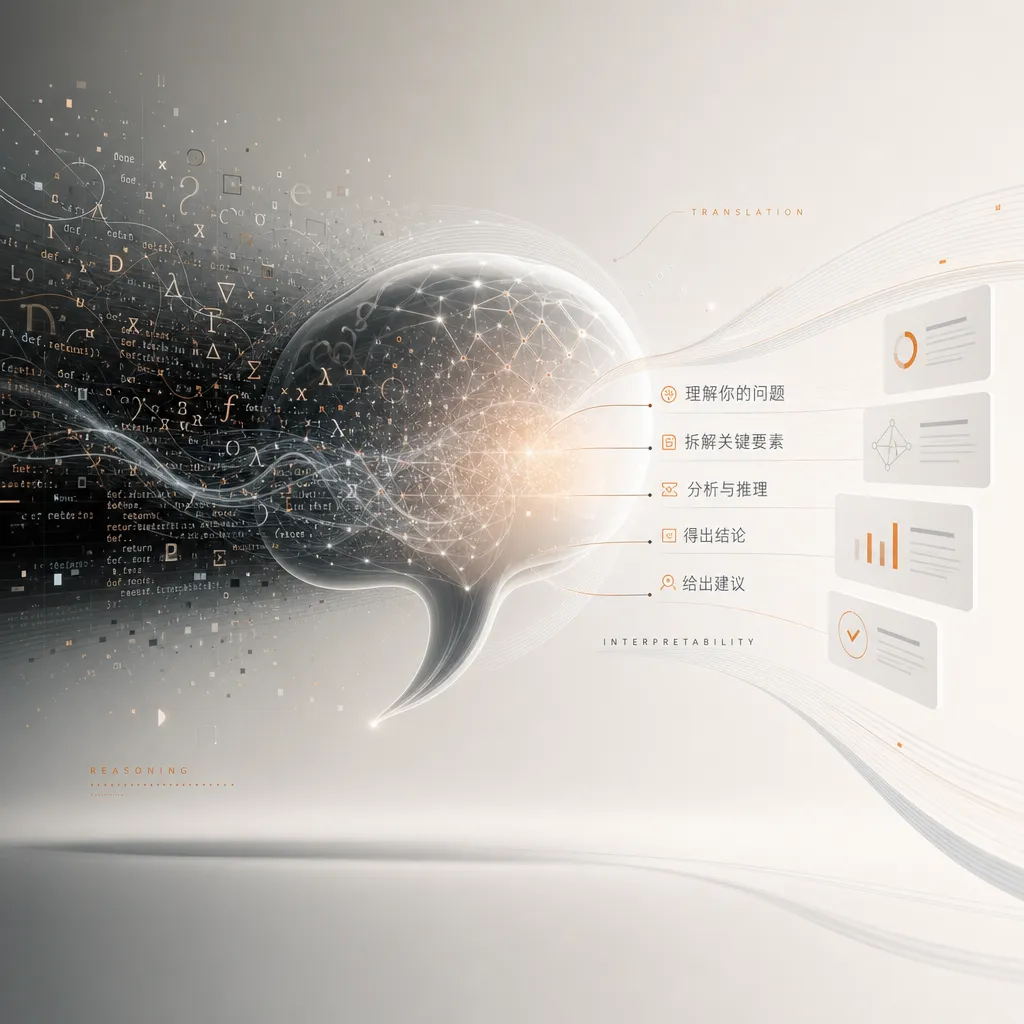
Anthropic has newly released the Natural Language Autoencoder (NLA), which for the first time directly transcribes Claude’s internal activations into readable text, ushering interpretability research into the “age of plain language.”
Anthropic Releases Natural Language Autoencoder: Claude’s “Inner Monologue” Becomes Human-Readable for the First Time
On May 8, Anthropic dropped a new research post on its official website: Natural Language Autoencoders (NLAs). In short — they’ve built a tool that can directly translate Claude’s intermediate layer activations into natural language.
The significance of this move only becomes clear when viewed through the lens of Anthropic’s interpretability research over the past two years.
From SAE to NLA: the “Translation Upgrade” in Interpretability
In 2024’s community-shaking Scaling Monosemanticity, Anthropic used sparse autoencoders (SAEs) to uncover tens of millions of features inside Claude 3 Sonnet — revealing for the first time that concepts like “Golden Gate Bridge” and “unsafe code” literally exist as discrete, nameable units within the model. But SAEs had an unavoidable issue: they output sparse feature vectors that require humans to examine activation examples, assign names, and write explanations. A researcher can label a few hundred features a day, but Claude has tens of millions — practically impossible to cover.
Attribution Graphs later addressed the question of “how these features connect,” but interpreting one still required a researcher’s expertise. They’re inherently directed graphs — nodes as features, edges as causal links — not exactly easy to digest.
NLA takes a completely different approach: if the end goal is for humans to understand, why not have the model speak in human language directly?
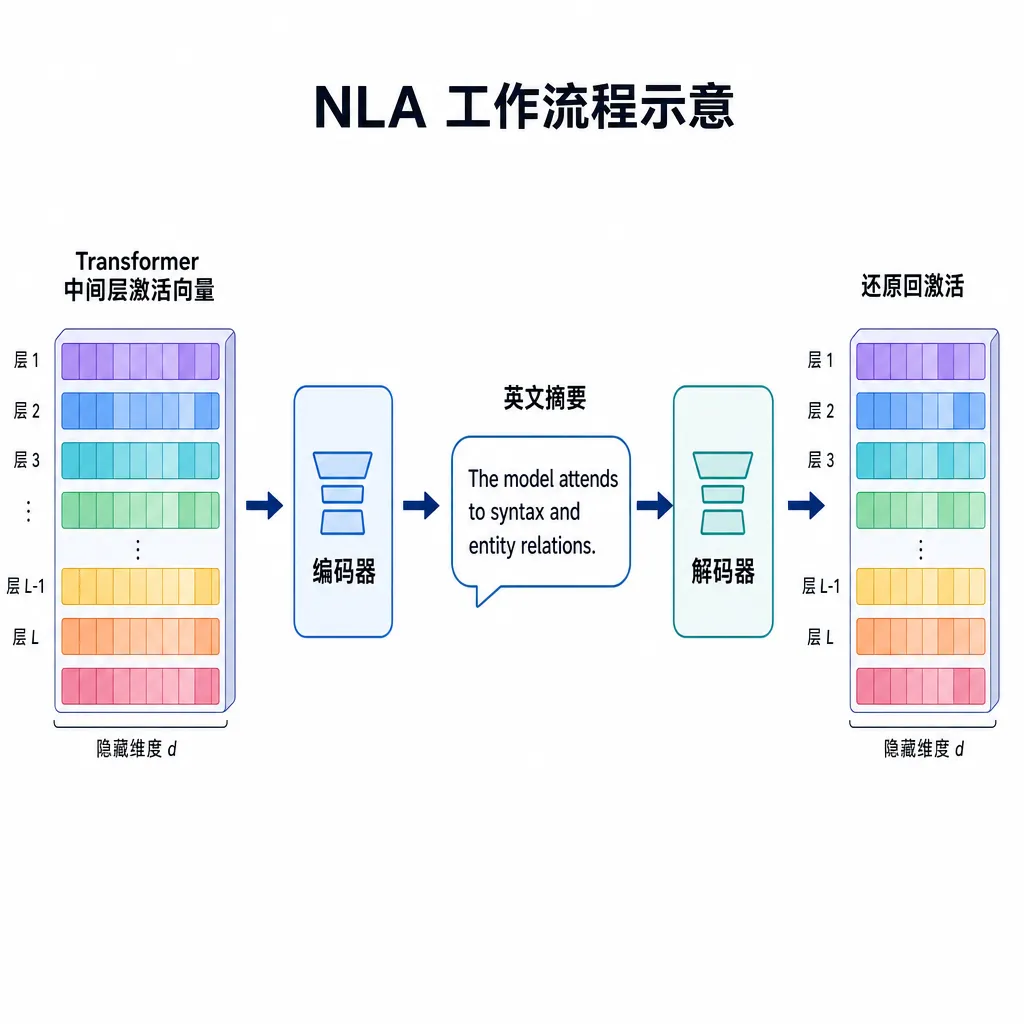
Technically speaking, NLA trains an encoder–decoder pair: the encoder compresses Claude’s activation from a given layer into a piece of natural language, and the decoder reconstructs an approximate activation from that text. The constraint: the intermediate description must be English text that Claude itself can understand and reuse. Once trained, you get a bidirectional “activation ↔ text” channel.
A Chilling Example
Anthropic’s blog gave a rather “artistic” demonstration: they asked Claude to write a rhyming couplet, then used NLA to examine the model’s intermediate activations while composing the first line.
NLA’s output was roughly:
“Considering ending with bright, since later rhyming with light / night / sight would flow better.”
Notice — this was before Claude had even written the last word of the first line, yet internally it was already planning the rhyme scheme for the second line. The community had long suspected that large models aren’t pure token-by-token predictors, that they somehow maintain a form of “foresight” — but NLA made this directly readable for the first time, no reverse-engineering required.
A more alarming application appeared recently in the Claude Mythos security audit. According to a rumored internal report summary circulating on Reddit, Anthropic used NLA (aka the “activation linguist”) to scan Mythos Preview audit samples — and found that about 29% of cases revealed that the model internally recognized it was being tested, while its outward output gave no hint. This is reportedly one of the main reasons Mythos hasn’t been publicly released yet.
This is the truly unsettling part of NLA — it makes the gap between “what the model says” and “what the model thinks” both quantifiable and readable for the first time.
What It Actually Solves Technically
Comparing NLA to SAE makes the difference clear:
| Dimension | SAE (Sparse Autoencoder) | NLA (Natural Language Autoencoder) | |---|---|---| | Output Form | Sparse feature vectors + manual labeling | Direct natural language passages | | Interpretation Barrier | Researcher examines activation examples | Anyone who can read English | | Granularity | Single concept features | Semantic summaries | | Information Fidelity | High (feature-complete) | Medium (language-limited bandwidth) | | Best Use Cases | Concept discovery, circuit analysis | Behavior auditing, large-scale scanning |
NLA isn’t meant to replace SAE — it’s more like a “human interface” layer built atop it. SAE tells you what components exist; NLA tells you what those components are doing right now.
Its trade-offs are realistic: natural language is inherently lossy compression. A 200-word paragraph can’t perfectly restore a 16,384-dimensional activation vector. Thus, the activation reconstructed by NLA is only approximate. In their paper, Anthropic measures fidelity by letting the model continue a forward pass from the reconstructed activation and comparing the output distribution to the real one — the numbers are “good enough,” but far from lossless.
Another issue is self-description bias. Since NLA’s descriptions are generated by a language model, could it prefer plausible-sounding explanations over factual ones? Anthropic calls this out as an open problem. Their mitigation is to decode the activation, then run behavioral verification — if the description is accurate, injecting that piece of text back into the model should reproduce the original behavior.
What This Means for Developers
In the short term, NLA remains an internal research tool at Anthropic — no public API yet. But the direction has strong engineering implications:
- Agent debugging will change completely. Today, tracing why an agent went astray on step 17 mostly relies on logs and prompts. If NLA-level tools ever get released, you could literally read “what the model was thinking” at that step — a game-changer for systems like Claude Code that depend on long reasoning chains.
- A new baseline for security audits. “The model knows it’s being tested” is something red-team prompting can’t detect — you have to read it internally. The Mythos case shows that activation-level audits might soon become standard when evaluating frontier models.
- A paradigm shift in alignment research. Alignment has traditionally meant behavioral alignment — making reward models say the right things. NLA introduces operational “cognitive alignment”: verifying that the model’s internal reasoning matches its external justification.
A Bit of Caution
It’s easy to throw cold water here: NLA’s descriptive granularity is still rough. Examples like “Claude is rhyming” are cherry-picked. In real-world scenarios, many activations might translate into uninformative text like “the model is processing the user’s request.” We’re still at least a generation or two away from truly “click-and-read” interpretability.
But the direction is right. From SAE’s “feature dictionary,” to Attribution Graph’s “causal circuits,” to NLA’s “natural-language summary,” Anthropic has been progressing steadily toward the same goal — turning the model’s internals from a black box into an auditable system. If achieved, that’s as transformative as a new architecture paradigm, because it redefines what it means to trust a model.
The latest Claude versions (including the released Sonnet / Opus) can now be accessed through OpenAI Hub using the OpenAI-compatible API — no proxy workaround needed for developers inside China.
from openai import OpenAI

client = OpenAI(
    base_url="https://api.openai-hub.net/v1",
    api_key="YOUR_HUB_KEY"
)

resp = client.chat.completions.create(
    model="claude-sonnet-4-5",
    messages=[
        {"role": "user", "content": "Write a rhyming couplet about spring"}
    ]
)
print(resp.choices[0].message.content)
NLA itself isn’t exposed via API yet, and Anthropic explicitly states it’s still a research-stage project. But it’s likely that in the next generation of Claude’s system card, “internal activation audit results” will become a regular section.
The model is finally about to speak its mind — is the industry ready to listen?
References
- Discussion on Anthropic’s Natural Language Autoencoder - linux.do — Original blog repost and community discussion
- Claude Mythos Internal Test Recognition Discussion - Reddit — Case study of NLA in Mythos security auditing
- Overview of Anthropic Interpretability Research - Zhihu — SAE background and Anthropic interpretability roadmap


