
SenseTime launches Flash-Lite: a lightweight multimodal agent, with free token access now open

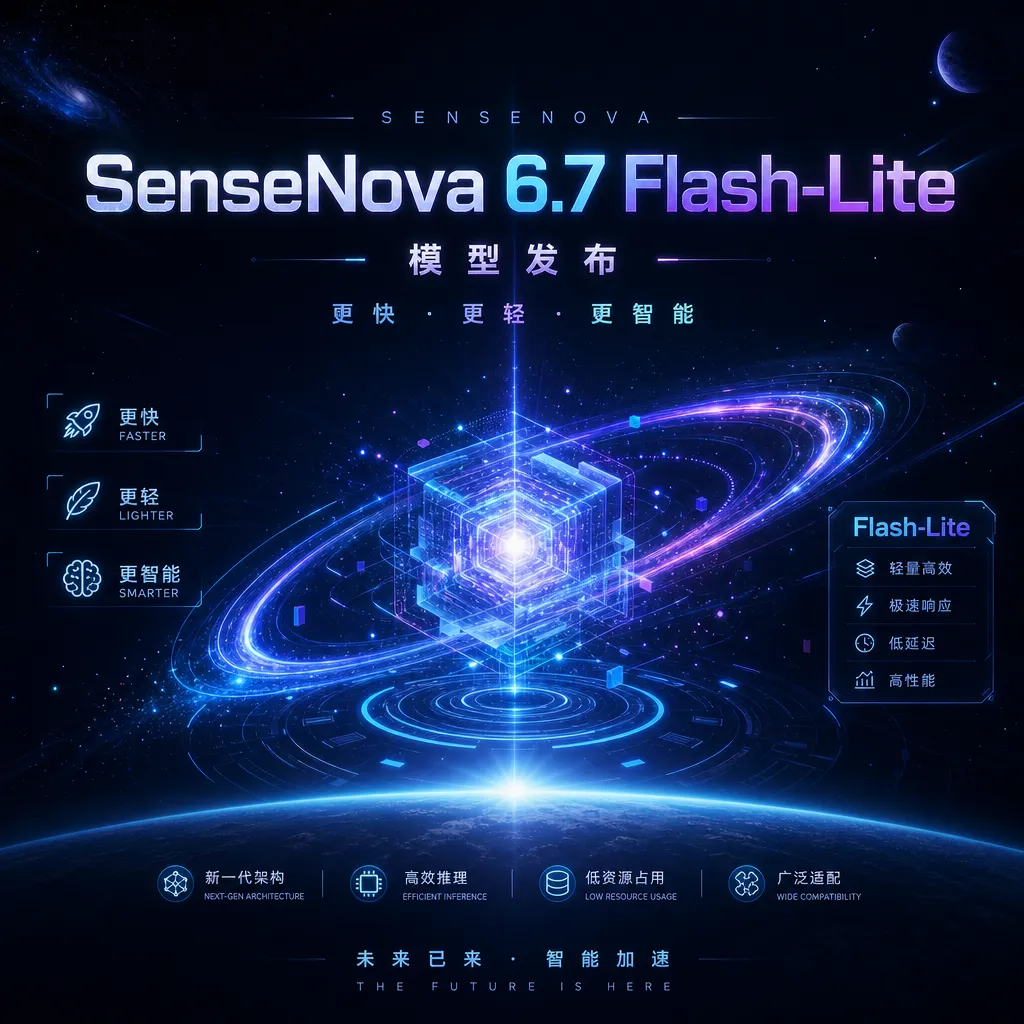
SenseTime today released the SenseNova 6.7 Flash-Lite native multimodal intelligent agent model, optimized for long office workflows. Token consumption is reduced by 60% compared to pure text agents. A limited-time free Token Plan is launched simultaneously, and the accompanying SenseNova-Skills are open-sourced on GitHub.
SenseTime Launches Flash-Lite: Lightweight Multimodal Agent, Free Token Plan Now Live
On May 8, SenseTime flipped another new card on its ever-evolving table — releasing SenseNova 6.7 Flash-Lite, a lightweight native multimodal agent model explicitly targeting “real workflows.” At the same time, SenseTime launched the SenseNova Token Plan, now temporarily free, and fully open-sourced SenseNova-Skills on GitHub.
This release focuses not on parameters or benchmark scores, but on efficiency — 60% fewer tokens consumed, fewer parameters as well, yet even stronger agent performance. For developers building agent-based applications, this is one of the year’s more noteworthy “cost-performance–driven” releases.
From "Seeing Pictures and Talking" to "Understanding the Screen Before Acting"
Over the past two years, most multimodal models have adopted a “vision encoder + LLM” pipeline: an image is first converted into a text/vector representation before being processed by a language model. This design is clean from an engineering standpoint, but the intermediate “translation layer” sacrifices information. Complex webpage DOM trees, dense multi-level financial report tables, and PPT master-slide hierarchies all lose fidelity in the process.
SenseTime has explicitly stated that Flash-Lite eliminates the vision-to-text middle layer, opting instead for a fully native multimodal architecture. In other words, the model performs reasoning directly on pixels rather than on textual descriptions generated by other models. This directly impacts agent-type tasks:
- When operating webpages, agents can reference layout coordinates directly instead of relying on OCR + text localization to guess button positions;
- When processing Excel sheets or financial PDFs, handling “nonlinear structures” like merged cells, cross-page tables, or annotated charts becomes more robust;
- In long-chain tasks, intermediate visual states can be reused, reducing repeated OCR/Caption calls.
That’s also why SenseTime dares to claim up to 60% token savings — the vision-to-text layer is itself a token sink, and removing it leads to major efficiency gains over long task chains.
Integrated “See–Think–Act”: Oriented Toward Office Productivity
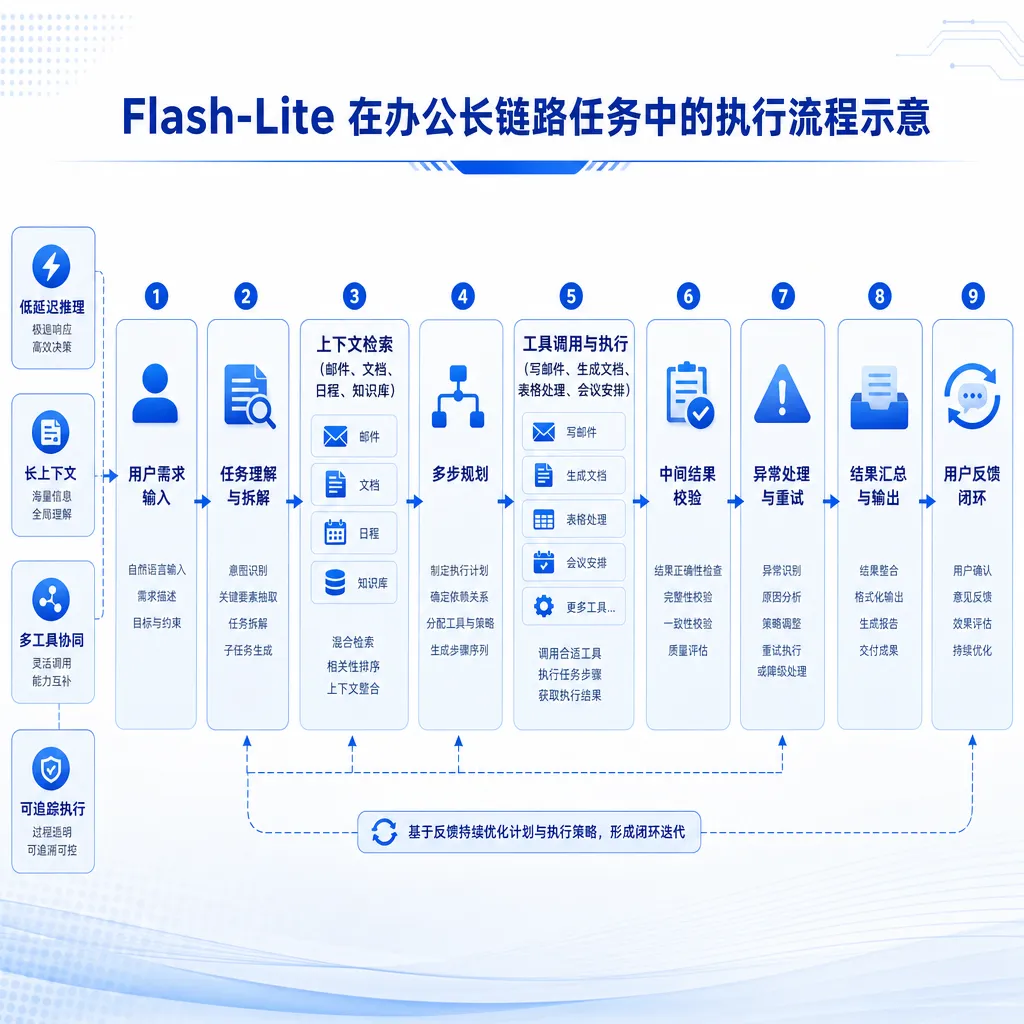
Flash-Lite is not a general-purpose chat model. Its positioning is very specific: long-chain agents for office scenarios. SenseTime outlines a typical workflow like this:
A raw Excel dataset → data insights → industry research → PPT presentation
It sounds like “yet another PPT generator,” but the details are interesting. The official demo shows an agent handling 10 monthly Excel files and 932 performance records from a wind power division, automatically unifying table structures, analyzing monthly trends, grade distributions, and role comparisons — while autonomously dealing with issues like missing fonts, plotting errors, and variable mismatches. When a user reports an abnormal chart, the agent can trace back to the data index layer to locate MultiIndex errors. That’s important — it indicates the model performs “trace–validate” loops rather than simply running linear execution.
Anyone who has built agent apps knows that long-chain workflows rarely fail at reasoning — they collapse when a single KeyError crashes the entire trace. Flash-Lite’s highlighted strength is precisely this resilience in error location and self-repair.
SenseTime claims multiple SOTA-level results in 10 benchmarks within its category, though it’s not competing head-on with GPT-4o or Claude — nor does it need to. Flash-Lite targets the “lightweight + high-frequency” segment, with millisecond-level latency suited to high-frequency interactive production environments rather than leaderboard contests.
SenseNova-Skills: Turning Model Capabilities Into Lego Blocks
A model alone isn’t enough — bridging the gap from model to real-world application has always been the hardest part for Chinese AI developers. SenseTime’s answer this time is the Cowork-Skills system: eight combinable skill components grouped into understanding, execution, and generation layers, all open-sourced on GitHub.
A quick look at the Skill design:
- Understanding layer: material analysis, table understanding, and image analysis
- Execution layer: multi-source retrieval integration and data insight extraction
- Generation layer: PPT creation, PPT editing & optimization, report writing, and infographic generation
The key is modularity — each can be called independently for single-point tasks (e.g., generating an infographic) or combined freely to run buy-side/sell-side research workflows. Turning model abilities into “Lego blocks” is far more practical than releasing yet another agent framework. Developers can cherry-pick components as needed without committing to a full SDK stack.
The open-source repo is at OpenSenseNova/SenseNova-Skills, aligned with the Flash-Lite and U1 Fast base models. Worth noting: the PPT editing skill supports “conversational revision” — one can chat to rewrite, reorder, unify style, or add slides. If this feature proves stable, it’s far more useful than regenerating an entire deck from scratch.
Token Plan: Free — and Surprisingly No Hidden Traps
On the commercialization side, SenseTime simultaneously launched the SenseNova Token Plan, currently in free public beta:
- Free tier: 1,500 calls per model every five hours, no registration threshold
- Supported models: SenseNova 6.7 Flash-Lite and SenseNova U1 Fast
- Native support for the Cowork-Skills system
- Compatible with Hermes Agent and OpenClaw for quick integration
- Up to 20 API keys per user
Paid Lite and Pro tiers will follow. That free quota — 1,500 calls/5 hours — is more than enough for individuals testing demos or proofs-of-concept, and it can even support small teams running internal tool pilots.
The API is fully OpenAI-compatible: base URL https://token.sensenova.cn/v1, model ID sensenova-6.7-flash-lite, supporting image_url input blocks, streaming output, JSON mode, and tool calling — all standard features, no proprietary protocols to adapt to. This is far more developer-friendly than many domestic alternatives.
Thoughts on This Release
Viewed in the broader landscape, Chinese AI vendors’ strategies are clearly diverging. One group continues to chase SOTA and parameter scaling (benchmarking closed-source global leaders); another leans into open-source ecosystems (like Qwen or DeepSeek); and a third — the path SenseTime now follows — pursues an “engineering route of vertical scenarios + lightweight models + skill modularization.”
Key takeaways from Flash-Lite’s launch:
- Native multimodality is the right direction. The vision-to-text intermediate layer truly is a bottleneck for agent tasks. GPT-4o and Gemini already shifted this way — it was only a matter of time before domestic models followed. SenseTime just proved it can be done in a lightweight architecture.
- Open-sourcing skills is a smart move. Keeping the model closed but the capability components open gives developers convenience while driving API usage — a stickier strategy than pure API sales.
- The free Token Plan tier is generous, but the real test will be Lite/Pro pricing — whether it can withstand the ongoing price war with Tongyi, Doubao, and DeepSeek.
- The office productivity market is crowded. DingTalk, Feishu, and WPS are all building their own agents. For an independent model vendor like SenseTime to break in, stronger ecosystem partnerships will be essential.
For developers, the most practical takeaway is this: if you’re building workflow-type apps for document processing, spreadsheet analytics, or PPT automation, Flash-Lite is worth half a day for benchmarking — especially if you previously used GPT-4o but were deterred by token costs. A 60% reduction isn’t trivial.
References
- ITHome: SenseTime Launches SenseNova 6.7 Flash-Lite Multimodal Model, Token Plan Free for a Limited Time: Original Chinese report
- SenseNova-Skills Open-Source Repository (GitHub): Source code for 8 Cowork-Skill components
- SenseNova 6.7 Flash-Lite Technical Details (GitHub): Model card and technical notes


