
China Mobile MoMA Launch: One API Call for 300+ Models, Token Costs Cut by 30%
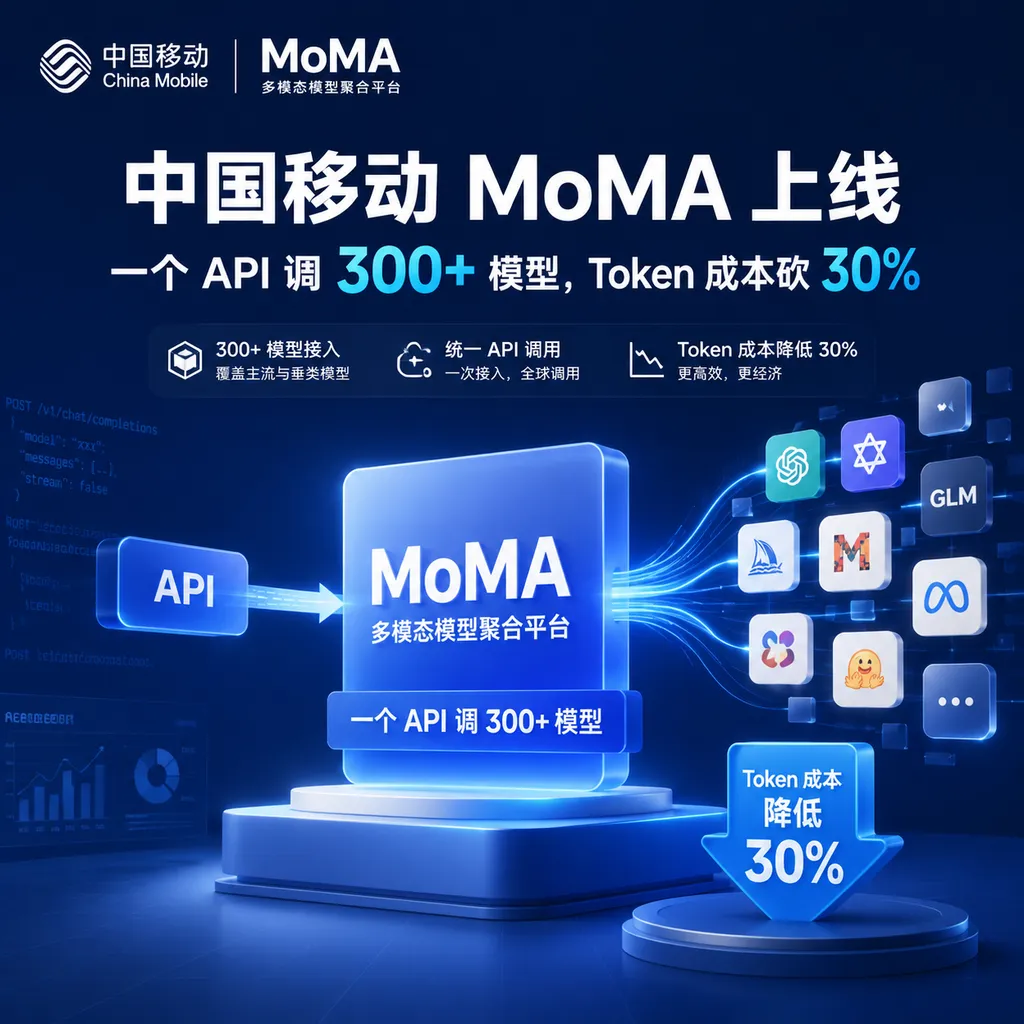
China Mobile officially launched the MoMA Model Service Platform today, integrating over 300 mainstream large models through a unified API gateway. Based on domestic computing power and a self-developed inference engine, it reduces per-token cost by about 30%, and pioneers an intelligent routing engine and confidential model services.
China Mobile MoMA Launch: One API Connects 300+ Models, Token Cost Cut by 30%
On May 8, China Mobile officially released its MoMA (Mixture of Models and Agents) service platform. In short: a central state-owned enterprise is entering the AI model aggregation field — a unified API gateway connects over 300 mainstream industry models, cutting unit Token cost by about 30% and reducing resource usage by over 50%.
This isn’t MoMA’s first appearance. As early as last July at WAIC, China Mobile’s Jiutian AI Research Institute introduced MoMA’s prototype, positioned as a “multi-model and agent aggregation & service engine” that aggregated 15+ models and 20+ agents. This launch marks the transition from a research prototype to an operator-grade commercial platform — model scale up 20×, and its operation model upgraded to “Token intensification.”
One Key Calls 300 Models — But It’s About More Than Just Quantity
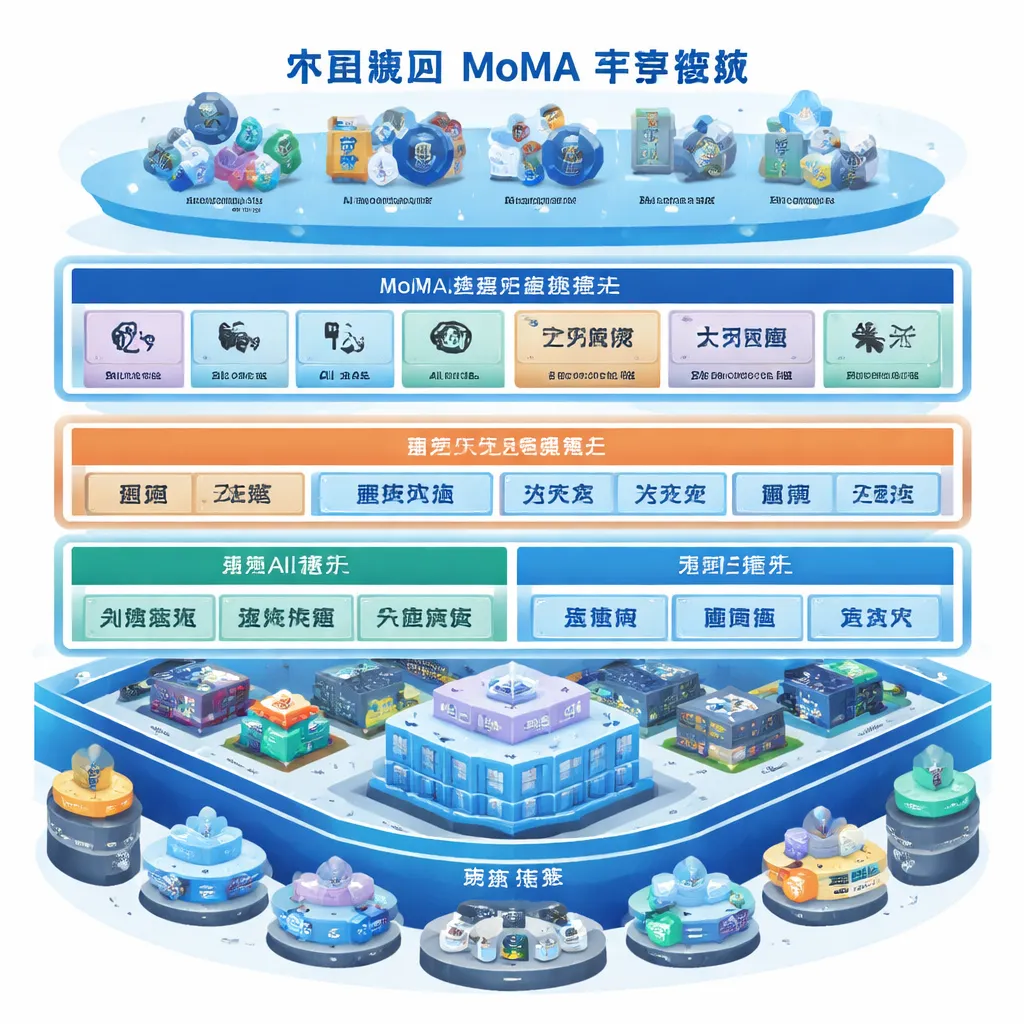
Model aggregation platforms aren’t new. Overseas there’s OpenRouter, and China Mobile isn’t the only domestic player doing this. What makes MoMA worth paying attention to are three things: domestic computing infrastructure + self-developed inference engine, pioneering Token-intensive operation, and operator-grade SLA with intelligent routing.
According to the official disclosure, MoMA currently integrates:
- China Mobile’s proprietary foundational large model Jiutian
- The full line of DeepSeek models (including the R series inference models)
- Alibaba’s Qwen
- ByteDance’s Doubao
- Moonshot AI’s Kimi
- Zhipu’s GLM
- And other text generation, speech processing, and multimodal understanding models
In capability, MoMA covers text, speech, and visual modalities. In application, it clearly targets government, finance, industry, and healthcare sectors — G-end and high-compliance industries. This naturally plays to China Mobile’s strengths as a central enterprise operator: meeting domestic-compliance (信创) requirements that Internet companies may struggle to satisfy.
Token Intensification: From “Selling Compute” to “Selling Tokens”
This is what differentiates MoMA’s approach and narrative from other aggregation platforms.
Traditionally, enterprises either buy GPUs to deploy models themselves or pay various vendors per API call. The former is capital-intensive — long-tail models are seldom used yet occupy resources. The latter leads to inconsistent billing, SLA, and throttling policies across vendors, making multi-model business cost estimation and budgeting chaotic.
MoMA abstracts Tokens as a unified operational unit. Built on domestic computing power pooling and its own inference engine, it schedules resources for long-tail models — meaning rarely used models no longer monopolize GPU memory; they are allocated on demand. Together with intelligent caching, context reuse, and Token compression optimizations, MoMA cuts per-Token cost by about 30% and reduces resource usage by more than 50%.
What does that mean? A 50% drop in resource usage, for an operator-level platform running dozens of models, means the same computing power can handle twice the requests.
Intelligent Routing Engine: Cost, Performance, or Balance — Choose Freely
MoMA highlights its “intelligent routing engine” as a key innovation. It offers three strategies:
- Cost priority: route to smaller, cheaper models
- Performance priority: route to the strongest models, spend more for quality
- Balanced priority: find an optimal point on the cost-performance Pareto curve
Technical details were already published in last year’s MoMA whitepaper. The core is the Jiutian team’s PD²-Matrix (Problem-difficulty vs. Domain Matrix) framework: tasks are mapped across two dimensions — “problem complexity” and “knowledge domain.” Each cell in this grid is assessed and used to generate a high-dimensional capability profile for each model. The system then uses Pareto optimization to fit performance-cost curves for dynamic trade-offs.
In simpler terms: MoMA knows which model to pick for which task — it doesn’t just route everything to the most expensive one.
Engineering-wise, MoMA uses hierarchical routing:
- Level 1 routing: distribute tasks to expert / simple / complex models
- Level 2 routing: assign tasks by complexity and cost constraints to parameter-scale models (1B, 3B, 8B, 75B, 200B)
- Monitor Model: real-time monitors inference output, reviews routing quality, and optimizes dynamically
An official metric: In million-user scenarios, MoMA’s dynamic routing improves overall response speed by 42% compared to using a fixed 75B model — a practical engineering figure, not marketing hype like “GPT-4 equivalent.”
For complex, multi-intent tasks, MoMA uses a Planner–Executor–Summarizer architecture, dynamically switching between ReAct, Route, Parallelize, and Swarm modes. This is conceptually aligned with mainstream agent frameworks like LangGraph and AutoGen, but MoMA decouples planning and execution routing to avoid redundant evaluations by a central planner, reducing hallucinations and improving latency.
Second-Level Failover + Confidential Containers: Operator-Grade Work
Another hidden benefit of intelligent routing is resilience. MoMA promises automatic failover within seconds when a model times out, throttles, or crashes. In production, that reliability matters more than “having many models.” If DeepSeek is throttled, the platform instantly switches to a Qwen model of comparable tier — uninterrupted service.
Such SLA-oriented thinking is a hallmark of telecom operators.
On the security side, MoMA introduces a “Confidential Model” service — deploying models within confidential containers, secured by hardware isolation (likely TEE-based), ensuring end-to-end confidential computation from chip to application. This clearly targets regulatory demands for government and financial data sovereignty — a moat that Internet vendors struggle to replicate.
Protocol Layer: Compatible with MCP and A2A, Enhanced for Enterprises
Interestingly, MoMA doesn’t reinvent its protocol layer but remains compatible with Anthropic’s MCP (Model Context Protocol) and Google’s A2A (Agent2Agent). Yet China Mobile points out two weaknesses in native MCP: lack of security constraints in model-tool interaction and insufficient specifications on tool schedulability.
Therefore, MoMA extends its implementation with unified authentication, secure communication, and enhanced tool schedulability, forming a “China Mobile-style A2A/MCP.” This is essential for enterprise adoption — elegant open standards often hit practical barriers like access control, auditing, and throttling in production.
How to View MoMA: The Logic of a State-Owned Aggregation Platform
Fundamentally, who has the upper hand in model aggregation — state-owned enterprises or Internet firms?
Internet vendors excel at fast iteration and broad ecosystem reach. But MoMA takes a different path: domestic computing foundation + operator-grade SLA + regulatory compliance. These three combined target G-end and large B-end markets, whose concerns lie less in six-month model refresh cycles and more in data non-exfiltration and 24/7 uptime.
MoMA is already powering China Mobile’s own Lingxi Agent 2.0, upgraded into a domain-crossing, multi-task, self-planning general agent covering communication, lifestyle, travel, work, and home scenarios. That’s a major internal PoC — proof that the platform scales to millions of users.
For developers, having an additional domestic and trustworthy aggregation option is welcome — especially in government-enterprise projects where integration with multiple model APIs and compliance adaptation used to be a headache, now theoretically streamlined into one MoMA gateway.
Additionally, OpenAI Hub is pursuing a similar unified interface — one key calling GPT, Claude, Gemini, DeepSeek, etc., with domestic connectivity and OpenAI-compatible format. Their target users diverge: OpenAI Hub focuses on global developer access; MoMA focuses on compliance foundations within state-owned ecosystems. Developers can choose case by case.
What to Watch Next
MoMA’s narrative is complete, but several aspects await market verification:
- Usability of the 300+ models — how many are actually live APIs versus “available upon process”
- True Token pricing unification — given differences in context windows, I/O ratios, and inference load, unified Token pricing requires precise accounting
- Third-party developer access — MoMA currently serves mobile cloud clients and government-enterprise users; individual and SME access and pricing remain unspecified
- PD²-Matrix evaluation system — whether it will be open-sourced determines the credibility of “intelligent routing”
By 2025, the model aggregation race has shifted from “existence” to “usability.” MoMA’s move expands the battlefield — now not just among Internet vendors but also among telecom and cloud providers. What’s next to watch: whether China Telecom and China Unicom follow suit, and how Alibaba Cloud and Volcano Engine will differentiate their model-hosting platforms.
References
- China Mobile launches MoMA platform: Unit Token cost reduced by 30%, integrating over 300 AI models – IT Home — IT Home’s core report on MoMA’s official release, covering cost reduction, intelligent routing, and confidential model features


