
Baidu DuMate tops PinchBench, marking the first time a Chinese AI agent has taken the lead
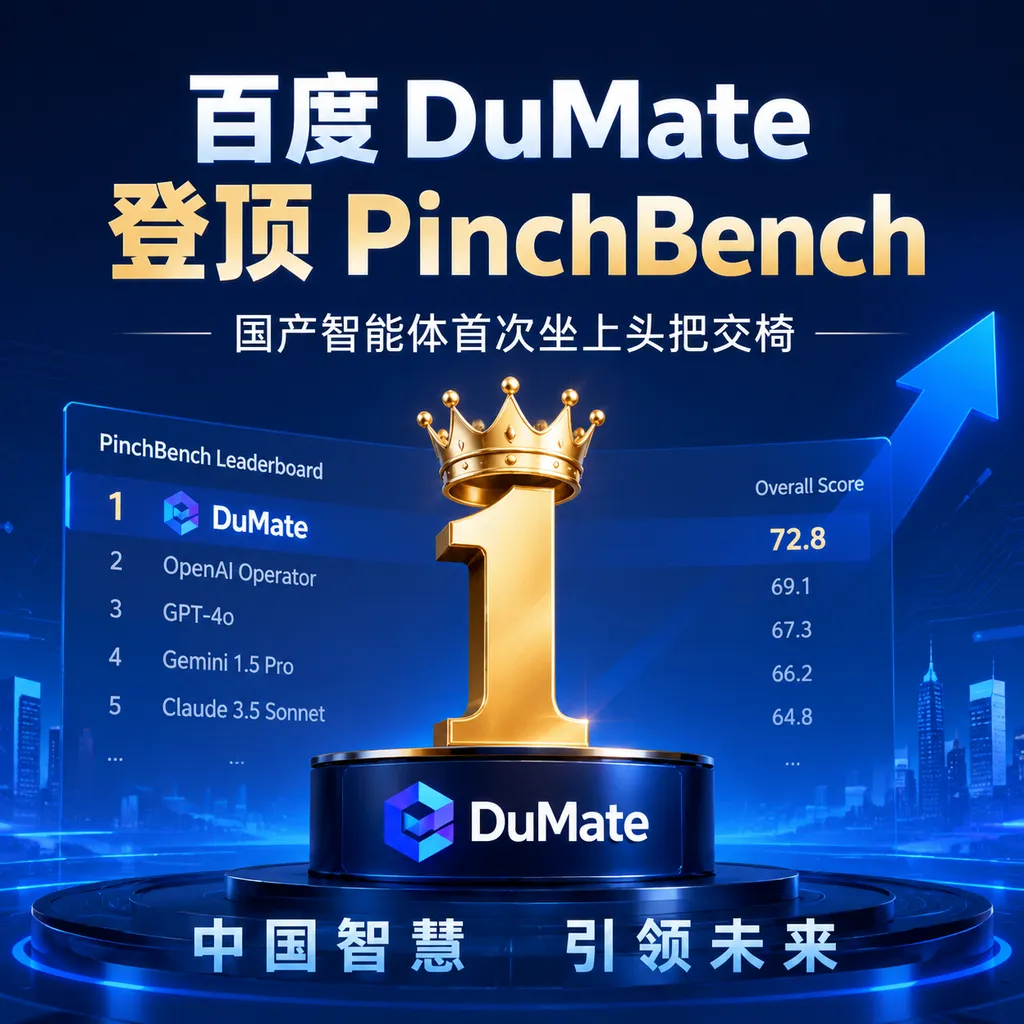
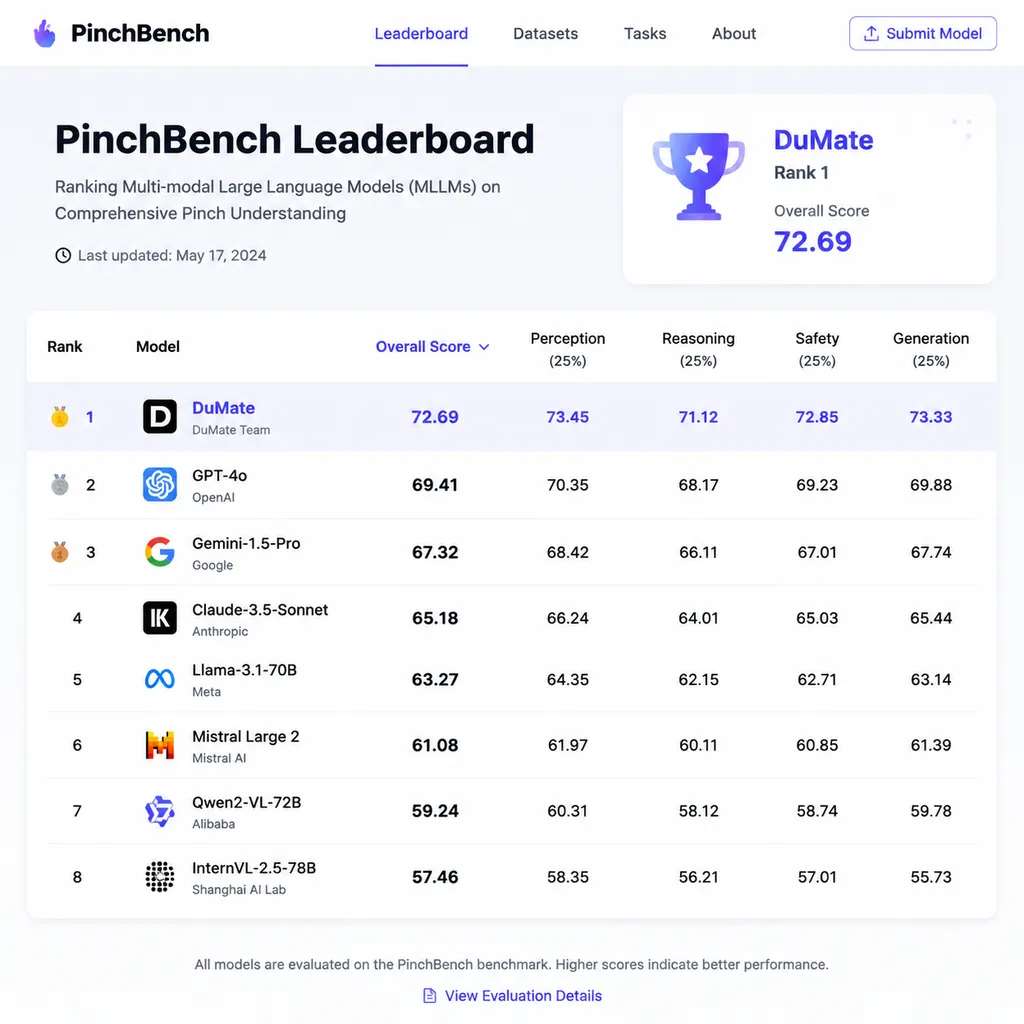
In the early hours of May 8, Baidu’s DuMate claimed the top spot on the intelligent agent benchmark PinchBench, holding three of the top five positions and also leading the DeepResearch ranking. This marks the first time a domestic intelligent agent has surpassed leading overseas competitors on this list.
Overnight, PinchBench Changed Hands
In the early morning of May 8, the PinchBench leaderboard quietly refreshed. The top spot—previously almost always occupied in turn by Claude Opus and GPT‑5.5 series—was overturned: Baidu’s agent product DuMate (Baidu Dazi) took first place, and three of the top five positions bore the Baidu name. On the concurrently released DeepResearch benchmark, DuMate also ranked first.
This marks the first time a domestic agent has taken the top position on PinchBench, a benchmark once regarded by overseas vendors as their “private turf.” For China’s AI agent ecosystem—often criticized for “ranking well but performing poorly in practice”—the signal conveyed here may be more significant than the score itself.
What Is PinchBench and Why This Win Matters
First, some background. PinchBench isn’t a traditional benchmark where models simply answer questions—it evaluates an agent’s ability to complete real-world task chains: task decomposition, tool calls, cross‑app operation, exception handling, and long‑chain reasoning, all scored together. Put simply: MMLU measures how much a model remembers; PinchBench measures whether an Agent can actually get the job done.
Who have been the regular contenders on this leaderboard over the past half‑year? Claude Opus 4.6/4.7, GPT‑5.4/5.5, Gemini 3.1—top‑tier players. A few months ago, the in‑car model Sage breaking 94% task completion on a sub‑benchmark was already considered “making waves,” but the overall championship had never changed hands.
DuMate didn’t just win a single sub‑test—it took first place on both the Comprehensive leaderboard and DeepResearch, doubling its gold content. Particularly, DeepResearch tests multi‑round retrieval, cross‑source verification, and long‑form report generation, heavily stressing reasoning depth and tool‑orchestration capability—precisely the two areas where domestic models used to be criticized.
How DuMate Rose to the Top
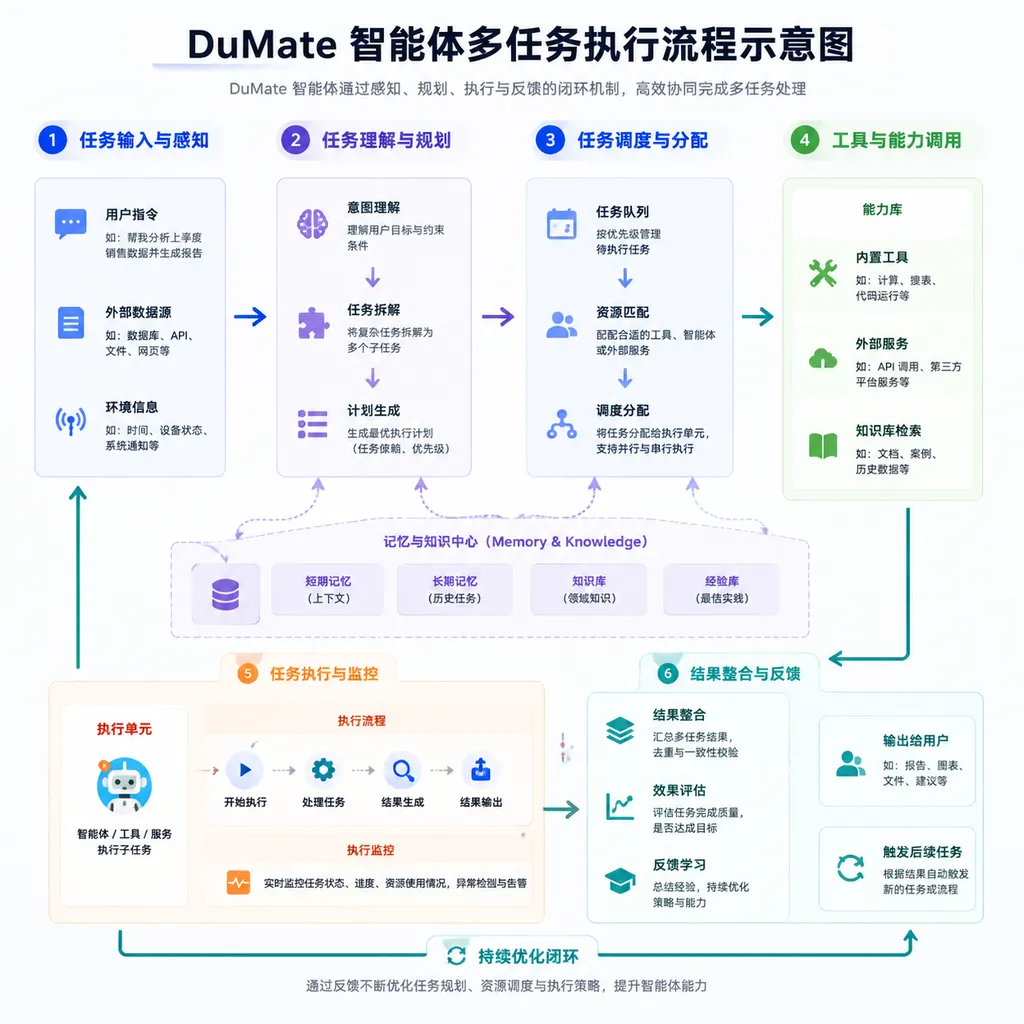
DuMate is not unfamiliar to the developer community. Positioned as an “AI buddy,” it’s built atop Baidu’s Wenxin series and wrapped with an aggressive multi‑agent orchestration framework. Several aspects of its success deserve attention:
1. The Multi‑Agent Orchestration Is Genuine Skill
You can tell from the detail that Baidu holds three of the top five spots—what they submitted wasn’t a single version but multiple agent configurations optimized for different task types. This approach aligns with Anthropic’s “multi‑agent orchestration + goal outcomes + autonomous reasoning” concept introduced at the Code with Claude conference: no matter how strong a single agent is, for long task chains it’s better to let multiple agents collaborate.
Baidu clearly strengthened the orchestration layer rather than just piling up model parameters.
2. Taking First in DeepResearch Means the Retrieval–Reasoning Loop Is Connected
Anyone who has built a Research Agent knows the bottleneck isn’t calling the search API—it’s:
- Deciding whether current information is sufficient or another search is needed
- Choosing which source to trust when faced with conflicting data
- Avoiding “amnesia” in long contexts
- Keeping citations aligned when generating the final report
DuMate ranking first on this sub‑benchmark means the loop works in these evaluation scenarios—a capability crucial for extending from a consumer‑facing “AI companion” to more valuable B2B scenes like research assistants, due diligence, and industry analysis.
3. Native Advantage in Chinese Scenarios Is Amplified
Although PinchBench is a comprehensive benchmark, its task set covers both Chinese and English. Overseas models face limits on Chinese long‑tail tasks and localized tool usage (maps, food delivery, calendars, etc.), while DuMate operates on home turf—these scores likely contributed greatly.
Shifting Landscape of Domestic AI Agents
Zooming out, the past half‑month has been dense with model‑related releases:
- ByteDance open‑sourced Mamoda 2.5: 25 B parameters, only 0.3 B activated per run, multimodal all‑task SOTA
- Ant Bailian open‑sourced Ling‑2.6‑1T: a trillion parameters, reaching open‑source SOTA on AIME 26 and SWE‑bench Verified
- DeepSeek introduced a “visual‑primitive‑based” reasoning framework whose spatial reasoning rivals GPT‑5.4
- Alibaba Tongyi released Qwen‑Scope, an explainability toolkit
Taken together, they send a clear message: domestic models no longer aim merely to score highly on open‑source benchmarks—they’re now competing in real‑application agent evaluations. DuMate’s new crown is a symbolic event of this momentum—benchmark focus is shifting from “model competence” to “product‑level agent capability,” and the domestic camp has, for the first time, claimed a comprehensive championship in the latter.
But a Few Points Require Cool‑headed Reflection
After the good news, some reality checks:
First, PinchBench is not absolute truth. All benchmarks carry risk of overfitting—especially an agent test with a relatively closed task set. DuMate’s overnight jump from off‑chart to first almost certainly came with targeted optimization for this benchmark. That’s not shameful—overseas vendors do the same—but users should keep it in mind while interpreting the results.
Second, leaderboard ≠ user experience. Claude Opus earned its reputation among developers not through high scores, but through stability in real engineering use like Claude Code. For DuMate to turn its lead into developer stickiness, openness of API, pricing, and ecosystem compatibility will matter.
Third, overseas competitors haven’t stopped. OpenAI just upgraded GPT‑5.5 Instant; Anthropic doubled call limits and relaxed rate caps for Claude Code at Code with Claude; xAI launched Grok 4.3. No one knows what the PinchBench leaderboard will look like a month from now.
What This Means for Developers
If you’re building agent‑type applications, this leaderboard shift offers at least three practical takeaways:
- Domestic base models now merit serious consideration. Previously, teams defaulted to “Claude for complex tasks, domestic models for simpler ones.” That logic needs re‑evaluation—at least for long‑chain Chinese tasks, the Wenxin series underlying DuMate now possesses top‑tier competitiveness.
- Multi‑Agent orchestration is the real trend. Three of the top five share the same base but different specialized configurations—this “one model, many personas” approach is worth adopting, yielding higher cost efficiency than just scaling the model up.
- DeepResearch‑type scenarios are becoming the next battleground. Market research, due diligence, compliance, and medical literature review—these domains have finally cleared the model capability threshold, opening the window for productization.
On OpenAI Hub (openai‑hub.com), a single key can already connect to mainstream models—Wenxin, Claude, GPT, Gemini, DeepSeek, etc.—so when running A/B tests, you don’t need to integrate multiple SDKs. This saves effort for cross‑model evaluations.
In Closing
DuMate’s PinchBench victory is, by itself, a highlight for one product; viewed against the past six‑month rhythm of China’s AI evolution, it’s a milestone of “domestic AI shifting from competition at the model layer to competition at the agent layer.”
The real drama is yet to come. The next leaderboard refresh may arrive within weeks, and Claude and GPT are certainly preparing their comeback. But one thing has already changed: where domestic models once appeared on these lists as “challengers,” they are now “defenders.” The switch from offense to defense is itself an outcome.
References
- PinchBench Ranking Analysis – Zhihu: background of the PinchBench leaderboard and global model token‑consumption data analysis


