
Codex quietly added a remote-control mode: use your phone to control your coding Agent.
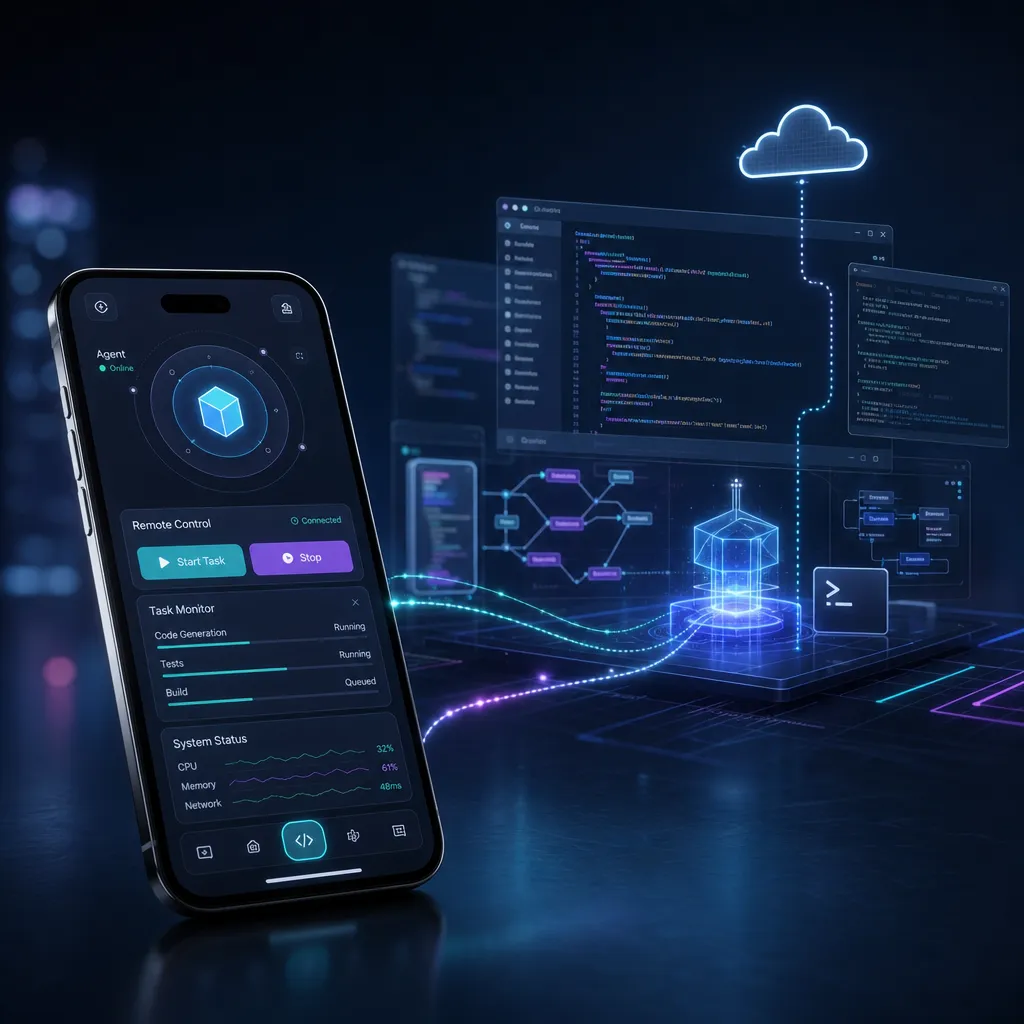
OpenAI has added a `codex remote-control` subcommand to the Codex repository, serving as a simplified entry point for launching a headless, remotely controlled app-server. This means Codex has officially filled in the missing piece that Claude Code already had—decoupling the coding Agent from the workstation and bringing it to mobile devices and browsers.
Explain It in One Sentence
OpenAI quietly added a new subcommand to Codex CLI: codex remote-control.
The official commit message is quite restrained — "Added codex remote-control as a simpler entrypoint for starting a headless, remotely controllable app-server."
Translated loosely: from now on, Codex can work even when nobody is sitting at the workstation. Your phone, browser, or even Apple Watch can become the remote.
This feature hasn’t been officially announced yet; the community discovered it while digging through the Codex repo commits. People are already discussing it on linux.do, and Reddit r/codex has been tracking the lead for weeks — from the earliest PR traces saying "remote control coming soon" to the actual remote-control subcommand landing, progress has been fairly quick.
Making Up for Claude Code’s Lesson
To understand the weight of this update, we need to look at what’s been happening at Anthropic.
Claude Code rolled out remote control late last year: you run a local Claude CLI session, and the mobile app can take over directly — view diffs, approve permissions, issue new commands, even use voice input. The core scenario is “I think of a change on the subway, pull out my phone to make the Agent run it, and by the time I’m home the code is done waiting for my review.”
Once you experience that, there’s no going back. Coding Agents are naturally long-running asynchronous tasks; staring at a terminal watching it type is a waste of life. Claude Code decoupled interactions from “synchronous terminal” to “asynchronous review,” one of the few paradigm-shifting changes in AI coding tools over the past year.
Codex had been lagging behind. Codex CLI has strong integration with the ChatGPT account system and excellent code capability from the GPT-5 series models, but its form is still tightly bound to the terminal. The community has complained many times: “Why can Claude Code do remote control, but Codex can’t?”
Now, it finally caught up.
What Exactly Is remote-control
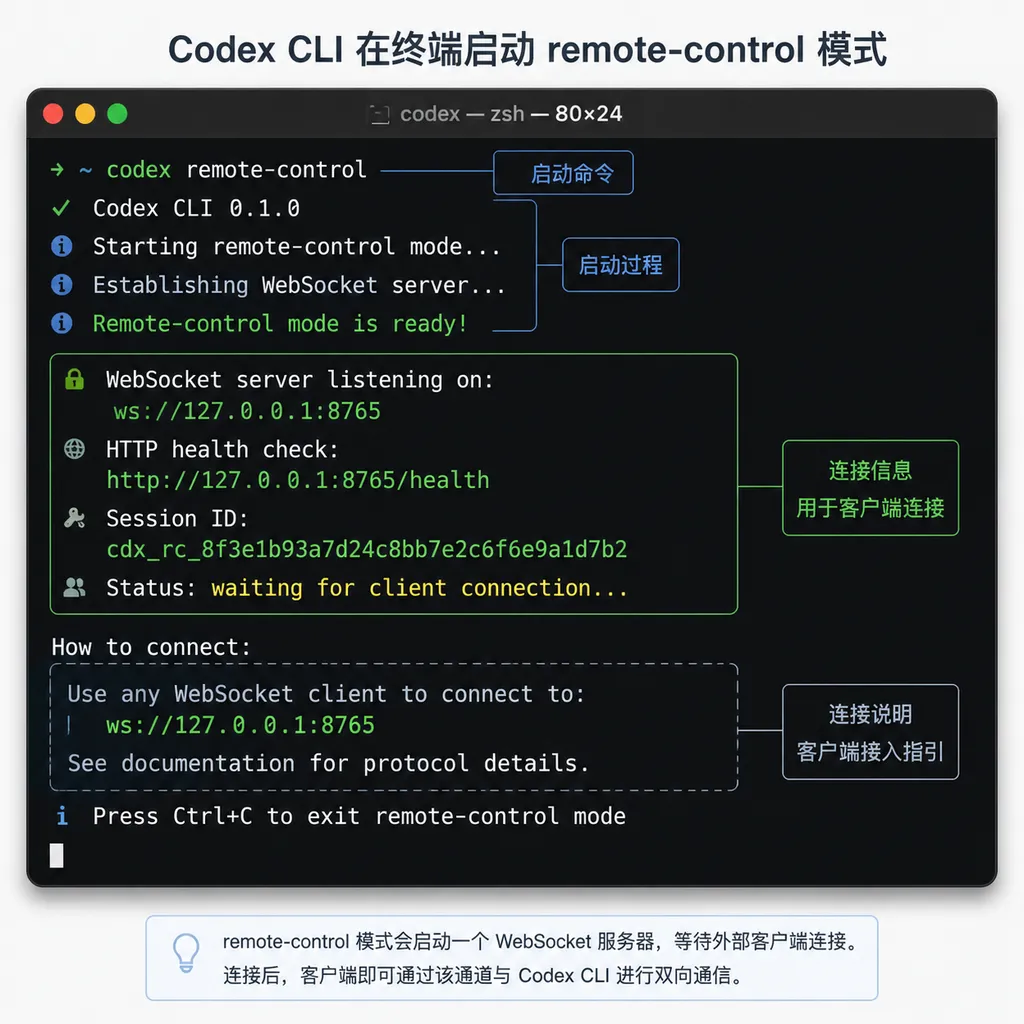
From the commit details and code changes, codex remote-control essentially launches a headless app-server — that is, a Codex service process without a TUI interface.
Key points:
- Headless: Doesn’t occupy your terminal; can run in the background, on a remote machine, or in a cloud sandbox.
- App-server: Exposes a set of externally callable interfaces (likely WebSocket or similar persistent protocol) to receive commands and push states.
- Remotely controllable: Implies that companion clients will communicate with it — most likely the upcoming Codex desktop and mobile apps.
The Codex repo already had some app-server-related code, but the launch process was cumbersome and required parameters. The goal of this remote-control is “a simpler entrypoint” — wrapping those parameters into a ready-to-use command.
It’ll probably be used like this:
# Start a remotely controllable Codex instance on your dev machine
codex remote-control

# Then connect from the mobile app / browser
# Automatically paired under the same ChatGPT account
Notice the topology here: The Codex process runs on your own machine (with access to your codebase, environment variables, git).
The mobile side is just a thin client, displaying and sending commands. This is entirely different from “uploading code to the cloud for OpenAI to run,” making it much more enterprise-friendly — your code stays local.
A Few Real-World Scenarios
This feature might sound flashy, but what real value does it bring? Here are a few cases developers may actually use:
Scenario 1: Supervising Long Tasks.
Let Codex perform a large refactor or migrate an old module, which might take forty minutes. Previously, you had to stay by your computer approving each permission request. Now you can go to a meeting; when your phone pings — it asks whether to execute rm -rf node_modules — you tap Allow and keep going with the meeting.
Scenario 2: Cross-Device Handoff.
Start a feature on your office computer in the morning, check progress and add requirements from your phone on the way home; review diffs on your tablet at home, and finally merge on your desktop. Session state stays consistent throughout.
Scenario 3: Cloud Sandbox Combo.
Someone on Reddit noted pairing remote-control with a cloud sandbox — Codex runs in an isolated environment in the cloud, and you can connect to it from anywhere. Essential for those unwilling to let the Agent mess with their local setup.
Scenario 4: Shared Team Agent.
A headless Codex service could theoretically allow multiple users to connect (permission model aside). A “duty” Agent that anyone can dispatch — plenty of potential there.
Comparing with Claude Code — Where’s the Gap
Frankly, Codex is “catching up,” not “leaping ahead.” Claude Code’s remote control has gone through months of iteration, ironing out many issues:
- Whether mobile could run slash commands like
/clear(early versions couldn’t, community complained). - Whether mobile could stop the Agent or view context usage (also missing at first).
- How to design the notification system and make approval latency tolerable.
These are the engineering details Codex will face next. Judging from the naming (remote-control, a plain English phrase) and the wording “simpler entrypoint,” OpenAI seems to be taking a steady approach — solidify the server first, then iterate on the clients.
Another notable difference is ecosystem openness. Claude Code’s remote control is locked into Anthropic’s own app. Codex, on the other hand, uses a relatively open app-server protocol layer, which theoretically allows community-built third-party clients — people are already experimenting with Happy CLI from happy.engineering for similar orchestration, and we may soon see third-party dashboards optimized for Codex remote-control.
Questions Still Unanswered
For now, the information stops at the commit. A few key questions remain until the official release:
- Authentication model: How will the mobile client pair with the local server? Through ChatGPT OAuth? Or a one-time token?
- Network traversal: If the dev machine is behind a corporate firewall and the phone is outside, how will it connect? Is a relay required? (Claude Code uses Anthropic’s own relay.)
- Offline fallback: How long is session state preserved after the server disconnects?
- Multi-session management: Can you keep five Codex instances running different tasks simultaneously?
The answers determine whether remote-control is a “toy” or a “productivity tool.”
Final Thoughts
The evolution path of AI coding Agents this year is becoming clearer:
From “Tab completion in IDEs,” to “chatting with you in the terminal,” to now “working asynchronously in the background while you just review.” Each step pushes humans further out of the loop.
The codex remote-control commit looks small, but it marks Codex’s official step into this third stage.
When it’s officially released and the mobile app is live, developers' workflows will be rewritten once again.
By the way, OpenAI Hub already supports GPT-5 series model API calls, with domestic direct connectivity compatible with OpenAI’s format. Developers running Codex CLI can switch the base_url to use it right away. Once remote-control officially hits GA, we’ll publish a hands-on review.
References
- linux.do: Codex supports remote control? — The earliest domestic community thread noticing this commit.
- Reddit r/codex: Remote Control Coming Soon to Codex — Early discussion speculating about the feature from repo commits.
- Reddit r/codex: Codex Desktop App Remote Development Feature — Leak on the companion desktop functionality.
- Reddit r/codex: Codex Remote Control? — Discussion about controlling Codex from phone/browser/Apple Watch.
- Reddit r/ClaudeAI: New in Claude Code Remote Control — Details and complaints about Claude Code’s remote control features.
- Reddit r/codex: Does Codex Have a Dispatch Mode? — Community summary of current dispatch/remote features.


