
OpenAI adds remote control to Codex: mobile takeover of desktop sessions is coming
The latest Android version of ChatGPT’s code reveals that OpenAI is building cross-platform remote control capabilities for Codex. Developers will be able to use their phones to take over Codex sessions on their desktops, closing the experience gap with Claude Code.
OpenAI Adds Remote Control to Codex: Developers Can Finally Take Over Desktop Sessions from Their Phones
It all started with a piece of Android code that was dug up.
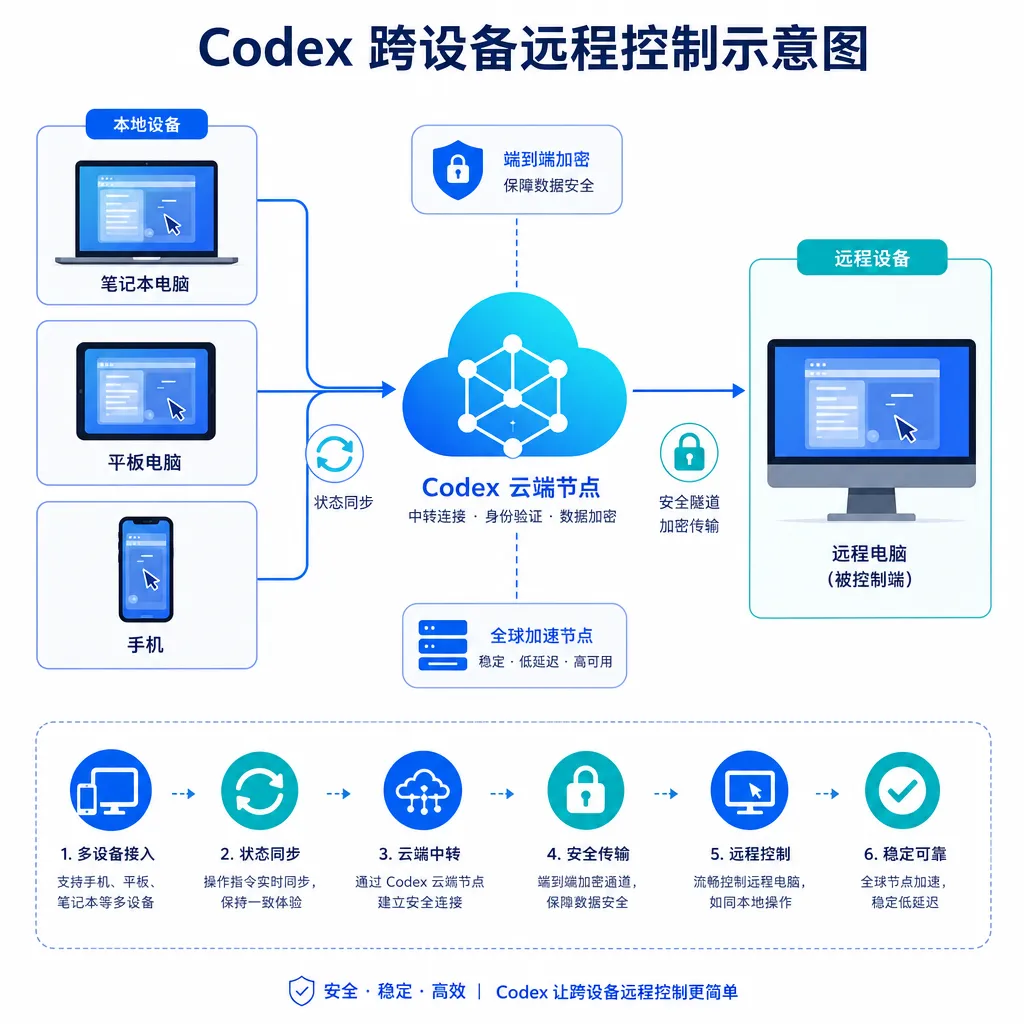
On May 8, Android Authority, while decompiling ChatGPT for Android version 1.2026.125, found that OpenAI was quietly building a full remote connection framework for Codex—developers will soon be able to log in to Codex on their desktop and then connect, restore, or even reconnect that remote session from their phone. In other words, Codex—the one that used to be "chained to your desk"—is about to become a pocketable agent.
This is a key, albeit long overdue, patch for Codex.
What We Can See from the Code Strings
The extracted strings reveal quite a lot. It’s not just a simple “remote view” read-only mode; it’s a full operating pipeline:
- Device discovery: The mobile client can recognize Codex instances running on the desktop
- Session recovery: After disconnection or backgrounding, the context can be seamlessly restored
- Resilient reconnect: Tasks don’t get dropped during network hiccups
- Version check: If the desktop Codex version is too old, the app pops up a prompt to restart and upgrade
More notable is the remote command system. The code contains hints like Type $ for skills and MCP servers, or @ for plugins, along with commands such as /help, /status, and /plan.
This means the mobile app isn't a crippled version—it preserves the same CLI interaction primitives. MCP servers, skills, plugins—all the things you can call on desktop Codex can also be invoked from your phone. For developers who’ve integrated Codex with a bunch of MCP tools, that’s a big deal.
Why Now?
Simply put—it’s because of Claude.
Anthropic has long been ahead in cross-device functionality. Claude Code has supported developers reconnecting to local PC sessions from their phone for quite some time—heading out for lunch, noticing the CI pipeline broke, pulling out your phone to let Claude continue debugging—that workflow has been working for months. Reddit threads in r/codex and r/OpenAI pushing OpenAI to catch up have been piling up for half a year; some people even cobbled together a local terminal bridge for Codex CLI using Mosh + SSH.
Meanwhile, Codex’s remote authentication has been widely criticized. One highly upvoted post in the community basically raged: “All they have to do is generate an authorization code and let the remote instance authenticate like Claude Code, but no—they insist on a damn callback URL and browser access.” Running Codex in containers or remote servers was a hassle.
So this time, OpenAI making remote control native isn’t a new innovation—it’s catching up.
Looking at This in the Current Codex Landscape
Staring at one feature alone doesn’t mean much. Placed in the context of OpenAI’s moves over the past two weeks, a clearer picture emerges.
Not long ago, OpenAI released GPT-5.3-Codex, its most powerful agent programming model yet. OSWorld-Verified scores jumped to 64.7 (previous gen: 38.2), and token consumption for equivalent tasks was halved. More importantly, it’s OpenAI’s first model that’s actually “employed” in its own R&D workflow—research teams use it to monitor training, debug infrastructure, and analyze logs; engineering teams use it to optimize their agent toolchain.
Soon after, OpenAI open-sourced Codex’s core architecture, App Server. It’s a bidirectional communication protocol built on JSON-RPC, defining three layers of dialog primitives from the ground up:
- Item: The smallest unit of interaction—such as a message or a tool call—with a full lifecycle (“start → stream updates → complete”)
- Turn: A complete agent work cycle—for example, “fix this bug” covering reading, thinking, coding, and explaining
- Thread: A persistent session container that holds history and supports cross-device restoration
See the third layer? Thread was designed for cross-device restoration. This means remote control isn’t an afterthought—it’s a capability embedded in the App Server architecture. The web version of Codex already uses this: the browser connects to the cloud container via HTTP + SSE, and even after closing the tab, the session continues running. The mobile app simply extends the same Thread model to a smartphone.
The beauty of this architecture is that CLI, VS Code plugin, macOS desktop app, and the upcoming mobile client all share the same logic—no need to reinvent the wheel for each platform. On the OpenAI Hub side, since the API syntax matches OpenAI’s unified spec, developers can use a single key to call models like GPT-5.3-Codex from their own tools, without switching SDKs back and forth.
Real Pain Points Remote Control Solves
When you look at developer workflows, Codex’s remote capability fills in several gaps:
Long-task monitoring. GPT-5.3-Codex can already autonomously iterate million-token-scale projects (like building a game). Developers shouldn’t have to sit in front of the screen. Checking status or issuing new commands from your phone when something stalls—totally essential.
Exception intervention. When an agent pauses mid-run to ask for confirmation (delete files, push to main, call paid APIs), a single tap on your phone to approve or deny evens the user experience gap with Claude Code.
Multi-device continuity. Start a refactor task at work in the morning, check progress on the way to lunch, continue editing on a MacBook at home—the Thread abstraction makes this possible at the protocol level.
Container/remote dev machines. This is the community’s most requested use case. Developers running cloud containers with only thin clients locally hit authentication roadblocks because the old callback URL flow doesn’t work inside containers. If the new remote session system is done right, it should solve this as a side effect.
A Few Unanswered Questions
But code leaks only confirm features exist—it doesn’t reveal details. Some open questions worth chasing:
First, security model design. Can the mobile client perform high-risk operations (rm, git push --force, external API calls)? Is it full access or tiered confirmation? Claude Code uses a session-level whitelist—whether OpenAI adopts a similar approach is unclear.
Second, end-to-end encryption. Does the mobile/desktop link route through OpenAI’s servers or create a direct tunnel? The former is easy but risks code exposure; the latter is harder but enterprise-friendly. Given that the Frontier platform emphasizes enterprise-grade AI agent collaboration, OpenAI will likely need a corporate solution.
Third, offline/weak network experience. A protocol like Mosh—tolerant of disconnections—is practically essential for mobile. Whether OpenAI sticks with SSE or adopts something more robust will determine if you can use it on the subway.
Fourth, iOS rollout timeline. The leak came from Android code; typically iOS follows the same release rhythm, but Apple’s background execution limits are stricter, so desktop control handover may require a different path.
One Take
Remote control itself isn’t revolutionary—Claude already does it, and community solutions have existed—but at this stage for Codex, it’s significant because it “completes the final piece of the puzzle.”
GPT-5.3-Codex pushed the model’s capability to the level of running long tasks autonomously; App Server provided the architecture for multi-device continuity; Frontier established the enterprise deployment framework. The remaining question is: can the developer—the “commander” of this agent system—issue commands, track progress, and make decisions anytime, anywhere?
Mobile remote control is that answer.
It also signals a fundamental shift in Codex’s product identity. It’s no longer an autocomplete plugin in an IDE, nor just a CLI command—it’s a “persistent online agent.” Desktop, mobile, and web are simply different entry points. OpenAI is redefining what an AI programming tool looks like—and doing so under the logic of an “AI coworker,” not an “AI tool.”
As for how Anthropic will respond—probably soon. This tug-of-war over agent programming experience is just kicking off in 2026.
References
- ITHome: OpenAI to Complete Codex’s Cross-Platform Connection Puzzle — Details of Codex remote features found in Android ChatGPT code
- Reddit r/OpenAI: Call for Codex Mobile Remote Control — Community discussions on remote control needs
- Reddit r/codex: Codex Desktop Remote Development Feature — Comparison between remote development and Claude’s workflow
- Reddit r/OpenAI: Codex Remote Terminal Authentication Pitfalls — Pain points in existing authentication flow


