
Ernie 5.1 Released: How Did It Reach the Top with Only 6% of the Training Cost?
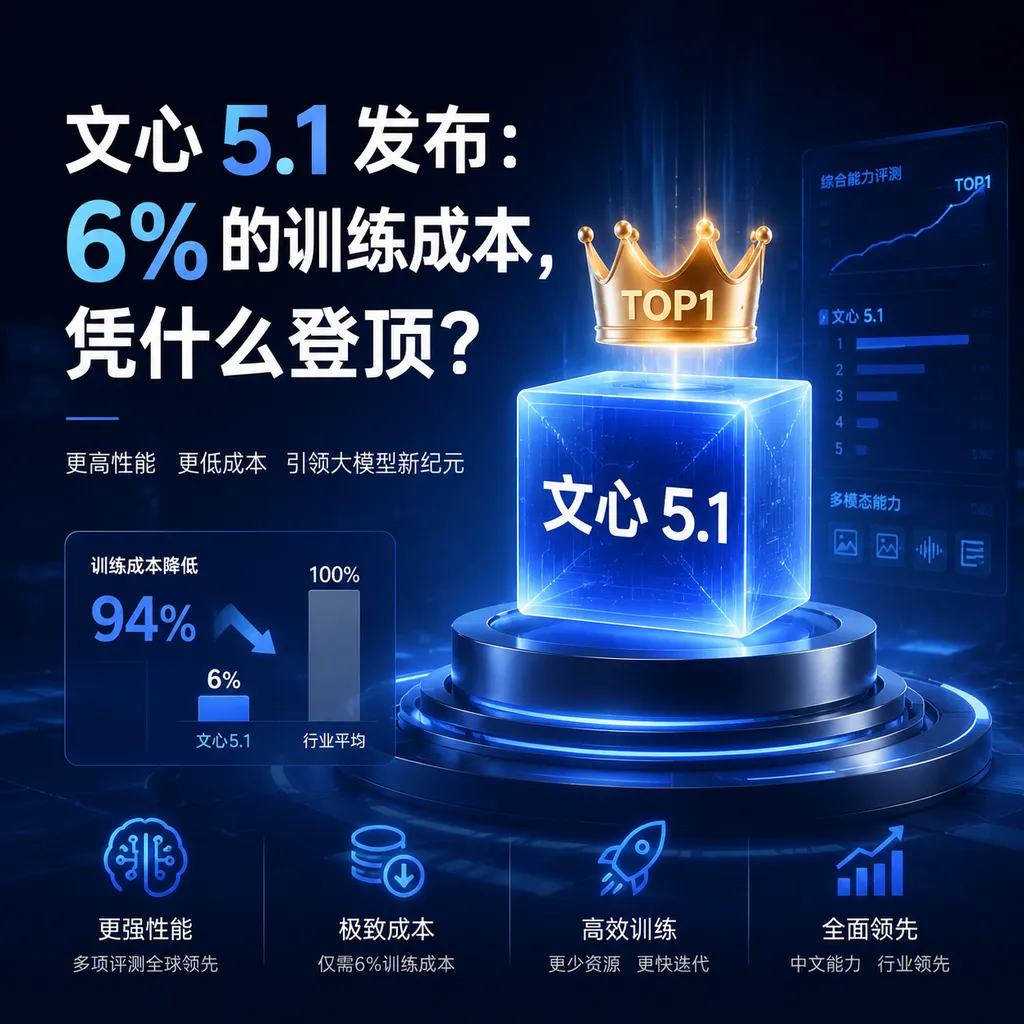
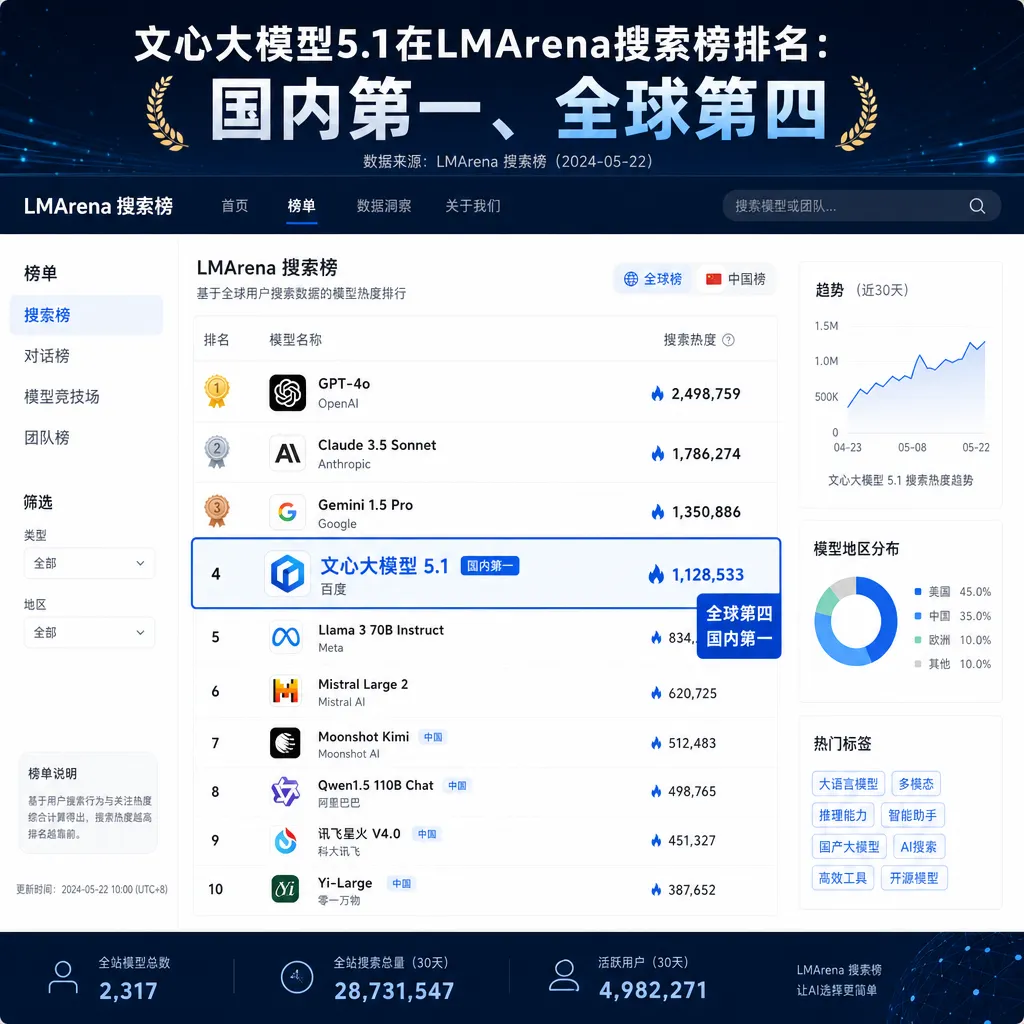
Baidu released the ERNIE large model 5.1 today, adopting multi-dimensional elastic pre-training technology that reduces pre-training costs to 6% of models of the same scale in the industry. It ranked first domestically and fourth globally on the LMArena search leaderboard, with its Agent capabilities surpassing DeepSeek-V4-Pro.
Wenxin 5.1 Launch: How Did It Reach the Top With Just 6% of the Training Cost?
Baidu officially released its Wenxin large model 5.1 today (May 9).
In one sentence: the parameter count has been cut to one-third of the previous generation, activated parameters halved, and pretraining costs just 6% of industry peers at the same scale—yet it still claimed #1 in China and #4 globally on the LMArena Search leaderboard.
That number alone is striking. While most competitors are competing by increasing compute and parameter sizes, Baidu went the other way—creating a stronger model with fewer resources. Whether you believe its benchmarks or not, the “6%” figure itself is enough to make the whole industry re‑examine pretraining efficiency.
Let’s Clarify First: What Does “6%” Really Mean?
Pretraining is by far the most expensive part of a large model’s life cycle. It often means thousands of GPUs running for months—electricity, depreciation, and manpower combined can push top-tier model training costs to hundreds of millions of dollars.
Baidu claims the pretraining cost of Wenxin 5.1 is about “6% of other models of similar scale in the industry.” Put more clearly: what costs others 100 units to train, Baidu says it cost them 6—while achieving even better results.
The foundation of that claim is a technology called “multi‑dimensional elastic pretraining.”
This technique didn’t originate with 5.1—it was first introduced with Wenxin 5.0. The core idea is “train once, generate multiple model sizes.” Traditionally, you have to train separate models for each scale—large, medium, small. Multi‑dimensional elastic pretraining merges this process, producing models of different parameter sizes in a single large‑scale run.
It sounds a bit like model distillation, but it’s not the same. Distillation uses a pretrained large model as the “teacher” and then trains smaller “student” models. Multi‑dimensional elastic pretraining instead acts as an “elastic training framework”—the training process itself runs at multiple scales, with all variants sharing the same infrastructure and data flow.
Wenxin 5.1 takes further steps in compression:
- Total parameters: reduced to about 1/3 of Wenxin 5.0.
- Activated parameters: reduced to about 1/2.
- Pretraining computational cost: only 6% of industry peers at the same scale.
Baidu also states that Wenxin 5.1 “fully inherits Wenxin 5.0’s knowledge.” In other words, it’s not trained from scratch but an efficient iteration on top of 5.0—explaining its dramatically reduced cost. Essentially, it’s leveraging and amplifying the investment made in 5.0.
Of course, the reference point for this “6%” figure matters greatly. Baidu says “models of similar scale in the industry,” but doesn’t specify which model or parameter size it’s comparing against. If it’s benchmarking against trillion‑parameter models like GPT‑4, 6% is astonishing; if against a mid‑sized open model, the meaning changes. We’ll have to wait for more clarity at Baidu’s developer conference on May 13.
LMArena Rankings: #4 Globally in Search, Surpassing GPT‑5.5 in Text
First, some context: LMArena is one of the most credible large‑model evaluation platforms. It uses real user blind tests—randomly presenting two model responses without revealing their identities, then collecting user votes. Results are ranked by Elo score.
LMArena’s results tend to reflect actual user experience better than self‑reported benchmarks.
Wenxin 5.1’s performance can be summarized in two tracks:
Search Leaderboard: 1,223 Points — #1 in China, #4 Globally
“Search capability” here doesn’t mean traditional web search. It refers to a model’s ability to retrieve, integrate, and generate information from multiple sources—essentially, finding key data among vast information and organizing it into coherent, structured responses.
This is Baidu’s forte. After over 20 years in search, if that accumulated retrieval expertise can’t shine in the age of LLMs, it would be a waste. Wenxin 5.1 topping China’s search chart isn’t surprising—but ranking #4 globally and being the only Chinese model on the list is remarkable.
For developers, strong search capabilities mean an advantage in RAG (Retrieval‑Augmented Generation) scenarios. You can spend less effort optimizing your retriever pipeline because the model itself better understands and integrates retrieval outputs.
Text Leaderboard: 5.1 Preview — 1,476 Points, #1 in China
Back on April 30, the Wenxin 5.1 Preview version already achieved a 1,476 Elo score on LMArena’s text leaderboard, ranking #1 in China—surpassing DeepSeek‑V4‑Pro and GPT‑5.5, both flagship models in their categories.
That said, surpassing GPT‑5.5 should be interpreted cautiously. LMArena scores are based on user votes, influenced by question types and voter demographics. GPT‑5.5 may still outperform in certain skill areas. But overall, Wenxin 5.1 clearly demonstrates competitive strength among top‑tier closed models.
Capability Breakdown: Agent Is the Highlight
Baidu’s official comparison covered multiple ability dimensions; here are some key takeaways:
Agent Capability: Surpassing DeepSeek‑V4‑Pro
This was Baidu’s main promotional focus. “Agent capability” refers to a model’s ability to autonomously handle complex tasks—such as tool use, multi‑step reasoning, task planning, and error handling.
If standard Q&A is like “you ask, I answer,” agent scenarios are more like “you give me a goal, I figure out how to achieve it.” Examples include:
- “Check sales data for the past three months, generate a trend chart, and email a report.”
- “Monitor this API’s latency; if it exceeds a threshold, auto‑scale and notify ops.”
Such tasks require a plan‑execute‑feedback‑adjust loop. DeepSeek‑V4‑Pro is already strong in this area, so Wenxin 5.1 surpassing it shows Baidu’s serious investment in the agent direction.
For developers building AI agent applications—whether internal automation tools or user‑facing assistants—Wenxin 5.1 deserves consideration.
Creative Writing: Comparable to Gemini 3.1 Pro
Writing has always been a stronghold for Chinese models. Baidu claims Wenxin 5.1’s creative writing ability matches Google’s Gemini 3.1 Pro. Given that Gemini 3.1 Pro is among the leaders in that field, that’s a respectable statement.
However, “comparable” doesn’t mean “better.” Matching Google’s offering in Chinese writing is good—but not groundbreaking.
Reasoning Capability: Approaching Leading Closed‑Source Models
Note the wording “approaching,” not “exceeding.” Reasoning—especially in mathematics and coding—has been a weak spot for domestic models. Baidu’s phrasing suggests progress but acknowledges remaining gaps.
This honesty feels more credible than exaggerated claims of “comprehensive leadership.”
The Underlying Logic: Efficiency First
Looking beyond Wenxin 5.1 as a single product, Baidu’s past year shows a clear strategy: compete on efficiency, not parameters.
While others raced to trillion‑parameter scales last year, Baidu invested in multi‑dimensional elastic pretraining. By 5.1, the technology is paying off—delivering equal or better results with fewer parameters and lower cost.
This philosophy resembles DeepSeek’s MoE (Mixture‑of‑Experts) approach—both aim to maximize output per compute unit. The difference is that DeepSeek’s MoE is focused on architectural sparsity, while Baidu’s approach innovates in training methodology.
Which path is better remains to be seen. But one thing is clear: the age of brute‑force compute scaling is ending. As training cost becomes an unavoidable constraint, training efficiency becomes the key differentiator.
This is especially critical for Chinese companies. With limited access to high‑end chips, “achieving more with less” is not optional—it’s survival.
What It Means for Developers
Wenxin 5.1 is now live on Baidu Qianfan Model Hub and the Wenxin Yiyan website, open to enterprise and developer access.
For practical adoption, developers should consider a few factors:
1. Inference Cost
With total parameters down to one‑third and activated parameters halved, inference cost drops significantly. For large‑scale API deployment, this might be even more compelling than pure performance gains. A powerful model is useless if each call breaks your business model.
Baidu’s official blog notes a “significant reduction in inference cost compared to Wenxin 5.0.” Exact numbers await future pricing updates.
2. Search‑Augmented Scenarios
If your application relies heavily on retrieval and synthesis (e.g., enterprise knowledge Q&A, news summarization, competitive analysis), Wenxin 5.1’s strength in search could bring real advantages. Its #4 global ranking wasn’t an accident.
3. Agent Development
If you’re building AI agents, take note of Wenxin 5.1’s lead over DeepSeek‑V4‑Pro here. Conduct side‑by‑side evaluations—especially for tool‑use accuracy and multi‑step task completion rates.
4. Model Selection Recommendations
The market overflows with choices: GPT‑5.5, Claude 4 Sonnet, Gemini 3.1 Pro, DeepSeek‑V4‑Pro, Wenxin 5.1… each claims superiority in some area.
My advice: ignore generic benchmarks—test your own scenarios. Use your own prompts and data for A/B comparisons. LMArena is a useful reference, not the final answer.
If you don’t want to integrate multiple vendor APIs separately, consider aggregated platforms like OpenAI Hub, which let you compare GPT, Claude, Gemini, DeepSeek, etc., with one key—saving signup hassle.
Questions Worth Asking
Despite a wealth of announcements, Baidu left several key points unclear:
1. What’s the baseline for “6% training cost”?
It sounds impressive, but without knowing the comparison model or scale, it’s hard to judge its significance. Compared to Llama 3? GPT‑4? Or some undefined “industry standard”?
2. What is the exact parameter size?
Baidu said “total parameters reduced to one‑third of 5.0,” but never disclosed 5.0’s size—making “one‑third of an unknown” an awkward metric.
3. Will it be open‑sourced?
In an era where DeepSeek and Qwen are aggressively open‑sourcing, Baidu’s Wenxin remains closed. So far, there’s no sign 5.1 will change that.
4. How about multimodality?
This release focused on text capabilities; little was said about image or video understanding and generation. Considering Wenxin 5.0 performed well on LMArena’s visual understanding charts, 5.1’s progress here will be worth watching.
We may have answers at the Create 2026 Baidu AI Developer Conference (May 13–14), where Robin Li is expected to share more technical details and commercialization plans.
Final Thoughts
Wenxin 5.1 isn’t a “sudden miracle”—it’s the result of continuous investment in Baidu’s multi‑dimensional elastic pretraining strategy. From 5.0’s theoretical proposal to 5.1 Preview’s validation and today’s official launch, this has been a months‑long process leading to a comprehensive outcome.
6% training cost, one‑third the parameters, LMArena leaderboard highs—these numbers together tell a unified story: the large‑model race is shifting from “who’s bigger” to “who’s more efficient.”
That’s good for the whole industry. Competing on efficiency instead of resource brute‑force means lower barriers to entry. The massive training runs only tech giants could afford today may soon be viable for smaller players tomorrow.
Whether Wenxin 5.1 truly delivers as advertised—you’ll only know by trying it yourself. The model is live; the Baidu Qianfan API is there. Put it to the test and see what it can do.
References
- Baidu Releases Wenxin 5.1: Tops China in Search Ability, Pretraining Cost Only 6% of Industry Peers — Original IT Home report with full official details and LMArena ranking data


