
Ant Bailin releases the trillion-parameter Ring-2.6-1T, with inference intensity adjustable by levels.

Ant Group’s Bailing large model today launched the trillion-scale reasoning model Ring-2.6-1T, featuring a pioneering dual-level **high/xhigh Reasoning Effort** mechanism. It is now live on OpenRouter with one week of free access and will be open-sourced later.
Ant Bailing launches trillion-parameter Ring-2.6-1T: reasoning intensity now adjustable
On May 9, Ant Group’s Bailing (inclusionAI) team officially released its trillion-parameter flagship reasoning model Ring-2.6-1T. This marks a major leap for the Ring series — not only reaching the "trillion-parameter club," but also taking a pragmatic engineering step: turning "how deeply to think" into an adjustable dial.
The model is now live on OpenRouter, with free access for one week, and the team has announced that open-source release is “coming soon.” For domestic developers, this makes it another open-source candidate capable of competing with top-tier closed models, following Qwen3, DeepSeek-V3.2, and GLM-4.6.
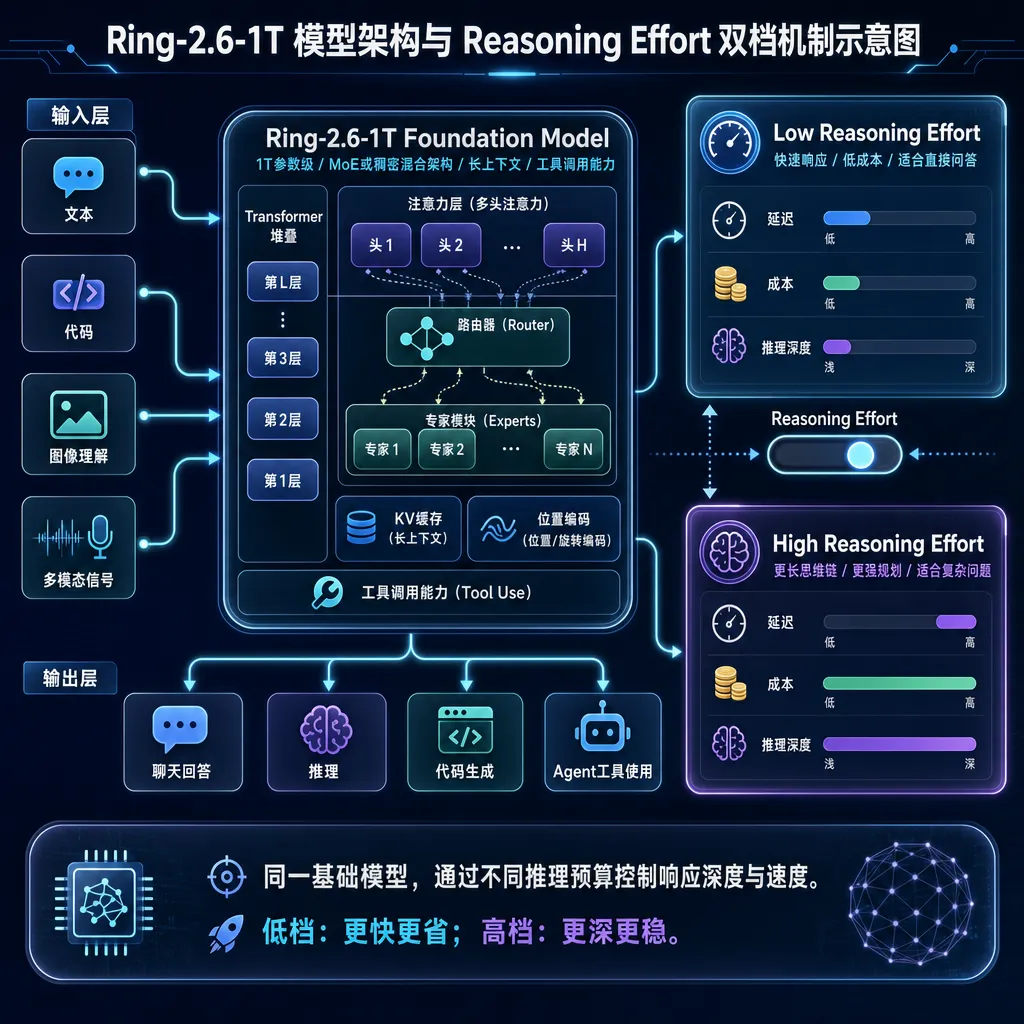
Not just another trillion model — the emphasis is on "adjustability"
Over the past year, the “reasoning model” paradigm has become clear: let models generate a long CoT (Chain-of-Thought) before producing the final answer, trading computational power for accuracy. OpenAI’s “o” series, Gemini 3’s Deep Think, and DeepSeek-R1 all follow this approach.
But the problem is also clear — reasoning length is uncontrollable. Give the model “1+1=?”, and it may generate 3000 tokens of proof branches; run an Agent workflow, and every tool call could trigger long reasoning chains — unsustainable for both token cost and latency. OpenAI later introduced the reasoning_effort parameter (low/medium/high) in its API, which started addressing this.
Ring-2.6-1T takes this idea and turns it into a core feature, offering two tiers:
- high: aimed at high-frequency Agent workflows; lower token cost, faster multistep execution — suitable for multi-turn interactions, tool use, and task decomposition. Positioned as the "production-grade default setting."
- xhigh: for high-difficulty tasks such as mathematics, scientific research, complex logical analysis, and multi-path exploration; allows more reasoning space.
This is not a simple max_tokens cutoff; the model was explicitly trained to exhibit two “thinking tempos.” In other words, high is not a “trimmed-down” xhigh — it’s an optimized “short-thinking steady state.” This matters greatly in Agent scenarios, where one long burst of internal monologue can blow the entire budget or latency budget for the chain.
Benchmark results: “high” mode can rival others’ “xhigh”
Official evaluation data is interesting — presented in two sets:
high mode (Agent & engineering scenarios)
- PinchBench: 87.60 (claimed to surpass GPT-5.4 xHigh and Gemini-3.1-Pro high)
- ClawEval: 63.82
- Tau2-Bench Telecom: 95.32
The Tau2-Bench Telecom score deserves mention. This benchmark simulates a multi-turn tool-using telecom customer service scenario, widely regarded as one of the best approximations of real-world Agent environments. Scoring 95.32 places it at top-tier levels, indicating that Ring-2.6-1T is not just a math solver but handles multi-step coordination and state management well.
xhigh mode (advanced reasoning)
- ARC-AGI-V2: 77.78
- AIME 26: 95.83
- GPQA Diamond: 88.27
Scoring near 96 on AIME 26 essentially means it performs at competition-level high school mathematics; GPQA Diamond 88+ puts it in the leading tier. ARC-AGI-V2’s 77.78 is even more meaningful — it tests abstract pattern induction, one of LLMs’ persistently weak dimensions.
Of course, benchmark scores should always be taken with a grain of salt. But if high mode can hold up in Agent-style benchmarks and xhigh mode can match state-of-the-art levels in math and scientific reasoning, then Ring-2.6-1T’s “dual gear” setup is not just marketing — it represents two genuinely usable working modes.
Why “dual gear” matters more than parameters
A few observations. In 2026, trillion-parameter models aren’t rare anymore — Kimi K2, DeepSeek V3 series, and Qwen3-Max all hover around that scale (though their active parameters differ). What’s truly scarce is a model that performs well across different reasoning rhythms.
Developers working on Agent applications have likely run into the same headache:
- Use a strong reasoning model: every step goes through CoT; one ReAct loop can take tens of seconds and tens of thousands of tokens.
- Switch to a normal chat model: it fails the moment planning is needed.
- The compromise is dual-model routing — “fast” for simple steps, “thinking” for complex ones — but the engineering overhead skyrockets.
Ring-2.6-1T’s high/xhigh effectively builds that router into the model. Developers no longer need to maintain two endpoints or write complexity detectors — just toggle a parameter. This is a product decision made by people who truly work with Agents — it’s not competing with GPT-5 on GPQA, it’s competing with your production bill.
How to use: one week free on OpenRouter
There are two ways to access Ring-2.6-1T:
- OpenRouter: model ID
inclusionai/ring-2.6-1t:free, free for one week. - Wait for open-source release: the team confirmed it will be open-sourced soon on inclusionAI’s GitHub/HuggingFace.
Usage: specify reasoning intensity through the standard reasoning_effort parameter, passing high or xhigh. It’s recommended to first run your main Agent pipeline in high mode; switch to xhigh for hard cases and compare token usage and success rate — that’s the best way to feel the value of the dual-gear system.
OpenAI Hub is also adding it soon; once the open-source version is released, it will be integrated immediately, allowing direct use via an OpenAI-compatible format.
Questions still to be answered
A few things to observe during real-world use:
- Active parameters and inference cost: Ring series models use MoE architecture, but activated parameters weren’t mentioned in the release — this determines whether the community can feasibly deploy it locally once open-sourced.
- Context length: no mention of context window size; 256K is currently the reasonable bar for Agent scenarios.
- Tool use format: whether it natively supports function calling and parallel tool use — key details for Agent deployment.
- xhigh stability: long-CoT models risk “thinking too long but circling back to wrong answers” — this will need community benchmarking after open-source release.
Summary
Ring-2.6-1T isn’t a revolutionary release, but it reflects a new maturity among domestic model teams — paying attention to real developer pain points in production, not just leaderboard rankings. The Reasoning Effort dual-mode mechanism is a pragmatic step toward engineering reasoning controllability, and with open source around the corner, it gives Agent developers another competitive option.
Free access lasts only a week — it’s worth integrating it into your Agent testing framework now; the hands-on experience will be far more telling than benchmarks.
References
- ITHome: Ant Group’s Bailing releases trillion-scale flagship reasoning model Ring-2.6-1T — original report, includes Reasoning Effort mechanism and OpenRouter access link
- ITHome mobile version of the same article — same content, mobile view


