
Open-source Skill gread: Allow the Agent to directly read GitHub source code
Developer NitroRCr has open-sourced **gread**, a Skill/MCP tool that loads the entire GitHub repository’s source code and documentation into an AI Agent’s context. It was built in three days and focuses on on-demand retrieval and automatic documentation linking.
A Skill That Lets an Agent Access All of GitHub
When you ask AI to use a slightly obscure library, it sometimes invents a few nonexistent APIs — every developer who’s used Cursor or Claude Code has probably seen this happen. Pasting documentation helps, but it’s tedious to do every time, and even then, if you ask about low-level implementations, you still have to paste the source code.
A developer named NitroRCr on linux.do recently solved this problem. He spent three days building a tool called gread, packaged in two forms — Skill and MCP — with a simple goal: to let an Agent access the source code and documentation of all open‑source repositories on GitHub, on demand, as if browsing a local file system. The project is fully open‑source at NitroRCr/gread.
It’s Solving "On‑Demand Reading," Not "Search"
There are plenty of AI‑doc‑reading solutions out there — Context7, DeepWiki, various RAG‑based doc sites. But most of them slice and vectorize documentation in advance, giving the AI fragments instead of a complete picture. Great for simple questions, but useless for deeper ones like "How is this library’s event loop scheduled?"
gread’s approach is more like handing AI a Swiss Army knife and letting it decide how to read:
- Search repositories: first locate which project to inspect
- List the directory tree: let the AI see the overall structure before diving into specific files
- Code search: search within a repo by keyword or symbol
- Read code: retrieve specific files or code segments
Put together, this toolset makes the AI behave like a newly hired engineer reading an unfamiliar codebase — first tree, then grep, then cat. This "exploratory reading" feels much more natural to an Agent than feeding it chunks of vectors, and it’s also far more token‑efficient.
Smart Trick: Automatic Documentation Linking
A common open‑source pattern: code lives in the main repo, docs are in xxx-docs or website, or even hosted on a separate site. When AI reads the main source repo, it often can’t find documentation; and when reading a docs repo, it misses implementation details.
During indexing, gread automatically identifies related documentation repos and exposes them alongside the main repo. In other words, when you ask about how a React hook works, the AI can see both the react source code and the official docs in react.dev — two separate GitHub repositories. This combined "main + docs repo" view is a rare design among similar tools.
Installation: Just Two Commands
For coding agents that support the Skill protocol — Claude Code, OpenCode, Codex, Cursor, Copilot — one line does the job:
npx skills add https://github.com/NitroRCr/gread --skill gread
For MCP‑compatible clients (Claude Desktop, Cherry Studio, various AI chat apps), connect via streamable HTTP:
{
  "mcpServers": {
    "gread": {
      "type": "streamableHttp",
      "url": "https://api.gread.dev/mcp"
    }
  }
}
The server is api.gread.dev, hosted by the author and free to use. If you prefer self‑hosting, the repo includes full source code and setup instructions — it’s easy to run your own instance.
Comparison with Context7 and DeepWiki: Key Differences and Strengths
Here’s what developers really want to know:
-
Context7 – Focused on latest‑version documentation, feeding AI versioned doc fragments.
Pros: high‑quality official docs, good coverage of mainstream libraries.
Cons: only covers libraries with official docs — obscure ones are missing, and it provides docs only, not source code. -
DeepWiki – Built by the Devin team; turns GitHub repos into interactive Q&A wikis.
Pros: pre‑generated project summaries.
Cons: the Q&A format means you only get processed answers, not raw code context. -
gread – Covers all public GitHub repositories and provides tools instead of answers.
Trade‑off: first‑time access to an obscure repo may take time for indexing.
If you need engineering‑level answers or want to read underlying implementations, gread’s "tool" approach is the right fit. If you just want AI to avoid outdated APIs when coding, Context7 is good enough. The two can actually coexist nicely.
A Note on the Growing Agent Skill Ecosystem
In early 2026, the concept of Skill clearly started taking off. Anthropic’s official anthropics/skills repo, Vercel’s vercel-labs/agent-skills, community hubs like skills‑hub, and curated collections — these days, npx skills add has pretty much become the standard command for installing Agent capabilities, similar to npm install in frontend development.
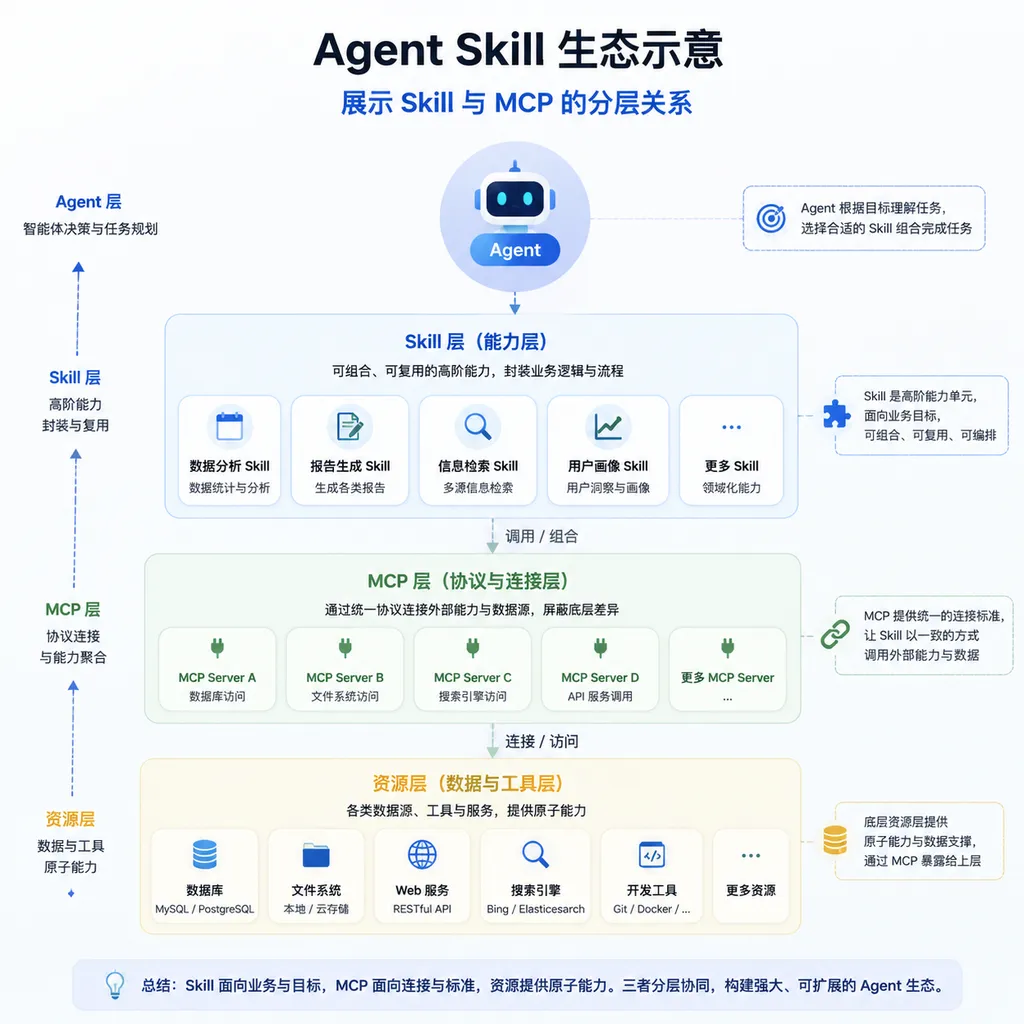
The relationship between Skill and MCP is also becoming clear: MCP is the protocol layer, defining how tools expose functionality to models; Skill is the distribution layer, packaging prompts, scripts, and MCP configs into a one‑click installable capability bundle. gread offering both formats is a clever strategy — coding agents use Skill, conversational apps use MCP — maximizing coverage.
Practical Usage Tips
A few hands‑on lessons learned:
- Works best with long‑context models like Claude Sonnet 4.5 / GPT‑5. Short‑context models fill up after a few files and can’t fully use on‑demand reading. Leading long‑context models on OpenAI Hub can be accessed directly without proxy hassles.
- Explicitly tell the Agent which repo to read. There’s a search function, but specifying
owner/repois much more accurate than asking it to search. - Ask complex questions in two steps: first have AI read the directory tree and README, then go deeper. Asking it to "analyze the entire project" in one go almost always fails.
Final Thoughts
gread isn’t revolutionary — but it’s the kind of tool that, once you try, you won’t go back. In AI programming, more evolution is happening at the tool layer rather than the model layer; model capabilities are already strong enough — what really matters is how we feed context and trigger tools.
A tool built in three days that solves a real pain point, open‑source, free, with its own hosted server — the more projects like this, the better.
References
- linux.do original post: Open‑source Skill to let Agents access GitHub code and docs — release thread by author NitroRCr
- NitroRCr/gread (GitHub) — main project repo, full source code and self‑hosting guide
- Lirsakura/skills-hub (GitHub) — open‑source Skill platform with ecosystem overview
- partme-ai/full-stack-skills (GitHub) — another Agent Skills repository for comparison


