
OpenAI Shuts Down Fine-Tuning API: The End of the Customization Era, Startups Lose Their Moat
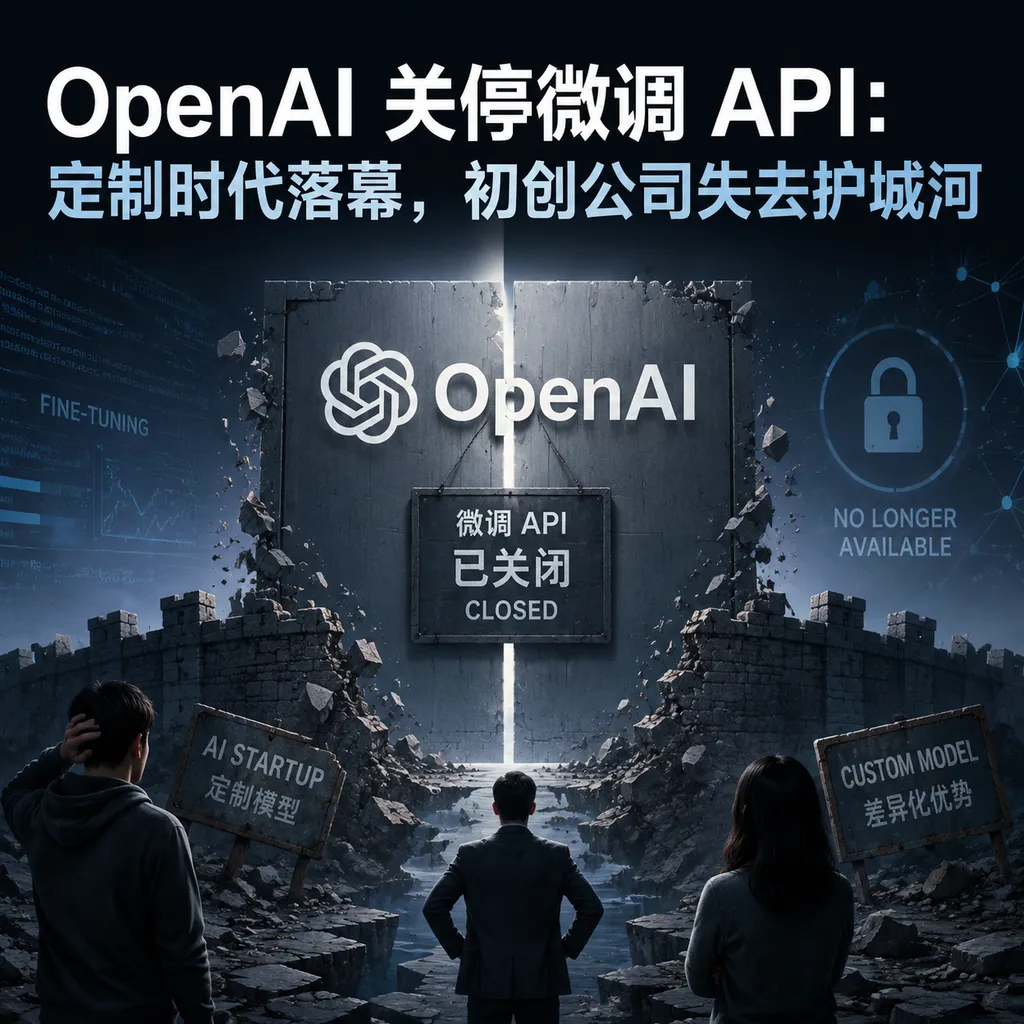
OpenAI announced a complete shutdown of its self-service fine-tuning feature. New users will lose access immediately, while existing users can continue using it until January 2027 at the latest. The official reason is that GPT-5.5 is powerful enough, and Prompt + RAG can cover most use cases. However, behind this is a tightening of the underlying APIs, which effectively blocks the path for startups to build competitive advantages based on fine-tuning.
One Email Shuts Down an Entire Industry Chain
On May 8, 2026, OpenAI sent developers a carefully worded email: the self-service fine-tuning (Fine-tuning) API will soon be completely taken offline. New users can no longer create tasks as of today; existing active users can continue using it until January 6, 2027. As for those fine-tuned models already deployed in production, their fate is tied to the underlying base model—once the base model is retired, those models immediately stop running inference.
This is not an ordinary product adjustment. Since the self-service fine-tuning API launched in August 2023 during the GPT-3.5 era, thousands of organizations have used it to train hundreds of thousands of models. Indeed used it to cut recommended tokens by 80% and expand monthly pushes from fewer than 1 million to 20 million; Harvey used its custom model so that lawyers chose it over GPT-4 in 97% of scenarios. Now, OpenAI has personally shut down the path that countless startups treated as the “go-to starting move” for vertical industries.
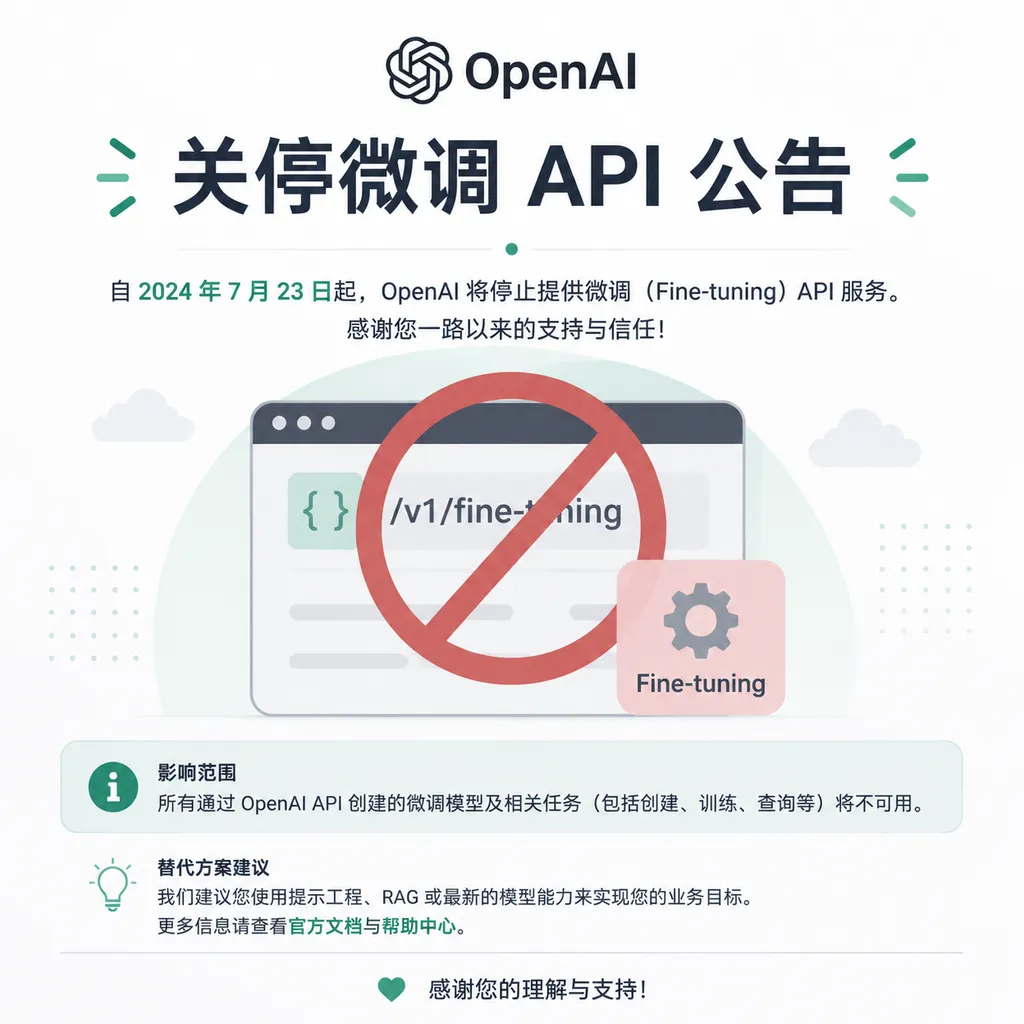
OpenAI’s Official Explanation: You Don’t Need Fine-tuning Anymore
The reasoning in the email was very “OpenAI”—
The new generation of base models (GPT-5.5) are already powerful enough in instruction-following and format control. Compared with expensive and cumbersome fine-tuning, prompt engineering + RAG (retrieval-augmented generation) is cheaper, faster, and more broadly applicable, enough to cover the vast majority of scenarios.
It sounds politically correct, and technically it makes some sense. This GPT-5.5 generation already offers out-of-the-box stability for long contexts (now supporting 1M tokens), strict JSON schema output, and tool calling—capabilities that previously required fine-tuning. Combined with OpenAI’s own Responses API and vector storage, the prompt + RAG combo now handles over 80% of common use cases.
But “the vast majority” is not “all,” and that’s precisely the issue.
What Does Fine-tuning Solve That Prompts Can’t?
Anyone who has worked on a serious product understands that fine-tuning and prompting operate at different levels:
- Internalization of style and tone: In medical, legal, and financial industries, word precision cannot be stabilized with a few few-shot examples. Harvey fed 10 billion tokens of legal text to make the model “talk like a lawyer”—this depth cannot be replaced by a context window.
- Structural compression of token cost: Indeed’s case is textbook—burning instructions into weights reduced prompts from thousands of tokens to hundreds, saving real money at scale.
- Low-resource languages and vertical corpora: SK Telecom’s fine-tuned Korean telecom customer service model improved intent recognition by 33% and raised satisfaction scores from 3.6 to 4.5. RAG can’t fix this because the issue lies not in “knowledge” but in “distribution of expression.”
- Latency-sensitive scenarios: Fine-tuned small models respond within tens of milliseconds, while large RAG-loaded models easily incur seconds of delay.
In other words, OpenAI saying “you don’t need fine-tuning” effectively means “most customers are not worth maintaining this product line for.”
The Real Cause: Strategic Retrenchment of Base-Level Interfaces
I agree with the view of tech media Startup Fortune: this is OpenAI actively shrinking its base-level model interfaces.
Over the past two years, OpenAI has quietly done several similar things:
- Starting with GPT-5.4, it stopped releasing separate
-chatAPI models; developers can only use unified product interfaces. - Assistants API was merged into Responses API mid-2025, reducing parameter flexibility.
- “Low-level knobs” like logprobs and custom embedding dimensions have been progressively removed.
- Now it’s fine-tuning’s turn.
This signals a very clear product philosophy shift: OpenAI no longer wants to be treated as a “model supplier,” but as an “AI product platform.” It wants vertical integration—you use ChatGPT, GPT Store, and its Agent Builder, not take its weights to build differentiated products yourself.
For OpenAI, the math works out:
- GPU use for fine-tuning is extremely inefficient—a long-tail training task from a single client could consume compute that could otherwise serve tens of millions of inference calls;
- Maintaining multiple base versions plus massive amounts of custom weights is engineering-heavy;
- And as general base models get stronger, the marginal value of customization drops.
Startup Moats Are Being Leveled
The problem lies on the other side.
Over the past three years, within the OpenAI ecosystem, many startups’ core technology narrative was:
“We fine-tuned GPT-3.5/4 with proprietary data and achieved 30% better performance in our vertical scenario.”
This “lightweight customization moat” was the key narrative that helped many YC projects get funding. With the fine-tuning API shut down, that story collapses instantly.
Only a few options remain:
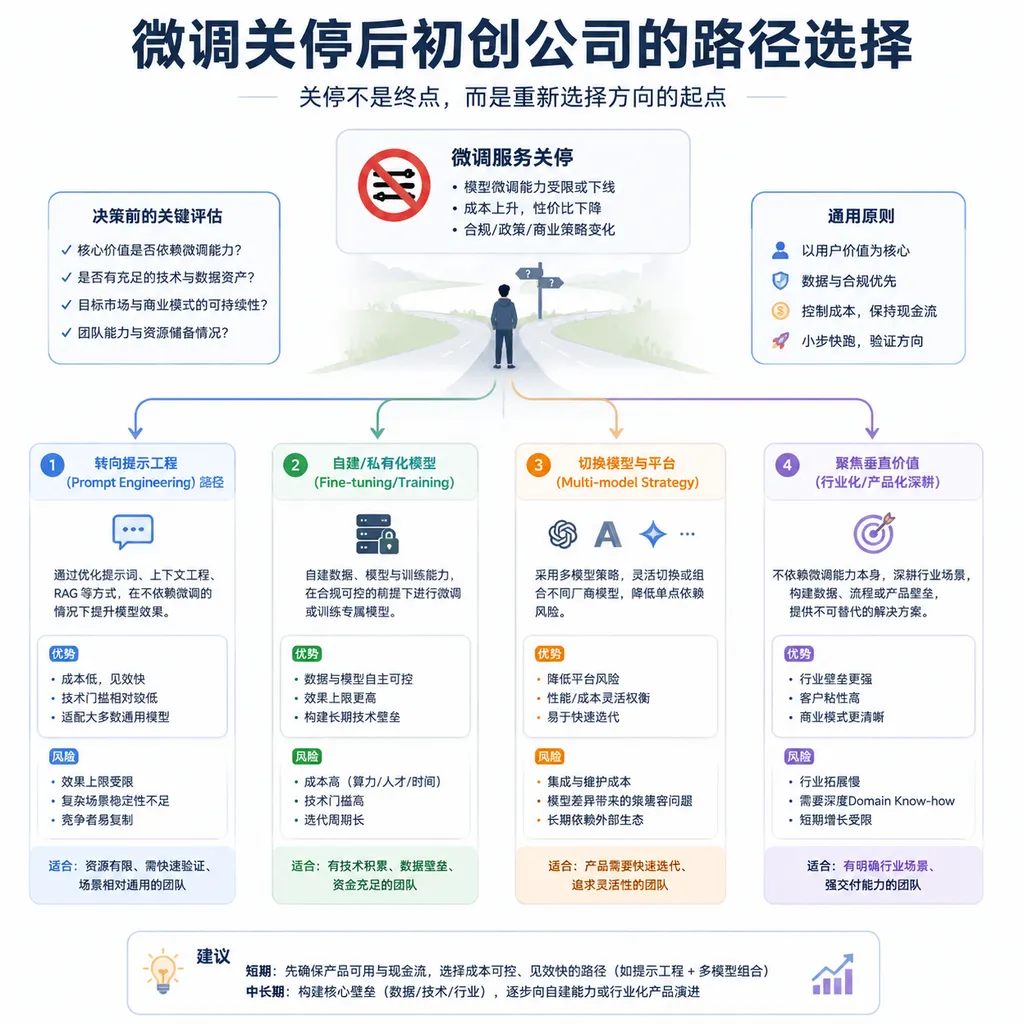
| Path | Realistic Issue | |---|---| | Shift to Prompt + RAG | No barrier—competitors can replicate in a week | | Use OpenAI’s Custom Model program | Starting price in the millions of dollars—unaffordable for startups | | Switch to open-source (Llama, Qwen, DeepSeek) | Must build own training/inference stack; massive team and cost increase | | Use Anthropic or Google fine-tuning | Claude still hasn’t opened public fine-tuning; Gemini is also tightening |
That’s why Startup Fortune’s comment matters—“This changes the startup playbook.” As the customization path closes, startups in the OpenAI ecosystem must either move upward to the application layer (competing on UI and workflows) or downward to open-source (building model capability themselves). The most comfortable middle path—“fine-tune on the shoulders of giants”—is gone.
Pragmatic Advice for Developers
If your team still has production businesses running on OpenAI fine-tuned models, time is actually short. Base model retirements are usually announced six months in advance, meaning you’ll need to complete migration assessment before the end of 2026 at the latest.
Short-term (within 3 months):
- Review all pipelines relying on fine-tuned models; mark how dependent they are on “format stability” and “style consistency”;
- Run a side-by-side test: GPT-5.5 + refined prompts vs. your fine-tuned models—you’ll likely find many cases truly replaceable;
- Back up your training data—those remain your core assets when moving to open-source solutions.
Mid-term (6–12 months):
- For highly sensitive or highly customized workloads, start evaluating fine-tuning feasibility on open-source bases like Qwen3, DeepSeek-V4, and Llama 4;
- In inference, consider a multi-model routing architecture—never assume a single vendor.
By the way, for multi-model routing, platforms like OpenAI Hub are currently the most convenient option—one key can call GPT-5.5, Claude, Gemini, and DeepSeek, directly accessible in China and compatible with OpenAI’s API format. During your architecture rebuild and A/B testing transition, this could save you tons of account and networking hassles.
Footnote of an Era
When the fine-tuning API launched in August 2023, OpenAI’s product blog headline read “Let Developers Precisely Control Models.” Three years later, when the same company announced its shutdown, the wording was “Prompting Is Enough.”
What happened in between is not just the birth and death of an API—it’s a shift in the mindset of an AGI company: When the base model is strong enough, customization becomes an ‘inefficient waste.’ Whether that judgment is correct depends on what happens over the next year—whether those startups expelled from the fine-tuning club can find new moats in the red ocean of prompt + RAG, and whether Anthropic, Google, and domestic open-source players will absorb the newly freed customization demand.
The “democratized era” of model customization is over. What the next era looks like may be more worth watching than the shutdown itself.
References
- OpenAI to Completely Shut Down Fine-tuning API: Large Models Move Fully to Prompts (linux.do) — First-hand discussion in Chinese developer communities
- Why Did OpenAI Stop Releasing -chat API Models? (reddit) — Developer discussion about OpenAI’s interface contraction trend
- Hello GPT-4o Comment Section (reddit) — Early talks on the “Prompt Manager Era”
- OpenAI Model Specifications and API Changes Explained (zhihu) — Chinese community analysis on recent OpenAI API strategy shifts


