
Codex Nexus Open Source: Enable Codex Full-Stack Integration with Any AI Model
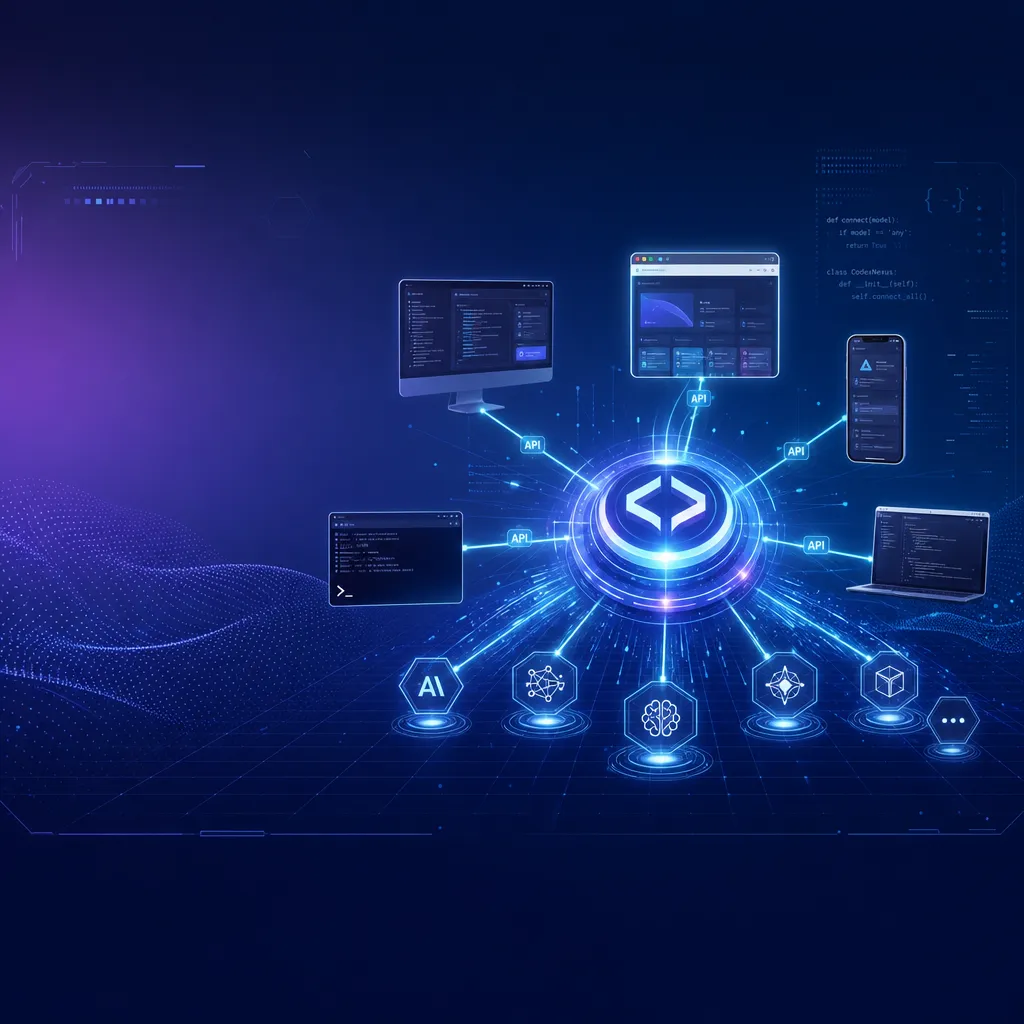
Developer linzy66 has open-sourced the Codex Nexus protocol translation layer, enabling Codex CLI/IDE/App to directly call any OpenAI-compatible models such as DeepSeek and Claude without modifying client configurations. It is now open-sourced on GitHub.
Codex Nexus Open Source: Enabling Codex to Access Any AI Model Across All Platforms
Codex’s CLI, IDE, and desktop app provide a solid experience, but they only support officially designated models. Want to switch to DeepSeek V3 or Claude 3.5 Sonnet? The protocol is incompatible—it simply freezes. Developer linzy66 got fed up with this limitation and built Codex Nexus, a protocol translation layer that allows the entire Codex ecosystem to connect with any OpenAI-compatible model. The project is open-sourced on GitHub, includes a web management interface, and automatically modifies Codex’s configuration upon startup—ready right out of the box.
The project’s value lies in breaking Codex’s model lock-in. The heart of any AI coding tool is the power of its model, but tool vendors typically only integrate with their own or partner models. Codex Nexus solves this with a relay layer, allowing developers to freely choose the model best suited for the task—DeepSeek Coder for code completion, Claude for complex reasoning, or open-source models for cost-sensitive scenarios. This level of flexibility is essential for heavy users.
Why a Protocol Translation Layer Is Needed
Codex’s CLI, IDE plugins, and desktop app all communicate with back-end services using a specific API protocol. This isn’t the standard OpenAI Chat Completions format—Codex uses its own Responses protocol. Even if you have DeepSeek or Claude API keys, you can’t simply plug them into Codex’s configuration—the protocol mismatch prevents requests from being sent.
Most AI model providers support the OpenAI Chat Completions standard, which has become the de facto protocol. Codex, however, follows its own path, locking users to officially supported models. Want to use a new one? Either wait for an official update or abandon Codex for another tool.
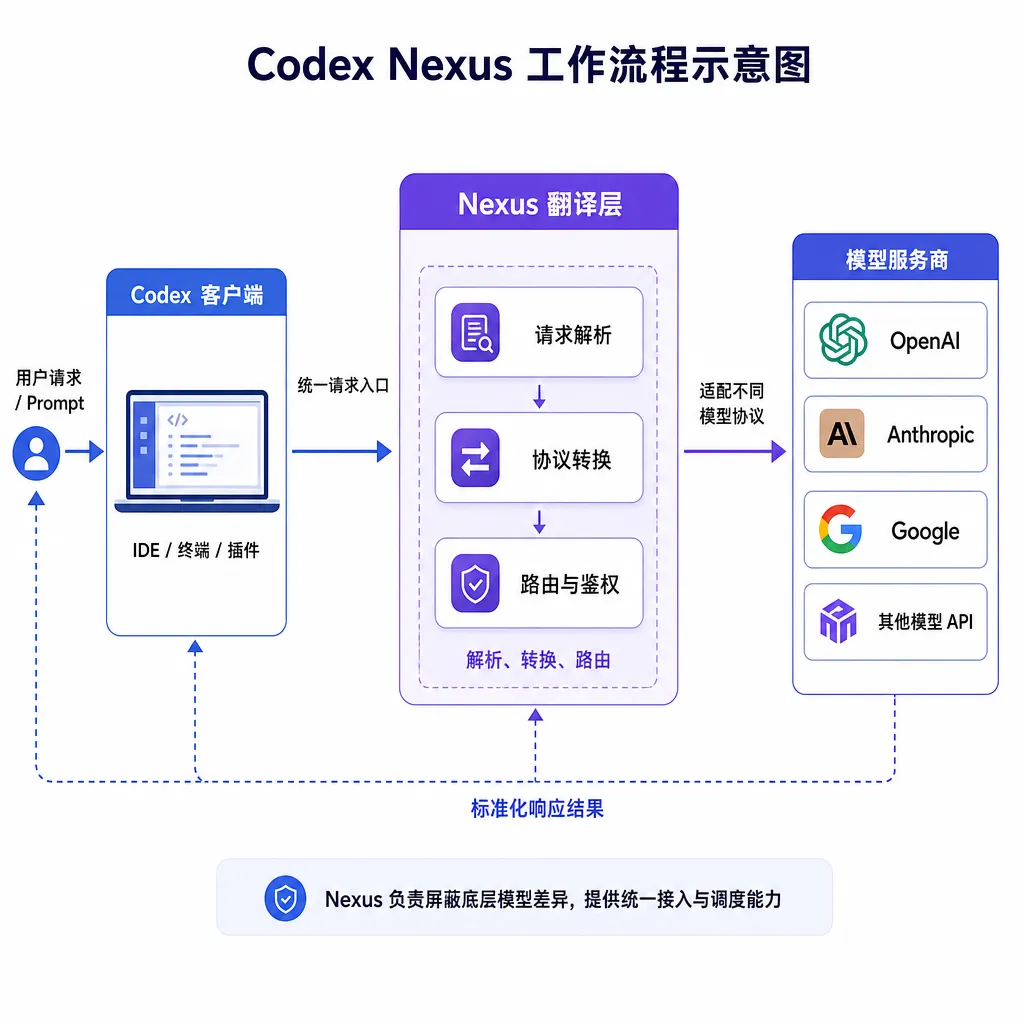
Codex Nexus takes a straightforward approach: add a translation layer between the Codex client and the model service. Codex sends a request in Responses format; Nexus converts it to Chat Completions format, forwards it to the model provider, then translates the response back to Responses format for Codex. Two-way translation, seamless integration.
Core Features: Automatic Configuration + Web Management
The most convenient aspect of Codex Nexus is its automatic configuration. Traditional proxy tools require manual editing of client config files—setting API addresses, ports, and authentication—making errors common. Nexus automatically detects Codex’s configuration file location and replaces the API Base URL with the local relay address, so users don’t need to do anything manually.
The project includes a web management interface where you can configure model lists, API keys, and request parameters directly from the browser. The interface is practical, supporting multiple model configurations; each model can have its own Base URL, API key, and default parameters (temperature, max_tokens, etc.). Model switching is as easy as clicking a button—no need to restart Codex.
Screenshots posted by the author on the Linux.do community show the web interface divided into key modules:
- Model Management: add, edit, delete model configurations; customize model names and parameters
- Request Logs: view requests and responses in real time for debugging
- Configuration Import/Export: supports JSON configs for quick migration or sharing
- System Settings: set global parameters like Nexus port and log level
This design is developer-friendly. Seeing full request/response logs is fundamental when debugging AI applications. Having it integrated into the web interface is far more convenient than manually checking log files.
Technical Implementation: Protocol Mapping Details
Codex’s Responses protocol and OpenAI’s Chat Completions format differ structurally. Responses is more stream-oriented—each block includes incremental content and metadata. Chat Completions uses standard JSON, supporting the messages array, role field, and function calling.
Codex Nexus needs to handle several mappings:
- Request Format Conversion: map Codex’s
prompt,context, andoptionsfields to Chat Completions’messages,temperature,max_tokens, etc. - Streaming Response Handling: Codex expects Server-Sent Events (SSE) streams; convert the streaming output of Chat Completions to incremental blocks in Responses format.
- Error Handling: unify error formats from different providers so Codex can interpret them.
- Metadata Transfer: preserve token usage and finish reasons so Codex displays correct statistics.
According to the GitHub repo, the core codebase is in Python, using FastAPI for the web service and httpx for asynchronous HTTP requests. The structure is clear, with main modules including:
translator.py– core protocol conversion logicconfig.py– configuration management and persistenceproxy.py– HTTP proxy server implementationweb.py– backend API for the web interface
The author has built in robust error handling. For example, if a provider’s streaming format doesn’t fully comply with OpenAI’s spec, Nexus automatically repairs or falls back to non-streaming mode. These details make the tool truly usable—there’s a big difference between “theoretically works” and “actually works.”
Use Cases: Practical Value of Multi-Model Collaboration
Simply supporting multiple models isn’t enough—the key is leveraging each model’s strengths in real workflows. Codex Nexus enables developers to choose models based on task characteristics:
Code Completion and Refactoring: DeepSeek Coder V2 performs excellently in code comprehension and generation, especially for large codebases. It’s fast and cost-efficient for everyday completions and simple refactorings.
Complex Architecture Design: For system design, tech stack planning, and performance optimization requiring deep reasoning, Claude 3.5 Sonnet or GPT-4 are better choices. These models provide comprehensive analysis and suggestions.
Documentation and Comment Generation: Qwen 2.5 Coder or Gemini 1.5 Pro excel in natural language generation—ideal for writing READMEs, API documentation, and comments.
Cost-Sensitive Scenarios: For personal projects or limited budgets, open-source models (deployed locally via Ollama or vLLM) can replace commercial ones. They may perform slightly worse but are sufficient for basic completion and Q&A tasks.
Such multi-model workflows are still rare in AI development tools. Most either support a single model or require reconfiguration/restart to switch models. Codex Nexus minimizes switching costs, making multi-model collaboration practical.
Significance for the Open-Source Ecosystem: Breaking Tool Lock-In
Codex Nexus’ open-source release benefits the AI programming tool ecosystem. Over the past year, competition among these tools has focused on model capabilities and user experience—but vendors often use model lock-in to retain users. To switch models, you must switch tools, creating high migration costs.
An open-source protocol translation layer breaks this lock-in. As long as a client protocol is known, developers can build a relay layer like Nexus to let users freely choose backend models. That’s great for users but pressures vendors—they can’t rely on exclusive model access and must differentiate with features and experience instead.
Technically, Codex Nexus isn’t complex—the core may be only a few hundred lines—but it solves a real pain point. Its open-source availability lets others learn from or directly use it. These “small but elegant” projects often prove more practical than large frameworks.
The project is still in its early stage. The author stated on Linux.do that they’ll continue improving features and welcome issues and pull requests. Community feedback is active—users are already suggesting improvements like support for more providers, optimizing stream latency, and adding request caching.
Complementarity with API Aggregation Platforms
It’s worth noting that Codex Nexus and API aggregation platforms (such as OpenAI Hub) are complementary, not competitors. Aggregation platforms tackle the problem of “using one key for all models”—they unify access, billing, and management. Codex Nexus solves the “making incompatible tools work with OpenAI-style models” problem—adapting at the protocol layer.
In practice, the two can integrate: users obtain a key from an aggregation platform, configure it as the backend in Codex Nexus, and seamlessly switch between all supported models in Codex. This combination offers the convenience of unified billing, domestic connectivity, and load balancing—while preserving Codex’s user experience.
For developers in mainland China, this combination is especially practical. Direct API calls to OpenAI or Anthropic often face network issues; aggregation platforms provide domestic nodes for stable connectivity. Codex Nexus then allows excellent tools like Codex to use those models without protocol barriers.
Future Outlook: Adapting More Tools
Codex Nexus currently focuses on the Codex ecosystem, but the concept can extend to other AI programming tools. Cursor, Continue, Cody, and similar products face model lock-in issues that could be solved with protocol translation layers.
If the open-source community develops a universal protocol adaptation framework, it would benefit the entire AI developer tools ecosystem. Users wouldn’t need to choose between tools and models—they could freely mix and match for their needs. Vendors, meanwhile, could focus on improving UX rather than relying on lock-in.
From a technical evolution perspective, AI dev tools may eventually adopt a “frontend tool + backend model” separation. The frontend handles code editing, context, and UI, while backend models provide AI capabilities through standardized protocols. Codex Nexus represents an early exploration toward that vision.
Of course, realizing this depends on vendor attitudes. If vendors deliberately obscure or frequently change protocols to block third-party integration, open-source efforts will suffer. But for now, most AI dev tool protocols are reverse-engineerable, and the community can build adapters.
Conclusion
Codex Nexus solves Codex’s model lock-in problem with a simple protocol translation layer, giving developers freedom to choose backend models. It’s open source, includes a web interface, and configures automatically—highly practical. For heavy users of AI development tools, it’s a project worth watching.
More importantly, Codex Nexus embodies a philosophy: using open-source tools to break commercial lock-in and give users back their freedom of choice. This matters greatly in the AI era—models evolve fast, tools multiply, and users need flexibility rather than being tied to one option.
The project is still early-stage; features and stability will improve over time. But its direction is right, and community feedback is strong. If you use Codex and want to try different models, check out the GitHub repo, submit issues or pull requests, and help improve the project. That’s the value of open source—discover problems, solve them, share solutions, and let everyone benefit.
References
- Codex Nexus GitHub Repository – Source code and documentation
- Linux.do Community Discussion Thread – Project introduction and usage guide, including web UI screenshots and workflow diagram


