
Volcano Engine launches Agent Plan: packaging and selling models and tools

On May 11, Volcano Engine released the **Agent Plan**, claiming to be the industry’s first **Agent package**, bundling multimodal models, third-party models, online search, and vectorization capabilities into a subscription service starting at 40 RMB per month. The **Coding Plan** only focuses on writing code, while the **Agent Plan** manages the entire fuel for intelligent agents.
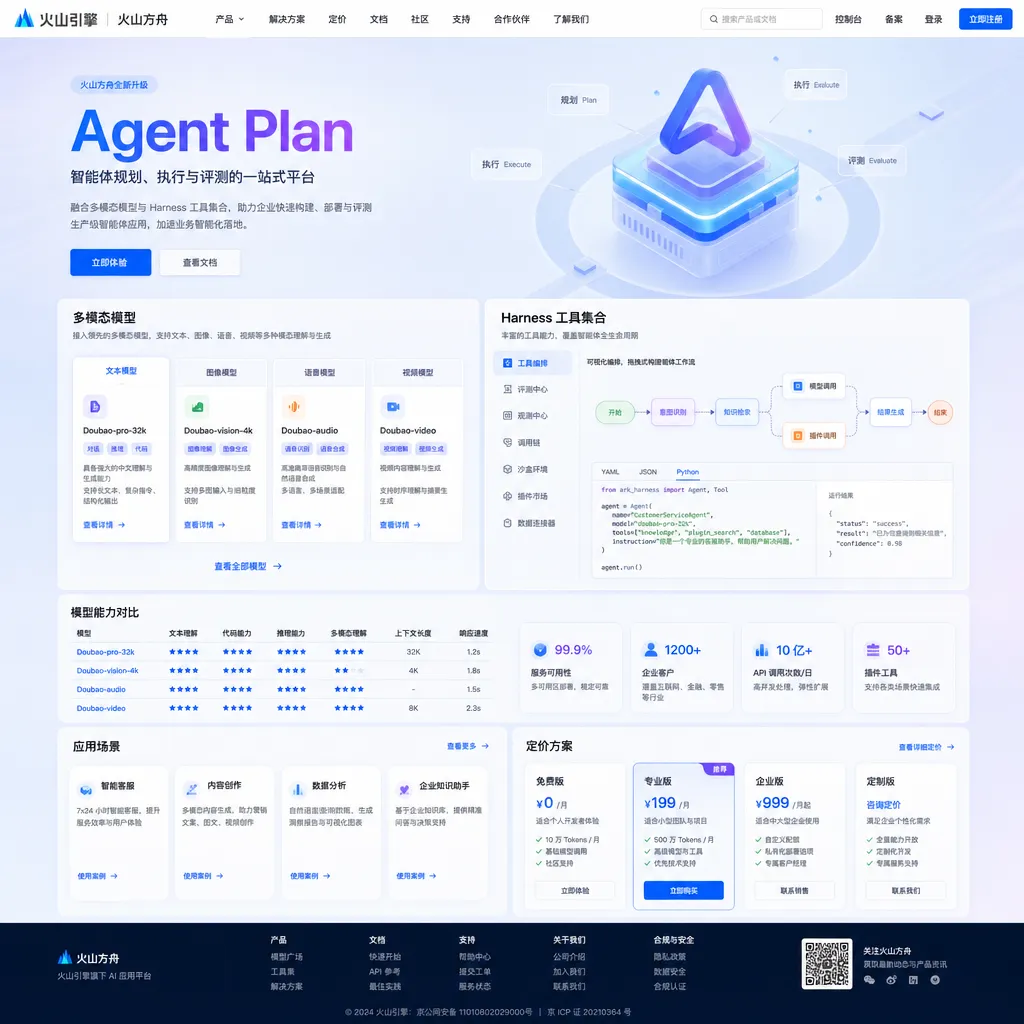
Today, Volcano Engine officially launched the Agent Plan. Starting at 40 yuan on a subscription basis, it bundles everything together: in-house models like Doubao-Seed, Seedance, and Seedream, plus third-party large models such as GLM-5.1 and Kimi-K2.6, and Harness tools like web-connected search and embedding APIs—all packed into one. The official description calls it “the industry’s first Agent bundle”, implying something clear—the Coding Plan era is over; from now on, they’re selling the full set of Agent fuel.
The timing of this release is pretty intriguing. From last year through the first half of this year, most cloud providers were still selling tokens or coding assistant subscriptions—Anthropic’s Claude Pro Plan and Cursor Pro are examples. But the consumption model for Agent scenarios is totally different from pure coding scenarios: coding mainly burns LLM tokens, while a useful Agent also needs to browse the web, use image models to generate materials, access vector databases for long-term memory, and occasionally generate video clips. Billing by token doesn’t really work for Agents—it’s messy for accounting and inefficient for scheduling. Volcano Engine simply consolidated everything this time—you get a unified “Fuel Value,” so users no longer have to worry about which API key goes with which model.
More Than a Price Cut—Redefining the Boundaries of Subscription Packages
Looking at the Agent Plan’s model lineup, ByteDance really laid all its cards on the table.
On the in-house side: Doubao-Seed handles text and code, Seedance 2.0 specializes in video generation, Seedream 5.0 lite handles images, and the embedding model manages memory retrieval—together forming a complete multimodal matrix. On the third-party side, GLM-5.1 and Kimi-K2.6 are two of the most popular domestic models right now. Zhipu’s GLM-5.1 is known for stability in long-context and tool-use tasks, while Moonshot’s Kimi-K2.6 has built a good reputation in coding and reasoning tasks. By bundling these two as well, Volcano essentially covers all the mainstream non-ByteDance models that domestic developers use daily.
One detail worth highlighting: the Agent Plan includes an Auto Mode, which automatically schedules models based on task scenarios. According to internal tests, Auto Mode outperforms manually fixing a single model on long-tail Agent tasks. This is quite similar to OpenRouter’s auto routing or GPT-5’s internal routing mechanism—so users no longer have to agonize over “Should I use Claude or GLM for this?” The platform decides. For developers building Agents, this is the right approach—once an Agent is running, no one has the bandwidth to do live A/B testing.
The Harness layer is another interesting part of the product design. Volcano bundled three key components:
- Web-connected search: same backend as Doubao’s search service, with free credits, real-time and authoritative.
- Doubao-embedding-vision: a multimodal embedding model serving as long-term memory for Agents.
- Private knowledge base search, image processing, and MCP deployment, among other tools.
In other words, one subscription now includes nearly everything an Agent needs to run. Before this, you’d have to separately apply for Bing Search API or Tavily, buy OpenAI’s text-embedding-3 for embeddings, and call DALL·E or Doubao Image via separate interfaces—but now, it’s all consolidated into one order.
Compatible with Claude Code, Cursor, and Cline: One Key Fits Existing Workflows
A clever move in this plan is that Volcano didn’t try to push its own IDE or Agent platform. Instead, it proactively supports the existing popular ones: Claude Code, Cursor, Cline, Kilo Code, Roo Code, and OpenCode are all on the compatibility list; on the Agent framework side, it supports OpenClaw, Hermes Agent, and TRAE.
This strategy is the opposite of last year’s domestic trend, where every vendor wanted to “build their own Copilot.” When Claude Code has already become many developers’ default tool, there’s little point in competing horizontally—it’s smarter to use it as a distribution channel. Volcano’s positioning is crystal clear: don’t fight for the front-end, power the back-end layer. In Claude Code, when a user types /model, they can now select GLM-5.1 or Kimi-K2.6; if an Agent needs to generate a video, it automatically calls Seedance 2.0; and when real-time information is needed, the web search skill triggers automatically. The entire flow remains transparent to the user.
This “build the base, not the front” approach has an obvious benefit: zero migration cost for developers. If you’re already using Cursor, you don’t need to switch IDEs—just point the backend to Volcano’s endpoint. For Volcano, this means locking in the model traffic of those external tools through a single subscription card.
Package Tiers, Pricing Logic, and “Limited Inventory”
Pricing-wise, Agent Plan tiers are based on usage intensity, starting at 40 yuan per month. The official documentation classifies models into several categories—fast, standard, advanced, image/video generation—each with different deduction coefficients, similar to how games consume “stamina.” Intensive tasks (like video generation with Seedance 2.0) consume more, while text calls consume less, all abstracted into one unified “Fuel Value.”
A subtle but important detail: the product page explicitly says “inventory released daily at 00:00, available while supplies last.” This actually matters. It shows two things: first, their compute scheduling has defined constraints—they’re not opening unlimited capacity; second, this isn’t a typical on-demand SaaS model, but rather a paced compute distribution.
Compared with Claude Pro Plan, Volcano claims that the base quota of Agent Plan is “several times that of Claude Pro.” The heavy-use tier (corresponding to around 12.5× Small usage) can cover a full-time engineer’s daily Agent workload. Considering Claude Pro costs about USD $20 per month (over 140 RMB), while Agent Plan starts at 40 RMB and includes image, video, search, and embedding features, the value proposition is hard to beat.
What This Means for Domestic Developers
From a developer’s perspective, the core problem that Agent Plan solves is aggregation. For those working on Agents, the major pain points aren’t about model quality but rather:
- Good models are scattered across vendors, making API key management a pain.
- Agent workflows require LLMs, multimodal models, and tool use—no single vendor covers everything well.
- Token-based billing is uncontrollable in iterative Agent loops.
- Buying web search or embedding components separately is costly and cumbersome.
Agent Plan addresses all of these with a single packaged solution. From a product design perspective, it’s currently the most cohesive Agent subscription offering in China, bar none. Zhipu, Alibaba, and Kimi’s current plans either focus on their own models or haven’t progressed beyond coding-assistant-level offerings. Volcano seems determined to establish the “Agent bundle” category first.
Of course, the product isn’t without drawbacks. Limited inventory means you might not get access during peak times. The Auto Mode’s real-world scheduling performance remains to be seen—if routing strategies are opaque, debugging could be painful. It’s also unclear whether third-party model updates will roll out in real time, as there’s no SLA yet. And for power users who already rely on API aggregation, the all-in-one package might even feel bloated—you might only want GLM-5.1’s API but end up forced to pay for a bundle that includes video generation.
It’s also worth noting that if you already use aggregation services to unify your model keys, platforms like OpenAI Hub support GLM, Kimi, DeepSeek, and international options like GPT, Claude, and Gemini—all accessible with a single OpenAI-compatible key and domestic connectivity. That offers an alternative for developers who prefer pay-as-you-go flexibility without subscription lock-ins. The two models serve different user needs: subscription for convenience, pay-per-use for flexibility, depending on your usage intensity and preference.
A Bigger Picture: Agent Billing Is Moving Away from Tokens
Zooming out, the release of Agent Plan signals something larger: the commercialization of Agent scenarios is moving beyond token-based billing.
Over the past two years, competition slashed token prices—from a few cents per 1K tokens to mere fractions. But the cost structure of running Agents can’t be summed up by “input vs. output tokens”—it includes tool call frequency, vector retrieval volume, number of image generations, video seconds, search queries, and more. With all these variables intertwined, token-based billing is neither accurate nor practical anymore.
OpenAI’s newly promoted Agent Builder, Anthropic’s Tool Use billing inside Claude, and now Volcano’s Agent Plan all follow the same trajectory—abstracting complex, heterogeneous resource use into a single unit of “Fuel Value” or “points” so users can buy based on intensity, not by technical granularity. This is an inevitable billing-layer overhaul in the Agent era, and Volcano is among the first in China to take this step.
Whether Agent Plan gains traction will depend on the coming months of real user feedback—especially how well Auto Mode performs in task routing, how stable supply remains under limited inventory, and how quickly third-party model updates roll out. But in terms of timing and product vision, Volcano seems to have struck the right chord.
References
- ITHome: Volcano Engine releases Agent Plan, the industry’s first Agent bundle, starting from 40 yuan/month — initial coverage including model list and subscription structure


